Last Updated: November 4, 2026

VIJOICE Drug Patent Profile


✉ Email this page to a colleague

« Back to Dashboard


Which patents cover Vijoice, and what generic alternatives are available?

Vijoice is a drug marketed by Novartis and is included in two NDAs. There are four patents protecting this drug.

The generic ingredient in VIJOICE is alpelisib. There is one drug master file entry for this compound. One supplier is listed for this compound. Additional details are available on the alpelisib profile page.

DrugPatentWatch® Generic Entry Outlook for Vijoice

Vijoice was eligible for patent challenges on May 24, 2023.

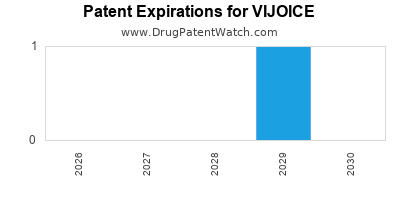
By analyzing the patents and regulatory protections it appears that the earliest date for generic entry will be April 5, 2029. This may change due to patent challenges or generic licensing.

Indicators of Generic Entry

< Available with Subscription >

  Start Trial

AI Deep Research
Questions you can ask:
  • What is the 5 year forecast for VIJOICE?
  • What are the global sales for VIJOICE?
  • What is Average Wholesale Price for VIJOICE?
Summary for VIJOICE
DrugPatentWatch® Estimated Loss of Exclusivity (LOE) Date for VIJOICE
Generic Entry Dates for VIJOICE*:
Constraining patent/regulatory exclusivity:

TREATMENT OF ADULT AND PEDIATRIC PATIENTS 2 YEARS OF AGE AND OLDER WITH SEVERE MANIFESTATIONS OF PIK3CA-RELATED OVERGROWTH SPECTRUM (PROS) WHO REQUIRE SYSTEMIC THERAPY

NDA:
Dosage:

TABLET;ORAL

Generic Entry Dates for VIJOICE*:
Constraining patent/regulatory exclusivity:
NDA:
Dosage:

GRANULES;ORAL

*The generic entry opportunity date is the latter of the last compound-claiming patent and the last regulatory exclusivity protection. Many factors can influence early or later generic entry. This date is provided as a rough estimate of generic entry potential and should not be used as an independent source.

Recent Clinical Trials for VIJOICE

Identify potential brand extensions & 505(b)(2) entrants

SponsorPhase
Celcuity, Inc.Phase 3

See all VIJOICE clinical trials

US Patents and Regulatory Information for VIJOICE

VIJOICE is protected by four US patents and one FDA Regulatory Exclusivity.

Based on analysis by DrugPatentWatch, the earliest date for a generic version of VIJOICE is ⤷  Start Trial.

This potential generic entry date is based on TREATMENT OF ADULT AND PEDIATRIC PATIENTS 2 YEARS OF AGE AND OLDER WITH SEVERE MANIFESTATIONS OF PIK3CA-RELATED OVERGROWTH SPECTRUM (PROS) WHO REQUIRE SYSTEMIC THERAPY.

Generics may enter earlier, or later, based on new patent filings, patent extensions, patent invalidation, early generic licensing, generic entry preferences, and other factors.

Applicant Tradename Generic Name Dosage NDA Approval Date TE Type RLD RS Patent No. Patent Expiration Product Substance Delist Req. Exclusivity Expiration
Novartis VIJOICE alpelisib GRANULE;ORAL 218466-001 Apr 24, 2024 RX Yes Yes 12,427,141 ⤷  Start Trial ⤷  Start Trial
Novartis VIJOICE alpelisib TABLET;ORAL 215039-003 Apr 5, 2022 RX Yes Yes 8,227,462 ⤷  Start Trial Y Y ⤷  Start Trial
Novartis VIJOICE alpelisib TABLET;ORAL 215039-001 Apr 5, 2022 RX Yes No 8,227,462 ⤷  Start Trial Y Y ⤷  Start Trial
Novartis VIJOICE alpelisib GRANULE;ORAL 218466-001 Apr 24, 2024 RX Yes Yes 8,227,462 ⤷  Start Trial Y Y ⤷  Start Trial
Novartis VIJOICE alpelisib TABLET;ORAL 215039-002 Apr 5, 2022 RX Yes No 8,476,268 ⤷  Start Trial Y Y ⤷  Start Trial
Novartis VIJOICE alpelisib TABLET;ORAL 215039-001 Apr 5, 2022 RX Yes No 8,476,268 ⤷  Start Trial Y Y ⤷  Start Trial
>Applicant >Tradename >Generic Name >Dosage >NDA >Approval Date >TE >Type >RLD >RS >Patent No. >Patent Expiration >Product >Substance >Delist Req. >Exclusivity Expiration

EU/EMA Drug Approvals for VIJOICE

Company Drugname Inn Product Number / Indication Status Generic Biosimilar Orphan Marketing Authorisation Marketing Refusal
Novartis Europharm Limited  Piqray alpelisib EMEA/H/C/004804Piqray is indicated in combination with fulvestrant for the treatment of postmenopausal women, and men, with hormone receptor (HR)-positive, human epidermal growth factor receptor 2 (HER2)-negative, locally advanced or metastatic breast cancer with a PIK3CA mutation after disease progression following endocrine therapy as monotherapy (see section 5.1). Authorised no no no 2020-07-27
>Company >Drugname >Inn >Product Number / Indication >Status >Generic >Biosimilar >Orphan >Marketing Authorisation >Marketing Refusal

International Patents for VIJOICE

When does loss-of-exclusivity occur for VIJOICE?

Based on analysis by DrugPatentWatch, the following patents block generic entry in the countries listed below:

Argentina

Patent: 3369
Estimated Expiration: ⤷  Start Trial

Patent: 2074
Estimated Expiration: ⤷  Start Trial

Australia

Patent: 09290904
Estimated Expiration: ⤷  Start Trial

Brazil

Patent: 0918750
Estimated Expiration: ⤷  Start Trial

Canada

Patent: 34819
Estimated Expiration: ⤷  Start Trial

Chile

Patent: 11000504
Estimated Expiration: ⤷  Start Trial

China

Patent: 2149711
Estimated Expiration: ⤷  Start Trial

Colombia

Patent: 51738
Estimated Expiration: ⤷  Start Trial

Costa Rica

Patent: 110059
Estimated Expiration: ⤷  Start Trial

Croatia

Patent: 0160014
Estimated Expiration: ⤷  Start Trial

Cuba

Patent: 000
Estimated Expiration: ⤷  Start Trial

Patent: 110052
Estimated Expiration: ⤷  Start Trial

Cyprus

Patent: 17078
Estimated Expiration: ⤷  Start Trial

Patent: 20037
Estimated Expiration: ⤷  Start Trial

Denmark

Patent: 31537
Estimated Expiration: ⤷  Start Trial

Dominican Republic

Patent: 011000070
Estimated Expiration: ⤷  Start Trial

Ecuador

Patent: 11010880
Estimated Expiration: ⤷  Start Trial

El Salvador

Patent: 11003853
Estimated Expiration: ⤷  Start Trial

Eurasian Patent Organization

Patent: 8863
Estimated Expiration: ⤷  Start Trial

Patent: 1100447
Estimated Expiration: ⤷  Start Trial

European Patent Office

Patent: 31537
Estimated Expiration: ⤷  Start Trial

Finland

Patent: 0200046
Estimated Expiration: ⤷  Start Trial

Georgia, Republic of

Patent: 0135991
Estimated Expiration: ⤷  Start Trial

Honduras

Patent: 11000699
Estimated Expiration: ⤷  Start Trial

Hong Kong

Patent: 56305
Estimated Expiration: ⤷  Start Trial

Hungary

Patent: 25884
Estimated Expiration: ⤷  Start Trial

Patent: 000044
Estimated Expiration: ⤷  Start Trial

Israel

Patent: 0976
Estimated Expiration: ⤷  Start Trial

Japan

Patent: 86601
Estimated Expiration: ⤷  Start Trial

Patent: 12502080
Estimated Expiration: ⤷  Start Trial

Jordan

Patent: 21
Estimated Expiration: ⤷  Start Trial

Lithuania

Patent: 331537
Estimated Expiration: ⤷  Start Trial

Patent: 2020534
Estimated Expiration: ⤷  Start Trial

Luxembourg

Patent: 0186
Estimated Expiration: ⤷  Start Trial

Malaysia

Patent: 1556
Estimated Expiration: ⤷  Start Trial

Mexico

Patent: 11002597
Estimated Expiration: ⤷  Start Trial

Montenegro

Patent: 284
Estimated Expiration: ⤷  Start Trial

Morocco

Patent: 604
Estimated Expiration: ⤷  Start Trial

Netherlands

Patent: 1071
Estimated Expiration: ⤷  Start Trial

New Zealand

Patent: 0754
Estimated Expiration: ⤷  Start Trial

Nicaragua

Patent: 1100049
Estimated Expiration: ⤷  Start Trial

Norway

Patent: 20037
Estimated Expiration: ⤷  Start Trial

Panama

Patent: 41901
Estimated Expiration: ⤷  Start Trial

Peru

Patent: 110796
Estimated Expiration: ⤷  Start Trial

Poland

Patent: 31537
Estimated Expiration: ⤷  Start Trial

Portugal

Patent: 31537
Estimated Expiration: ⤷  Start Trial

San Marino

Patent: 201100019
Estimated Expiration: ⤷  Start Trial

Patent: 01100019
Estimated Expiration: ⤷  Start Trial

Serbia

Patent: 476
Estimated Expiration: ⤷  Start Trial

Slovenia

Patent: 31537
Estimated Expiration: ⤷  Start Trial

South Africa

Patent: 1100699
Estimated Expiration: ⤷  Start Trial

South Korea

Patent: 1290844
Estimated Expiration: ⤷  Start Trial

Patent: 110038737
Estimated Expiration: ⤷  Start Trial

Spain

Patent: 60673
Estimated Expiration: ⤷  Start Trial

Taiwan

Patent: 1014851
Estimated Expiration: ⤷  Start Trial

Patent: 53206
Estimated Expiration: ⤷  Start Trial

Tunisia

Patent: 11000053
Estimated Expiration: ⤷  Start Trial

Ukraine

Patent: 4147
Estimated Expiration: ⤷  Start Trial

Uruguay

Patent: 096
Estimated Expiration: ⤷  Start Trial

Generics may enter earlier, or later, based on new patent filings, patent extensions, patent invalidation, early generic licensing, generic entry preferences, and other factors.

See the table below for additional patents covering VIJOICE around the world.

Country Patent Number Title Estimated Expiration
Australia 2017219834 BYL719 (Alpelisib) for use in the treatment of PIK3CA-Related Overgrowth Spectrum (PROS - CLOVES syndrome) ⤷  Start Trial
Australia 2022235569 BYL719 (Alpelisib) for use in the treatment of PIK3CA-Related Overgrowth Spectrum (PROS - CLOVES syndrome) ⤷  Start Trial
Australia 2024278598 BYL719 (Alpelisib) for use in the treatment of PIK3CA-Related Overgrowth Spectrum (PROS - CLOVES syndrome) ⤷  Start Trial
Canada 3013845 METHODES POUR LE TRAITEMENT DU SPECTRE DE SURCROISSANCE LIE AU PIK3CA (METHODS FOR THE TREATMENT OF PIK3CA-RELATED OVERGROWTH SPECTRUM) ⤷  Start Trial
China 109562103 用于治疗PIK3CA相关过度生长综合征群的方法 (BYL719 (ALPELISIB) FOR USE IN THE TREATMENT OF PIK3CA-RELATED OVERGROWTH SPECTRUM (PROS - CLOVES SYNDROME)) ⤷  Start Trial
China 118477075 用于治疗PIK3CA相关过度生长综合征群的方法 (Methods for treating PIK3CA-related overgrowth syndrome populations) ⤷  Start Trial
>Country >Patent Number >Title >Estimated Expiration

Supplementary Protection Certificates for VIJOICE

Patent Number Supplementary Protection Certificate SPC Country SPC Expiration SPC Description
2331537 C02331537/01 Switzerland ⤷  Start Trial PRODUCT NAME: ALPELISIB; REGISTRATION NO/DATE: SWISSMEDIC-ZULASSUNG 67359 24.03.2020
2331537 301071 Netherlands ⤷  Start Trial PRODUCT NAME: ALPELISIB OF EEN FARMACEUTISCH AANVAARDBAAR ZOUT ERVAN; REGISTRATION NO/DATE: EU/1/20/1455 20200728
2331537 LUC00186 Luxembourg ⤷  Start Trial PRODUCT NAME: ALPELISIB OU UN SEL PHARMACEUTIQUEMENT ACCEPTABLE DE CELUI-CI; FIRST MARKETING AUTHORISATION NUMBER AND DATE: EU/1/20/1455; 20200728
2331537 CA 2020 00054 Denmark ⤷  Start Trial PRODUCT NAME: ALPELISIB ELLER ET FARMACEUTISK ACCEPTABELT SALT HERAF; REG. NO/DATE: EU/1/20/1455 20200728
2331537 PA2020534 Lithuania ⤷  Start Trial PRODUCT NAME: ALPELISIBAS ARBA JO FARMACINIU POZIURIU PRIIMTINA DRUSKA; REGISTRATION NO/DATE: EU/1/20/1455 20200727
2331537 2020C/547 Belgium ⤷  Start Trial PRODUCT NAME: ALPELISIB OF EEN FARMACEUTISCH AANVAARDBAAR ZOUT HIERVAN; AUTHORISATION NUMBER AND DATE: EU/1/20/1455 20200728
>Patent Number >Supplementary Protection Certificate >SPC Country >SPC Expiration >SPC Description

VIJOICE (Alpelisib) Market Dynamics and Financial Trajectory

Last updated: August 26, 2026

VIJOICE is Novartis’ alpelisib product for severe PIK3CA-related overgrowth spectrum, or PROS. Its commercial opportunity is structurally different from conventional oncology drugs: the eligible population is small, diagnosis is specialized, treatment duration can be prolonged, and market expansion depends on genetic testing and recognition of a rare disorder. Novartis does not publicly report VIJOICE revenue as a standalone line item, so its financial trajectory cannot be measured directly from company disclosures. The principal commercial indicators are patient identification, payer access, treatment persistence, and the performance of the broader alpelisib franchise.

What is VIJOICE approved to treat?

VIJOICE is approved in the United States for adults and pediatric patients aged two years and older with severe manifestations of PROS requiring systemic therapy. The active ingredient is alpelisib, a selective phosphatidylinositol-3-kinase alpha, or PI3K-alpha, inhibitor. The FDA approved VIJOICE on April 5, 2022, based primarily on evidence from the EPIK-P2 study and supporting clinical data.[1]

What is PROS?

PROS is a group of disorders caused by activating mutations in the PIK3CA gene. The conditions can produce segmental or widespread overgrowth of tissue, bone, blood vessels, skin, and other organs. Clinical burden varies substantially. Severe manifestations can include pain, functional impairment, vascular malformations, scoliosis, limb asymmetry, and organ involvement.

The addressable population is limited by four factors:

  1. PROS is rare.
  2. Diagnosis often requires molecular confirmation.
  3. Only patients with severe manifestations requiring systemic therapy are candidates for VIJOICE.
  4. Alpelisib treatment requires monitoring for hyperglycemia, diarrhea, rash, and other adverse events.

The commercial market is therefore defined by a high-value, low-volume treatment model rather than mass prescribing.

How large is the VIJOICE market?

The VIJOICE market is likely to remain a specialty rare-disease market, with growth driven more by diagnosis and access than by broad population expansion.

Addressable-market structure

Market driver Effect on VIJOICE
PROS prevalence Limits total patient volume
Genetic testing Expands the diagnosed population
Severe disease burden Concentrates treatment among high-need patients
Pediatric use Extends treatment duration and lifetime value per patient
Chronic administration Supports recurring revenue
Specialist prescribing Slows initial market penetration
Payer review Can delay starts and restrict coverage
Oral formulation Avoids infusion infrastructure but requires adherence monitoring
Lack of an approved direct competitor Supports differentiation
Off-label alternatives Creates pricing and utilization pressure

Published estimates of PROS prevalence vary because the disorder includes multiple phenotypes and is frequently underdiagnosed. The commercially relevant population is materially smaller than total genetic prevalence because VIJOICE is indicated for severe manifestations requiring systemic therapy.

Novartis has not disclosed a target patient count or a standalone VIJOICE revenue forecast in its public annual-report materials. That limits precise market-sizing calculations. Revenue estimates based on total PROS prevalence would overstate the near-term commercial opportunity.

What is the financial trajectory of VIJOICE?

VIJOICE revenue is not separately disclosed by Novartis. The company reports alpelisib-related sales primarily through the broader Piqray franchise or aggregated product categories, depending on the reporting period. Those figures cannot be used as a direct proxy for VIJOICE because Piqray is approved for HR-positive, HER2-negative, PIK3CA-mutated advanced or metastatic breast cancer, while VIJOICE addresses PROS.

Financial trajectory by phase

Period Commercial phase Financial implication
2022 U.S. launch following April approval Initial revenue from limited specialist adoption
2023-2024 Diagnosis and reimbursement expansion Growth depends on genetic testing, referral networks, and payer approvals
2025 onward Market maturation Recurring revenue should depend on persistence, pediatric conversion, and geographic expansion
Patent and regulatory maturity Generic-entry preparation Price erosion becomes a longer-term risk for the alpelisib franchise

The VIJOICE business can produce attractive revenue per treated patient, but it is unlikely to become a major Novartis revenue contributor without substantial expansion in diagnosis and treatment duration. The product’s financial value is more likely to come from:

  • recurring use in chronic disease;
  • pediatric patients treated over multiple years;
  • penetration into specialist centers;
  • expansion outside the United States;
  • improved identification of patients through PIK3CA testing; and
  • use in patients who previously received surgery, embolization, sirolimus, or other supportive interventions without adequate disease control.

What is the pricing and reimbursement outlook for VIJOICE?

VIJOICE is positioned as a high-cost specialty oral therapy. The economic case for treatment depends on whether payers recognize the burden of severe PROS, including repeated surgeries, hospitalizations, rehabilitation, disability, and long-term supportive care.

Payer friction can arise from:

  • requirements for molecular confirmation of a PIK3CA mutation;
  • documentation of severe disease;
  • prior use of surgery or other treatment;
  • age-specific coverage criteria;
  • quantity limits;
  • site-of-care and specialty-pharmacy controls; and
  • reauthorization requirements based on clinical response.

The product’s oral delivery is commercially favorable because it avoids infusion costs. It also shifts responsibility to patients, caregivers, and specialty pharmacies for adherence and toxicity management.

Hyperglycemia is a major safety and reimbursement consideration because it can require glucose monitoring, dietary management, antidiabetic therapy, or dose modification. Diarrhea, rash, stomatitis, and weight loss can also affect persistence. The FDA label includes detailed monitoring and dose-adjustment guidance.[2]

How does VIJOICE compete with other PROS treatments?

VIJOICE has no FDA-approved direct pharmacologic competitor for severe PROS. Its principal competitive set consists of off-label and procedural care.

VIJOICE versus competing treatment approaches

Treatment Position relative to VIJOICE Commercial implication
Surgery Established for localized or resectable lesions May compete directly in patients with surgically manageable disease
Interventional radiology Used for selected vascular malformations Can be complementary or substitutive
Sirolimus Used off label in complicated vascular and overgrowth disorders Provides a lower-cost systemic alternative in some centers
Supportive care Includes pain, orthopedic, and rehabilitation services Does not modify the underlying molecular pathway
Clinical trials May test PI3K, mTOR, or pathway combinations Creates future competitive risk
VIJOICE FDA-approved systemic therapy for severe PROS Has regulatory differentiation and a defined label

The strongest commercial argument for VIJOICE is targeted treatment of the underlying PI3K-alpha pathway in genetically confirmed disease. The strongest challenge is that treatment decisions are individualized and often involve multidisciplinary care. Some patients may receive procedures or off-label medicines before alpelisib, while others may use those treatments alongside VIJOICE.

What FDA regulatory protections apply to VIJOICE?

VIJOICE received FDA approval through the conventional drug approval framework for a rare, genetically defined disorder. The FDA label identifies the approved population, dosing, warnings, pediatric use, and clinical evidence supporting efficacy and safety.[1][2]

FDA regulatory factors

  • Active ingredient: alpelisib.
  • U.S. approval date: April 5, 2022.
  • Dosage form: oral tablets.
  • Pediatric use: patients aged two years and older within the approved indication.
  • Biomarker: activating PIK3CA mutation associated with PROS.
  • Regulatory differentiation: first FDA-approved therapy specifically indicated for severe PROS.
  • Safety monitoring: glucose abnormalities, diarrhea, rash, hypersensitivity, pneumonitis, and other toxicities.

The regulatory label is commercially important because it distinguishes VIJOICE from off-label sirolimus and other systemic treatments. The indication also creates a basis for payer policies tied to genetic testing and severe manifestations.

What patents protect VIJOICE?

VIJOICE is a small-molecule drug, so its protection depends on patents covering alpelisib, pharmaceutical compositions, dosing, and methods of treating PIK3CA-driven disease. The same active ingredient is marketed as Piqray, making the patent analysis a franchise-level issue rather than a VIJOICE-only issue.

Patent categories relevant to alpelisib

Patent category Potential role
Compound patents Protect alpelisib or related chemical matter
Composition patents Cover tablets, excipients, or specific formulations
Method-of-use patents Cover treatment of PROS or PIK3CA-mutated disease
Dosing patents Cover pediatric or disease-specific dosing regimens
Manufacturing patents Protect synthesis, purification, or solid-state forms
Regulatory exclusivity May delay approval or marketing of competing products independently of patents

The Orange Book is the controlling FDA source for listed patents and expected patent-expiration information for approved small-molecule products.[3] Because VIJOICE and Piqray use the same active ingredient, an ANDA applicant would evaluate the full alpelisib patent and exclusivity landscape, including patents listed against the relevant reference product.

When does VIJOICE lose exclusivity?

There is no single VIJOICE exclusivity date that determines all generic-entry risk. Commercial protection can end in stages:

  1. FDA regulatory exclusivity may expire.
  2. Composition or formulation patents may expire.
  3. Method-of-use patents may remain relevant.
  4. Generic applicants may file Paragraph IV certifications before patent expiry.
  5. Litigation may delay approval or commercial launch.
  6. A generic may launch with a carved-out label if protected indications remain.

VIJOICE is not a biologic. Biosimilar substitution rules do not apply. Any competitive product would generally follow the ANDA pathway for a small-molecule generic, subject to patent certifications and labeling requirements.

What Paragraph IV and generic-entry risks exist for VIJOICE?

No publicly established generic launch has displaced VIJOICE in the United States. The near-term risk is more likely to emerge through patent challenges to alpelisib products than through biosimilar competition.

Generic-entry scenarios

Scenario 1: Patent-protected launch

A generic applicant files an ANDA with Paragraph IV certifications. Novartis sues within the statutory period, triggering a potential 30-month stay of FDA approval under the Hatch-Waxman framework, subject to litigation developments.[4]

Scenario 2: Carve-out launch

A generic applicant removes protected PROS or oncology uses from its label and markets only for unprotected indications. This strategy can still affect pricing and pharmacy substitution, depending on the approved label and prescribing patterns.

Scenario 3: Settlement

Novartis and a generic applicant agree to a later-entry date, license terms, or other restrictions. The commercial outcome depends on the settlement’s entry date and whether multiple applicants receive first-filer rights.

Scenario 4: Patent invalidation or non-infringement

A successful challenge could permit entry before the expected expiration of some patents. The impact would depend on whether the challenged patents cover the active ingredient, a formulation, or only a specific use.

No publicly confirmed Paragraph IV litigation or settlement should be treated as established without a current FDA Orange Book, PACER, and company-disclosure review. Patent-risk assessment must distinguish VIJOICE-specific use patents from broader alpelisib patents covering Piqray.

What is the biosimilar risk for VIJOICE?

VIJOICE has no biosimilar risk because alpelisib is a chemically synthesized small molecule. The relevant threat is generic competition under the Hatch-Waxman Act, not competition under the Biologics Price Competition and Innovation Act.

This distinction matters commercially. Generic applicants can potentially rely on the reference product’s safety and efficacy findings through an ANDA, provided they demonstrate pharmaceutical equivalence and bioequivalence. The principal barriers are patents, exclusivity, manufacturing complexity, and the economics of a small patient population.

How strong is the VIJOICE patent estate?

The estate is strategically stronger if Novartis holds enforceable protection around the active molecule or long-lived composition claims. Method-of-use patents for PROS can provide targeted protection but may be easier to avoid through label carving or alternative prescribing patterns.

Strength indicators

Indicator Assessment
Molecular differentiation High, because alpelisib directly targets the PIK3CA pathway
Regulatory differentiation High in severe PROS
Direct approved competition Limited
Generic substitution risk Moderate over the long term
Formulation barrier Depends on listed composition and dosage patents
Method-of-use protection Important for PROS-specific defense
Manufacturing barrier Potentially relevant, but unlikely to prevent all generic development
Market size Small, which may reduce generic competition but also limits revenue

The commercial patent position should be evaluated across the entire alpelisib franchise. A patent that remains valuable for Piqray may also delay generic access to VIJOICE, while a VIJOICE-specific method patent may have limited value if generics enter for other indications.

Which companies are challenging VIJOICE?

No company has emerged as a publicly established commercial challenger with an approved competing product for severe PROS. Competitive pressure comes from:

  • generic-drug manufacturers assessing alpelisib;
  • pharmaceutical companies developing PI3K or mTOR pathway inhibitors;
  • academic groups testing targeted treatments;
  • manufacturers of sirolimus and related off-label systemic therapies; and
  • surgical and interventional treatment providers.

The lack of an approved direct competitor supports Novartis’ pricing and clinical-positioning strategy. It does not eliminate future risk because the treatment population is genetically defined and attractive for precision-medicine development.

What licensing deals affect VIJOICE?

VIJOICE is a Novartis-originated product. No major third-party licensing transaction has been publicly identified as central to the commercial launch of VIJOICE. The financial and strategic exposure is therefore concentrated within Novartis rather than shared through a visible co-commercialization structure.

The broader alpelisib asset originated through Novartis’ internal and acquired oncology portfolio. Any assessment of royalty obligations, regional rights, or underlying patent licenses should be based on transaction documents and Novartis’ intellectual-property disclosures rather than inferred from the VIJOICE label.

What geographic markets could expand VIJOICE revenue?

The United States is the lead market because of the 2022 FDA approval and the concentration of specialized PROS centers. International expansion depends on country-level approvals, reimbursement, genetic-testing infrastructure, and rare-disease referral systems.

Geographic growth variables

  • regulatory approval in Europe and other major markets;
  • recognition of PROS as a reimbursable rare disease;
  • access to molecular diagnostics;
  • specialist-center concentration;
  • national health technology assessment;
  • pediatric treatment coverage;
  • cross-border referral patterns; and
  • availability of local specialty pharmacies.

The global commercial opportunity is not simply the U.S. patient population multiplied by other-country populations. Diagnosis and reimbursement capability vary sharply across jurisdictions.

What manufacturing and intellectual-property barriers affect VIJOICE?

VIJOICE tablets require pharmaceutical manufacturing, quality control, stability testing, and supply-chain management. Manufacturing is less complex than biologic production, but generic competitors still must demonstrate bioequivalence and replicate the relevant dosage strengths and release characteristics.

Potential barriers include:

  • control of alpelisib solid-state properties;
  • formulation know-how;
  • impurity and degradation control;
  • pediatric dosing requirements;
  • supply of specialized active pharmaceutical ingredient;
  • validated analytical methods; and
  • patent claims covering compositions or manufacturing processes.

These barriers can delay entry but generally do not provide the same long-term protection associated with complex biologics or cell therapies.

Key Takeaways

  • VIJOICE is approved for severe PROS in adults and children aged two years and older.
  • Its addressable market is small, genetically defined, and concentrated in specialist centers.
  • Novartis does not separately disclose VIJOICE revenue, so standalone financial performance cannot be calculated from public company reporting.
  • Growth depends on genetic diagnosis, payer access, treatment persistence, pediatric use, and international reimbursement.
  • VIJOICE has no approved direct competitor and no biosimilar risk.
  • Generic risk will arise through the alpelisib patent and exclusivity estate, including Piqray-related patents.
  • Surgery, interventional treatment, sirolimus, and supportive care are the main current alternatives.
  • The product may generate strong revenue per treated patient but is unlikely to become a major Novartis revenue driver without substantial expansion in diagnosed and treated patients.
  • The most important diligence documents are the FDA label, Orange Book listings, Novartis annual reports, patent records, and any future ANDA litigation filings.

FAQs

Is VIJOICE the same drug as Piqray?

Yes. Both products contain alpelisib. Piqray is marketed for certain PIK3CA-mutated breast cancers, while VIJOICE is approved for severe PROS.

Can VIJOICE be used in children?

Yes. The FDA indication includes patients aged two years and older with severe PROS requiring systemic therapy.

Does VIJOICE have orphan-drug exclusivity?

The applicable regulatory exclusivity must be assessed from the FDA approval and exclusivity records. Patent protection and regulatory exclusivity are separate rights and can expire on different schedules.[3]

Will a generic alpelisib automatically replace VIJOICE?

No. Generic substitution depends on FDA approval, therapeutic-equivalence classification, patent status, label scope, payer rules, and pharmacy substitution practices.

Is VIJOICE a high-growth pharmaceutical product?

It has a meaningful growth opportunity within rare disease, but its absolute revenue ceiling is constrained by the small severe-PROS population. Growth is more likely to be steady and diagnosis-led than driven by broad-market prescribing.

References

  1. U.S. Food and Drug Administration. (2022, April 5). FDA approves alpelisib for PIK3CA-related overgrowth spectrum. https://www.fda.gov
  2. U.S. Food and Drug Administration. (2024). VIJOICE (alpelisib) prescribing information. Novartis Pharmaceuticals Corporation.
  3. U.S. Food and Drug Administration. (2024). Approved drug products with therapeutic equivalence evaluations: Orange Book. https://www.accessdata.fda.gov/scripts/cder/ob/
  4. U.S. Food and Drug Administration. (2024). Hatch-Waxman amendments and ANDA patent certifications. https://www.fda.gov
  5. Novartis AG. (2024). Annual report 2023. https://www.novartis.com/investors/financial-data/annual-report

More… ↓

⤷  Start Trial

DrugChatter Q&A for VIJOICE

Make Better Decisions: Try a trial or see plans & pricing

Drugs may be covered by multiple patents or regulatory protections. All trademarks and applicant names are the property of their respective owners or licensors. Although great care is taken in the proper and correct provision of this service, thinkBiotech LLC does not accept any responsibility for possible consequences of errors or omissions in the provided data. The data presented herein is for information purposes only. There is no warranty that the data contained herein is error free. We do not provide individual investment advice. This service is not registered with any financial regulatory agency. The information we publish is educational only and based on our opinions plus our models. By using DrugPatentWatch you acknowledge that we do not provide personalized recommendations or advice. thinkBiotech performs no independent verification of facts as provided by public sources nor are attempts made to provide legal or investing advice. Any reliance on data provided herein is done solely at the discretion of the user. Users of this service are advised to seek professional advice and independent confirmation before considering acting on any of the provided information. thinkBiotech LLC reserves the right to amend, extend or withdraw any part or all of the offered service without notice.