Last updated: August 6, 2026
Promacta, marketed as Revolade outside the United States, is Novartis' branded eltrombopag product. The product is used for immune thrombocytopenia, severe aplastic anemia, and selected cases of hepatitis C-associated thrombocytopenia. "Promacta kit" generally refers to the oral-suspension presentation and administration materials rather than a separate active pharmaceutical ingredient.
Promacta generated approximately $1.1 billion in global sales in 2023. Its commercial profile remains supported by specialist use, pediatric demand, severe aplastic anemia indications, and the absence of a broad launched generic competitor in the United States through the latest publicly reported period. The primary medium-term risk is erosion from generic eltrombopag tablets and oral-suspension products after regulatory and patent barriers decline.
What is Promacta and what does the Promacta kit contain?
Promacta contains eltrombopag olamine, an orally administered thrombopoietin-receptor agonist. The product stimulates megakaryocyte proliferation and platelet production.
Promacta dosage forms and delivery systems
| Presentation |
Typical strength or format |
Principal commercial use |
| Film-coated tablets |
12.5 mg, 25 mg, 50 mg, 75 mg |
Adult and pediatric treatment |
| Powder for oral suspension |
12.5 mg and 25 mg packets |
Pediatric patients and patients unable to swallow tablets |
| Oral-suspension administration materials |
Dosing container and mixing instructions |
Product-specific administration of the suspension |
The oral-suspension product is commercially important because it addresses pediatric and administration-sensitive patients. It also creates a formulation and device barrier that is more complex than a conventional tablet-only generic.
The FDA approved Promacta in 2008 for chronic immune thrombocytopenic purpura, now generally termed immune thrombocytopenia. The FDA later expanded its label to include thrombocytopenia in patients with chronic hepatitis C and severe aplastic anemia. The current prescribing information includes important food, mineral, hepatic, thrombotic, and hepatotoxicity restrictions. [1]
How large is the Promacta market?
Promacta is a specialty hematology product with global sales near the billion-dollar level. The product's revenue base is concentrated in chronic immune thrombocytopenia and severe aplastic anemia, with smaller exposure to hepatitis C-related thrombocytopenia.
Promacta global sales trajectory
| Fiscal year |
Promacta/Revolade sales |
Year-over-year change |
| 2020 |
Approximately $1.0 billion |
Broadly stable |
| 2021 |
Approximately $1.0 billion |
Low single-digit change |
| 2022 |
Approximately $1.0 billion |
Low single-digit growth |
| 2023 |
Approximately $1.1 billion |
Mid- to high-single-digit growth |
Novartis reports Promacta and Revolade as a combined brand because the product carries different names across markets. Novartis' reported figures therefore represent worldwide sales rather than U.S.-only revenue. [2]
What drives demand for Promacta?
Demand is supported by four commercial factors:
- Chronic immune thrombocytopenia creates recurring treatment demand.
- Severe aplastic anemia provides a higher-acuity indication with fewer treatment alternatives.
- Pediatric use supports the oral-suspension format.
- Specialist prescribing reduces substitution risk compared with mass-market primary-care products.
The main demand constraints are treatment sequencing, safety monitoring, platelet-count response variability, and competition from other thrombopoietin-receptor agonists.
How does Promacta compare with competing thrombopoietin-receptor agonists?
Promacta competes primarily with Nplate, Doptelet, and established immunosuppressive or platelet-supportive treatment approaches.
| Product |
Active ingredient |
Administration |
Core competitive point |
| Promacta/Revolade |
Eltrombopag |
Oral tablet or oral suspension |
Oral administration and severe aplastic anemia positioning |
| Nplate |
Romiplostim |
Weekly subcutaneous injection |
Established chronic immune thrombocytopenia use |
| Doptelet |
Avatrombopag |
Oral tablet |
Oral dosing and differentiated food or monitoring profile |
| Mulpleta |
Lusutrombopag |
Oral tablet |
Primarily procedural thrombocytopenia in chronic liver disease |
Promacta's strongest competitive position is its oral delivery and severe aplastic anemia label. Nplate retains a strong position among patients managed through injection-based hematology care. Doptelet competes directly on oral convenience, particularly in immune thrombocytopenia and liver-disease-related thrombocytopenia.
Generic competition would affect Promacta more directly than competition from branded agents because payers can substitute an equivalent active ingredient at a lower price.
When does Promacta lose exclusivity?
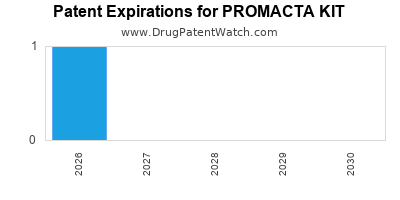
Promacta's effective exclusivity has several layers: FDA regulatory exclusivity, composition patents, formulation patents, method-of-use patents, pediatric exclusivity, and potential settlement restrictions.
FDA regulatory exclusivity
Promacta's original U.S. approval occurred in 2008. The original orphan-drug exclusivity period attached to the initial indication, while later indications received separate regulatory and orphan-designation treatment where applicable. Regulatory exclusivity does not necessarily prevent an ANDA referencing the active ingredient once the relevant exclusivity periods expire, but it can delay approval of certain competing applications.
The FDA Orange Book is the controlling public source for listed patents and exclusivity codes. [3]
Patent expiration and formulation protection
The original eltrombopag composition patent has reached or approached the end of its ordinary U.S. patent term, depending on the specific patent, patent-term adjustment, and pediatric extension. Later patents covering formulations, salts, dosing regimens, and specific uses can extend practical protection beyond the basic compound patent.
The commercial issue is not a single expiration date. It is whether a generic applicant can obtain approval by:
- certifying that listed patents are invalid or not infringed;
- omitting protected indications through a Section VIII statement;
- designing around formulation claims;
- launching after a settlement date; or
- obtaining approval after relevant Orange Book patents expire.
The oral-suspension format may carry longer-lived protection than the original tablet composition because later patents can cover particle properties, reconstitution, excipients, packaging, or dosing methods. Patent protection for the kit does not automatically block a tablet generic.
What patents protect Promacta?
Promacta protection has historically involved several patent categories rather than a single blocking right.
Composition-of-matter patents
The early patent estate covered eltrombopag and related chemical entities. These patents provided the strongest protection during the initial launch period. Their remaining value is limited once the core term expires because an ANDA applicant can generally challenge or await expiration of the principal compound claims.
Formulation patents
Formulation patents may cover:
- eltrombopag salt forms;
- tablet compositions;
- oral-suspension powders;
- particle-size distributions;
- stability characteristics;
- excipient combinations;
- reconstitution behavior; and
- packaging or administration systems.
These patents matter most for a Promacta kit because the generic applicant may need to replicate the oral-suspension product while avoiding asserted formulation claims.
Method-of-use patents
Promacta's method-of-use protection may cover treatment of immune thrombocytopenia, severe aplastic anemia, or other platelet-related conditions. A generic applicant can sometimes use a Section VIII statement to omit a patented indication from its labeling. That strategy is less effective when the protected use is embedded in the product's principal commercial indication or when physicians are expected to prescribe the generic for that use.
Geographic coverage
U.S. protection is reflected primarily through FDA Orange Book listings and U.S. patent litigation. European and other-market protection depends on national validation, supplementary protection certificates, local patent-term rules, and the Revolade brand. The U.S. market remains the most important jurisdiction for Paragraph IV risk because of its size and ANDA litigation framework.
Which companies are challenging Promacta exclusivity?
Generic-drug companies have shown interest in eltrombopag because of the product's substantial revenue base and relatively concentrated specialist market. Publicly disclosed challenges have involved ANDA filings and patent disputes concerning generic eltrombopag products.
The key risk groups are:
- large generic manufacturers with U.S. ANDA infrastructure;
- vertically integrated suppliers able to manufacture active pharmaceutical ingredient and finished dosage forms;
- companies developing tablets first and oral suspension later; and
- manufacturers using Paragraph IV certifications against listed patents.
A final commercial assessment requires separating an ANDA filing from an actual launch. A Paragraph IV notice can trigger litigation and a 30-month stay, but it does not establish that the generic will enter the market.
What is the Orange Book status of Promacta?
The Orange Book identifies FDA-approved drug products, therapeutic equivalence information, listed patents, and certain exclusivity data. Promacta listings include the tablet and oral-suspension products, with patent information varying by strength and dosage form.
The practical Orange Book analysis is:
| Issue |
Commercial implication |
| Listed patent remains unexpired |
ANDA approval may be delayed or exposed to Paragraph IV litigation |
| Patent expires without enforceable settlement restriction |
Generic approval and launch risk increase |
| Method-of-use patent only |
Label carve-out may be available |
| Formulation patent |
Oral suspension or specific kit replication may face higher barriers |
| No listed patent for a particular product attribute |
Competitors may design around that attribute |
Orange Book status should be evaluated by dosage form and strength. A tablet challenge does not necessarily authorize an oral-suspension product, and a generic label that omits a protected indication may have a different litigation profile from a full-label product.
What patent litigation affects Promacta?
Promacta-related litigation has centered on generic eltrombopag ANDA filings, patent validity, infringement, and the timing of potential entry. These cases typically involve Novartis as the branded sponsor and one or more generic applicants as defendants.
The principal business questions are:
- Whether the generic applicant has filed a Paragraph IV certification.
- Which Orange Book patents Novartis has asserted.
- Whether the case is stayed, settled, dismissed, or proceeding to judgment.
- Whether any settlement permits an earlier launch date.
- Whether the settlement includes supply, license, or authorized-generic provisions.
A litigation settlement can materially change the value of remaining patent life. The settlement date, not only the nominal patent expiration date, often determines the commercial erosion curve.
What generic entry risks exist for Promacta?
Promacta faces a staged generic-entry risk rather than an immediate full-market collapse.
Scenario 1: Tablet-only generic entry
This is the most likely initial erosion pathway. A tablet generic can target the largest adult population while avoiding some of the technical and patent complexity of the oral-suspension kit.
Expected effects include:
- payer-mandated substitution;
- price reductions and rebate pressure;
- lower net sales in chronic immune thrombocytopenia;
- retention of some brand demand in severe aplastic anemia and pediatric use; and
- slower erosion where physicians prefer the established brand.
Scenario 2: Multiple tablet generics
Two or more generic entrants would produce sharper price compression. The first entrant may receive a period of commercial advantage, but later entrants usually accelerate reimbursement substitution and reduce branded negotiating leverage.
Scenario 3: Oral-suspension generic entry
A generic oral suspension would increase risk in pediatric and administration-sensitive segments. The effect would be smaller in absolute dollars than tablet substitution but strategically important because it would remove one of Promacta's remaining differentiated delivery barriers.
Scenario 4: Authorized generic or license-backed entry
Novartis could limit market disruption through an authorized generic, a settlement license, or a manufacturing arrangement. Such a strategy would protect supply and capture some post-exclusivity revenue while reducing the incentive for a fully independent challenger.
How strong is the Promacta patent estate?
The estate is strongest where formulation and product-specific claims cover the oral suspension, reconstitution, or administration system. It is weaker against a conventional tablet generic if core composition protection has expired and later patents can be carved out or designed around.
| Patent-estate component |
Relative strength |
| Original chemical compound |
Declining after core-term expiry |
| Tablet formulation |
Moderate, depending on claim scope and expiration |
| Oral-suspension kit |
Potentially stronger because of product-specific technical claims |
| Method of use |
Variable because of label-carve-out options |
| Manufacturing process |
Relevant if claims are difficult to design around |
| Trade secrets and know-how |
Useful for supply protection but generally does not block an ANDA |
The overall estate is commercially meaningful but does not provide indefinite protection against generic eltrombopag. Its value depends on the claims that remain enforceable and the extent to which they cover the most commercially important presentations.
What is Promacta's financial trajectory after generic entry?
Promacta's revenue trajectory should be modeled in three phases.
Pre-entry phase
Revenue remains supported by brand prescribing, specialty distribution, and severe aplastic anemia demand. Growth is likely to be modest because the product is mature and competes with other platelet-raising therapies.
First generic-entry phase
The first tablet generic would probably cause a substantial decline in U.S. brand revenue, but the decline would be moderated by:
- pediatric oral-suspension demand;
- severe aplastic anemia prescribing;
- non-U.S. launch timing;
- payer contracting;
- physician familiarity; and
- possible litigation settlements.
Multi-generic phase
Once several generic suppliers are active, Promacta revenue would likely contract toward a lower, specialty-brand maintenance level. The oral suspension, hospital-based demand, and clinically stable patients may preserve residual revenue, but the product would no longer support billion-dollar sales without new indication growth or a differentiated commercial strategy.
Novartis' broader portfolio reduces company-level exposure, but Promacta remains material within the hematology franchise. The principal financial risk is concentrated in U.S. net sales because U.S. generic substitution can occur faster than branded erosion in markets governed by national reimbursement and patent rules.
What licensing deals or settlement agreements could change the outlook?
A settlement with a generic applicant could create a defined entry date before the last asserted patent expires. The most important terms would include:
- licensed launch date;
- whether entry is limited to tablets;
- whether oral suspension is included;
- authorized-generic rights;
- supply obligations;
- royalty structure;
- acceleration clauses; and
- treatment of future patent claims.
No settlement should be valued solely by its headline launch date. A settlement that permits tablet entry but excludes the oral suspension can preserve a meaningful pediatric and specialty segment. Conversely, a settlement covering all presentations can produce a much steeper revenue decline.
What FDA regulatory factors affect Promacta's market?
Promacta's regulatory risk is primarily clinical and labeling-related. The FDA label includes warnings and restrictions involving hepatotoxicity, thrombosis, hepatobiliary laboratory abnormalities, renal or hepatic impairment, and interactions with polyvalent cations. [1]
For generics, the key regulatory questions are bioequivalence, dosage-form comparability, product-specific guidance, manufacturing consistency, and labeling carve-outs. Oral suspension may require more complex comparative testing than standard immediate-release tablets.
There is no biosimilar pathway for Promacta because eltrombopag is a chemically synthesized small molecule. Competition will proceed through the generic-drug pathway, including ANDAs and possible Paragraph IV challenges, rather than through the abbreviated biosimilar pathway.
Key Takeaways
- Promacta is the U.S. brand for eltrombopag olamine; Revolade is the principal ex-U.S. brand.
- Global sales were approximately $1.1 billion in 2023.
- The oral-suspension kit supports pediatric and administration-sensitive demand.
- The core composition protection is mature, while formulation, method-of-use, and product-specific patents determine remaining barriers.
- Tablet generic entry is the most important near-term erosion risk.
- Oral-suspension generic entry would create a second, more targeted erosion wave.
- Promacta has no biosimilar risk because eltrombopag is a small-molecule drug.
- Settlement terms, Paragraph IV litigation, and Orange Book listings are more important than the original compound patent alone.
- Novartis' revenue exposure is material but manageable within its diversified portfolio.
FAQs
Does Promacta have a biosimilar competitor?
No. Promacta contains the small-molecule drug eltrombopag, so competition uses the generic ANDA pathway rather than the biosimilar pathway.
Is the Promacta oral suspension commercially more defensible than the tablet?
Potentially. The oral suspension can be protected by formulation, reconstitution, packaging, and administration claims that do not apply to a conventional tablet generic.
Can a generic eltrombopag launch without copying every Promacta indication?
Yes. An ANDA applicant may use a Section VIII statement or a label carve-out for certain patented methods of use, subject to FDA requirements and litigation risk.
Does a Paragraph IV filing mean a generic Promacta launch is imminent?
No. Paragraph IV litigation can delay approval, end in settlement, or result in a finding that the patent is valid and infringed. Filing activity is an early risk indicator, not proof of commercial entry.
Which Promacta indication is most important for long-term brand retention?
Severe aplastic anemia and pediatric use are the strongest retention candidates because they involve specialized treatment decisions and greater value from the oral-suspension presentation.
References
- U.S. Food and Drug Administration. (2024). Promacta (eltrombopag) prescribing information.
- Novartis AG. (2024). Annual report 2023.
- U.S. Food and Drug Administration. (2024). Approved drug products with therapeutic equivalence evaluations: Orange Book.
- U.S. Food and Drug Administration. (2008). FDA approves Promacta for chronic immune thrombocytopenic purpura.
- U.S. Food and Drug Administration. (2015). FDA approves Promacta for severe aplastic anemia.