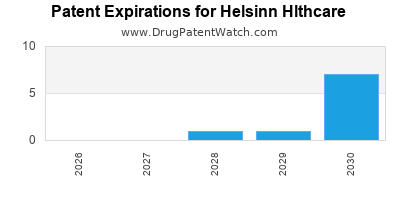
Last updated: June 14, 2026
Helsinn Healthcare is a global specialty pharmaceutical company focused on products that address oncology supportive care and opioid-induced side effects, with a portfolio that includes palonosetron (Aloxi) and netupitant/palonosetron (NEPAK/other market names). Its competitive edge is strongest where branded supportive-care products face limited therapeutic interchange and where formulation and patient-management IP can slow generic or biosimilar-type entry. The company’s market position depends on: (1) Orange Book patent coverage around active and formulation, (2) how quickly exclusivity and patent estates expire in each jurisdiction, and (3) whether challenger pathways (Paragraph IV for small molecules) can launch at-risk before expiry or via licensed entry.
The practical outcome for competitors and investors is that Helsinn’s defensibility is highest in markets with dense, still-unexpired patent thickets and where clinical practice guidelines sustain branded use. Competitive risk tends to rise at patent step-outs, post-expiry carve-outs, and following settlements that permit earlier-to-market generics.
What is Helsinn Healthcare’s market position in oncology supportive care and opioid-induced side effects?
Helsinn’s positioning clusters around two demand pools:
-
Oncology antiemetics (5-HT3 antagonists and NK1 antagonists combinations)
- Helsinn is tied to palonosetron-based antiemetic regimens and netupitant/palonosetron combination products used with chemotherapy, including high emetogenic risk settings.
- Competitive context: branded antiemetics compete with generics of older 5-HT3 options and with differentiated combo regimens; payer policies often push toward lower-cost agents once generic coverage is available.
-
Opioid-induced nausea/vomiting supportive care
- Helsinn is associated with Helsinn-developed netupitant formulations in some geographies/brands aligned to opioid-related indications.
- Competitive context: generic entry depends on method/formulation IP and how the indication is defined in label and labeling exclusivity.
Featured-snippet answer: Helsinn’s strongest market position is in supportive-care segments where branded antiemetic regimens are maintained by guideline-backed use and where patent coverage around specific formulations and combinations delays generic substitution.
Where does Helsinn compete most directly versus branded and generic players?
- US and Europe: high importance of Orange Book listings, FDA approvals, and patent-expiration scheduling. In Europe, national SPCs and supplemental protection matter.
- Institutional oncology centers: higher switching friction due to protocolized regimens and formulary committees that resist frequent changes.
- Payer economics: once generics have clear label parity, volume shifts can be fast.
What patents protect Helsinn Healthcare products in the Orange Book and SPC landscape?
Helsinn’s defensibility in the US typically depends on a combination of:
- Drug product patents (composition, dosage form, stability, polymorphs)
- Method-of-use patents (patient subsets, emetogenic risk regimens, administration schedules)
- Process/manufacturing patents (where listed and enforceable)
How to assess Helsinn patent coverage strength quickly
A high-level strength score for each marketed product comes from:
- Number of Orange Book entries per NDA
- How many are still unexpired in the intended launch window
- Whether key claims map to the exact product attributes generics must copy:
- fixed-dose combination ratios
- formulation components (excipients, solubilizers)
- administration timing and regimen language
Where method-of-use claims matter most
Method patents are most impactful when:
- The generic’s label is constrained, requiring litigation to secure carve-outs
- The branded regimen aligns to clinical pathways that clinicians follow even after generic availability
Featured-snippet answer: Helsinn’s patent estate strength is driven by formulation and method-of-use coverage that constrains generic “label parity” and increases at-risk litigation and design-around costs.
When does Helsinn exclusivity and key patent coverage typically lose exclusivity in the US and EU?
For small-molecule supportive-care products, exclusivity risk usually moves in this sequence:
- Regulatory exclusivities (if applicable for NDA approvals, new indications, or certain formulation changes)
- Primary composition and dosage form patent expirations
- Secondary formulation/process patents
- SPC expirations in Europe, which can extend exclusivity beyond baseline patent terms
Featured-snippet answer: Competitive pressure increases in a staged pattern: the first wave comes after composition/dosage form patent expiry; a second wave depends on whether remaining formulation/process patents and SPCs still cover the branded product characteristics.
Practical timing considerations competitors model
- Paragraph IV filing windows relative to listed patents
- Whether settlements permit “design-to-expiry” timelines
- Whether label carve-outs reduce payer adoption
Which generic or biosimilar entry risks exist for Helsinn Healthcare products?
Helsinn’s portfolio is small-molecule supportive care, so the primary competitive mechanism is generic entry via ANDA, with Paragraph IV challenges against listed patents. Biosimilar pathways are not the dominant framework for Helsinn’s core antiemetic assets unless Helsinn has biologic adjuncts (not indicated in this topic scope).
Generic entry risk factors that matter
- Patent density: more listed patents increases the number of potential teases for multiple Paragraph IV plays.
- Claim breadth: broad formulation or method-of-use claims raise injunction and settlement leverage.
- Litigation history: prior disputes can guide likely settlement structures and design-around feasibility.
Featured-snippet answer: Entry risk for Helsinn is mainly ANDA-based and rises when remaining Orange Book listings are narrow enough to design around or when settlement agreements allow early launches.
What patent litigation affects Helsinn Healthcare, including Paragraph IV and settlement dynamics?
Helsinn’s competitive landscape is shaped by:
- Whether challengers succeed at invalidating key claims or obtaining non-infringement rulings
- Whether a generic challenger settles and gains a mutually agreed launch date
- Whether courts grant injunctions that delay generic supply
How Paragraph IV cases typically influence market share
- If challengers obtain an early launch right, branded sales can compress quickly through payer switching.
- If challengers lose or settle late, Helsinn retains price and volume, and payers keep branded protocols longer.
Featured-snippet answer: The most market-relevant litigation is tied to enforceable claims that map to the marketed dosage form and dosing regimen.
What formulations are protected for Helsinn antiemetic and supportive-care products?
For antiemetics, the “protectable product” often includes:
- Fixed-dose combinations (e.g., NK1 antagonist + 5-HT3 antagonist)
- Dosage forms (capsules vs injectables)
- Stability and solubilization system used to achieve bioavailability and shelf life
- Patient-relevant regimen instructions (method-of-use language)
Where formulation patents can block generic copy
Generics can be blocked if:
- Key formulation attributes are claimed (not merely “equivalent”)
- The claimed composition is not easily redesigned without affecting performance
- The generic must meet BE requirements and falls into infringement for claimed ranges or components
Featured-snippet answer: Helsinn’s formulation IP can delay generic substitution when claims target combination integrity and stability-relevant composition rather than only the active ingredient.
How does Helsinn Healthcare compare with other antiemetic and supportive-care players?
In oncology supportive care, the competitive set typically includes:
- Branded innovators in antiemetics
- Generic manufacturers with ANDA capabilities
- Contract manufacturers that can support authorized generics post-settlement
Competitive comparison framework
Helsinn’s comparative advantages usually show up in:
- Differentiated combination products and regimen fit
- Dense, continuously maintained patent estates
- Established hospital/oncology center adoption
Generic competitors’ comparative advantage is:
- Lower net pricing after generic launch
- Volume penetration once payer policies accept substitution
Featured-snippet answer: Helsinn competes on combination differentiation and patent durability; generic competitors win primarily on price after legal barriers clear.
What is the Orange Book status of Helsinn Healthcare products and how does it impact generic launch risk?
Orange Book status directly drives:
- Whether ANDA applicants must certify against each listed patent
- Whether a Paragraph IV suit can be filed to trigger forfeiture of exclusivity for the ANDA sponsor’s first filing
- The probability of an injunction or settlement delay
How to interpret Orange Book “shape” for market planning
- Many patents with staggered expirations: longer branded runway, more complex generic launch calendar
- Few key patents with broad claims: higher litigation leverage for Helsinn, but higher odds of a single pivotal litigation outcome
Featured-snippet answer: When Orange Book coverage is dense and staggered, Helsinn’s launch calendar is protected through multiple legal checkpoints, reducing the chance of a single early generic entry wiping out the branded position.
What regulatory milestones and FDA status factors matter for Helsinn launches and competition?
FDA-driven competitive impacts include:
- NDA/BLA approval dates (for exclusivity calculations)
- Supplements (label expansion, formulation changes, new strengths)
- Orphan designation or pediatric exclusivity (if applicable for specific assets)
- BE requirements and labeling parity for ANDAs
Competitive implication
Even when an active ingredient is generic-available, label modifications can preserve some protected uses. Conversely, if generics launch with “therapeutic equivalence” that payers accept, branded volume can decline quickly.
Featured-snippet answer: FDA labeling and supplement history determine which uses remain protected longer than the underlying molecule’s initial approvals.
How do geographic patent estates in the EU, UK, and other markets change Helsinn’s competitive runway?
Helsinn’s competitive runway is often longer in Europe if:
- SPCs attach to key patents for combination and formulation
- National validation of patents plus SPCs stretches effective expiry
Cross-market modeling approach
- US: Orange Book listings and litigation settlements determine effective launch timing.
- EU: SPC expiry, plus national enforcement, determines whether generic substitutions can proceed without litigation.
Featured-snippet answer: Effective exclusivity is usually longer in jurisdictions where SPCs validate against formulation or dosage form claims, even after base patent expiry.
What licensing or authorized generic strategies can reduce litigation exposure for Helsinn?
Specialty pharma frequently uses licensing or authorized generics to manage:
- Court resource costs
- Supply certainty
- Payer contracting stability
Where licensing is most likely
Licensing is most attractive when:
- The patent estate is strong but litigation would be prolonged
- The branded originator can negotiate shared economics and control launch timing
- Generic challengers offer manufacturing scale benefits
Featured-snippet answer: Authorized entry deals can preserve price floors and reduce the volatility caused by at-risk launches, especially when patent claims are defensible but time-to-judgment is uncertain.
Key takeaways for business strategy: R&D, licensing, litigation, and investment
- Helsinn’s defensibility is primarily patent-driven in small-molecule supportive care. The highest leverage comes from formulation and method-of-use claims that constrain generic label parity.
- Competitive risk is staged, not binary. Each patent layer and each regulatory label expansion affects whether competitors can launch and how quickly payers switch.
- Litigation outcomes can reshape market share quickly, but settlements often control the real timeline. For competitive planning, settlement launch dates and carve-outs matter as much as court holdings.
- Geo-variance is material. SPC and national validation in Europe can extend effective runway even when US timelines shorten.
- Strategic response for competitors should focus on claim mapping. The value is in identifying which Helsinn claims are essential to the exact marketed dosage form and regimen instructions.
FAQs
What factors determine whether a generic can enter Helsinn’s antiemetic markets quickly after patent expiry?
Listed patent scope (composition/formulation vs active-only), whether label parity is available, and whether settlement terms permit immediate launch.
How do formulation patents change ANDA design-around strategies for fixed-dose combinations?
They restrict the permissible excipient and stability system modifications and can create infringement risk even when the active ingredients match.
What does “Orange Book density” imply for Paragraph IV litigation likelihood?
More listed patents increase certification complexity and increase the chance of multiple suits or settlement pressure points.
Which settlement terms usually matter most to payer and wholesaler adoption?
Launch date, authorized generic availability, label carve-outs, and any supply timing constraints that affect contract pricing.
How does EU SPC coverage alter the expected competitive impact relative to the US?
SPCs can extend effective exclusivity beyond US base patent expiry, delaying generic substitution and reducing the immediate erosion of branded volume.
References (APA)
- FDA. Orange Book: Approved Drug Products with Therapeutic Equivalence Evaluations. U.S. Food and Drug Administration. https://www.accessdata.fda.gov/scripts/cder/daf/
- United States Patent and Trademark Office. Patent and Patent Application Full Text and Image Databases. https://patft.uspto.gov/
- European Patent Office. Supplementary Protection Certificates (SPC) and related legal framework. https://www.epo.org/