Last Updated: September 24, 2026

AKYNZEO Drug Patent Profile


✉ Email this page to a colleague

« Back to Dashboard


Which patents cover Akynzeo, and what generic alternatives are available?

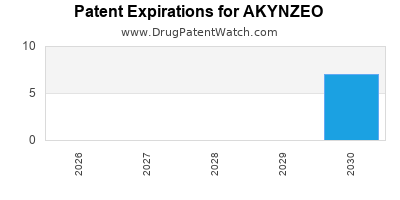
Akynzeo is a drug marketed by Helsinn Hlthcare and is included in two NDAs. There are twenty-two patents protecting this drug and one Paragraph IV challenge.

The generic ingredient in AKYNZEO is fosnetupitant chloride hydrochloride; palonosetron hydrochloride. There are two drug master file entries for this compound. One supplier is listed for this compound. Additional details are available on the fosnetupitant chloride hydrochloride; palonosetron hydrochloride profile page.

DrugPatentWatch® Generic Entry Outlook for Akynzeo

Akynzeo was eligible for patent challenges on April 19, 2022.

By analyzing the patents and regulatory protections it appears that the earliest date for generic entry will be May 23, 2032. This may change due to patent challenges or generic licensing.

There have been four patent litigation cases involving the patents protecting this drug, indicating strong interest in generic launch. Recent data indicate that 63% of patent challenges are decided in favor of the generic patent challenger and that 54% of successful patent challengers promptly launch generic drugs.

Indicators of Generic Entry

< Available with Subscription >

  Start Trial

AI Deep Research
Questions you can ask:
  • What is the 5 year forecast for AKYNZEO?
  • What are the global sales for AKYNZEO?
  • What is Average Wholesale Price for AKYNZEO?
DrugPatentWatch® Estimated Loss of Exclusivity (LOE) Date for AKYNZEO
Generic Entry Dates for AKYNZEO*:
Constraining patent/regulatory exclusivity:
NDA:
Dosage:

CAPSULE;ORAL

Generic Entry Dates for AKYNZEO*:
Constraining patent/regulatory exclusivity:
NDA:
Dosage:

POWDER;INTRAVENOUS

*The generic entry opportunity date is the latter of the last compound-claiming patent and the last regulatory exclusivity protection. Many factors can influence early or later generic entry. This date is provided as a rough estimate of generic entry potential and should not be used as an independent source.

Recent Clinical Trials for AKYNZEO

Identify potential brand extensions & 505(b)(2) entrants

SponsorPhase
Fondazione IRCCS Istituto Nazionale dei Tumori, MilanoPHASE4
Helsinn Healthcare SAPhase 2
Simon Williamson ClinicPhase 2

See all AKYNZEO clinical trials

Paragraph IV (Patent) Challenges for AKYNZEO
Tradename Dosage Ingredient Strength NDA ANDAs Submitted Submissiondate
AKYNZEO Solution in SDV fosnetupitant chloride hydrochloride; palonosetron hydrochloride 235 mg/0.25 mg per 20 mL 210493 1 2022-04-19

US Patents and Regulatory Information for AKYNZEO

AKYNZEO is protected by twenty-four US patents.

Based on analysis by DrugPatentWatch, the earliest date for a generic version of AKYNZEO is ⤷  Start Trial.

This potential generic entry date is based on patent 9,908,907.

Generics may enter earlier, or later, based on new patent filings, patent extensions, patent invalidation, early generic licensing, generic entry preferences, and other factors.

Applicant Tradename Generic Name Dosage NDA Approval Date TE Type RLD RS Patent No. Patent Expiration Product Substance Delist Req. Exclusivity Expiration
Helsinn Hlthcare AKYNZEO fosnetupitant chloride hydrochloride; palonosetron hydrochloride SOLUTION;INTRAVENOUS 210493-002 May 27, 2020 RX Yes Yes 9,908,907 ⤷  Start Trial Y Y ⤷  Start Trial
Helsinn Hlthcare AKYNZEO fosnetupitant chloride hydrochloride; palonosetron hydrochloride SOLUTION;INTRAVENOUS 210493-002 May 27, 2020 RX Yes Yes 10,208,073 ⤷  Start Trial ⤷  Start Trial
Helsinn Hlthcare AKYNZEO fosnetupitant chloride hydrochloride; palonosetron hydrochloride SOLUTION;INTRAVENOUS 210493-002 May 27, 2020 RX Yes Yes 8,426,450 ⤷  Start Trial Y Y ⤷  Start Trial
>Applicant >Tradename >Generic Name >Dosage >NDA >Approval Date >TE >Type >RLD >RS >Patent No. >Patent Expiration >Product >Substance >Delist Req. >Exclusivity Expiration

Expired US Patents for AKYNZEO

Applicant Tradename Generic Name Dosage NDA Approval Date Patent No. Patent Expiration
Helsinn Hlthcare AKYNZEO netupitant; palonosetron hydrochloride CAPSULE;ORAL 205718-001 Oct 10, 2014 5,202,333 ⤷  Start Trial
Helsinn Hlthcare AKYNZEO netupitant; palonosetron hydrochloride CAPSULE;ORAL 205718-001 Oct 10, 2014 6,297,375 ⤷  Start Trial
>Applicant >Tradename >Generic Name >Dosage >NDA >Approval Date >Patent No. >Patent Expiration

International Patents for AKYNZEO

When does loss-of-exclusivity occur for AKYNZEO?

Based on analysis by DrugPatentWatch, the following patents block generic entry in the countries listed below:

Argentina

Patent: 9019
Patent: DERIVADOS MODIFICADOS DE 4-FENIL-PIRIDINA
Estimated Expiration: ⤷  Start Trial

Australia

Patent: 12346133
Patent: Substituted 4 - phenyl - pyridines for the treatment of NK-1 receptor related diseases
Estimated Expiration: ⤷  Start Trial

Patent: 15323515
Patent: Crystalline forms of an NK-1 antagonist
Estimated Expiration: ⤷  Start Trial

Brazil

Patent: 2014012878
Patent: composto, método de tratamento de emese, composição farmacêutica, método de fabricação, método sintético e método para estabilização de um composto
Estimated Expiration: ⤷  Start Trial

Canada

Patent: 50644
Patent: 4 PHENYL-PYRIDINES SUBSTITUEES POUR LE TRAITEMENT DE MALADIES ASSOCIEES A UN RECEPTEUR NK-1 (SUBSTITUTED 4 - PHENYL - PYRIDINES FOR THE TREATMENT OF NK-1 RECEPTOR RELATED DISEASES)
Estimated Expiration: ⤷  Start Trial

Patent: 60599
Patent: FORMES CRISTALLINES D'UN ANTAGONISTE DES RECEPTEURS NK-1 (CRYSTALLINE FORMS OF AN NK-1 ANTAGONIST)
Estimated Expiration: ⤷  Start Trial

Chile

Patent: 14001280
Patent: Compuestos derivados de 4-fenil -piridinas sustituidas, moduladores del receptor de nk1; procedimiento de preparacion; composicion farmaceutica; y su uso en el tratamiento de la emesis, disfuncion vesical, depresion o ansiedad
Estimated Expiration: ⤷  Start Trial

China

Patent: 4053652
Patent: Substituted 4-phenyl-pyridines for the treatment of NK-1 receptor related diseases
Estimated Expiration: ⤷  Start Trial

Patent: 6518924
Patent: 用于治疗 NK‑1 受体相关疾病的取代的 4‑苯基吡啶 (Substituted 4 - phenyl - pyridines for the treatment of NK-1 receptor related diseases)
Estimated Expiration: ⤷  Start Trial

Patent: 6986822
Patent: 用于治疗 NK‑1 受体相关疾病的取代的 4‑苯基吡啶 (Substituted 4-phenyl-pyridines for the treatment of NK-1 receptor related diseases)
Estimated Expiration: ⤷  Start Trial

Patent: 7001275
Patent: NK‑1拮抗剂的晶型 (Crystalline forms of an NK-1 antagonist)
Estimated Expiration: ⤷  Start Trial

Patent: 1662330
Patent: 用于治疗NK-1受体相关疾病的取代的4-苯基吡啶 (Substituted 4-phenyl pyridines for treatment NK-1 receptor related diseases)
Estimated Expiration: ⤷  Start Trial

Patent: 2961104
Patent: 用于治疗NK-1受体相关疾病的取代的4-苯基吡啶 (SUBSTITUTED 4 - PHENYL - PYRIDINES FOR THE TREATMENT OF NK-1 RECEPTOR RELATED DISEASES)
Estimated Expiration: ⤷  Start Trial

Patent: 2979543
Patent: 用于治疗NK-1受体相关疾病的取代的4-苯基吡啶 (Substituted 4-phenylpyridines for treatment of NK-1 receptor related diseases)
Estimated Expiration: ⤷  Start Trial

Colombia

Patent: 90728
Patent: 4-fenil-piridinas sustituidas para el tratamiento de enfermedades relacionadas con el receptor de nk1
Estimated Expiration: ⤷  Start Trial

Costa Rica

Patent: 140312
Patent: 4-FENIL-PIRIDINAS SUSTIUIDAS PARA EL TRATAMIENTO DE ENFERMEDADES RELACIONADAS CON EL RECEPTOR DE NK1
Estimated Expiration: ⤷  Start Trial

Croatia

Patent: 0161708
Estimated Expiration: ⤷  Start Trial

Cyprus

Patent: 18416
Estimated Expiration: ⤷  Start Trial

Denmark

Patent: 85706
Estimated Expiration: ⤷  Start Trial

Dominican Republic

Patent: 014000115
Patent: USO DE 4-FENIL-PIRIDINAS SUSTITUIDAS PARA LA FABRICACIÓN DE MEDICAMENTOS ÚTILES EN EL TRATAMIENTO DE ENFERMEDADES RELACIONADAS CON EL RECEPTOR DE NK1
Estimated Expiration: ⤷  Start Trial

Ecuador

Patent: 14003642
Patent: 4-FENIL-PIRIDINAS SUSTITUIDAS PARA EL TRATAMIENTO DE ENFERMEDADES RELACIONADAS CON EL RECEPTOR DE NK1
Estimated Expiration: ⤷  Start Trial

Eurasian Patent Organization

Patent: 6553
Patent: ЗАМЕЩЕННЫЕ 4-ФЕНИЛПИРИДИНЫ ДЛЯ ЛЕЧЕНИЯ БОЛЕЗНЕЙ, СВЯЗАННЫХ С РЕЦЕПТОРОМ NK-1 (SUBSTITUTED 4-PHENYL-PYRIDINES FOR THE TREATMENT OF NK-1 RECEPTOR RELATED DISEASES)
Estimated Expiration: ⤷  Start Trial

Patent: 1400624
Patent: ЗАМЕЩЕННЫЕ 4-ФЕНИЛПИРИДИНЫ ДЛЯ ЛЕЧЕНИЯ БОЛЕЗНЕЙ, СВЯЗАННЫХ С РЕЦЕПТОРОМ NK-1 (SUBSTITUTED 4-PHENYL-PYRIDINES FOR THE TREATMENT OF NK-1 RECEPTOR RELATED DISEASES)
Estimated Expiration: ⤷  Start Trial

European Patent Office

Patent: 85706
Patent: 4 PHÉNYL-PYRIDINES SUBSTITUÉES POUR LE TRAITEMENT DE MALADIES ASSOCIÉES À UN RÉCEPTEUR NK-1 (SUBSTITUTED 4-PHENYL-PYRIDINES FOR THE TREATMENT OF NK-1 RECEPTOR RELATED DISEASES.)
Estimated Expiration: ⤷  Start Trial

Patent: 97871
Patent: FORMES CRYSTALLINES D'UN ANTAGONIST DE NK-1 (CRYSTALLINE FORMS OF AN NK-1 ANTAGONIST)
Estimated Expiration: ⤷  Start Trial

France

Patent: C1029
Estimated Expiration: ⤷  Start Trial

Georgia, Republic of

Patent: 01706695
Patent: SUBSTITUTED 4-PHENYL-PYRIDI-NES FOR THE TREATMENT OF NK-1 RECEPTOR RELATED DISEASES
Estimated Expiration: ⤷  Start Trial

Guatemala

Patent: 1400102
Patent: 4-FENIL-PIRIDINAS SUSTITUIDAS PARA EL TRATAMIENTO DE ENFERMEDADES RELACIONADAS CON EL RECEPTOR DE NK1
Estimated Expiration: ⤷  Start Trial

Hong Kong

Patent: 99030
Patent: 用於治療 受體相關疾病的取代的 -苯基吡啶 (SUBSTITUTED 4 - PHENYL - PYRIDINES FOR THE TREATMENT OF NK-1 RECEPTOR RELATED DISEASES NK-1 4-)
Estimated Expiration: ⤷  Start Trial

Hungary

Patent: 32288
Estimated Expiration: ⤷  Start Trial

Patent: 000032
Estimated Expiration: ⤷  Start Trial

India

Patent: 07CHN2014
Estimated Expiration: ⤷  Start Trial

Israel

Patent: 2859
Patent: 4–פניל פירידינים מותמרים לטיפול במחלות הקשורות ברצפטור ל–nk–1 (Substituted 4-phenyl-pyridines for the treatment of nk-1 receptor related diseases)
Estimated Expiration: ⤷  Start Trial

Japan

Patent: 35708
Estimated Expiration: ⤷  Start Trial

Patent: 23146
Estimated Expiration: ⤷  Start Trial

Patent: 74083
Estimated Expiration: ⤷  Start Trial

Patent: 14507446
Patent: NK−1レセプター関連疾患の治療のための置換4−フェニル−ピリジン
Estimated Expiration: ⤷  Start Trial

Patent: 15017121
Patent: NK−1レセプター関連疾患の治療のための置換4−フェニル−ピリジン (SUBSTITUTED 4-PHENYL-PYRIDINES FOR TREATMENT OF NK-1 RECEPTOR RELATED DISEASES)
Estimated Expiration: ⤷  Start Trial

Patent: 16147868
Patent: NK−1レセプター関連疾患の治療のための置換4−フェニル−ピリジン (SUBSTITUTED 4-PHENYL PYRIDINES FOR TREATING NK-1 RECEPTOR ASSOCIATED DISEASES)
Estimated Expiration: ⤷  Start Trial

Patent: 17529380
Patent: NK−1アンタゴニストの結晶形態
Estimated Expiration: ⤷  Start Trial

Jordan

Patent: 02
Patent: مركبات 4- فينيل- بيريدين بها استبدال لعلاج الامراض ذات الصلة بمستقبل NK-1 (SUBSTITUTED 4-PHENYL-PYRIDINES FOR THE TREATMENT OF NK-1 RECEPTOR RELATED DISEASES)
Estimated Expiration: ⤷  Start Trial

Lithuania

Patent: 85706
Estimated Expiration: ⤷  Start Trial

Patent: 785706
Estimated Expiration: ⤷  Start Trial

Patent: 2020510
Estimated Expiration: ⤷  Start Trial

Malaysia

Patent: 5514
Patent: SUBSTITUTED 4-PHENYL-PYRIDINES FOR THE TREATMENT OF NK-1 RECEPTOR RELATED DISEASES
Estimated Expiration: ⤷  Start Trial

Mexico

Patent: 14006423
Patent: 4-FENIL-PIRIDINAS SUSTITUIDAS PARA EL TRATAMIENTO DE ENFERMEDADES RELACIONADAS CON EL RECEPTOR NK-1. (SUBSTITUTED 4 - PHENYL - PYRIDINES FOR THE TREATMENT OF NK-1 RECEPTOR RELATED DISEASES.)
Estimated Expiration: ⤷  Start Trial

Moldova, Republic of

Patent: 39
Patent: 4-Fenilpiridine substituite pentru tratamentul bolilor asociate cu receptorul NK-1 (Substituted 4-phenyl-pyridines for the treatment of NK-1 receptor related diseases)
Estimated Expiration: ⤷  Start Trial

Patent: 140059
Patent: 4-Fenilpiridine substituite pentru tratamentul bolilor asociate cu receptorul NK-1 (Substituted 4-phenyl-pyridines for the treatment of NK-1 receptor related diseases)
Estimated Expiration: ⤷  Start Trial

Montenegro

Patent: 561
Patent: SUPSTITUISANI 4-FENIL-PIRIDINI ZA TERAPIJU BOLESTI POVEZANIH SA NK- 1 RECEPTOROM (SUBSTITUTED 4 - PHENYL - PYRIDINES FOR THE TREATMENT OF NK-1 RECEPTOR RELATED DISEASES)
Estimated Expiration: ⤷  Start Trial

Morocco

Patent: 836
Patent: 4 phényl-pyridines substituées pour le traitement de maladies associées à un récepteur nk-1
Estimated Expiration: ⤷  Start Trial

Netherlands

Patent: 1047
Estimated Expiration: ⤷  Start Trial

New Zealand

Patent: 3746
Patent: Substituted 4-phenyl-pyridines for the treatment of nk-1 receptor related diseases
Estimated Expiration: ⤷  Start Trial

Nicaragua

Patent: 1400043
Patent: 4 - FENIL - PIRIDINAS SUSTITUIDAS PARA EL TRATAMIENTO DE ENFERMEDADES RELACIONADAS CON EL RECEPTOR DE NK1
Estimated Expiration: ⤷  Start Trial

Peru

Patent: 141421
Patent: 4-FENIL-PIRIDINAS SUSTITUIDAS PARA EL TRATAMIENTO DE ENFERMEDADES RELACIONADAS CON EL RECEPTOR DE NK1
Estimated Expiration: ⤷  Start Trial

Philippines

Patent: 014501199
Patent: SUBSTITUTED 4-PHENYL - PYRIDINES FOR THE TREATMENT OF NK-1 RECEPTOR RELATED DISEASES
Estimated Expiration: ⤷  Start Trial

Poland

Patent: 85706
Estimated Expiration: ⤷  Start Trial

Portugal

Patent: 85706
Estimated Expiration: ⤷  Start Trial

San Marino

Patent: 01600467
Patent: 4-FENIL-PIRIDINE SOSTITUITE PER IL TRATTAMENTO DI MALATTIE CORRELATE AL RECETTORE NK-1
Estimated Expiration: ⤷  Start Trial

Serbia

Patent: 448
Patent: SUPSTITUISANI 4-FENIL-PIRIDINI ZA TERAPIJU BOLESTI POVEZANIH SA NK-1 RECEPTOROM (SUBSTITUTED 4-PHENYL-PYRIDINES FOR THE TREATMENT OF NK-1 RECEPTOR RELATED DISEASES.)
Estimated Expiration: ⤷  Start Trial

Singapore

Patent: 201402044X
Patent: SUBSTITUTED 4 - PHENYL - PYRIDINES FOR THE TREATMENT OF NK-1 RECEPTOR RELATED DISEASES
Estimated Expiration: ⤷  Start Trial

Slovenia

Patent: 85706
Estimated Expiration: ⤷  Start Trial

South Africa

Patent: 1404787
Patent: SUBSTITUTED 4-PHENYL-PYRIDINES FOR THE TREATMENT OF NK-1 RECEPTOR RELATED DISEASES
Estimated Expiration: ⤷  Start Trial

South Korea

Patent: 1979050
Estimated Expiration: ⤷  Start Trial

Patent: 140103991
Patent: NK-1 수용체 관련 질환의 치료를 위한 치환된 4-페닐-피리딘 (SUBSTITUTED 4-PHENYL-PYRIDINES FOR THE TREATMENT OF NK-1 RECEPTOR RELATED DISEASES)
Estimated Expiration: ⤷  Start Trial

Patent: 170063768
Patent: NK-1 길항제의 결정질 형태 (-1 CRYSTALLINE FORMS OF AN NK-1 ANTAGONIST)
Estimated Expiration: ⤷  Start Trial

Spain

Patent: 03958
Estimated Expiration: ⤷  Start Trial

Taiwan

Patent: 1331181
Patent: Modified 4-phenyl-pyridine derivatives
Estimated Expiration: ⤷  Start Trial

Patent: 1613888
Patent: Crystalline forms of an NK-1 antagonist
Estimated Expiration: ⤷  Start Trial

Patent: 38806
Estimated Expiration: ⤷  Start Trial

Tunisia

Patent: 14000165
Patent: SUBSTITUTED 4 - PHENYL - PYRIDINES FOR THE TREATMENT OF NK-1 RECEPTOR RELATED DISEASES
Estimated Expiration: ⤷  Start Trial

Ukraine

Patent: 5136
Patent: ЗАМІЩЕНІ 4-ФЕНІЛПІРИДИНИ ДЛЯ ЛІКУВАННЯ ХВОРОБ, ПОВ'ЯЗАНИХ З РЕЦЕПТОРОМ NK-1 (SUBSTITUTED 4-PHENYL-PYRIDINES FOR THE TREATMENT OF NK-1 RECEPTOR RELATED DISEASES)
Estimated Expiration: ⤷  Start Trial

Uruguay

Patent: 472
Patent: DERIVADOS MODIFICADOS DE 4-FENIL-PIRIDINA
Estimated Expiration: ⤷  Start Trial

Generics may enter earlier, or later, based on new patent filings, patent extensions, patent invalidation, early generic licensing, generic entry preferences, and other factors.

See the table below for additional patents covering AKYNZEO around the world.

Country Patent Number Title Estimated Expiration
Australia 2015323515 ⤷  Start Trial
Canada 2960599 ⤷  Start Trial
China 107001275 ⤷  Start Trial
>Country >Patent Number >Title >Estimated Expiration
Last updated: August 12, 2026

Akynzeo is a differentiated antiemetic combination of netupitant and palonosetron used to prevent acute and delayed chemotherapy-induced nausea and vomiting. Its commercial profile is stable but mature: the product benefits from convenient single-dose administration and broad guideline positioning, while generic aprepitant, generic palonosetron, competing NK1 antagonists, and payer price pressure limit expansion. Helsinn does not publicly disclose Akynzeo revenue as a standalone line item, so its financial trajectory must be assessed through product lifecycle, market access, licensing structure, and competitive erosion rather than reported product sales.

Akynzeo Market Dynamics, Patent Exclusivity, and Financial Trajectory

What is Akynzeo and how does it work?

Akynzeo combines two antiemetic mechanisms in one product:

Component Pharmacologic class Primary role
Netupitant Neurokinin-1, or NK1, receptor antagonist Controls delayed chemotherapy-induced nausea and vomiting
Palonosetron 5-HT3 receptor antagonist Controls acute chemotherapy-induced nausea and vomiting

The oral capsule contains 300 mg of netupitant and 0.5 mg of palonosetron. The product is administered once before chemotherapy. The FDA approved Akynzeo capsules in October 2014 for prevention of acute and delayed nausea and vomiting associated with initial and repeat courses of cancer chemotherapy, including highly emetogenic chemotherapy and anthracycline plus cyclophosphamide regimens.[1]

A parenteral formulation, fosnetupitant and palonosetron, was later developed to extend the franchise to patients unable to take oral medication. The FDA approved the intravenous formulation in 2018 under the Akynzeo brand.[2] In Europe, the product is authorized for prevention of acute and delayed nausea and vomiting associated with highly emetogenic and moderately emetogenic chemotherapy.[3]

How large is the Akynzeo market?

Akynzeo competes in the supportive-care market for chemotherapy-induced nausea and vomiting, or CINV. The addressable market is driven by oncology treatment volume rather than by the number of patients receiving chronic therapy. Revenue therefore depends on:

  • Number of chemotherapy cycles administered.
  • Use of highly emetogenic and moderately emetogenic regimens.
  • Guideline adherence.
  • Hospital and oncology-clinic formulary placement.
  • Reimbursement for branded fixed-dose combinations.
  • Conversion from multi-pill antiemetic regimens to single-dose products.

CINV prevention is a guideline-supported standard of care. Major guideline frameworks recommend combinations incorporating an NK1 antagonist, a 5-HT3 antagonist, and dexamethasone for patients receiving highly emetogenic chemotherapy. The combination can be supplemented with olanzapine depending on the regimen and clinical risk.[4]

Akynzeo’s commercial value is concentrated in treatment settings where convenience, delayed-emesis control, and predictable administration are important. It has less pricing power in formularies that substitute generic aprepitant and generic palonosetron as separate products.

How does Akynzeo compare with competing antiemetics?

Akynzeo competes against both branded combinations and low-cost generic components.

Product or regimen Main active ingredient or combination Commercial position
Akynzeo Netupitant plus palonosetron Fixed-dose oral and intravenous combination
Emend Aprepitant Originator NK1 antagonist; oral and intravenous competitors include generic versions
Cinvanti Injectable aprepitant emulsion IV NK1 antagonist
Fosaprepitant and generic fosaprepitant Prodrug of aprepitant Common hospital-based alternative
Aloxi and generic palonosetron Palonosetron 5-HT3 component used separately
Varubi Rolapitant Alternative oral NK1 antagonist with limited commercial momentum
Generic aprepitant plus generic palonosetron Separate NK1 and 5-HT3 agents Main price-based substitute

Akynzeo’s principal clinical differentiation is consolidation. A physician or infusion center can prescribe one fixed-dose product rather than separate netupitant or aprepitant and palonosetron products. That advantage is strongest where adherence, administration time, and delayed CINV control matter.

The economic disadvantage is the branded combination price. Generic aprepitant and palonosetron allow payers to unbundle the regimen at lower acquisition cost. This creates a persistent ceiling on Akynzeo pricing, particularly in hospital outpatient departments and integrated delivery networks.

What is the FDA regulatory status of Akynzeo?

The FDA approved Akynzeo capsules in 2014 and the intravenous formulation in 2018. The product is regulated as a small-molecule fixed-dose combination rather than a biologic.[1,2]

Regulatory event Approximate date Significance
FDA approval of oral Akynzeo October 2014 Established the U.S. fixed-dose combination
FDA approval of IV Akynzeo 2018 Expanded use to patients requiring parenteral administration
European authorization 2015 Established commercial access across European markets
Post-approval lifecycle activity Ongoing Supports route-of-administration and market-access expansion

The FDA label supports use before chemotherapy and covers both highly emetogenic chemotherapy and anthracycline plus cyclophosphamide regimens. The product is not a treatment for established nausea and vomiting after onset; it is administered prophylactically.[1]

What patents protect Akynzeo?

Akynzeo is protected by patents covering the fixed combination, pharmaceutical compositions, and related formulations. The key U.S. patent family has included the following patents associated with Akynzeo listings and product protection:

Patent General subject matter Reported protection profile
U.S. Patent No. 8,609,863 Netupitant and palonosetron pharmaceutical composition Core combination protection
U.S. Patent No. 9,018,311 Combination composition and formulation claims Follow-on composition protection
U.S. Patent No. 9,463,220 Additional fixed-dose combination claims Follow-on protection
U.S. Patent No. 10,292,922 Pharmaceutical formulation and related claims Later-expiring formulation protection
Additional IV-related patents Fosnetupitant and parenteral formulations Route-specific protection

The FDA Orange Book is the controlling source for current listed patents, pediatric exclusivity, and applicable patent expiration information.[5] Patent portfolios can include multiple expiration dates because composition, formulation, method-of-use, and pediatric protections do not necessarily end simultaneously.

When does Akynzeo lose U.S. exclusivity?

The earliest core U.S. patent protection has generally been associated with the 2030 period, subject to patent-term adjustment, patent-term extension, terminal disclaimers, and the specific patent claims listed for the product.[5] Later formulation and IV patents may extend protection beyond the earliest core combination patent.

Akynzeo’s practical generic-entry date will depend on:

  1. Which patents an ANDA applicant challenges.
  2. Whether the applicant files a Paragraph IV certification.
  3. Whether the patent holder files suit within the statutory period.
  4. Whether the litigation triggers a 30-month stay.
  5. Whether any listed patents are invalidated, narrowed, or not infringed.
  6. Whether an ANDA applicant targets the oral product, the IV product, or both.

Patent expiry should therefore be assessed at the product-and-route level rather than through a single headline date.

What Orange Book status does Akynzeo have?

Akynzeo is an FDA-approved small-molecule product with Orange Book-listed patents. The Orange Book distinguishes the reference-listed drug from its patents and regulatory exclusivities.[5]

The principal regulatory risk is an ANDA for a generic oral fixed-dose combination. A generic developer may also pursue separate netupitant and palonosetron products, although a direct generic substitute would need to match the reference product’s active ingredients, strength, dosage form, route, and relevant labeling requirements.

The IV formulation presents a more complex development path because the applicant must address fosnetupitant, the prodrug formulation, intravenous administration, and any formulation-specific patents. This can reduce the number of technically credible competitors relative to the oral capsule.

Are Paragraph IV challenges threatening Akynzeo?

A Paragraph IV challenge is possible when an ANDA applicant certifies that a listed patent is invalid, unenforceable, or not infringed. Publicly available product information and FDA records establish the Orange Book patent framework, but a definitive assessment of current Paragraph IV activity requires case-level review of FDA litigation records, district court dockets, and ANDA litigation notices.

The likely sequence for Akynzeo is:

  • Early development of an oral generic fixed-dose combination.
  • Patent certifications against core combination patents.
  • Potential litigation by the patent holder.
  • A statutory 30-month stay if litigation is timely filed.
  • Market entry before patent expiry only if the generic prevails, reaches settlement, or obtains a licensed launch date.

The absence of a widely visible generic launch before the core patent period supports the view that Akynzeo remains commercially protected in the United States. That protection is stronger for the branded combination than for its individual pharmacologic components, both of which face generic competition in other products.

What formulation patents protect Akynzeo?

Formulation protection is commercially important because netupitant and palonosetron must be delivered in a stable, bioavailable fixed-dose product. The relevant formulation strategy covers:

  • Co-formulation of the NK1 antagonist and 5-HT3 antagonist.
  • Oral capsule composition.
  • Dose uniformity and stability.
  • Intravenous fosnetupitant delivery.
  • Compatibility and administration requirements for the parenteral product.

Formulation patents can delay a direct copy even after broad composition claims expire. Their strength depends on claim breadth and whether a generic can design around specific excipients, ratios, particle characteristics, or manufacturing steps.

The IV franchise may have a higher technical barrier than the oral capsule because it combines a prodrug, sterile manufacturing, injectable formulation requirements, and clinical bridging considerations. That barrier can support longer post-core-patent commercial protection even if the oral product faces earlier substitution.

What method-of-use patents protect Akynzeo?

Akynzeo’s principal method of use is prophylaxis of acute and delayed CINV associated with chemotherapy. Method-of-use patents may cover:

  • Use before highly emetogenic chemotherapy.
  • Use with anthracycline and cyclophosphamide regimens.
  • Prevention of delayed nausea and vomiting.
  • Particular dosing schedules or combination regimens.

Method-of-use claims are less effective against generic entry when physicians can prescribe the generic for a non-patented indication or when the applicant uses a Section VIII statement to carve out patented uses. Their commercial value depends on how tightly the labeled indication maps to the patented method and how effectively the reference sponsor can enforce induced-infringement claims.

Which companies commercialize or license Akynzeo?

Helsinn is the originator and principal rights holder associated with Akynzeo. The company has historically used regional licensing and commercialization partnerships rather than relying on a single global operating model.

Eisai has been associated with Akynzeo commercialization in the United States through a collaboration with Helsinn. Regional rights and distribution arrangements have changed across markets and over time, making territory-specific diligence necessary.[6]

The licensing structure affects financial performance in two ways:

  1. Helsinn can recognize licensing income, milestones, supply revenue, or royalties without bearing all commercial costs.
  2. Regional partners can improve access to hospital and oncology channels while reducing Helsinn’s direct sales infrastructure.

Because Helsinn is privately held and does not provide a public-company segment breakdown for Akynzeo, reported partner revenue does not provide a clean global product-sales figure.

What is Akynzeo’s financial trajectory?

Akynzeo’s standalone revenue is not publicly disclosed by Helsinn in a sufficiently granular way to establish a verified annual sales series. The product is included within Helsinn’s broader portfolio, which has included oncology and supportive-care medicines, but public corporate reporting does not consistently isolate Akynzeo sales by year.

The financial trajectory can be characterized in four phases:

Launch and adoption, 2014 to 2017

The oral product entered a market already familiar with NK1 and 5-HT3 antiemetic therapy. Initial uptake depended on the value of combining two active agents in one capsule. Adoption was supported by guideline alignment and the need to control delayed CINV.

Franchise expansion, 2018 to 2020

The IV formulation expanded the addressable patient population and gave Helsinn a second route of administration. This reduced dependence on oral dosing and improved the product’s relevance in infusion-center settings.

Mature branded phase, 2021 onward

The product entered a mature commercial phase characterized by repeat use in chemotherapy cycles, regional formulary negotiations, and competition from generic component regimens. Growth likely depends more on market share, route expansion, and geographic penetration than on rapid category expansion.

Pre-generic defense phase

As core patents approach the 2030 period, value shifts from volume growth to lifecycle management. The IV product, formulation patents, regulatory exclusivity, and partner agreements become more important. The commercial objective is to preserve price and delay substitution rather than maximize unprotected volume.

How much revenue is exposed to generic entry?

The direct revenue exposure cannot be calculated from public disclosures because Akynzeo sales are not separately reported. The economic exposure is nevertheless material within the relevant product franchise.

Generic entry would affect:

  • Branded oral capsule volume.
  • Net price after payer rebates.
  • Hospital formulary positioning.
  • Partner royalties and supply revenue.
  • Prescribing of the fixed combination versus separate generic components.

The erosion pattern would likely be gradual rather than immediate if substitution is limited by physician preference, hospital protocols, and the technical difficulty of reproducing the combination. The oral product would face the earliest substitution risk. The IV product could retain a longer period of premium pricing if formulation and manufacturing patents remain enforceable.

How strong is the Akynzeo patent estate?

Akynzeo has a moderately strong patent estate for a mature small-molecule combination. Its strengths are:

  • Multiple patents around the fixed-dose combination.
  • Separate oral and IV product strategies.
  • Technical formulation requirements.
  • A product aligned with a defined oncology-supportive-care use.
  • Partner distribution across multiple regions.

Its weaknesses are:

  • Generic availability of the underlying therapeutic classes.
  • Potential design-around options for formulation claims.
  • Method-of-use enforcement limitations.
  • Limited ability to maintain premium pricing where payers can use separate generic agents.
  • Absence of biologic-style interchangeability barriers.

The estate is stronger against a direct copy of the fixed-dose combination than against therapeutic substitution.

What generic launch scenarios exist for Akynzeo?

Three launch scenarios are commercially relevant:

Scenario Timing Market effect
Patent-protected launch after core expiry Around or after the earliest core patent expiration Rapid price erosion in the oral product
At-risk launch after successful Paragraph IV challenge Before patent expiry Potential sharp revenue loss and damages litigation
Staggered entry by route Oral entry first, IV entry later Preserves part of the franchise through injectable protection

A licensed generic settlement could create an agreed launch date before the final patent expiration. Settlement terms are not a public feature of the Akynzeo commercial record at the level required to quantify an authorized-generic risk.

Does Akynzeo face biosimilar risk?

Akynzeo faces no biosimilar risk because it is a small-molecule drug, not a biologic. Its relevant competitive threats are ANDA generics, therapeutic substitutes, hospital formulary restrictions, and generic versions of aprepitant and palonosetron.

This distinction matters financially. Biosimilar entry often produces a slower, multi-source erosion curve governed by interchangeability, contracting, and physician adoption. Akynzeo’s risk is more conventional small-molecule substitution, with potentially faster price compression once a substitutable generic is approved.

What litigation and settlement issues affect Akynzeo?

The principal litigation risk is ANDA patent litigation under the Hatch-Waxman framework. Relevant disputes would likely concern:

  • Validity of core combination claims.
  • Infringement of formulation claims.
  • Patent-term calculations.
  • Section VIII label carve-outs.
  • Induced infringement of CINV prevention methods.
  • Launch timing under a settlement agreement.

No major public litigation outcome has established a broad commercial reset for Akynzeo comparable to the high-profile patent disputes affecting major oncology biologics. The main legal exposure remains prospective and tied to generic filings as the 2030 patent window approaches.

What geographic markets matter most for Akynzeo?

The United States is commercially important because it combines high oncology drug spending with substantial use of branded supportive-care products. Europe provides a broad multi-country market but introduces country-level pricing controls, health-technology assessment, hospital tenders, and parallel trade.

Key geographic variables include:

  • U.S. Orange Book patent litigation and payer contracting.
  • European centralized authorization and national reimbursement.
  • Hospital procurement in the United Kingdom and other tender-driven markets.
  • Local patent enforcement in major European states.
  • Distribution economics in emerging oncology markets.

Regional rights can produce different loss-of-exclusivity dates and revenue curves. A U.S. generic launch would not automatically create simultaneous generic entry across Europe or other territories.

What manufacturing and intellectual-property barriers protect Akynzeo?

Manufacturing barriers are higher for the IV formulation than for the oral capsule. The IV product requires sterile production, validated stability, appropriate prodrug conversion, and regulatory control of injectable quality attributes.

The oral product is easier to manufacture in principle, but a generic applicant must still demonstrate bioequivalence and reproduce the required fixed-dose presentation. Formulation patents can raise development costs and force design-around work.

These barriers do not create permanent protection. They can delay entry, reduce the number of viable competitors, and support a period of limited generic supply after patent expiry.

Key Takeaways

  • Akynzeo is a netupitant-palonosetron fixed-dose combination for prevention of acute and delayed CINV.
  • Helsinn is the originator and principal rights holder; regional commercialization has involved licensing and collaboration partners, including Eisai in the United States.
  • The FDA approved the oral product in 2014 and the IV formulation in 2018.
  • The core U.S. patent estate has been associated with protection extending into the 2030 period, with later formulation and route-specific patents potentially extending beyond that date.
  • Akynzeo has no biosimilar risk because it is a small molecule.
  • Generic aprepitant, generic palonosetron, fosaprepitant, and separate-component regimens are the main commercial constraints.
  • Standalone Akynzeo revenue is not publicly disclosed, preventing a verified annual sales trajectory.
  • The oral product is likely to face earlier generic substitution than the IV formulation.
  • The strongest commercial defense is the combination of fixed-dose convenience, route-specific formulation protection, and oncology-channel partnerships.
  • The principal value inflection point is the approach of U.S. core patent expiry and any associated Paragraph IV litigation.

FAQs

Is Akynzeo more effective than aprepitant?

Akynzeo provides a fixed combination of netupitant and palonosetron, while aprepitant is an NK1 antagonist usually combined with a separate 5-HT3 antagonist. Comparative value depends on chemotherapy regimen, institutional protocol, patient risk, cost, and payer coverage.

Can generic companies copy Akynzeo as separate drugs?

Yes. Generic companies can market separate NK1 and 5-HT3 agents if they obtain the required approvals. That approach can compete with Akynzeo without reproducing the exact fixed-dose combination.

Will Akynzeo lose all value when the first patent expires?

No. Commercial erosion will depend on the number of approved generics, patent coverage for later formulations, payer substitution rules, physician adoption, and whether the IV product has separate remaining protection.

Does Akynzeo qualify for pediatric exclusivity?

Any pediatric exclusivity must be confirmed through current FDA product and Orange Book records. Pediatric exclusivity, if awarded, can add six months to applicable patent or regulatory protection.[5]

Is Akynzeo included in U.S. Medicare reimbursement?

Coverage depends on the administration setting, chemotherapy regimen, Part B or Part D treatment pathway, payer policy, and formulary status. Hospital outpatient and physician-office reimbursement can differ materially from retail pharmacy coverage.

References

  1. U.S. Food and Drug Administration. (2014). Akynzeo prescribing information: Netupitant and palonosetron capsules. FDA.

  2. U.S. Food and Drug Administration. (2018). Akynzeo prescribing information: Fosnetupitant and palonosetron for injection. FDA.

  3. European Medicines Agency. (2015). Akynzeo: EPAR product information. EMA.

  4. National Comprehensive Cancer Network. (2024). NCCN Clinical Practice Guidelines in Oncology: Antiemesis. NCCN.

  5. U.S. Food and Drug Administration. (2024). Approved drug products with therapeutic equivalence evaluations, Orange Book. FDA.

  6. Eisai Co., Ltd. (2015). Annual report and pharmaceutical product information. Eisai.

More… ↓

⤷  Start Trial

Make Better Decisions: Try a trial or see plans & pricing

Drugs may be covered by multiple patents or regulatory protections. All trademarks and applicant names are the property of their respective owners or licensors. Although great care is taken in the proper and correct provision of this service, thinkBiotech LLC does not accept any responsibility for possible consequences of errors or omissions in the provided data. The data presented herein is for information purposes only. There is no warranty that the data contained herein is error free. We do not provide individual investment advice. This service is not registered with any financial regulatory agency. The information we publish is educational only and based on our opinions plus our models. By using DrugPatentWatch you acknowledge that we do not provide personalized recommendations or advice. thinkBiotech performs no independent verification of facts as provided by public sources nor are attempts made to provide legal or investing advice. Any reliance on data provided herein is done solely at the discretion of the user. Users of this service are advised to seek professional advice and independent confirmation before considering acting on any of the provided information. thinkBiotech LLC reserves the right to amend, extend or withdraw any part or all of the offered service without notice.