Last updated: September 5, 2026
ZUPLENZ is an ondansetron oral soluble film approved by the U.S. Food and Drug Administration for the prevention of nausea and vomiting associated with chemotherapy, radiotherapy, and postoperative recovery. Its commercial position is limited by generic ondansetron competition, the availability of low-cost tablets and orally disintegrating tablets, and the absence of separately reported product revenue. ZUPLENZ’s differentiation is its film delivery system, which targets patients who have difficulty swallowing conventional tablets.
Product-specific sales are not publicly disclosed. Public-company filings from the commercial rights holder report aggregate revenue and operating results rather than a standalone ZUPLENZ income statement. The product therefore appears to be a niche branded specialty product rather than a material growth driver.
What is ZUPLENZ and how does it work?
ZUPLENZ contains ondansetron hydrochloride, a 5-HT3 receptor antagonist. It is supplied as a rapidly dissolving oral film placed on the tongue. The product is designed to deliver ondansetron without requiring water or tablet swallowing.
| Attribute |
ZUPLENZ data |
| Active ingredient |
Ondansetron hydrochloride |
| Dosage form |
Oral soluble film |
| U.S. regulatory application |
NDA 022524 |
| FDA approval |
2010 |
| Therapeutic category |
Antiemetic |
| Primary use |
Prevention of nausea and vomiting |
| Delivery differentiator |
Waterless, orally dissolving film |
| Principal commercial competitor |
Generic ondansetron |
| Regulatory pathway |
New drug application, not a biologic |
FDA labeling covers chemotherapy-induced nausea and vomiting, radiotherapy-induced nausea and vomiting, and postoperative nausea and vomiting. The product is not a new molecular entity. Its commercial value depends on formulation convenience and distribution rather than pharmacologic exclusivity. (U.S. Food and Drug Administration [FDA], 2010)
What is the FDA regulatory status of ZUPLENZ?
ZUPLENZ remains an FDA-approved ondansetron product under NDA 022524. The approval was based on the established pharmacology of ondansetron and the product’s oral-film formulation.
The FDA approval does not prevent other companies from selling conventional ondansetron dosage forms. Generic manufacturers can compete through abbreviated new drug applications for tablets, orally disintegrating tablets, and oral solutions. A generic oral film would face additional formulation and manufacturing requirements, but conventional generic ondansetron remains a strong substitute.
Is ZUPLENZ a biologic or a small-molecule drug?
ZUPLENZ is a small-molecule drug. Biosimilar legislation does not apply. Competitive entry occurs through the generic drug framework under section 505(j) of the Federal Food, Drug, and Cosmetic Act, rather than through the biosimilar pathway under the Public Health Service Act.
What patents protect ZUPLENZ?
ZUPLENZ’s protection is primarily formulation-based. The commercial concept relies on an oral film containing ondansetron rather than on a novel active ingredient.
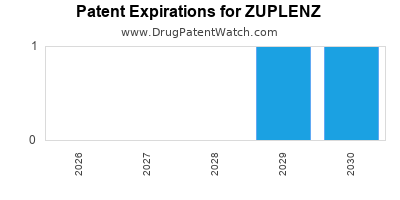
Public patent records associated with oral-film technology include patents assigned to or originating from MonoSol Rx and related film-platform entities. The relevant estate has historically included patents covering self-supporting oral films, film-forming compositions, and active pharmaceutical ingredient incorporation. Patent scope depends on claim language, terminal disclaimers, prosecution history, and any Orange Book listing for NDA 022524.
The key commercial limitation is age. ZUPLENZ was approved in 2010, so any original formulation patents are now mature or approaching the end of their ordinary patent terms. The product does not have the long remaining exclusivity period associated with a recently approved molecular entity.
What is the Orange Book status of ZUPLENZ?
The FDA Orange Book is the controlling source for current patent listings and regulatory exclusivity. NDA 022524 should be evaluated against the latest Orange Book edition for:
- Listed formulation patents;
- Patent expiration dates;
- Pediatric exclusivity;
- Whether any listed patents have been delisted;
- Whether approved product labeling contains protected method-of-use claims.
A patent’s existence does not establish a current barrier to generic entry. Only a listed patent with enforceable claims covering the proposed generic product or use creates a meaningful Paragraph IV litigation risk.
The publicly available product profile does not support treating ZUPLENZ as protected by an active new-chemical-entity exclusivity period. Any remaining protection is formulation-, method-, or manufacturing-related and must be assessed claim by claim.
When does ZUPLENZ lose exclusivity?
ZUPLENZ’s principal regulatory exclusivity period has expired. Ondansetron has been generic for many years, and generic tablets, orally disintegrating tablets, and oral solutions are widely available.
The commercial question is therefore not whether ondansetron is exclusive. It is whether the specific oral-film formulation retains patent protection or market access advantages that prevent direct film competition.
| Exclusivity category |
ZUPLENZ position |
| New chemical entity exclusivity |
Expired or not applicable to current commercial strategy |
| Orphan-drug exclusivity |
Not applicable |
| Pediatric exclusivity |
No current material barrier identified |
| Biosimilar exclusivity |
Not applicable |
| Formulation patents |
Potentially relevant, subject to current Orange Book and patent records |
| Method-of-use patents |
Potentially relevant, but likely limited against broad generic substitution |
| Generic ondansetron competition |
Established |
How many patents cover ZUPLENZ?
A precise count requires a current patent-family review tied to NDA 022524, product labeling, Orange Book listings, and continuation applications. A simple count of patents mentioning ondansetron or oral films would overstate the enforceable estate.
The commercially relevant categories are:
- Oral-film composition patents.
- Film manufacturing patents.
- Drug-loading and content-uniformity patents.
- Dissolution and taste-masking patents.
- Method-of-use patents covering antiemetic treatment.
Manufacturing patents can raise operational costs for a competing film product, but they usually do not block conventional ondansetron products. Their value is highest where they cover a necessary process rather than an optional production technique.
What formulation patents are important for ZUPLENZ?
The formulation moat is based on the practical requirements of an oral film:
- Mechanical integrity during handling;
- Rapid wetting and dissolution;
- Uniform ondansetron distribution;
- Taste acceptability;
- Stability under controlled storage;
- Packaging that protects the film from humidity;
- Consistent dose delivery at commercial scale.
These requirements create development and quality-control burdens. They do not necessarily create durable legal exclusivity. A competitor can design around one film composition by changing polymers, plasticizers, sweeteners, flavoring systems, film thickness, or manufacturing conditions.
The most valuable claims would cover a narrow combination that is difficult to reproduce without infringing. Broad claims to oral films are more vulnerable to prior-art challenges and design-around strategies because oral-film technology has been developed across multiple therapeutic categories.
Which companies challenge ZUPLENZ commercially?
The principal competitive threat comes from generic ondansetron manufacturers rather than from a direct oral-film rival.
| Competitor group |
Competitive product |
Threat level |
| Generic manufacturers |
Ondansetron tablets |
High |
| Generic manufacturers |
Ondansetron orally disintegrating tablets |
High |
| Generic manufacturers |
Ondansetron oral solution |
Moderate |
| Branded antiemetic companies |
Other 5-HT3 antagonists and antiemetics |
Moderate |
| Direct oral-film developers |
Ondansetron or alternative antiemetic films |
Unclear |
| Hospital and pharmacy purchasing groups |
Formulary substitution |
High |
Generic ondansetron products are generally cheaper and familiar to prescribers. Orally disintegrating tablets provide part of the same convenience benefit as ZUPLENZ, reducing the product’s differentiation.
What is the financial trajectory of ZUPLENZ?
ZUPLENZ product revenue is not separately reported in a consistent public series. The product has been included within the commercial portfolio of Midatech Pharma and its successor corporate structures, but public filings do not provide a reliable standalone revenue, gross-margin, or EBITDA history for ZUPLENZ.
The financial trajectory can therefore be assessed through market structure:
Commercial phase
ZUPLENZ entered a mature ondansetron market rather than a protected new-drug market. The initial commercial thesis depended on convenience, adherence, and use in patients who could not swallow tablets.
Portfolio phase
The product became one asset within a broader specialty-pharmaceutical portfolio. Portfolio owners have had to support commercial infrastructure, wholesaler access, reimbursement negotiations, pharmacovigilance, and inventory management despite the limited size of the addressable branded market.
Mature-product phase
The product’s economics are likely determined by:
- Net price after wholesaler and payer discounts;
- Prescription volume;
- Pharmacy benefit coverage;
- Hospital and oncology clinic adoption;
- Cost of film manufacturing;
- Working-capital requirements;
- Sales and marketing expense.
A mature product can remain cash-generative if manufacturing cost is low and commercial overhead is shared with other products. It becomes unattractive if prescription volume is low, reimbursement is inconsistent, or minimum manufacturing batches create inventory risk.
What revenue exposure does ZUPLENZ create for its owner?
ZUPLENZ appears to represent concentrated product risk rather than a major diversified revenue stream. Because the product is not a new molecular entity and does not command broad market exclusivity, revenue is vulnerable to:
- Generic substitution;
- Payer exclusion;
- Pharmacy-level therapeutic interchange;
- Price erosion;
- Competing orally disintegrating tablets;
- Discontinuation by wholesalers;
- Manufacturing interruptions.
No public filing establishes ZUPLENZ as a large percentage of a major pharmaceutical company’s consolidated revenue. For a smaller commercial-stage company, however, even modest ZUPLENZ revenue can be material to liquidity and operating leverage.
The key financial indicator is not absolute sales alone. It is contribution margin after product acquisition costs, manufacturing, distribution, regulatory maintenance, and sales expense.
What generic launch risks exist for ZUPLENZ?
A direct generic oral-film launch would face more technical complexity than a standard ondansetron tablet. The applicant would need to demonstrate pharmaceutical equivalence and bioequivalence under the applicable FDA requirements, while addressing film-specific attributes such as dissolution, content uniformity, packaging, and stability.
Generic entry risks include:
| Risk |
Effect on ZUPLENZ |
| Conventional ondansetron substitution |
Existing and persistent price pressure |
| Generic oral-film approval |
Direct erosion of differentiated positioning |
| Patent Paragraph IV filing |
Litigation cost and potential launch uncertainty |
| Formulation design-around |
Weakens reliance on platform patents |
| FDA manufacturing observations |
Can delay competitor entry but may also affect supply |
| Payer formulary exclusion |
Reduces prescription conversion |
| Wholesaler delisting |
Limits pharmacy availability |
A Paragraph IV challenge would be relevant only if an applicant certifies that a listed patent is invalid, unenforceable, or not infringed. Given the product’s age, any litigation would likely center on formulation or manufacturing claims rather than the ondansetron molecule.
What patent litigation and settlement agreements affect ZUPLENZ?
No major, currently material patent litigation or settlement agreement is established in the public record as a central driver of ZUPLENZ’s commercial outlook. The principal legal risk is prospective: a future applicant could challenge any remaining Orange Book-listed patent through a Paragraph IV certification.
Potential litigation outcomes include:
- Early generic entry under a settlement agreement.
- Entry after patent invalidation or non-infringement.
- Delayed entry until patent expiry.
- A court finding that the generic does not infringe.
- A negotiated license permitting launch on an agreed date.
Because ondansetron itself is off-patent, litigation would not preserve molecule-level exclusivity. It could protect only the specific dosage form, formulation, or approved use covered by an enforceable patent.
How strong is the ZUPLENZ patent estate?
The estate is best characterized as moderate-to-weak for broad commercial protection and potentially stronger for narrow manufacturing or formulation claims.
Strengths
- Oral-film manufacturing has technical barriers.
- A well-drafted formulation claim can impede an identical film product.
- Manufacturing know-how may be difficult to replicate quickly.
- Pediatric and dysphagia-oriented use cases support product differentiation.
Weaknesses
- Ondansetron is an established generic active ingredient.
- Conventional dosage forms remain close substitutes.
- Older oral-film patents face prior-art and obviousness challenges.
- Competitors can alter film polymers, excipients, dose loading, or process parameters.
- Patent protection does not prevent substitution with generic tablets.
The product’s commercial defense is therefore stronger as a combined formulation, manufacturing, and distribution platform than as a standalone patent monopoly.
How does ZUPLENZ compare with generic ondansetron?
| Factor |
ZUPLENZ |
Generic ondansetron |
| Active ingredient |
Ondansetron |
Ondansetron |
| Delivery system |
Oral soluble film |
Tablet, ODT, or solution |
| Water required |
No |
Usually no for ODT; often yes for tablets |
| Unit cost |
Generally higher |
Generally lower |
| Patent dependence |
Formulation and process |
Molecule largely off-patent |
| Patient differentiation |
Swallowing difficulty and convenience |
Broad access and low price |
| Payer position |
More vulnerable |
Usually preferred |
| Market growth |
Niche and access-driven |
Mature and price-driven |
ZUPLENZ can retain value in selected patients, but the product must overcome a substantial price and reimbursement disadvantage.
What is the geographic coverage of ZUPLENZ?
The principal commercial and regulatory relevance is in the United States. The product’s intellectual-property position may include foreign counterparts, but international value depends on country-specific patent expiry, marketing authorization, reimbursement, and local generic competition.
U.S. commercial performance should not be extrapolated directly to Europe or other markets. Oral-film uptake, prescription practices, hospital formularies, and reimbursement rules vary materially by jurisdiction.
Key Takeaways
- ZUPLENZ is an FDA-approved ondansetron oral soluble film under NDA 022524.
- Its differentiation is dosage-form convenience, not a novel mechanism or active ingredient.
- Generic ondansetron competition is established and remains the main commercial constraint.
- Product-specific revenue and profitability are not separately disclosed in public filings.
- The financial trajectory is likely that of a mature niche product with limited growth and high sensitivity to reimbursement and manufacturing economics.
- Any remaining patent value is concentrated in formulation, film manufacture, and related process claims.
- A Paragraph IV challenge would target listed formulation or manufacturing patents, not ondansetron itself.
- ZUPLENZ has no biosimilar risk because it is a small-molecule drug.
- Direct oral-film competition is less important than substitution by generic tablets and orally disintegrating tablets.
- The product’s strongest defense is an integrated combination of convenience, manufacturing know-how, distribution, and selected patient use cases.
FAQs About ZUPLENZ Market and Exclusivity
Is ZUPLENZ still available in the United States?
ZUPLENZ has an FDA-approved product history, but commercial availability depends on the current marketing and distribution status of the rights holder, wholesalers, and pharmacies.
Does ZUPLENZ have an active ingredient patent?
No meaningful active-ingredient exclusivity should be assumed. Ondansetron is a long-established generic molecule. Any relevant protection would be tied to the oral-film formulation, manufacturing process, or approved use.
Can a generic company make an ondansetron oral film?
Yes, subject to FDA approval and compliance with applicable patents. A generic applicant would need to address bioequivalence, film performance, content uniformity, stability, and packaging.
Is ZUPLENZ more effective than ondansetron tablets?
ZUPLENZ contains the same active ingredient as conventional ondansetron products. Its principal advantage is administration convenience, not a materially different pharmacologic effect.
What would most increase ZUPLENZ’s commercial value?
The strongest opportunities would be improved payer coverage, reliable pharmacy distribution, evidence supporting use in patients with swallowing difficulties, and lower manufacturing cost. A new patent on the active ingredient would not be available because ondansetron is an established molecule.
References
- U.S. Food and Drug Administration. (2010). ZUPLENZ (ondansetron hydrochloride) oral soluble film: Prescribing information and approval materials. NDA 022524.
- U.S. Food and Drug Administration. (n.d.). Approved drug products with therapeutic equivalence evaluations: Orange Book.
- U.S. Food and Drug Administration. (n.d.). Drugs@FDA: FDA-approved drugs database.
- Biodexa Pharmaceuticals PLC. (2023). Annual report and audited financial statements.
- Midatech Pharma PLC. (2022). Annual report and audited financial statements.
- U.S. Food and Drug Administration. (2023). Approved drug products with therapeutic equivalence evaluations: Electronic Orange Book data files.