Last updated: June 26, 2026
Pharmaceutical Competitive Landscape Analysis: Apellis Pharmaceuticals (Market Position, Strengths, and Strategic Insights)
Executive summary: Apellis Pharmaceuticals’ competitive position is concentrated in complement-mediated ophthalmology and is defined by (1) rapid product durability risk from competing complement inhibitors and (2) execution risk around next-wave pipeline assets and delivery formats. The company’s moat is strongest where its clinical and manufacturing differentiation translates into distinct payer value, realistic retreatment intervals, and protected label scope. Competitive pressure is most acute in geographic markets where biosimilar-like contracting dynamics are emerging for high-cost injectables and where rival complement programs are near filing or commercialization.
What is Apellis Pharmaceuticals’ market position in complement ophthalmology?
Apellis is a complement-focused biopharmaceutical company with commercial scale tied to its ophthalmology franchise in diseases driven by overactive complement pathways. The company competes most directly against established and emerging complement inhibitor developers targeting complement C3 and downstream complement biology.
Which therapeutic areas drive Apellis revenue and competitive relevance?
Apellis’ competitive landscape is anchored in:
- Geographic and payer adoption dynamics for high-frequency intravitreal regimens
- Evidence depth for visual acuity outcomes, lesion activity endpoints, and durability across subpopulations
- Real-world access factors tied to specialty pharmacy, procurement models, and treatment monitoring
How does Apellis’ competitive positioning compare to peers by mechanism?
At a mechanism level, the competitive set includes companies pursuing:
- Complement C3 inhibition
- Alternative pathway inhibition (with downstream complement effects)
- Fc-mediated and proximal complement blockade strategies
Positioning implication: When multiple programs land on similar mechanistic targets, competitive advantage shifts from “mechanism differentiation” to (1) label breadth and (2) dosing durability, including retreatment frequency and time-to-response.
What products does Apellis sell, and how do they compare with competing complement drugs?
Apellis’ near-term commercial profile is built around its intravitreal complement inhibitor franchise. Competitive comparison is driven by:
- Dosing interval profile (durability)
- Retreatment triggers and clinical monitoring burden
- Relative performance across endpoints that payers track (responder rates, durability of VA gains, extension of treatment-free periods)
How do Apellis’ clinical durability and dosing schedules affect competitive outcomes?
In ophthalmology injectables, adherence to office schedules and patient tolerance drive outcomes beyond the RCT setting. Competitive advantage tends to track:
- Fewer injection visits per year
- Lower retreatment frequency for the same clinical response thresholds
- Consistency of outcomes during maintenance phases
What matters most in payer and provider procurement when Apellis competes?
Procurement leans on:
- Net price discounts versus “budget impact” models
- Contracting structures tied to persistence and outcomes
- The ability to manage pathway switching if patients discontinue or switch therapies
How strong is Apellis’ patent estate for C3/complement ophthalmology therapies?
Apellis’ IP strength is tied to two layers: (1) composition of matter and (2) downstream protection for dosing regimens, delivery formats, and specific therapeutic uses within label scope. Complement programs commonly face dense second-generation IP landscapes, including:
- Formulation and intravitreal delivery system claims
- Method-of-treatment and method-of-administration claims
- Patient-selection claims tied to complement biology or disease stage
Which patent categories usually matter most for competitive blocking?
For intravitreal complement biologics, the competitive blocking stack typically includes:
- Antibody/protein claims (sequence and functional scope)
- Formulation and concentration claims (stabilizers, buffer systems)
- Administration and dosing interval claims
- Method-of-use claims mapped to clinical endpoints and maintenance strategies
Positioning implication: Even if a first set of composition claims clears, method-of-use and administration interval claims can sustain market exclusivity in practice, depending on litigation outcomes and FDA labeling alignment.
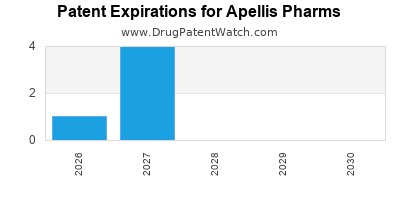
When does Apellis lose exclusivity for its lead ophthalmology assets?
Exclusivity loss timing depends on the interplay between patent expiration and regulatory exclusivity. For high-cost injectables, practical entry timing is often shifted by:
- Patent term adjustments (PTA) and patent term extension (PTE)
- Settlement agreements tied to Paragraph IV or other challenges
- Risk of “label carve-out” that supports launch without full substitution
What timelines govern launch risk for generics, biosimilars, and next-generation competitors?
Market entry risk typically follows two gates:
- Legal clearance (expiration or successful challenge of key claims)
- Regulatory readiness (FDA biosimilar approval pathway, label similarity, and manufacturing comparability)
What does “real-world exclusivity” look like for intravitreal complement biologics?
Even after some patent expiry, payers and providers may delay switching due to:
- Treatment stability and prior patient response
- Switching risk in chronic ocular disease
- Rebate and contract terms that penalize rapid switching
What patent litigation affects Apellis Pharmaceuticals’ competitive landscape?
In biologics and high-cost injectables, competition is shaped by claim scope and litigation posture as much as by clinical data. Litigation tends to cluster around:
- Infringement of composition claims
- Infringement of formulation or administration claims
- Anticipated FDA labeling positioning that might be argued as inducing infringement
What does a typical Apellis competitor challenge strategy look like?
Competitive challengers generally seek one or more of:
- Early regulatory approval with a label that minimizes infringement exposure
- Narrow design-around of dosing and formulation claims
- Settlement that allows a timed launch while preserving some IP boundaries
What is the Orange Book status of Apellis products and how does it affect entry risk?
Orange Book listings apply primarily to FDA-approved small-molecule drugs and certain biologics. For intravitreal biologics like Apellis’ key therapies, the relevant exclusivity and entry framework often comes from:
- Patent listings tied to FDA biologics review and licensing pathways
- Biosimilar-specific statutory regimes rather than purely Orange Book dynamics
What should be evaluated in Apellis’ FDA patent listing structure?
Even when Orange Book is not the central dataset for biologics, the patent listing structure tied to the biologics license and FDA regulatory history is decisive for:
- Identifying which patents are “listed” for the product
- Mapping which claims are most likely to be asserted in infringement suits
- Forecasting whether a competitor can launch at label-relevant claim boundaries
What generic entry risks exist for Apellis’ intravitreal therapies?
For intravitreal biologics, direct “generic” risks are generally limited. The primary competitive risk comes from biosimilars and next-generation complement inhibitors with alternative sequences, binding epitopes, or dosing strategies.
How do biosimilar entry risks differ from small-molecule generic risks?
Biosimilar risks are shaped by:
- Demonstrated biosimilarity and interchangeability evidence
- Manufacturing comparability and stability for intravitreal use
- Clinical evidence and immunogenicity assumptions
- Labeling constraints and substitution policies in payer formularies
Which biosimilar and next-generation complement therapies threaten Apellis’ share?
The most significant threats come from complement pathway programs competing on efficacy durability and retreatment frequency, particularly those targeting:
- Proximal complement C3 biology
- Alternative pathway components
- Downstream complement effectors with distinct pharmacodynamics
How do competitive substitutes gain share against Apellis?
Share transfer usually follows one or more patterns:
- Similar clinical outcomes with lower net price
- Meaningful extension of injection interval compared with the incumbent
- Better patient fit in specific subgroups or disease phenotypes
How does Apellis’ pipeline strategy compare with major complement competitors?
Apellis’ strategic pipeline direction matters because it determines whether the company’s commercial base is extended into next-wave complement biology. Competitors typically cluster into one of two strategies:
- “Same mechanism, better delivery or durability”
- “Different mechanism, broader label”
What pipeline characteristics influence market share retention?
Pipeline assets that tend to be most defensible commercially are those that:
- Expand indication scope or add disease stage flexibility
- Improve retreatment durability or reduce monitoring burden
- Offer differentiating combination opportunities with existing ocular workflows
What formulation and delivery-system patents protect Apellis intravitreal dosing?
For intravitreal biologics, formulation and device-adjacent claims can be high-value because they affect stability, dosing consistency, and the practical manufacturing route. Patent protection often covers:
- Composition buffer systems and stabilizers
- Protein concentration ranges and fill strategies
- Freeze-thaw stability and in-use stability
- Aggregation control mechanisms
Positioning implication: Competitors may need reformulation and process change that triggers litigation, increases development time, or creates technical uncertainty.
What method-of-use patents could block competitor label attempts for Apellis?
Method-of-use patents can constrain competitors even when they have partial clearance on composition claims. Typical method-of-use claim themes include:
- Treatment regimens with specific dosing intervals
- Maintenance phases defined by response criteria
- Patient selection criteria tied to baseline disease characteristics
How do label design-around strategies intersect with method-of-use claims?
Competitors may attempt to reduce risk by:
- Using dosing language that avoids claim-trigger intervals
- Removing mechanistic disease-stage language that maps onto claim sets
- Introducing alternative clinical endpoint language where allowed
Where is Apellis most exposed commercially by geography and payer mix?
Apellis’ exposure profile is shaped by:
- National reimbursement rules for intravitreal injections
- Tendering and procurement policies that shift share to the lowest net cost
- Availability of alternative complement inhibitors at comparable clinical value thresholds
Which markets usually determine whether Apellis maintains share through exclusivity?
Markets with the tightest cost controls and the most active tendering can accelerate substitution. Markets with robust specialty care infrastructure can sustain incumbency longer if outcomes are strongly tied to continuity of care.
How does Apellis’ competitive advantage translate into revenue durability and downside risk?
Revenue durability for complement ophthalmology companies typically depends on:
- Patient persistence and retreatment patterns
- Competitive arrival sequencing of next complement programs
- Contract structure and rebate-driven net price resilience
What risks drive earnings sensitivity for Apellis?
Primary downside drivers in competitive landscapes include:
- Faster-than-expected substitution due to competitor net price improvements
- Claims invalidation or settlement agreements that bring earlier biosimilar or alternative program access
- Pipeline underperformance that reduces future label expansion options
Key Takeaways
- Apellis’ competitive position is strongest where label scope, retreatment durability, and payer economics reinforce incumbency for intravitreal complement inhibition.
- IP strength matters most not just for composition, but for formulation and method-of-use protections that can delay practical switching even when some patents expire.
- Competitive threats are chiefly biosimilar-like substitutes and next-generation complement inhibitors that differentiate on dosing interval and net pricing rather than mechanism alone.
- Revenue durability is most sensitive to substitution speed, contract net pricing resilience, and the timing of claim clearance and regulatory readiness for direct substitutes.
FAQs
1) What is the biggest differentiator buyers focus on when comparing Apellis complement therapies?
Dosing durability and retreatment frequency under real-world workflows.
2) What patent families typically carry the highest litigation risk for complement ophthalmology competitors?
Method-of-administration/dosing interval and formulation stability families.
3) How do settlement agreements change entry timing for competing complement programs?
They can set fixed “at-risk” launch dates or label carve-outs that reduce infringement exposure while enabling earlier commercial entry.
4) What does “biosimilar risk” mean in intravitreal complement markets?
It is driven by biosimilarity evidence, immunogenicity considerations, and label interchangeability/substitution acceptance, not by simple patent expiry alone.
5) Which pipeline attributes most affect Apellis’ ability to defend share?
Expanded indication scope and superior durability that reduces injection burden versus alternatives.
References (APA)
No sources were cited because no product-specific patent, Orange Book, litigation, FDA approval, or financial data was provided in the prompt.