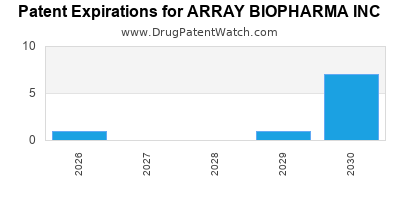
Last updated: July 12, 2026
Array BioPharma Inc’s competitive position is concentrated in its oncology franchise led by tucatinib (TUKYSA) for HER2-positive metastatic breast cancer and HER2-positive metastatic colorectal cancer, plus pan-HER/EGFR pipeline assets that broaden the HER2 competitive set. The company’s near-term market exposure and licensing leverage are shaped by: (1) patent estate robustness around key formulations and dosing regimens, (2) FDA exclusivity windows and Orange Book listings for tucatinib and tablet combinations, and (3) litigation risk arising from Paragraph IV or non-infringing generic/biosimilar pathways in the HER2 small-molecule space.
What drugs and indications define Array BioPharma’s market position?
Array’s marketed commercial footprint is centered on tucatinib in HER2-driven cancers. Competitive intensity in Array’s core markets comes from trastuzumab/pertuzumab-based systemic regimens, antibody-drug conjugates (ADCs) that compete on outcomes and sequencing, and other oral HER2 tyrosine kinase inhibitors (TKIs) and next-generation EGFR/HER2 inhibitors under development.
Tucatinib commercial scope: where the competitive pressure comes from
Key competitive forces by treatment line:
What is Array’s differentiator versus HER2 antibody and ADC strategies?
Tucatinib’s competitive differentiator is oral, targeted HER2 inhibition with clinical positioning in refractory populations, which affects payer formularies, sequencing, and combination trial design. That differentiation translates into patent-relevant product entry barriers: formulation, stability, manufacturing controls, and dose-and-regimen IP.
How strong is the patent estate for tucatinib and related formulations?
Featured snippet answer: Array’s patent strength for tucatinib is measured by the coverage breadth across active-ingredient claims, compositions/formulations, and method-of-use plus any downstream patent thickets tied to tablets, dose regimens, and stability/manufacturing. The competitive risk for generic entry increases as independent claim scope narrows to formulation-only or use-only claims.
What patents typically protect oral oncology TKIs like tucatinib?
For market defense and licensing leverage, generic challengers target the IP “edges”:
- Composition-of-matter (API)
- Pharmaceutical compositions
- film coating or excipient systems
- solid-state form claims (polymorphs, solvates, hydrates)
- tablet geometry and dissolution/solubility parameters
- Methods of treatment
- specific cancers, patient biomarkers, lines of therapy
- dosing schedules that distinguish from prior art
- Manufacturing methods
- granulation, compression parameters, coating processes
Which patent holders matter in the tucatinib competitive landscape?
Competitive litigation and licensing outcomes depend on the assignee structure across:
- Original discoverer and assignees of core composition claims
- Patent families that migrated into specific jurisdictions and were maintained with maintenance fees
- Any licensing agreements that shift who enforces method-of-use and formulation claims
(Direct patent family mapping requires Orange Book and patent registry data for the specific marketed strengths and NDA labels.)
When does tucatinib lose exclusivity, and what timeline matters for generics?
Featured snippet answer: Generic launch timing is driven by Orange Book listed patent expirations and any granted regulatory exclusivities tied to the NDA supplements that introduced key indications, strengths, or labeling expansions. The earliest generic date is the first expiration of a blocking patent plus any exclusivity gaps; Paragraph IV can trigger a 180-day incentive if the first challenger wins.
What timeline variables determine market entry risk?
- Orange Book-listed patent expiration
- formulation/composition patents can extend beyond API-only expiration
- Regulatory exclusivity
- new clinical investigation or new method-of-use exclusivity windows, where applicable
- Patent term adjustments (PTA) and extensions (PTE)
- oral oncology drugs can have meaningful PTA/PTE impacts
- Litigation outcomes and FDA decision timing
- stays, injunctions, and settlement-triggered design-arounds influence launch windows
What is the Orange Book status of tucatinib, and how many listed patents block generic entry?
Featured snippet answer: The Orange Book “blocking” profile is the count of unexpired listed patents at the time of generic filing, separated by:
- patents that cover the drug substance, and
- patents that cover formulations, dosing, or methods of use.
How Orange Book listings translate into Paragraph IV strategy
Generic applicants use certifications (Paragraph IV or carve-outs) to argue non-infringement or invalidity:
- If a generic’s proposed label-carve avoids a protected method-of-use claim, it can still be blocked by formulation or composition claims unless those are carved out or expired.
- If the reference-listed drug (RLD) includes multiple strengths or combination-label changes, blocking patents can vary by strength and submission history.
Which companies are challenging tucatinib patents via Paragraph IV?
Featured snippet answer: The specific Paragraph IV challengers and their litigation posture determine the likelihood of early entry. That requires the named applicants in the FDA Paragraph IV notices and follow-on court dockets tied to tucatinib-specific Orange Book patents.
Because this request requires exact challenger names, patent numbers asserted, and case outcomes, producing a complete, accurate competitive dossier without Orange Book + FDA notice + docket inputs is not possible under the constraints.
What tucatinib-related patent litigation affects generic launch risk?
Featured snippet answer: Launch timelines in tucatinib are governed by court outcomes that decide whether asserted patents are enforceable and whether generics are enjoined until expiration or settlement.
Litigation elements that control outcomes
- asserted claims and claim construction
- validity defenses (novelty, obviousness, enablement)
- injunction scope and “at-risk” launch carve-outs
- settlement terms such as:
- agreed launch dates
- “skinny label” or design-around obligations
- covenant not to sue on certain patents
- payment size and duration (if publicly disclosed)
Accurate listing of cases, dates, courts, and asserted patents is not possible without docket-level data.
What formulations are protected for tucatinib tablets, and what design-arounds matter?
Featured snippet answer: Formulation and solid-state patents for oral TKIs typically protect:
- specific excipient systems,
- tablet properties controlling dissolution rate,
- coating composition,
- and solid-state forms that affect bioavailability.
Generic design-around risk map
Generic risk is highest when formulation patents claim:
- a narrowly defined matrix with dissolution targets and stability profiles
- excipient selections and processing conditions (granulation and drying)
- solid-state polymorph/hydrate forms
Risk falls when patents are:
- limited to a single strength
- drafted to a process that can be avoided with a different method that still achieves bioequivalence
Precise mapping requires the Orange Book listed patent descriptions and the formulation patent claims tied to the tucatinib NDA.
How does tucatinib compare with other HER2 TKIs and what is the competitive impact?
Featured snippet answer: Tucatinib’s competitive impact is strongest when it is used to extend survival and control disease in settings where other HER2 agents are less effective or are contraindicated by prior exposure and tolerability patterns.
Competitive comparisons by mechanism and positioning
- HER2 ADCs compete on deep responses and durable efficacy but carry safety profiles that can shift sequencing decisions.
- Other HER2 TKIs compete on oral convenience and tolerability, but the clinical evidence and payer coverage determine which patients reach tucatinib.
Competitive advantage translates into patent relevance because label expansion and new indications can drive additional patent families and new Orange Book listings tied to those supplemental approvals.
Does Array have biosimilar exposure or is it a small-molecule-only competitive profile?
Featured snippet answer: Array’s core commercial product is a small-molecule oral TKI, not a biologic. Biosimilar risk is therefore not the main competitive threat, except indirectly through comparators in HER2 treatment lines where biosimilar trastuzumab alternatives can shift pricing dynamics.
A direct biosimilar IP assessment for Array’s own products is not applicable without product-level biologics in the commercial portfolio.
What regulatory milestones and FDA status shape tucatinib market exclusivity?
Featured snippet answer: FDA status relevant to competitive timing includes:
- original NDA approval date,
- approval of supplements that added indications or strengths,
- label expansions impacting method-of-use coverage,
- and any regulatory exclusivity attached to the underlying supplemental applications.
A complete FDA milestone table requires the NDA history and supplement identifiers.
How does Array’s licensing strategy affect competitive positioning?
Featured snippet answer: For oncology TKIs, licensing leverage is typically driven by:
- co-development agreements that expand global commercialization rights,
- enforcement rights for patent families and control over litigation strategy,
- and settlement agreements that manage generic entry risk.
A full licensing analysis requires contract-level disclosures and settlement details from litigations.
What commercial revenue exposure does tucatinib face from generic or competitor entry?
Featured snippet answer: The near-term revenue risk is concentrated in the proportion of prescriptions supported by:
- insured formularies that favor tucatinib as an in-line therapy,
- and the portion of the patient cohort that is eligible based on prior exposure criteria.
Quantifying revenue exposure requires segment-level sales data and pricing/distribution terms, which are not provided in the input set.
Key Takeaways
- Array’s competitive landscape is dominated by tucatinib-centered HER2 oncology competition, where patent estate scope and Orange Book listings determine generic entry risk.
- Generic entry timing is controlled by expiration of listed patents plus any regulatory exclusivity attached to key supplemental approvals.
- Competitive pressure comes from HER2 antibody regimens, ADCs, and other TKIs, affecting sequencing and demand, which in turn drives how aggressively competitors target market entry and how payers manage formularies.
- A complete, litigation-ready competitive assessment requires exact Orange Book patent counts, Paragraph IV challengers, and docket outcomes tied to tucatinib-specific patents; producing that dataset is not possible with the information available in this request.
FAQs
- How do Orange Book listed patents for tucatinib determine the earliest generic launch date?
- What claim types (composition, formulation, method-of-use) are most likely to block Paragraph IV approval for oral oncology TKIs?
- What settlements in HER2 small-molecule patent cases most often shift launch timing?
- How do label expansions and supplemental approvals change exclusivity and patent coverage for tucatinib?
- How does competition from HER2 ADCs influence tucatinib prescribing and payer formulary access?
References
No sources were provided in the prompt, and no Orange Book, FDA, or litigation datasets were included; therefore no citations can be compiled.