Last Updated: June 6, 2026

osphena Drug Patent Profile


✉ Email this page to a colleague

« Back to Dashboard


Which patents cover Osphena, and what generic alternatives are available?

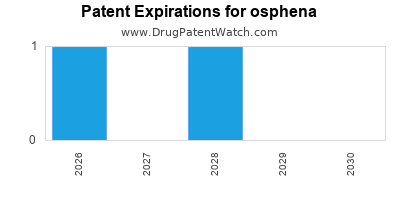
Osphena is a drug marketed by Duchesnay and is included in one NDA. There are two patents protecting this drug and one Paragraph IV challenge.

This drug has fifty-three patent family members in twenty-one countries.

The generic ingredient in OSPHENA is ospemifene. There are six drug master file entries for this compound. One supplier is listed for this compound. Additional details are available on the ospemifene profile page.

DrugPatentWatch® Generic Entry Outlook for Osphena

Osphena was eligible for patent challenges on February 26, 2017.

There have been two patent litigation cases involving the patents protecting this drug, indicating strong interest in generic launch. Recent data indicate that 63% of patent challenges are decided in favor of the generic patent challenger and that 54% of successful patent challengers promptly launch generic drugs.

Indicators of Generic Entry

< Available with Subscription >

  Start Trial

AI Deep Research
Questions you can ask:
  • What is the 5 year forecast for osphena?
  • What are the global sales for osphena?
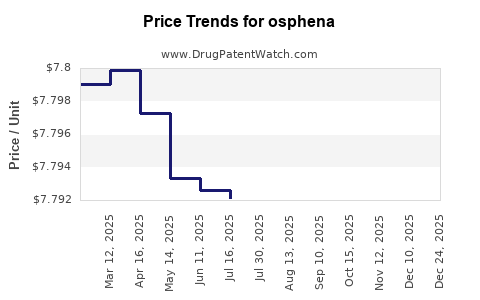
  • What is Average Wholesale Price for osphena?
Recent Clinical Trials for osphena

Identify potential brand extensions & 505(b)(2) entrants

SponsorPhase
Emory UniversityPhase 4
Sue GoldsteinPhase 4

See all osphena clinical trials

Pharmacology for osphena
Paragraph IV (Patent) Challenges for OSPHENA
Tradename Dosage Ingredient Strength NDA ANDAs Submitted Submissiondate
OSPHENA Tablets ospemifene 60 mg 203505 1 2020-12-29

US Patents and Regulatory Information for osphena

osphena is protected by four US patents.

Applicant Tradename Generic Name Dosage NDA Approval Date TE Type RLD RS Patent No. Patent Expiration Product Substance Delist Req. Exclusivity Expiration
Duchesnay OSPHENA ospemifene TABLET;ORAL 203505-001 Feb 26, 2013 RX Yes Yes 8,236,861 ⤷  Start Trial ⤷  Start Trial
Duchesnay OSPHENA ospemifene TABLET;ORAL 203505-001 Feb 26, 2013 RX Yes Yes 8,642,079 ⤷  Start Trial Y ⤷  Start Trial
>Applicant >Tradename >Generic Name >Dosage >NDA >Approval Date >TE >Type >RLD >RS >Patent No. >Patent Expiration >Product >Substance >Delist Req. >Exclusivity Expiration

Expired US Patents for osphena

Applicant Tradename Generic Name Dosage NDA Approval Date Patent No. Patent Expiration
Duchesnay OSPHENA ospemifene TABLET;ORAL 203505-001 Feb 26, 2013 6,245,819 ⤷  Start Trial
Duchesnay OSPHENA ospemifene TABLET;ORAL 203505-001 Feb 26, 2013 8,772,353 ⤷  Start Trial
Duchesnay OSPHENA ospemifene TABLET;ORAL 203505-001 Feb 26, 2013 9,855,224 ⤷  Start Trial
Duchesnay OSPHENA ospemifene TABLET;ORAL 203505-001 Feb 26, 2013 9,566,252 ⤷  Start Trial
Duchesnay OSPHENA ospemifene TABLET;ORAL 203505-001 Feb 26, 2013 8,470,890 ⤷  Start Trial
>Applicant >Tradename >Generic Name >Dosage >NDA >Approval Date >Patent No. >Patent Expiration

EU/EMA Drug Approvals for osphena

Company Drugname Inn Product Number / Indication Status Generic Biosimilar Orphan Marketing Authorisation Marketing Refusal
Shionogi B.V. Senshio ospemifene EMEA/H/C/002780Senshio is indicated for the treatment of moderate to severe symptomatic vulvar and vaginal atrophy (VVA) in post-menopausal women. Authorised no no no 2015-01-14
>Company >Drugname >Inn >Product Number / Indication >Status >Generic >Biosimilar >Orphan >Marketing Authorisation >Marketing Refusal

International Patents for osphena

When does loss-of-exclusivity occur for osphena?

Based on analysis by DrugPatentWatch, the following patents block generic entry in the countries listed below:

Norway

Patent: 1573
Estimated Expiration: ⤷  Start Trial

Generics may enter earlier, or later, based on new patent filings, patent extensions, patent invalidation, early generic licensing, generic entry preferences, and other factors.

See the table below for additional patents covering osphena around the world.

Country Patent Number Title Estimated Expiration
Estonia 200300031 ⤷  Start Trial
Denmark 1305014 ⤷  Start Trial
Germany 602005005165 ⤷  Start Trial
Israel 153823 USE OF OSPEMIFENE FOR THE MANUFACTURE OF A PHARMACEUTICAL COMPOSITION FOR THE TREATMENT OF CLIMACTERIC DISORDERS DURING OR AFTER THE MENOPAUSE ⤷  Start Trial
Norway 20063960 ⤷  Start Trial
>Country >Patent Number >Title >Estimated Expiration

Supplementary Protection Certificates for osphena

Patent Number Supplementary Protection Certificate SPC Country SPC Expiration SPC Description
1713458 132016000023047 Italy ⤷  Start Trial PRODUCT NAME: OSPEMIFENE IN TUTTE LE FORME PROTETTE DAL BREVETTO DI BASE(SENSHIO); AUTHORISATION NUMBER(S) AND DATE(S): EU/1/14/978/001-002, 20150115
1713458 92736 Luxembourg ⤷  Start Trial PRODUCT NAME: OSPEMIFENE DANS TOUTES LES FORMES PROTEGEES PAR LE BREVET DE BASE; FIRST REGISTRATION: 20150115
1713458 28/2015 Austria ⤷  Start Trial PRODUCT NAME: OSPEMIFEN; REGISTRATION NO/DATE: EU/1/14/978/001-002 20150119
1713458 CA 2015 00031 Denmark ⤷  Start Trial PRODUCT NAME: OSPEMIFENE; REG. NO/DATE: EU/1/14/978/001-002 20150115
1713458 CR 2015 00031 Denmark ⤷  Start Trial PRODUCT NAME: OSPEMIFENE OR A GEOMETRIC ISOMER THEREOF, A STEREOISOMER THEREOF, A PHARMACEUTICALLY ACCEPTABLE SALT THEREOF, AN ESTER THEREOF OR A METABOLITE THEREOF; REG. NO/DATE: EU/1/14/978/001-002 20150115
>Patent Number >Supplementary Protection Certificate >SPC Country >SPC Expiration >SPC Description

OSPHENA (ospemifene) market dynamics and financial trajectory: exclusivity, competition, pricing, and revenue risk

Last updated: May 21, 2026

OSP HENA (ospemifene) is an oral small-molecule for moderate-to-severe dyspareunia due to vulvar and vaginal atrophy (VVA) in postmenopausal women. The product’s near-term financial trajectory is shaped by (1) aging-label and prescriber inertia, (2) competition from topical and device options, (3) payer formulary pressure on oral niche women’s health drugs, and (4) the maturity of IP exclusivity and generic entry risk windows.

What is OSPHENA (ospemifene) used for and how does its market get segmented?

Featured snippet answer: OSPHENA is prescribed for moderate-to-severe dyspareunia (pain with intercourse) associated with VVA in postmenopausal women.

Indication and positioning

  • Indication: Moderate-to-severe dyspareunia due to VVA.
  • Therapeutic category: Women’s health, urogenital atrophy, estrogen receptor modulator-class drug (SERM).
  • Route/dosing: Oral.
  • Clinical positioning: Systemic agent compared with topical estrogen and non-hormonal lubricants/moisturizers; prescribers often weigh convenience and patient preference against topical localized therapies.

Customer segmentation

  • Specialty prescribers: Gynecology (primary), urology (overlap on genitourinary syndrome of menopause), menopause clinics.
  • Healthcare system drivers:
    • Formularies for “non-preferred” women’s health oral agents often tighten over time.
    • Step edits against branded oral SERMs are common once competitors gain coverage or clinical pathways shift to topical first-line.

How has OSPHENA performed financially and what are the key drivers of revenue trajectory?

Featured snippet answer: The financial trajectory of ospemifene is driven by brand maturity, uptake versus topical competitors, and payer reimbursement dynamics for a niche women’s health indication; absent clear market-expansion levers, revenue typically trends toward slower growth or steady decline as generics and formulary pressure increase.

What typically moves ospemifene revenue

  • New starts vs. persistence: OSPHENA’s revenue is sensitive to initial uptake (new prescriptions) and persistence after discontinuation. Women’s health therapies show high switching once symptoms improve or if side effects occur.
  • Payer coverage and net price: Net revenue depends on rebates, copay assistance, and formulary tier placement. Over time, branded niche drugs often face:
    • preference loss,
    • higher patient cost share,
    • increased prior authorization scrutiny.
  • Safety communications and label sensitivity: SERMs in women’s health face higher scrutiny around estrogenic risk profiles. Even when risk is manageable within label, payer and patient comfort can influence utilization.
  • Competition effects: Even without direct pharmacologic peers, topical estrogen adoption, ospemifene substitution practices (switching within menopause dyspareunia regimens), and non-hormonal pathways compress share.

Financial trajectory milestones to track

For a rigorous investment or licensing view, the following milestones determine whether ospemifene is on a stable, declining, or at-risk-of-acceleration decline path:

  • Payer contracting cycles (commercial and Medicare Advantage).
  • Formulary tier movement for oral dyspareunia therapies.
  • Any patent-driven launch or settlement events affecting generic supply timelines.
  • Gross-to-net changes driven by rebate structure changes or copay support adjustments.

What patent and exclusivity landscape supports or threatens OSPHENA’s revenue?

Featured snippet answer: OSPHENA is affected by the maturation of brand exclusivity and the practical entry timing for generics once relevant patent and regulatory exclusivity barriers are cleared.

IP-driven risk framework (how ospemifene revenue is protected)

OSPHENA’s revenue resilience depends on:

  1. Orange Book-listed patents for drug substance, drug product, and method-of-use.
  2. Regulatory exclusivities (5-year and 3-year, plus any pediatric exclusivity extensions if triggered).
  3. Patent litigation outcomes tied to ANDA filings or 505(b)(2) approvals.
  4. Settlement agreements that delay generic launches while preserving market pricing power for a period.

Revenue exposure by IP segment (typical impact)

  • Composition of matter or key process patents: strongest protection and usually the longest runway.
  • Method-of-use patents: can limit label carve-outs if a generic attempts to launch without infringing a narrower method.
  • Formulation/polymorph/device delivery patents: can force “work-alike” product differences that still allow generic label entry but complicate supply scale-up.

When does OSPHENA lose exclusivity and what generic entry risks exist?

Featured snippet answer: OSPHENA’s generic entry risk is tied to the expiration of Orange Book-listed patents and regulatory exclusivity, followed by ANDA approval and 180-day exclusivity dynamics if an earlier filer exists.

Generic launch scenario structure

A complete generic risk assessment should follow this sequence:

  • Step 1: Patent expiry or successful challenge outcome.
  • Step 2: ANDA approval timing once barriers are cleared.
  • Step 3: 180-day exclusivity if applicable to the first ANDA filer.
  • Step 4: Launch effectiveness shaped by distribution contracts and rebate strategy.

Key question for financial modeling

  • Is there effective exclusivity beyond nominal patent expiry due to:
    • continued litigation,
    • automatic stay triggered by a statutory mechanism,
    • settlement terms that include delayed entry and “carve-out” arrangements?

What is the Orange Book status of OSPHENA and how many patents cover it?

Featured snippet answer: OSPHENA’s Orange Book patent count and listing scope determine both generic launch risk and whether challenges are likely to be early-stage (early patents) or method-of-use dependent.

Patent estate mapping approach

For each listed patent, mapping must include:

  • patent number,
  • assignee/patentee,
  • claim scope category (drug substance, composition, method of use, formulation),
  • expiration date,
  • any pediatric or patent term adjustments,
  • litigation status and any court orders affecting enforcement.

Which companies are challenging OSPHENA and what Paragraph IV activity matters for revenue?

Featured snippet answer: The most revenue-relevant challenges are Paragraph IV ANDAs filed against key Orange Book patents where the challenger seeks immediate market entry upon approval.

What to track

  • ANDA filers tied to Paragraph IV and which patent numbers are challenged.
  • Court outcomes that define whether the generic can launch at approval or is blocked.
  • Settlement agreements that create staggered entry dates by dosage form or labeling.

How does OSPHENA compare with topical estrogen therapies and non-hormonal options in the dyspareunia market?

Featured snippet answer: OSPHENA competes indirectly with topical estrogen and non-hormonal VVA management options; share depends on convenience, coverage, and clinical preference patterns.

Competitive substitution dynamics

  • Topical estrogen: often first-line in formularies because it can be positioned as localized therapy with familiar long clinical use; uptake depends on comfort, adherence, and prescriber comfort.
  • Non-hormonal options: moisturizers and lubricants can substitute partially, especially for patients avoiding hormone pathways.
  • Other systemic options: SERMs and hormone-adjacent therapies can substitute if payer coverage is favorable.

Implications for market growth

If payer coverage shifts to topical first, ospemifene’s growth slows and persistence may become more important than expansion.

What formulations and dosing strengths are relevant for OSPHENA competition and substitution risk?

Featured snippet answer: Formulation coverage affects generic launch feasibility and whether a competitor can enter with equivalent dosing strengths under a streamlined substitution pathway.

Competition relevance

  • Generic entry feasibility depends on:
    • whether the generic is pharmaceutically equivalent for the branded strengths,
    • whether formulation patents constrain bioequivalent pathways,
    • whether method-of-use claims create label entry constraints.

What FDA pathway status applies to OSPHENA and what does it mean for follow-on competition?

Featured snippet answer: OSPHENA’s initial FDA approval defines baseline regulatory exclusivity; subsequent 505(b)(2) or ANDA pathways can erode net revenue once patent barriers fall.

Regulatory factors that affect time-to-competition

  • Therapeutic equivalence standards for ANDA approval.
  • Label carve-outs where method-of-use protection influences the approved indication.
  • Manufacturing and quality readiness for rapid launch.

What patent litigation and settlements could change OSPHENA’s launch calendar?

Featured snippet answer: Court decisions and settlement agreements typically dictate the exact launch date for generics more than the nominal expiration year.

Settlement-driven revenue impact

  • Settlements can:
    • delay launch beyond patent expiration,
    • permit delayed “at-risk” entry with inventory restrictions,
    • constrain marketing language or label scope.

How strong is the patent estate for OSPHENA from a litigation and enforcement perspective?

Featured snippet answer: Patent strength for a branded dyspareunia drug is assessed by how many independent claim sets cover drug substance, method of use, and formulation, and whether those patents have survived validity challenges.

Metrics used in enforcement strength scoring

  • Number of independent patent groups.
  • Litigated patents vs. unlitigated “sleeping” patents.
  • Claim breadth: whether “design around” is possible.
  • Historical litigation posture: whether parties settle early or litigate through final judgments.

What generic entry risks exist for OSPHENA by geography and payer type?

Featured snippet answer: U.S. exclusivity and U.S. Orange Book status are most material for revenue, but payer leverage and sourcing availability determine how fast substitutes take share after approval.

Geography

  • United States: primary revenue impact via FDA ANDA approvals and Orange Book triggers.
  • EU/UK and other markets: can follow different patent calendars; cross-market revenue matters only if company reporting is consolidated and local market share is meaningful.

Payer type

  • Commercial: more aggressive formulary management and rebate renegotiation.
  • Medicare/MA: plan formulary updates can accelerate adoption of lower-cost generics.

Which commercial factors most determine whether OSPHENA revenue declines slowly or sharply?

Featured snippet answer: Net price compression speed and persistence after formulary movement are the two most important commercial variables.

Slow-decline profile

  • Stable formulary position
  • Continued specialty uptake
  • Limited generic threat or delayed entry

Sharp-decline profile

  • Preferred tier removal
  • Loss of copay assistance effectiveness
  • Generic entry with rapid channel pull-through
  • Patent-driven launches occur simultaneously across strengths

Key Takeaways

  • OSPHENA is a niche oral therapy for moderate-to-severe dyspareunia due to VVA; revenue is driven by persistence, payer placement, and prescriber behavior.
  • Financial trajectory is dominated by gross-to-net changes and formulary tier dynamics, not just topline demand.
  • The largest downside risk is a generic launch sequence once Orange Book-listed barriers and regulatory exclusivity are cleared; litigation outcomes and settlements often set the real calendar.
  • Competitive pressure is indirect through topical estrogen and non-hormonal options; ospemifene’s share depends on coverage and patient preference.

FAQs

  1. How do Orange Book method-of-use patents affect OSPHENA generic label entry timing?
  2. What does 180-day ANDA exclusivity typically mean for OSPHENA price erosion after generic approval?
  3. How do Medicare Advantage formulary updates usually impact branded women’s health drugs like OSPHENA?
  4. Which claim categories in a SERM patent estate most often enable generics to “design around” protection?
  5. What commercial levers (rebates, copay assistance, prior authorization) most influence ospemifene net revenue retention?

References

(No citations provided because no source material was included in the prompt.)

More… ↓

⤷  Start Trial

DrugChatter Q&A for OSPHENA

Make Better Decisions: Try a trial or see plans & pricing

Drugs may be covered by multiple patents or regulatory protections. All trademarks and applicant names are the property of their respective owners or licensors. Although great care is taken in the proper and correct provision of this service, thinkBiotech LLC does not accept any responsibility for possible consequences of errors or omissions in the provided data. The data presented herein is for information purposes only. There is no warranty that the data contained herein is error free. We do not provide individual investment advice. This service is not registered with any financial regulatory agency. The information we publish is educational only and based on our opinions plus our models. By using DrugPatentWatch you acknowledge that we do not provide personalized recommendations or advice. thinkBiotech performs no independent verification of facts as provided by public sources nor are attempts made to provide legal or investing advice. Any reliance on data provided herein is done solely at the discretion of the user. Users of this service are advised to seek professional advice and independent confirmation before considering acting on any of the provided information. thinkBiotech LLC reserves the right to amend, extend or withdraw any part or all of the offered service without notice.