Last updated: August 12, 2026
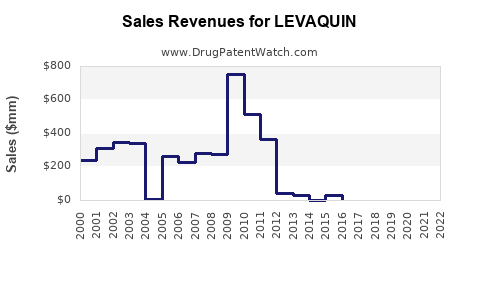
Levaquin, the brand name for levofloxacin, moved from a high-revenue branded antibiotic to a mature generic product after loss of US market exclusivity. Johnson & Johnson’s Janssen generated more than $1 billion in annual global sales at the product’s peak, but revenue declined sharply after generic entry and later regulatory restrictions on fluoroquinolone use. The current commercial market is driven by low-cost generic tablets, injections, and ophthalmic products rather than by the Levaquin brand.
What is Levaquin and how is it used?
Levaquin is the US brand name for levofloxacin, a fluoroquinolone antibacterial agent. It inhibits bacterial DNA gyrase and topoisomerase IV and was approved by the FDA in December 1996 under NDA 020634 (FDA, 2016).
The product was marketed in several dosage forms:
| Dosage form |
Typical commercial use |
| Oral tablets |
Respiratory, urinary tract, skin, and other bacterial infections |
| Oral solution |
Patients unable to take tablets |
| Intravenous injection |
Hospital and acute-care treatment |
| Ophthalmic solution |
Marketed separately as ophthalmic levofloxacin products |
Levaquin was positioned as a broad-spectrum treatment for community-acquired pneumonia, acute bacterial sinusitis, complicated urinary tract infections, pyelonephritis, skin infections, and other susceptible bacterial infections. Its commercial value came from broad prescribing across hospitals, primary care, emergency medicine, and outpatient settings.
FDA safety communications later narrowed the product’s commercial profile. In 2016, the FDA warned that systemic fluoroquinolones could cause disabling and potentially permanent adverse effects involving tendons, muscles, joints, nerves, and the central nervous system. The agency recommended reserving systemic fluoroquinolones for certain uncomplicated infections when alternative treatments were available (FDA, 2016).
How did Levaquin’s financial trajectory develop?
Levaquin became one of Janssen’s major pharmaceutical products during the 2000s. Public Johnson & Johnson filings reported annual worldwide sales in excess of $1 billion before generic competition materially eroded the brand.
Levaquin historical commercial trajectory
| Period |
Commercial position |
Financial effect |
| 1996-2000 |
US launch and formulary adoption |
Revenue ramp-up |
| 2001-2006 |
Expansion across outpatient and hospital indications |
Strong branded sales |
| 2007-2009 |
Mature blockbuster phase |
Approximately $1 billion-plus annual sales |
| 2010-2011 |
Patent expiry and generic competition |
Rapid price and volume erosion |
| 2012 onward |
Generic-dominated market |
Limited brand value |
| 2016 onward |
Fluoroquinolone safety restrictions and stewardship pressure |
Lower utilization in several indications |
Johnson & Johnson’s annual reports identified Levaquin as a significant contributor to pharmaceutical revenue before loss of exclusivity. The company disclosed a sharp sales decline around the period when generic levofloxacin entered the US market and patent protection ended (Johnson & Johnson, 2010, 2011).
The financial decline had two components:
- Unit-price compression from generic substitution.
- Lower prescribing volume after safety warnings, stewardship policies, and the availability of competing antibiotics.
The brand’s decline was therefore more severe than a conventional patent-cliff event. Generic entry reduced price, while clinical and regulatory factors reduced demand.
When did Levaquin lose exclusivity?
Levaquin’s principal US patent protection expired around the end of 2010, after patent-term adjustment or extension associated with the regulatory review period. The principal compound patent commonly associated with levofloxacin was US Patent No. 5,053,407, assigned to Daiichi Seiyaku and related entities.
Key US exclusivity milestones
| Event |
Date or period |
| FDA approval of Levaquin |
December 20, 1996 |
| New chemical entity exclusivity |
Approximately through December 2001 |
| Principal patent protection |
Extended into 2010 |
| Generic levofloxacin competition |
Emerged before or around the 2010 loss-of-exclusivity period |
| Brand erosion |
Accelerated from 2010 onward |
The exact commercial timing depended on the applicant, dosage form, Paragraph IV certifications, litigation outcomes, and authorized or settlement-based launch rights. The Orange Book, rather than the original approval date alone, controls the relevant listed-patent analysis for an ANDA applicant (FDA, 2024).
What patents protected Levaquin?
Levaquin’s historical patent estate centered on the levofloxacin active ingredient and related pharmaceutical compositions. The principal patent was:
| Patent |
Subject matter |
Historical relevance |
| US 5,053,407 |
Levofloxacin-related quinolone compound technology |
Core composition-of-matter protection |
| Related formulation and process rights |
Pharmaceutical compositions and manufacturing technology |
Potential secondary protection |
The commercial strength of the original estate came from composition-of-matter protection rather than from late-stage formulation patents. Once the core patent barrier expired, generic manufacturers could compete using the same active ingredient in equivalent dosage forms.
Secondary patents can delay generic entry when they cover a distinct formulation, dosage regimen, crystalline form, manufacturing process, or delivery system. For Levaquin, those secondary rights did not preserve a durable branded monopoly after the core patent expired.
What was the Orange Book status of Levaquin?
Levaquin was listed in the FDA Orange Book as an NDA product with patent information associated with its approved dosage forms. After the relevant patents expired, generic applicants could rely on the abbreviated new drug application pathway and establish bioequivalence rather than repeat full clinical efficacy trials (FDA, 2024).
The Orange Book remained commercially important for:
- Identifying listed patents submitted by the NDA holder.
- Tracking patent expiry dates.
- Reviewing ANDA certifications.
- Assessing Paragraph IV litigation risk.
- Determining potential 30-month stays.
- Evaluating dosage-form-specific generic entry.
The current Orange Book significance of Levaquin is primarily historical. It provides the framework explaining how generic levofloxacin reached the market, but it does not support a meaningful remaining US exclusivity position for the original brand.
Which companies challenged Levaquin patents?
Generic competition came from multiple manufacturers, including large US and international generic companies. Publicly reported generic participants included companies such as Teva Pharmaceuticals, Mylan, Sandoz, Watson Pharmaceuticals, and other ANDA sponsors, depending on the dosage form and market.
Paragraph IV challenges were commercially important because they allowed generic applicants to contest patent validity, enforceability, or infringement before the listed patents reached their stated expiry dates. The Hatch-Waxman framework permitted the first successful Paragraph IV applicant to receive 180 days of generic exclusivity in relevant circumstances (FDA, 2024).
For Levaquin, the practical result was a staged erosion process:
- Patent challenges created a pathway for early generic launch.
- Litigation and settlement terms determined the launch date for individual applicants.
- Additional ANDA approvals increased supply.
- Generic substitution rapidly reduced the branded price and market share.
What generic entry risks affected Levaquin?
Levaquin faced high generic entry risk because the product had several characteristics that favor rapid substitution:
- Small-molecule active ingredient.
- Well-established clinical profile.
- Oral solid dosage form.
- Straightforward bioequivalence pathway.
- Multiple potential manufacturing sources.
- Limited need for complex delivery technology.
- Strong pharmacy substitution incentives.
- Hospital purchasing based on price and formulary contracts.
The main entry barriers were regulatory compliance, manufacturing validation, sterile production for injectable products, and quality-system requirements. Those barriers could delay individual manufacturers but did not protect the brand from market-wide generic competition.
Generic launch scenarios
| Scenario |
Expected effect |
| One first-to-file generic |
Initial price decline, temporary concentration |
| Several tablet manufacturers |
Rapid substitution and steep price compression |
| Injectable competition |
Hospital contract erosion and tender pressure |
| Ophthalmic competition |
Separate product-level competition |
| Supply disruption |
Temporary price increases without restoring brand power |
The commercial distinction between dosage forms mattered. Tablets generally experienced the fastest generic substitution. Injectable products carried higher manufacturing and quality requirements. Ophthalmic levofloxacin competed in a related but separate market with different prescribing and purchasing dynamics.
How did FDA safety actions affect Levaquin demand?
The FDA’s boxed-warning and labeling actions materially affected systemic fluoroquinolone utilization. In 2008, the FDA required a boxed warning regarding tendinitis and tendon rupture. In 2016, it strengthened warnings regarding disabling adverse reactions and advised that systemic fluoroquinolones should generally be reserved for selected situations when alternatives were unsuitable (FDA, 2008, 2016).
These actions affected Levaquin through:
- Reduced use for uncomplicated sinusitis and urinary tract infections.
- Greater physician preference for narrower-spectrum antibiotics.
- Hospital antimicrobial stewardship restrictions.
- Increased review of patient-specific risk factors.
- Lower willingness to prescribe fluoroquinolones when alternatives existed.
The safety profile did not eliminate levofloxacin from the market. It remained relevant for serious infections, resistant organisms, hospital treatment, pneumonia, selected urinary infections, and situations involving limited therapeutic alternatives. The warnings did reduce the addressable market and made a branded premium difficult to sustain.
What is the current market structure for levofloxacin?
The current US market is generic-led. Levaquin no longer has the commercial characteristics of a branded blockbuster. Generic levofloxacin is supplied by multiple manufacturers, with competition occurring through pharmacy benefit managers, wholesalers, hospital group purchasing organizations, and public-sector tenders.
Current competitive landscape
| Segment |
Competitive basis |
| Oral tablets |
Lowest acquisition cost, supply reliability, pharmacy substitution |
| Intravenous injection |
Hospital contracts, sterile manufacturing, shortages |
| Ophthalmic products |
Prescriber preference, formulary placement, product availability |
| Branded Levaquin |
Limited residual value and weak pricing power |
| Alternative antibiotics |
Safety, resistance profile, spectrum, and stewardship policies |
Competitors are not limited to other fluoroquinolones. Levofloxacin competes with macrolides, beta-lactams, tetracyclines, trimethoprim-sulfamethoxazole, cephalosporins, and newer agents for selected indications. Treatment selection increasingly depends on resistance patterns, safety, local guidelines, and antimicrobial stewardship.
Are there biosimilar risks for Levaquin?
No. Levaquin is a small-molecule drug, not a biologic. Biosimilar regulation does not apply. Competitive entry occurs through the generic drug pathway under section 505(j) of the Federal Food, Drug, and Cosmetic Act.
The relevant risks are generic substitution, price competition, supply concentration, manufacturing inspections, drug shortages, and reduced utilization from safety restrictions. A biosimilar-style interchangeability dispute is not relevant to levofloxacin.
What manufacturing and intellectual-property barriers remain?
Levofloxacin has limited residual intellectual-property protection for the original branded product. The principal commercial barriers are operational:
- Compliance with current good manufacturing practices.
- Control of impurities and degradation products.
- Consistent active pharmaceutical ingredient supply.
- Sterile manufacturing for intravenous products.
- Container-closure and stability validation.
- FDA inspection readiness.
- Reliable supply during low-margin pricing conditions.
Process patents or formulation patents may still affect particular manufacturers or products in some jurisdictions. Those rights do not recreate the broad exclusivity once provided by the original composition patent.
Geographic protection also differs. US patent expiry does not establish the expiry date in Europe, Japan, China, or other markets. Each jurisdiction requires separate review of national patent filings, supplementary protection certificates, pediatric extensions, regulatory exclusivities, and local generic approvals.
What licensing deals affected Levaquin?
Levaquin was developed and commercialized through the Daiichi Sankyo and Johnson & Johnson pharmaceutical relationship. Janssen marketed the product in the United States, while Daiichi Sankyo retained an important role in the underlying compound and global rights structure.
The commercial relevance of the alliance was greatest during the branded period. After generic entry, licensing economics became less important because the active ingredient was broadly available and the original branded product lost pricing power. Public financial disclosures do not identify a current material Levaquin licensing stream.
What patent litigation and settlements affected Levaquin?
Levaquin faced the standard Hatch-Waxman litigation pattern associated with a high-value small-molecule product. ANDA filers could submit Paragraph IV certifications, prompting patent litigation by the NDA holder or patent owner. Settlements could provide a generic company with a defined launch date before full patent expiry.
The principal commercial questions in any Levaquin settlement were:
- Whether the generic could launch before the patent expiry date.
- Whether the launch was authorized or at risk.
- Whether the first filer received a period of exclusivity.
- Whether multiple generic manufacturers could enter simultaneously.
- Whether the agreement created antitrust concerns.
By the end of the principal patent term, litigation no longer supported a durable branded market. Generic entry converted the dispute from a patent-access issue into a price and supply competition issue.
How strong is the Levaquin patent estate today?
The historical estate was strong while composition-of-matter protection remained enforceable. Its current strength as a commercial barrier is low.
| Patent-estate factor |
Assessment |
| Core active-ingredient protection |
Expired |
| Generic pathway |
Established |
| Formulation protection |
Limited commercial impact |
| Manufacturing barriers |
Relevant for injectables, but not brand-protective |
| Biosimilar protection |
Not applicable |
| Residual brand pricing power |
Minimal |
| Geographic variation |
Possible, jurisdiction-specific |
The key distinction is between historical patent strength and current strategic value. Levaquin generated substantial revenue because the core compound was protected during a period of broad clinical use. The same patent estate has little ability today to prevent generic competition in the United States.
What is the revenue exposure and investment outlook?
The revenue exposure associated with Levaquin is primarily historical. Johnson & Johnson no longer depends on the product as a major growth driver. Any remaining branded sales are unlikely to have material influence on the company’s consolidated financial trajectory.
For generic manufacturers, the opportunity is volume-based and operationally sensitive. Margins depend on:
- Number of approved suppliers.
- Wholesale acquisition price.
- Contracting concentration.
- API costs.
- Manufacturing complexity.
- Product shortages.
- Hospital tender dynamics.
- Regulatory compliance costs.
The market has limited potential for premium pricing. A manufacturer could achieve temporary pricing gains during a shortage, but sustained returns are constrained by the mature generic structure and clinical pressure against unnecessary fluoroquinolone use.
Key Takeaways
- Levaquin is the branded formulation of levofloxacin, a small-molecule fluoroquinolone antibiotic.
- The product generated more than $1 billion in annual global sales during its branded peak.
- The core US patent estate expired around the 2010 loss-of-exclusivity period.
- Generic levofloxacin caused steep price and market-share erosion.
- FDA safety warnings and antimicrobial stewardship reduced systemic fluoroquinolone demand.
- No biosimilar pathway applies; competition occurs through ANDAs and generic substitution.
- Current commercial value is concentrated in low-cost generic tablets, injections, and ophthalmic products.
- The remaining barriers are manufacturing, regulatory, and supply-chain barriers rather than broad blocking patents.
- Levaquin has low current brand value and limited ability to support premium pricing or material licensing revenue.
FAQs
Is Levaquin still sold in the United States?
Generic levofloxacin remains widely available in the United States. The original Levaquin brand has little current commercial importance compared with generic products.
Did Levaquin have orphan-drug exclusivity?
No. Levaquin was approved for common bacterial infections and did not depend on orphan-drug exclusivity.
Can a generic manufacturer launch levofloxacin without clinical trials?
Generally, yes. An ANDA applicant can rely on the reference product’s safety and efficacy findings while demonstrating pharmaceutical equivalence and bioequivalence.
Does levofloxacin face antibiotic-resistance pricing pressure?
Yes. Resistance surveillance and stewardship policies restrict use in some settings. At the same time, resistance can preserve demand for levofloxacin when clinicians need a fluoroquinolone-active option.
Is Levaquin more commercially exposed to generic competition than a biologic antibiotic?
Yes. Levaquin is a small molecule with a conventional ANDA pathway. Biologic antibiotics can face more complex manufacturing, interchangeability, and biosimilar-development barriers.
References
-
Food and Drug Administration. (2008). FDA requires boxed warning for fluoroquinolone antibacterial drugs. U.S. Department of Health and Human Services.
-
Food and Drug Administration. (2016). FDA updates warnings for oral and injectable fluoroquinolone antibiotics due to disabling side effects. U.S. Department of Health and Human Services.
-
Food and Drug Administration. (2016). Levaquin prescribing information. U.S. Department of Health and Human Services.
-
Food and Drug Administration. (2024). Approved drug products with therapeutic equivalence evaluations, commonly known as the Orange Book. U.S. Department of Health and Human Services.
-
Johnson & Johnson. (2010). 2010 annual report. Johnson & Johnson.
-
Johnson & Johnson. (2011). 2011 annual report. Johnson & Johnson.
-
United States Patent and Trademark Office. (1991). U.S. Patent No. 5,053,407: Quinolone carboxylic acid derivatives. U.S. Department of Commerce.