Last updated: June 28, 2026
Boniva (ibandronate) market dynamics and financial trajectory (revenue, uptake, and exclusivity-driven risk)
Boniva (ibandronate) has shifted from an expansion phase into a mature, price- and volume-constrained bisphosphonate market dominated by generic and multisource supply in major geographies. The financial trajectory is driven by (1) patent and exclusivity wind-down for branded entry, (2) substitution pressure from generics and alternative osteoporosis therapies (denosumab and oral/IV bisphosphonates), and (3) payer and guideline dynamics that favor agents with stronger comparative outcomes or dosing convenience.
What is the market size and demand drivers for Boniva (ibandronate) in osteoporosis?
Boniva treats osteoporosis in postmenopausal women, with clinical use anchored to fracture risk reduction and dosing schedules that affect adherence and persistence. Demand is shaped by the osteoporosis drug adoption curve, screening and diagnosis rates, and payer coverage rules.
Core demand drivers
- Higher prevalence of postmenopausal osteoporosis and fragility fractures.
- Clinician preference for regimens with dosing convenience (Boniva’s monthly oral and quarterly IV schedules historically aligned to adherence goals).
- Payer formularies that place bisphosphonates as cost-effective first-line options when no contraindications exist.
- Persistence: dosing schedule impacts long-term use; discontinuation risk is a key determinant of revenue stability in mature segments.
Key channel dynamics
- High generic substitution once exclusivity ends.
- Shift of branded sales into smaller niches where prescribers remain comfortable with a specific dosing option or where formulary positioning persists.
How has Boniva’s financial trajectory evolved after branded peak and generic competition?
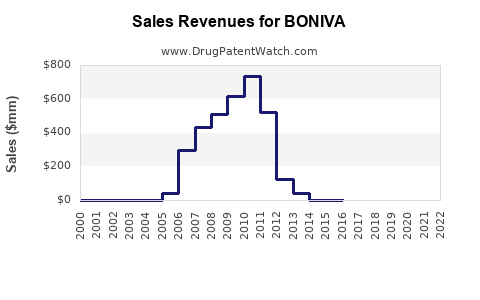
Boniva’s branded revenue profile typically follows a pattern seen across branded osteoporosis drugs: peak performance during exclusivity, then rapid volume decline as generics enter, followed by stabilization at lower price levels.
Branded-to-generic lifecycle pattern (what it means for financial trajectory)
- Revenue compression: branded unit volume falls as multisource supply expands; net price declines via payer rebates and wholesale acquisition cost reductions.
- Mix change: remains more durable in settings where dosing convenience or IV administration workflows keep a subset of patients on ibandronate.
- Share reallocation: competing therapies take incremental share, especially when payer policy supports higher-cost agents with favorable benefit-risk profiles.
What investors and licensing teams should watch in Boniva’s trajectory
- Absolute prescription volume trends versus net sales (price vs volume separation).
- Formulary tier movement and utilization management changes (prior authorization, step edits).
- Patient adherence metrics tied to monthly oral versus quarterly IV utilization.
- Regional differences: generic launch timing and rebates vary by geography.
When did Boniva lose exclusivity and how does that drive revenue decline?
Exclusivity is the main inflection point for branded bisphosphonates. Once branded market protections end, generic ibandronate erodes pricing power.
Exclusivity and patenting dynamics that typically govern Boniva revenue
- Orange Book-listed patents (composition, formulation, and method-of-use) determine the timeline for Paragraph IV leverage and generic launch eligibility.
- Any additional protections for specific dosing regimens can delay full substitution, but the overall market often transitions quickly once core composition protections expire.
Revenue impact mechanism
- Generic entry triggers:
- formulary substitution
- increased pharmacist switching
- rebate compression on branded products
- lower wholesale prices and pressure on patient out-of-pocket costs
How many patents protect Boniva and what do they cover (composition, formulation, and method of use)?
Boniva’s patent estate historically covered multiple layers:
- Composition of matter for ibandronate (and salt forms where applicable).
- Formulations that enable dosing schedules and bioavailability targets.
- Method-of-use claims covering treatment of osteoporosis and fracture-risk reduction in specific patient populations.
Why patent count alone is not enough
- The subset of patents that appear in the FDA Orange Book and are tied to specific NDCs governs generic entry timing and litigation leverage.
- Method-of-use and formulation patents can create litigation risk for specific generic candidates, even after composition protections expire, depending on how the Orange Book is structured and how generics design around claims.
What is the Orange Book status of Boniva (ibandronate) and how does it affect generic entry?
Orange Book status determines:
- which patents are listed for each NDC
- the “trigger dates” for potential generic filings
- whether generic applicants can file an ANDA with Paragraph IV certifications
Practical impact
- If fewer, narrow patents remain for a particular dosage form (e.g., monthly oral versus IV), generic entry can occur in phases.
- If multiple formulation or dosing regimen patents are listed for the same NDC, the branded holder can extend exclusivity through litigation and settlements.
Which generic and biosimilar competitors pressure Boniva sales?
Boniva is a small-molecule bisphosphonate; biosimilar risk is not the primary competitive threat. The main competitive pressure is from:
- generic ibandronate oral tablets
- generic ibandronate IV products (where approved and supplied)
- alternative osteoporosis therapies with different mechanisms
Competitive substitution
- Denosumab (prolia) has competed through dosing convenience (every 6 months) and payer acceptance.
- Other bisphosphonates (alendronate, risedronate, zoledronic acid) compete on cost and outcomes data.
- Therapy sequencing and guideline updates can reduce incremental share for ibandronate.
What Paragraph IV challenges and patent litigations affect Boniva generic launch timing?
Paragraph IV challenges are the key pathway to accelerate generic entry against Orange Book-listed patents. The litigation pattern typically follows:
- branded holder files suit after the Paragraph IV notice
- court timelines can delay launch pending injunctions
- settlements can shift entry dates without full adjudication
Revenue effect
- Litigation delays can protect branded sales temporarily, but once generic substitution is allowed, the branded business often transitions to a low-share, low-price equilibrium.
How does Boniva compare with denosumab and other bisphosphonates on market access and payer behavior?
Payer behavior in osteoporosis is driven by:
- comparative cost-effectiveness
- coverage rules and step edits
- drug persistence and adherence data at the plan level
Competitive comparison channels
- Cost: bisphosphonates usually price favorably relative to denosumab, supporting first-line coverage.
- Convenience: dosing interval impacts adherence; payer policies may promote agents with fewer administration burdens.
- Clinical fit: contraindications for oral bisphosphonates (GI intolerance, esophageal disorders, ability to remain upright) can steer patients toward IV bisphosphonates or denosumab, shaping regional sales mix.
What financial metrics best track Boniva’s trajectory (prescriptions, net sales, price, and persistence)?
For decision-grade monitoring, track:
- net sales for branded Boniva versus total ibandronate category
- prescriptions by route (oral monthly vs IV quarterly)
- average net price trends (or list price as a proxy where net is not published)
- persistence rates post-initiation (time to discontinuation)
- channel inventory signals (wholesale demand and destocking patterns)
Interpretation
- Falling prescriptions indicate true demand loss.
- Stable prescriptions with falling net price indicates reimbursement and rebate pressure, not market shrinkage.
How do settlement agreements and licensing deals influence Boniva’s market dynamics?
Settlements can:
- define launch dates by dosage form and strength
- allocate territory coverage or products
- establish design-around terms (e.g., manufacturing processes, excipients, or dosing presentation)
Business impact
- Settlements can delay generic entry and preserve branded revenue through specific dates.
- After settlement expiration, price declines often reassert quickly as competing ANDAs launch.
What manufacturing and formulation/IP barriers exist for generic Boniva?
Manufacturing/IP barriers relevant to a tablet or IV product include:
- stability and bioavailability targets that support label claims
- validation of dissolution and impurity profiles for oral products
- sterility assurance, container closure systems, and process controls for IV products
- process claims or formulation-specific patents that can delay approval or trigger litigation
Market effect
- Even when ANDA eligibility is achieved, technical barriers can delay commercialization and fragment supply timing.
What geographic differences matter for Boniva revenue exposure (US vs EU vs key markets)?
Boniva’s market dynamics differ across regions due to:
- patent and litigation schedules
- generic launch timing
- payer formularies and pricing frameworks
- reimbursement rules for osteoporosis care and fracture-risk assessment programs
US-centric note
- In the US, Orange Book listing and ANDA/Paragraph IV litigation largely determine the path and speed of erosion of branded sales.
EU-centric note
- EU market entry timing depends on national approvals, SPC landscapes (where applicable), and local generic substitution norms.
What is the competitive landscape for Boniva across dosing routes (oral vs IV)?
Oral monthly
- typically more exposed to generic substitution because dosing and patient workflows are straightforward.
- persistence depends on GI tolerability, adherence to dosing instructions, and clinician education.
IV quarterly
- exposed to substitution where IV supply is available, but administration and infusion center workflows can slow switching.
- channel relationships and therapeutic inertia can support more stable utilization even post-exclusivity.
How strong is the patent estate for Boniva and how does it affect risk for brand holders?
Patent estate strength is measured by:
- breadth of independent claims
- linkage to FDA-listed NDCs
- litigation outcomes and likelihood of injunctions
- remaining term across the dosing routes
Commercial implication
- Stronger estates can delay generic entry and preserve pricing.
- Narrow or non-NDC-linked patents tend to have less effect on near-term market erosion.
What generic entry risks exist for Boniva and when could launches accelerate?
Generic entry risk is highest when:
- multiple Orange Book patents remain unaddressed by generics’ design-around strategies
- litigation is in early stages with uncertain injunction outcomes
- a settlement agreement ends and a pathway opens to immediate launch
Revenue consequence
- Brands often see a sharp step down around allowed launch dates, followed by ongoing incremental share losses as marketing and rebates adjust.
Key Takeaways
- Boniva’s market dynamics are dominated by the small-molecule osteoporosis bisphosphonate lifecycle: branded pricing power declines after exclusivity as generics enter and payers push substitution.
- Financial trajectory is driven by (1) patent and exclusivity wind-down, (2) payer formulary positioning and rebate compression, and (3) competition from denosumab and other bisphosphonates with favorable adherence and access profiles.
- Route-level dynamics matter: oral monthly tends to erode faster with substitution, while IV quarterly can retain utilization longer due to administration workflows and therapeutic inertia.
- The practical determinant of revenue timing is Orange Book-linked patent and litigation outcomes for the specific NDCs/dosage strengths, which govern ANDA and Paragraph IV acceleration risk.
FAQs
- How quickly do generic ibandronate prescriptions replace branded Boniva after launch permission?
- Do osteoporosis guidelines recommend ibandronate first-line, and how does that affect Boniva utilization?
- Which patient contraindications most commonly shift use from oral Boniva to IV bisphosphonates or denosumab?
- What NDC or dosage form factors most influence Orange Book patent exposure for Boniva?
- How do infusion center formularies and administration protocols change IV ibandronate substitution timing?
References (APA)
- FDA. Orange Book: Approved Drug Products with Therapeutic Equivalence Evaluations. U.S. Food and Drug Administration. https://www.accessdata.fda.gov/scripts/cder/daf/
- FDA. Drugs@FDA. U.S. Food and Drug Administration. https://www.accessdata.fda.gov/scripts/cder/daf/index.cfm