You're using a free limited version of DrugPatentWatch: Upgrade for Complete Access

Last Updated: March 26, 2026

ZOLEDRONIC Drug Patent Profile


✉ Email this page to a colleague

« Back to Dashboard


Which patents cover Zoledronic, and what generic alternatives are available?

Zoledronic is a drug marketed by Gland, Accord Hlthcare, Actavis Inc, Amneal, Apotex, Avet Lifesciences, Bpi Labs, Breckenridge, Chartwell Rx, Dr Reddys, Dr Reddys Labs Ltd, Epic Pharma Llc, Eugia Pharma, Fresenius Kabi Usa, Hikma Farmaceutica, Hospira, Hospira Inc, Inforlife, Meitheal, Mylan Labs Ltd, Novast Labs, Sagent Pharms Inc, Shilpa, Sun Pharma Global, and USV. and is included in thirty-nine NDAs.

The generic ingredient in ZOLEDRONIC is zoledronic acid. There are twenty-five drug master file entries for this compound. Twenty-two suppliers are listed for this compound. Additional details are available on the zoledronic acid profile page.

DrugPatentWatch® Litigation and Generic Entry Outlook for Zoledronic

A generic version of ZOLEDRONIC was approved as zoledronic acid by DR REDDYS LABS LTD on March 4th, 2013.

  Start Trial

AI Deep Research
Questions you can ask:
  • What is the 5 year forecast for ZOLEDRONIC?
  • What are the global sales for ZOLEDRONIC?
  • What is Average Wholesale Price for ZOLEDRONIC?
Drug patent expirations by year for ZOLEDRONIC
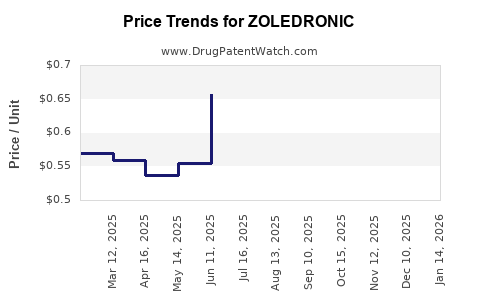
Drug Prices for ZOLEDRONIC

See drug prices for ZOLEDRONIC

Recent Clinical Trials for ZOLEDRONIC

Identify potential brand extensions & 505(b)(2) entrants

SponsorPhase
National Taiwan University HospitalPHASE4
National Taiwan University Hospital, Yun-Lin BranchPHASE4
University of FloridaPHASE1

See all ZOLEDRONIC clinical trials

Pharmacology for ZOLEDRONIC
Drug ClassBisphosphonate

US Patents and Regulatory Information for ZOLEDRONIC

Applicant Tradename Generic Name Dosage NDA Approval Date TE Type RLD RS Patent No. Patent Expiration Product Substance Delist Req. Exclusivity Expiration
Mylan Labs Ltd ZOLEDRONIC ACID zoledronic acid INJECTABLE;INTRAVENOUS 205254-001 Oct 27, 2017 AP RX No No ⤷  Start Trial ⤷  Start Trial ⤷  Start Trial
Inforlife ZOLEDRONIC ACID zoledronic acid INJECTABLE;INTRAVENOUS 202828-001 Sep 23, 2013 AP RX No No ⤷  Start Trial ⤷  Start Trial ⤷  Start Trial
Novast Labs ZOLEDRONIC ACID zoledronic acid INJECTABLE;INTRAVENOUS 208968-001 Feb 19, 2020 DISCN No No ⤷  Start Trial ⤷  Start Trial ⤷  Start Trial
Meitheal ZOLEDRONIC ACID zoledronic acid INJECTABLE;INTRAVENOUS 213371-001 Jun 5, 2023 AP RX No No ⤷  Start Trial ⤷  Start Trial ⤷  Start Trial
Gland ZOLEDRONIC zoledronic acid INJECTABLE;INTRAVENOUS 205749-001 Jun 29, 2018 AP RX No Yes ⤷  Start Trial ⤷  Start Trial ⤷  Start Trial
Eugia Pharma ZOLEDRONIC ACID zoledronic acid INJECTABLE;INTRAVENOUS 209125-001 Dec 8, 2017 DISCN No No ⤷  Start Trial ⤷  Start Trial ⤷  Start Trial
Hikma Farmaceutica ZOLEDRONIC ACID zoledronic acid INJECTABLE;INTRAVENOUS 202182-001 Jun 3, 2013 AP RX No No ⤷  Start Trial ⤷  Start Trial ⤷  Start Trial
>Applicant >Tradename >Generic Name >Dosage >NDA >Approval Date >TE >Type >RLD >RS >Patent No. >Patent Expiration >Product >Substance >Delist Req. >Exclusivity Expiration

EU/EMA Drug Approvals for ZOLEDRONIC

Company Drugname Inn Product Number / Indication Status Generic Biosimilar Orphan Marketing Authorisation Marketing Refusal
Accord Healthcare S.L.U. Zoledronic Acid Accord zoledronic acid EMEA/H/C/002667Prevention of skeletal related events (pathological fractures, spinal compression, radiation or surgery to bone, or tumour-induced hypercalcaemia) in adult patients with advanced malignancies involving bone.Treatment of adult patients with tumour-induced hypercalcaemia (TIH). Authorised yes no no 2014-01-16
Actavis Group PTC ehf   Zoledronic acid Actavis zoledronic acid EMEA/H/C/002488Prevention of skeletal-related events (pathological fractures, spinal compression, radiation or surgery to bone, or tumour-induced hypercalcaemia) in adult patients with advanced malignancies involving bone.Treatment of adult patients with tumour-induced hypercalcaemia. Authorised yes no no 2012-04-20
Mylan Pharmaceuticals Limited Zoledronic acid Mylan zoledronic acid EMEA/H/C/002482Prevention of skeletal related events (pathological fractures, spinal compression, radiation or surgery to bone, or tumour-induced hypercalcaemia) in adult patients with advanced malignancies involving bone;treatment of adult patients with tumour-induced hypercalcaemia (TIH). Authorised yes no no 2012-08-23
Pfizer Europe MA EEIG Zoledronic Acid Hospira zoledronic acid EMEA/H/C/0023654 mg / 5 ml and 4 mg / 100 ml:Prevention of skeletal-related events (pathological fractures, spinal compression, radiation or surgery to bone, or tumour-induced hypercalcaemia) in adult patients with advanced malignancies involving bone.Treatment of adult patients with tumour-induced hypercalcaemia (TIH).5 mg / 100 ml:Treatment of osteoporosis:in post-menopausal women;in men;at increased risk of fracture, including those with a recent low-trauma hip fracture.Treatment of osteoporosis associated with long-term systemic glucocorticoid therapy:in post-menopausal women;in men;at increased risk of fracture.Treatment of Paget's disease of the bone in adults. Authorised yes no no 2012-11-19
Teva B.V. Zoledronic acid Teva zoledronic acid EMEA/H/C/002439Prevention of skeletal-related events and treatment of tumour-induced hypercalcaemia. Authorised yes no no 2012-08-16
Sandoz Pharmaceuticals d.d. Aclasta zoledronic acid EMEA/H/C/000595Treatment of osteoporosis:, , , in post-menopausal women;, in men;, , , at increased risk of fracture, including those with a recent low-trauma hip fracture., , Treatment of osteoporosis associated with long-term systemic glucocorticoid therapy in post-menopausal women and in men at increased risk of fracture., , Treatment of Paget's disease of the bone., Authorised no no no 2005-04-15
Phoenix Labs Unlimited Company Zometa zoledronic acid EMEA/H/C/000336Prevention of skeletal related events (pathological fractures, spinal compression, radiation or surgery to bone, or tumour-induced hypercalcaemia) in patients with advanced malignancies involving bone;treatment of tumour-induced hypercalcaemia (TIH);prevention of skeletal related events (pathological fractures, spinal compression, radiation or surgery to bone, or tumour-induced hypercalcaemia) in patients with advanced malignancies involving bone;treatment of tumour-induced hypercalcaemia (TIH);prevention of skeletal related events (pathological fractures, spinal compression, radiation or surgery to bone, or tumour-induced hypercalcaemia) in adult patients with advanced malignancies involving bone;treatment of adult patients with tumour-induced hypercalcaemia (TIH). Authorised no no no 2001-03-20
>Company >Drugname >Inn >Product Number / Indication >Status >Generic >Biosimilar >Orphan >Marketing Authorisation >Marketing Refusal

Market Dynamics and Financial Trajectory for ZOLEDRONIC

Last updated: January 27, 2026

Executive Summary

Zoledronic acid (brand names: Zometa, Reclast, Aclasta) is a potent bisphosphonate used primarily for bone metastases, osteoporosis, and Paget’s disease. Over recent years, the global market for zoledronic acid has experienced steady growth driven by escalating prevalence of osteoporosis, rising incidences of bone metastases among cancer patients, and expanding approval scope across geographies. This report analyzes the market drivers, competitive landscape, revenue projections, pricing strategies, and regulatory environments influencing zoledronic acid’s financial trajectory from 2023 to 2030.


What Are the Key Market Drivers for Zoledronic Acid?

Increasing Prevalence of Osteoporosis and Bone-related Conditions

  • Osteoporosis statistics: WHO estimates (~2019) indicate approximately 200 million women worldwide suffer from osteoporosis, expected to rise with aging populations.
  • Cancer-related bone metastases: Approximately 70% of advanced breast or prostate cancers develop bone metastases, necessitating bisphosphonate therapy.

Expanding Withdrawal and Off-Label Uses

  • Additional indications: Studies explore zoledronic acid for early-stage cancer prevention, multiple myeloma, hypercalcemia of malignancy, and certain inflammatory diseases.
  • Off-label prescriptions: Growing off-label use in osteoporosis management in regions with limited bisphosphonate options.

Rising Healthcare Expenditure and Aging Population

  • Demographics: The global population aged over 65 is expected to reach 1.5 billion by 2050, increasing osteoporosis and fracture-related burden.
  • Healthcare budgets: Increased spending on cancer and osteoporosis management enhances market penetration.

Patent Expiries and Biosimilar Development

  • Patent cliff: Patents expiring in key markets (e.g., US patent expired in 2017 for some formulations) opened pathways for biosimilar competition.
  • Biosimilar entrants: Several biosimilars introduced, impacting pricing and market share.

What Is the Competitive Landscape?

Key Players (2023) Market Share Estimates Major Products & Approvals Biosimilars & Generics
Novartis (Aclasta, Reclast) 35% Zometa, Reclast Several biosimilars (e.g., Teva, Amgen)
Sanofi (Zoledronic acid) 20% Zometa Biosimilar options emerging
Teva, Amgen 15% Biosimilar Zoledronic Acid Increasing share
Other (Eli Lilly, Mylan) 10% Limited Some biosimilar products
Generic manufacturers 20% Generic formulations Dominant in mature markets

Note: Market share figures are estimates based on sales volume, revenue, and regional sales data.

Regulatory Barriers and Market Access

  • Regulatory approval for biosimilars varies globally, influencing competitiveness.
  • WHO and FDA approve specific biosimilar versions, often at lower prices.

What Are the Revenue Trends and Forecasts?

Historical Revenue (2017–2022)

Year Estimated Global Revenue (USD billion) Growth Rate
2017 1.2 -
2018 1.4 16.7%
2019 1.6 14.3%
2020 1.8 12.5%
2021 2.0 11.1%
2022 2.2 10.0%

Projected Revenue (2023–2030)

Year Estimated Revenue (USD billion) Compound Annual Growth Rate (CAGR)
2023 2.4 9.1%
2024 2.6 8.3%
2025 2.8 7.7%
2026 3.1 7.1%
2027 3.4 6.6%
2028 3.7 6.0%
2029 4.0 5.4%
2030 4.4 4.8%

Note: Growth driven by increasing global demand, expansion into emerging markets, and expanding indications.

Regional Revenue Breakdown

Region 2022 Revenue Share (%) Key Market Drivers
North America 40% High osteoporosis prevalence, extensive off-label use, biosimilar competition
Europe 30% Aging population, cancer prevalence, healthcare investment
Asia-Pacific 15% Growing awareness, healthcare infrastructure development
Rest of World 15% Increasing affordability and access

How Are Pricing Strategies Evolving?

Originator vs. Biosimilar Pricing

Strategy Originator Price Biosimilar Price Impact on Market Share
Premium pricing High Lower (50-70% discount) Biosimilars gain volume share
Value-based Tiered discounts Cost-effective options Price competition intensifies

Factors Affecting Pricing

  • Regulatory approval timelines
  • Reimbursement policies
  • Negotiation power of payers
  • Patent status and legal challenges

What Regulatory and Policy Frameworks Influence Market Trajectory?

  • FDA and EMA approvals: Biosimilar approvals streamline market entry.
  • Price regulation: Countries like Japan and certain European nations enforce price caps, constraining revenue growth.
  • Reimbursement policies: Favoring biosimilars to reduce healthcare costs, encouraging market penetration.
  • Indication expansion: Regulatory bodies approving additional uses can drive higher utilization.

How Do Comparative Metrics Assess Zoledronic Acid's Market Position?

Metric Zoledronic Acid Key Competitor (Denosumab) Implications
Efficacy Proven for osteoporosis, bone metastases Similar efficacy Competitive indication overlap
Safety Profile Generally well tolerated; osteonecrosis of jaw risk Similar Safety concerns influence choice
Cost Lower than denosumab Higher Cost drives biosimilar and generics adoption
Administration IV infusion, annual/quarterly regimens Subcutaneous injections Patient adherence considerations

What Are the Challenges and Opportunities?

Challenges

  • Patent expirations leading to price erosion
  • Rising competition from biosimilars
  • Variability in regional regulatory approvals
  • Off-label use with limited evidence

Opportunities

  • Expanding indications (e.g., hypercalcemia, prophylaxis)
  • Adoption in emerging markets
  • Value-based healthcare models incentivizing low-cost therapies
  • Combination therapies and new formulations

Conclusion

Zoledronic acid maintains a strong market position driven by longstanding efficacy, established clinical protocols, and expanding use cases. The market is approaching an era of intensified biosimilar competition, prompting pricing and strategic adaptations. Revenue growth is projected to persist at a CAGR of approximately 4.8–9.1% through 2030, contingent on regulatory facilitation, healthcare policy, and demographic trends.


Key Takeaways

  • Global demand for zoledronic acid is buoyed by aging populations and increasing osteoporosis and cancer-related bone disease prevalence.
  • Biosimilar competition is reshaping pricing strategies, with significant price reductions and volume increases driving revenues.
  • Regional disparities exist, with North America maintaining top revenue share, but Asia-Pacific offers significant growth opportunities.
  • The evolving regulatory landscape favors biosimilars, reducing barriers for market entry but introducing price-based challenges.
  • Expansion into new indications and markets offers future revenue upside, provided safety and efficacy profiles are validated.

FAQs

  1. What are the primary indications for zoledronic acid today?
    Treatment of osteoporosis, bone metastases in cancer, multiple myeloma, and Paget’s disease.

  2. How does biosimilar competition impact zoledronic acid’s market?
    Biosimilars lower prices, increasing accessibility and market share, but exert pressure on revenue and profit margins.

  3. What regions are expected to show the fastest growth for zoledronic acid?
    Asia-Pacific, driven by demographic shifts and healthcare infrastructure development.

  4. Are there major safety concerns with zoledronic acid?
    Risks include osteonecrosis of the jaw and renal impairment, influencing clinician choice and patient monitoring.

  5. How does the expiration of patents influence future market dynamics?
    Opens opportunities for biosimilar entries, leading to price competition but also potential revenue decline for originators.


References

[1] World Health Organization, "Osteoporosis Fact Sheet," 2019.
[2] MarketsandMarkets, "Bisphosphonates Market by Type, Application, Region - Forecast to 2027," 2022.
[3] EvaluatePharma, "Global Oncology & Bone Health Market Analysis," 2023.
[4] U.S. FDA, "Biosimilar Drug Development," 2022.

More… ↓

⤷  Start Trial

Make Better Decisions: Try a trial or see plans & pricing

Drugs may be covered by multiple patents or regulatory protections. All trademarks and applicant names are the property of their respective owners or licensors. Although great care is taken in the proper and correct provision of this service, thinkBiotech LLC does not accept any responsibility for possible consequences of errors or omissions in the provided data. The data presented herein is for information purposes only. There is no warranty that the data contained herein is error free. We do not provide individual investment advice. This service is not registered with any financial regulatory agency. The information we publish is educational only and based on our opinions plus our models. By using DrugPatentWatch you acknowledge that we do not provide personalized recommendations or advice. thinkBiotech performs no independent verification of facts as provided by public sources nor are attempts made to provide legal or investing advice. Any reliance on data provided herein is done solely at the discretion of the user. Users of this service are advised to seek professional advice and independent confirmation before considering acting on any of the provided information. thinkBiotech LLC reserves the right to amend, extend or withdraw any part or all of the offered service without notice.