Last updated: August 6, 2026
Zileuton is a mature, low-volume asthma drug with limited commercial momentum. Its original commercial opportunity declined because leukotriene receptor antagonists, especially montelukast, captured the broader oral asthma market, while inhaled corticosteroids remained standard controller therapy. Zileuton’s hepatotoxicity monitoring, drug-interaction burden, and multiple-daily dosing weakened adoption.
The branded products Zyflo and Zyflo CR are no longer meaningful growth assets. Generic zileuton has a narrow, specialist-oriented market. The drug has no biosimilar exposure, no material current patent barrier, and limited potential for revenue expansion without a new formulation, combination product, or repositioning strategy.
What is zileuton and how does it work?
Zileuton is an oral 5-lipoxygenase inhibitor approved for the prophylaxis and chronic treatment of asthma. It blocks leukotriene synthesis upstream of leukotriene receptors, reducing production of leukotriene B4 and cysteinyl leukotrienes involved in bronchoconstriction, airway inflammation, and mucus production.
The FDA approved immediate-release Zyflo in 1996. An extended-release version, Zyflo CR, was later approved to reduce dosing frequency. Zileuton is not an acute rescue treatment and does not replace short-acting bronchodilators or inhaled corticosteroids in standard asthma management.[1][2]
| Attribute |
Zileuton |
| Active ingredient |
Zileuton |
| Mechanism |
5-lipoxygenase inhibition |
| Main indication |
Chronic asthma treatment |
| Dosage forms |
Immediate-release tablets; extended-release tablets |
| Original brand |
Zyflo |
| Extended-release brand |
Zyflo CR |
| FDA pathway |
New drug application, followed by generic abbreviated new drug applications |
| Biologic status |
Small molecule |
| Biosimilar relevance |
None |
| Primary commercial competitors |
Montelukast, zafirlukast, inhaled corticosteroids, inhaled corticosteroid/LABA products |
When did zileuton lose market exclusivity?
Zileuton lost practical market exclusivity after the expiration of the patents covering the original product and the subsequent entry of generic products. The core commercial patents date from the development period in the 1980s and early 1990s. Their ordinary patent terms have expired.
The relevant commercial consequence is more important than the exact historical patent dates: generic zileuton is available, and the branded product no longer controls the market through patent exclusivity.
The FDA Orange Book identifies discontinued branded zileuton products and provides patent and exclusivity information associated with listed products. Discontinuation of a brand does not necessarily mean the active ingredient has been withdrawn for safety reasons. In the case of Zyflo, market withdrawal reflected commercial status rather than a known FDA safety withdrawal.[3]
Zileuton exclusivity timeline
| Event |
Approximate timing |
Commercial effect |
| FDA approval of immediate-release Zyflo |
1996 |
Initial branded market entry |
| Development of extended-release Zyflo CR |
2000s |
Attempt to improve adherence and commercial durability |
| Generic competition |
Following patent expiry |
Price compression and reduced brand leverage |
| Brand discontinuation or reduced commercial availability |
2010s |
Shift from branded to limited generic demand |
| Current market |
2020s |
Mature generic, niche prescription product |
No active regulatory exclusivity period materially protects zileuton today. Any historical pediatric, regulatory, or formulation exclusivity would have expired.
What patents protect zileuton today?
No known active patent estate provides a meaningful barrier to ordinary generic zileuton tablets. The original composition-of-matter and product patents are expired or commercially exhausted.
Composition and formulation patents
Historical patent protection focused on:
- The zileuton chemical entity and related N-hydroxyurea compounds.
- Pharmaceutical compositions containing zileuton.
- Immediate-release tablet formulations.
- Extended-release delivery systems used for Zyflo CR.
- Manufacturing and formulation processes associated with oral dosage forms.
The extended-release product may have had additional formulation or method patents beyond the original compound protection. Those rights no longer appear to create a current market-wide barrier to generic entry.
A patent-by-patent freedom-to-operate analysis would need to distinguish expired patents from abandoned applications, terminal disclaimers, patent-term adjustments, and any privately asserted formulation rights. For the commercial market, the key conclusion is that generic competition has already occurred and the branded product does not retain a defensible patent moat.
What formulations are protected by zileuton patents?
The commercially relevant formulations were immediate-release tablets and extended-release 600 mg tablets. The extended-release formulation was intended to support twice-daily dosing instead of the more burdensome schedule associated with immediate-release therapy.
Any residual formulation patent value is limited by three factors:
- Generic manufacturers can market formulations outside expired claims.
- The addressable patient population is small.
- Physicians have access to alternative leukotriene-modifying therapies with simpler dosing.
What is the FDA regulatory status of zileuton?
Zileuton remains an FDA-recognized active pharmaceutical ingredient for chronic asthma treatment, but the branded Zyflo franchise is no longer a major commercial product.
The original prescribing information requires liver-function monitoring because zileuton can cause elevations in hepatic transaminases. The label also identifies clinically relevant interactions, including effects involving the cytochrome P450 system. These requirements increase prescribing friction compared with montelukast, which generally does not require routine liver monitoring.[1][2]
FDA labeling constraints
Key label-related commercial disadvantages include:
- Baseline and periodic hepatic monitoring.
- Contraindication or caution in active liver disease.
- Potential drug interactions.
- No role in acute bronchospasm.
- Multiple daily dosing for immediate-release therapy.
- Limited positioning relative to inhaled controller therapies.
These restrictions do not prevent use, but they reduce zileuton’s attractiveness as a first-line oral controller.
How does zileuton compare with montelukast?
Montelukast has a substantially stronger commercial position. It offers once-daily dosing, broad pediatric use, extensive physician familiarity, and a large generic supply base. Zileuton has a differentiated mechanism but a more difficult monitoring and dosing profile.
| Factor |
Zileuton |
Montelukast |
| Mechanism |
5-lipoxygenase inhibitor |
Leukotriene receptor antagonist |
| Dosing convenience |
Immediate-release product historically required multiple daily doses; ER product twice daily |
Generally once daily |
| Liver monitoring |
Required or recommended under labeling |
No comparable routine monitoring burden |
| Market familiarity |
Limited |
High |
| Generic availability |
Yes |
Yes |
| Patent position |
Expired |
Expired |
| Pediatric commercial breadth |
More limited |
Broad |
| Competitive status |
Niche |
Established generic asthma therapy |
| Growth profile |
Declining or stable at low base |
Mature but larger market |
Montelukast’s historical safety concerns, including the FDA boxed warning regarding serious neuropsychiatric events, created a potential opening for alternatives. That issue has not materially restored zileuton’s market position because zileuton carries its own hepatic and drug-interaction disadvantages.[4]
How large is the zileuton market?
Zileuton is a small market relative to montelukast, inhaled corticosteroids, inhaled corticosteroid/LABA combinations, and biologic asthma therapies.
Public company disclosures have not established a current, separately reported global revenue base for zileuton. Historical sales were associated with the Zyflo franchise and its commercial rights holders, but the product was not a major contributor to the financial results of the larger pharmaceutical companies that handled it.
The financial trajectory followed a conventional mature-product pattern:
- Initial value came from first-in-class oral leukotriene synthesis inhibition.
- Growth was constrained by monitoring and dosing requirements.
- Montelukast expanded the oral leukotriene market with a simpler regimen.
- Generic entry reduced price and brand share.
- Commercial value declined as the product moved into a narrow residual market.
Revenue exposure for manufacturers
Zileuton is unlikely to have material revenue exposure for major diversified pharmaceutical companies today. The product may generate limited revenue for generic suppliers, specialty distributors, or contract manufacturers, but public reporting generally does not separate zileuton sales from broader generic portfolios.
A commercial diligence model should therefore treat zileuton as:
- A low-revenue mature generic.
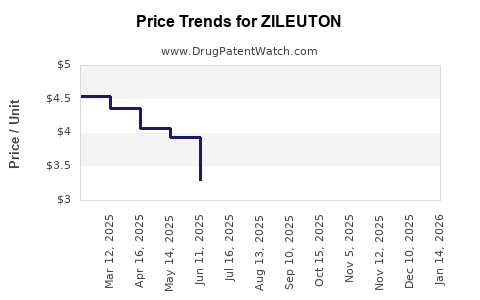
- A product with limited price power.
- A low-probability business-development target unless bundled with a broader respiratory portfolio.
- A product with limited upside from market expansion.
Which companies have commercial exposure to zileuton?
The historical branded product was associated with Abbott Laboratories and later with specialty pharmaceutical commercialization arrangements, including Cornerstone Therapeutics. Chiesi acquired Cornerstone in 2014, expanding its U.S. specialty pharmaceutical portfolio.[5]
The current generic market is more fragmented. Generic manufacturers may change over time because of supply economics, contract manufacturing, and product-line rationalization. No single manufacturer appears to control a durable branded franchise comparable to the original Zyflo business.
Licensing deals and ownership history
The commercial history involved rights transfers rather than a durable global franchise:
| Period |
Commercial position |
| Original development period |
Abbott-associated development and commercialization |
| Post-launch period |
Zyflo branded commercialization |
| Specialty-pharma period |
Rights associated with Cornerstone Therapeutics |
| Following Cornerstone acquisition |
Chiesi inherited the relevant portfolio exposure |
| Current period |
Generic and limited commercial availability |
The product’s low sales potential reduces the likelihood of a major new licensing transaction. A transaction would make more sense as part of a respiratory portfolio acquisition than as a standalone zileuton deal.
What generic entry risks exist for zileuton?
Generic entry risk is already realized rather than prospective. The key risks now concern commercial erosion, manufacturing continuity, and substitution.
Generic launch scenarios
| Scenario |
Probability assessment |
Market effect |
| Continued low-volume generic supply |
Most likely |
Stable but limited access |
| Additional generic entrants |
Possible |
Further price erosion |
| Brand relaunch |
Unlikely |
Requires evidence of differentiated demand |
| New ER or combination product |
Low probability |
Could create limited premium pricing |
| Complete supply withdrawal |
Possible |
Patients may shift to alternative therapies |
Generic manufacturers face low patent risk but also limited commercial incentive. A small market can support intermittent supply if manufacturing economics deteriorate. The principal access risk is not a patent injunction. It is product discontinuation, distributor delisting, or insufficient manufacturing margins.
What patent litigation affects zileuton?
There is no prominent current patent litigation involving zileuton that materially affects generic market access or commercial valuation. Historical patent disputes, if any, do not appear to have created a current litigation overhang comparable to active branded respiratory products.
Paragraph IV risk is therefore historical or irrelevant to current investment analysis. A new generic applicant would generally face an expired-patent and low-value market rather than a contested Orange Book patent landscape.
Does zileuton face biosimilar competition?
No. Zileuton is a chemically synthesized small molecule, not a biologic. The relevant competitive pathway is an ANDA for a generic drug, not a biosimilar application under the Public Health Service Act.
The absence of biosimilar risk does not improve the product’s commercial outlook. Generic small-molecule substitution is already established and usually produces faster price erosion than biosimilar competition.
How strong is the zileuton patent estate?
The current patent estate is weak from a commercial exclusivity perspective.
| Patent-estate factor |
Assessment |
| Core compound protection |
Expired |
| Immediate-release product protection |
Expired or no longer commercially blocking |
| Extended-release protection |
Historical; no apparent current market-wide barrier |
| Method-of-use protection |
Limited practical value |
| Orange Book leverage |
Low |
| Paragraph IV exposure |
No major current issue |
| Manufacturing barriers |
Manageable but may affect supply economics |
| Repositioning potential |
Limited without new IP |
A new formulation, inhaled delivery system, fixed-dose combination, or targeted inflammatory indication could create new patentable subject matter. Such a program would require clinical differentiation and would compete against inexpensive, established asthma therapies.
What is the outlook for zileuton revenue?
The revenue outlook is flat to declining at a low base. Volume may persist among patients who respond to zileuton or cannot tolerate alternatives, but the product has limited ability to expand its prescriber base.
Potential revenue-supporting factors include:
- Continued generic availability.
- Use in selected patients with leukotriene-driven asthma.
- Interest in non-receptor leukotriene pathway inhibition.
- Use where montelukast is unsuitable.
Revenue-limiting factors include:
- Low generic pricing.
- Liver-function monitoring.
- Drug interactions.
- Twice-daily or multiple-daily dosing.
- Stronger physician familiarity with montelukast.
- Extensive inhaled therapy competition.
- No current patent-based pricing power.
Key Takeaways
- Zileuton is a mature oral asthma therapy with limited commercial relevance.
- Zyflo and Zyflo CR no longer have a meaningful branded growth trajectory.
- Core and historical formulation patents are expired or do not create a current market-wide barrier.
- Generic competition is established, making Paragraph IV and patent litigation risk low.
- Zileuton has no biosimilar exposure because it is a small-molecule drug.
- Montelukast is commercially stronger because of once-daily dosing, broader use, and greater physician familiarity.
- The principal current risks are low demand, price erosion, and inconsistent generic supply.
- Standalone licensing or acquisition value is limited unless zileuton is included in a broader respiratory portfolio.
- A meaningful revival would require a differentiated formulation, fixed-dose combination, or new clinical positioning.
FAQs
Is zileuton still prescribed in the United States?
Yes. Zileuton may remain available as a generic prescription product, but use is limited compared with montelukast and inhaled controller therapies.
Is Zyflo still commercially available?
The branded Zyflo franchise has been discontinued or substantially reduced in commercial importance. Availability depends on generic supply and current distributor listings.
Does zileuton require liver tests?
Yes. Zileuton labeling includes hepatic monitoring because the drug can increase liver enzymes and carries restrictions for patients with liver disease.[1][2]
Can zileuton be used for acute asthma attacks?
No. Zileuton is a chronic controller treatment and does not provide rapid relief during an acute asthma attack.
Is there a new patent opportunity for zileuton?
Potentially, but only a new formulation, delivery method, combination product, or clinically differentiated use could support meaningful new intellectual-property value. The original zileuton compound does not provide current exclusivity.
References
-
U.S. Food and Drug Administration. (1996). Zyflo (zileuton) tablets prescribing information. FDA.
-
U.S. Food and Drug Administration. (2007). Zyflo CR (zileuton extended-release tablets) prescribing information. FDA.
-
U.S. Food and Drug Administration. (2024). Approved drug products with therapeutic equivalence evaluations: Orange Book. FDA.
-
U.S. Food and Drug Administration. (2020). FDA requires boxed warning about serious mental health side effects for asthma and allergy drug montelukast. FDA.
-
Chiesi Farmaceutici S.p.A. (2014). Acquisition of Cornerstone Therapeutics. Company announcement.