Last updated: August 25, 2026
Zerviate, the branded cetirizine ophthalmic solution 0.24%, occupies a narrow prescription market for ocular itching associated with allergic conjunctivitis. Its commercial opportunity is constrained by extensive generic and over-the-counter competition, seasonal demand, and limited product differentiation. Santen owns U.S. commercialization rights through its acquisition of Eyevance Pharmaceuticals, but Santen does not report Zerviate revenue as a standalone line item.
The product’s financial profile is therefore best assessed through ownership transactions, prescription-market positioning, reimbursement pressure, patent duration, and the performance of competing allergy eye drops rather than through disclosed product sales.
What is Zerviate and how does it work?
Zerviate is a prescription ophthalmic solution containing cetirizine hydrochloride at a concentration of 0.24%. The FDA approved it on May 31, 2017, under New Drug Application 210595 for the treatment of ocular itching associated with allergic conjunctivitis. It is administered as one drop in each affected eye four times daily. [1]
Cetirizine is widely known as an oral antihistamine. Zerviate applies the molecule topically to the eye, where it acts primarily as an H1 histamine-receptor antagonist. The product is supplied in single-dose containers and does not require a conventional multidose preserved bottle. [2]
Zerviate product profile
| Attribute |
Zerviate |
| Active ingredient |
Cetirizine hydrochloride |
| Strength |
0.24% ophthalmic solution |
| Indication |
Ocular itching associated with allergic conjunctivitis |
| FDA approval |
May 31, 2017 |
| NDA |
210595 |
| Dosing |
One drop in each affected eye four times daily |
| Dosage form |
Single-dose ophthalmic containers |
| Primary commercial owner |
Santen Pharmaceutical |
| U.S. launch |
2018 |
| Therapeutic class |
Ophthalmic antihistamine |
Who owns Zerviate and what licensing deals affect the product?
Nicox developed Zerviate and entered into a U.S. commercialization arrangement with Eyevance Pharmaceuticals. Eyevance launched Zerviate in the United States in 2018.
Santen acquired Eyevance in 2020 for $225 million in upfront consideration, with potential additional milestone payments reported at up to $100 million. The transaction transferred Eyevance’s ophthalmic portfolio, including Zerviate, to Santen. [3]
Zerviate ownership timeline
| Date |
Event |
| 2017 |
FDA approves Zerviate |
| 2017-2018 |
Eyevance obtains U.S. commercial rights and prepares launch |
| 2018 |
U.S. commercial launch |
| 2020 |
Santen acquires Eyevance |
| 2020 onward |
Santen manages Zerviate commercialization in the United States |
The transaction gave Santen a commercial ophthalmology platform in the U.S. market. Zerviate was strategically relevant because it added an allergy product to a portfolio otherwise concentrated in prescription eye care, including glaucoma and retinal products.
How large is the Zerviate market?
Zerviate competes in the allergic-conjunctivitis eye-drop market, where the relevant patient population is large but fragmented across prescription, over-the-counter and generic therapies.
The market has several structural characteristics:
- Allergic conjunctivitis is common and often treated seasonally.
- Symptoms are frequently managed with low-cost OTC products.
- Generic olopatadine, ketotifen and cromolyn products reduce pricing power.
- Prescribers often select products based on formulary access, sampling, convenience and perceived tolerability.
- Demand is concentrated during pollen seasons, which creates working-capital and inventory variability.
Zerviate’s most important commercial challenge is that cetirizine is already familiar to consumers as an inexpensive oral antihistamine. The ophthalmic product must therefore justify a prescription price through local ocular activity, formulation characteristics and physician preference.
Prescription and OTC competitors
| Product |
Active ingredient |
Market status |
Competitive relevance |
| Zerviate |
Cetirizine |
Prescription |
Branded topical ophthalmic antihistamine |
| Pataday |
Olopatadine |
OTC and prescription legacy products |
Major consumer-facing competitor |
| Patanol/generic olopatadine |
Olopatadine |
Generic and legacy prescription |
Strong price competitor |
| Lastacaft |
Alcaftadine |
OTC |
Direct branded allergy-drop competitor |
| Bepreve |
Bepotastine |
Prescription |
Prescription antihistamine/mast-cell stabilizer |
| Optivar/generic |
Azelastine |
Prescription and generic |
Low-cost alternative |
| Zaditor/generic ketotifen |
Ketotifen |
OTC |
Broad consumer availability |
The conversion of Pataday to OTC status in 2020 increased consumer access to a direct branded alternative and intensified price competition in the category. [4]
What is Zerviate’s financial trajectory?
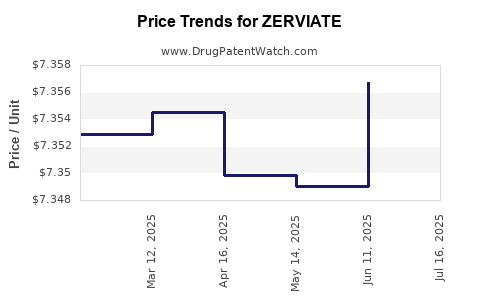
Zerviate’s standalone revenue, prescription volume and operating profit are not separately disclosed by Santen in its public financial reporting. Santen reports sales at broader product, regional or therapeutic-area levels rather than providing a dedicated Zerviate revenue series. [5]
The publicly observable financial trajectory has three phases.
Phase 1: Development and regulatory validation
Nicox advanced Zerviate through development and secured FDA approval in 2017. The approval created an asset with commercial value but did not establish a large financial base because the product entered a competitive category with mature alternatives.
Phase 2: U.S. launch and commercial buildout
Eyevance launched Zerviate in 2018. The initial commercial model depended on specialist promotion, ophthalmology sales coverage, prescription reimbursement and seasonal allergy demand. Early-stage branded ophthalmic products normally incur substantial field-force, sampling and payer-access costs before reaching operating scale.
Phase 3: Santen ownership
Santen’s $225 million acquisition of Eyevance established a transaction benchmark for the portfolio, not a disclosed valuation of Zerviate alone. The deal price reflected the combined value of Eyevance’s assets, commercial infrastructure and pipeline. It should not be treated as Zerviate revenue or as a product-specific sales estimate.
Financial indicators
| Indicator |
Publicly available position |
| Standalone annual Zerviate sales |
Not separately disclosed by Santen |
| Standalone operating margin |
Not disclosed |
| Standalone prescription volume |
Not disclosed |
| Santen acquisition consideration for Eyevance |
$225 million upfront, plus potential milestones |
| Revenue exposure |
U.S.-focused ophthalmic allergy product |
| Main financial risk |
Price and volume erosion from OTC and generic alternatives |
| Main upside driver |
Greater physician adoption and branded prescription persistence |
Zerviate is therefore a strategic specialty product rather than a disclosed major revenue pillar of Santen. Its financial contribution is likely evaluated within the U.S. ophthalmology portfolio.
When does Zerviate lose exclusivity?
Zerviate did not receive five-year new chemical entity exclusivity because cetirizine was an established active ingredient before the ophthalmic product’s approval. The relevant FDA approval date was May 31, 2017, and any applicable three-year approval-related exclusivity would have expired by 2020.
Zerviate exclusivity timeline
| Protection |
Date or period |
| FDA approval |
May 31, 2017 |
| Likely three-year clinical-investigation exclusivity window |
Through May 31, 2020 |
| Five-year NCE exclusivity |
Not applicable to established cetirizine |
| Key formulation patent |
U.S. Patent No. 9,050,301 |
| Reported patent expiration |
October 13, 2030 |
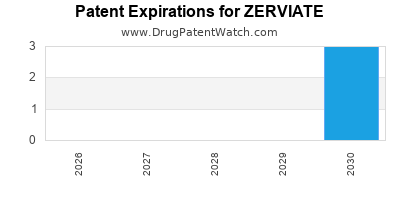
U.S. Patent No. 9,050,301 covers ophthalmic compositions containing cetirizine and is associated with the Zerviate formulation. Its reported expiration date is October 13, 2030. [6]
Patent expiry does not automatically produce generic entry. An ANDA applicant must obtain FDA approval, address listed patents and meet formulation, manufacturing and bioequivalence requirements.
What patents protect Zerviate?
Zerviate’s principal intellectual-property protection is formulation-based rather than based on a new chemical entity. That distinction limits the estate’s breadth relative to products protected by composition-of-matter patents.
Core patent protection
| Patent |
Subject matter |
Reported expiration |
| U.S. Patent No. 9,050,301 |
Ophthalmic compositions containing cetirizine |
October 13, 2030 |
Formulation protection can cover concentration, excipients, pH, delivery characteristics and stability. It may create a meaningful barrier to an identical generic formulation, but it generally provides narrower protection than a broad active-ingredient patent.
Zerviate’s practical patent strength depends on:
- The exact claims listed in the FDA Orange Book.
- Whether an ANDA applicant can design around the patented formulation.
- The validity of the claims against obviousness and written-description challenges.
- The availability of alternative cetirizine ophthalmic formulations.
- Whether any additional patents or regulatory exclusivities remain enforceable.
What is the Orange Book status of Zerviate?
Zerviate is an FDA-approved prescription drug listed under NDA 210595. Orange Book-listed patents, if active, can create a Hatch-Waxman pathway for Paragraph IV litigation. The commercial significance of the listing depends on the scope and expiry of the patent claims rather than on the mere presence of a patent number.
A generic applicant seeking approval before listed-patent expiry may file a Paragraph IV certification asserting that a patent is invalid, unenforceable or not infringed. The sponsor can then bring patent litigation within the statutory period, potentially triggering a 30-month stay of FDA approval under the Hatch-Waxman framework.
No widely reported, product-defining Paragraph IV litigation against Zerviate establishes a current generic launch date. The absence of reported litigation does not eliminate future ANDA risk.
Are biosimilars or generic versions a risk to Zerviate?
Biosimilar risk is not relevant. Zerviate is a small-molecule ophthalmic drug, so competitive entry would occur through an ANDA generic pathway rather than through a biosimilar application.
Generic risk is moderate to high over the long term because:
- Cetirizine is an old, well-characterized active ingredient.
- The indication is straightforward.
- Competing antihistamine eye drops already exist.
- The product category has established generic substitution.
- The formulation patent is narrower than a composition-of-matter patent.
The main barrier is ophthalmic formulation development. A generic applicant must reproduce an acceptable sterile topical product with suitable stability, delivery and local tolerability. These requirements are real but do not create the same manufacturing complexity as biologic products or sophisticated sustained-release implants.
What generic launch scenarios exist for Zerviate?
Scenario 1: No near-term generic entry
A generic applicant may defer development if the market is too small, prescription volume is insufficient or formulation work does not justify litigation expense. Zerviate could retain branded sales through physician loyalty, payer positioning and product differentiation.
Scenario 2: Paragraph IV challenge before 2030
An ANDA applicant could challenge the core formulation patent before its reported expiry. A successful challenge could permit launch before 2030, subject to FDA approval and litigation outcomes.
Scenario 3: At-risk launch
A generic company could launch after obtaining approval but before final patent resolution. This exposes the company to damages and injunctive risk if the patent survives.
Scenario 4: Post-expiry entry
If no earlier challenge succeeds, generic cetirizine ophthalmic products could enter after the relevant patent expiry. Price erosion would depend on the number of entrants, payer substitution rules and the extent of physician prescribing.
What litigation and settlement agreements affect Zerviate?
No major publicly reported Zerviate patent settlement has established a generic-entry date or altered the product’s commercial timetable. The most important legal variables remain the validity and scope of the formulation patent, Orange Book listings and any future ANDA certifications.
The Eyevance-Santen acquisition was a corporate transaction rather than a generic settlement. Nicox’s earlier licensing arrangement with Eyevance transferred U.S. commercialization responsibilities and economics, while Santen later acquired the commercial platform.
How does Zerviate compare with competing allergy eye drops?
Zerviate’s main differentiation is the use of cetirizine in a topical ophthalmic formulation. Its commercial disadvantage is that the underlying molecule is familiar, inexpensive and available in other dosage forms.
| Factor |
Zerviate |
Generic olopatadine |
Pataday OTC |
Lastacaft OTC |
| Prescription requirement |
Yes |
Usually no or limited by product |
No |
No |
| Brand pricing power |
Moderate |
Low |
Moderate |
Moderate |
| Payer pressure |
High |
High |
Consumer-paid |
Consumer-paid |
| Physician differentiation |
Cetirizine ophthalmic formulation |
Established allergy therapy |
Strong consumer awareness |
Branded OTC positioning |
| Generic substitution risk |
Material |
Already genericized |
Limited for OTC brand, but category substitution is high |
Category substitution is high |
| Seasonal exposure |
High |
High |
High |
High |
Zerviate is more exposed to reimbursement decisions than OTC products because patients and physicians must justify prescription use. Its commercial opportunity improves when patients seek prescription-strength treatment, have inadequate OTC response or prefer physician-directed care.
What is the outlook for Zerviate’s revenue exposure?
Zerviate’s revenue outlook is best characterized as stable but limited, with downside pressure from low-cost alternatives and upside tied to share gains within ophthalmology practices.
The principal revenue drivers are:
- Prescription growth during allergy seasons.
- Coverage by commercial insurers and pharmacy benefit managers.
- Physician adoption in ophthalmology and optometry.
- Patient acceptance of four-times-daily dosing.
- Santen’s sales-force allocation.
- Product availability and sampling.
- The timing and success of any generic challenge.
The principal risks are:
- OTC substitution.
- Generic olopatadine and ketotifen competition.
- Limited differentiation from other topical antihistamines.
- Seasonal demand variability.
- Formulation-patent invalidity or design-around risk.
- Lack of publicly visible standalone financial momentum.
Santen’s acquisition economics suggest that Zerviate had meaningful strategic value as part of a broader U.S. ophthalmology platform. Public filings do not support treating it as a billion-dollar product or as a separately measurable growth engine.
Key Takeaways
- Zerviate is cetirizine hydrochloride ophthalmic solution 0.24%, approved by the FDA in 2017 for ocular itching associated with allergic conjunctivitis.
- Santen owns the product through its $225 million acquisition of Eyevance Pharmaceuticals in 2020.
- Santen does not disclose standalone Zerviate sales, profit or prescription volume.
- The product competes with generic olopatadine, ketotifen, azelastine, Pataday and Lastacaft.
- OTC conversion of Pataday increased pressure on prescription allergy products.
- Zerviate has no biosimilar risk because it is a small-molecule drug.
- Generic risk is material because cetirizine is an established active ingredient and the product relies primarily on formulation protection.
- U.S. Patent No. 9,050,301 is reported to expire on October 13, 2030.
- No major publicly reported Paragraph IV settlement has established an earlier generic launch date.
- Zerviate is commercially relevant to Santen’s ophthalmology portfolio but is not separately reported as a major revenue contributor.
FAQs
Is Zerviate still available in the United States?
Yes. Zerviate remains an FDA-approved prescription ophthalmic product marketed in the United States by Santen.
Is Zerviate stronger than over-the-counter Pataday?
The products use different active ingredients and have different labeling. Zerviate is not directly classified by the FDA as universally stronger than Pataday. Treatment selection depends on clinical response, tolerability, access and prescriber preference.
Does Zerviate require prior authorization?
Coverage varies by insurer and plan. Prescription allergy eye drops may require formulary review, step therapy or prior authorization, particularly when lower-cost generic or OTC alternatives are available.
Can cetirizine eye drops replace oral cetirizine?
Zerviate is labeled for ocular itching and is not a substitute for oral cetirizine when treatment of systemic allergy symptoms is required.
Is Zerviate protected by a new chemical entity patent?
No. Cetirizine predates Zerviate as an active ingredient. Zerviate’s protection is primarily linked to its ophthalmic formulation and related intellectual property.
References
- U.S. Food and Drug Administration. (2017). FDA approves Zerviate for ocular itching associated with allergic conjunctivitis.
- DailyMed. (2024). Zerviate: Cetirizine hydrochloride ophthalmic solution prescribing information. National Library of Medicine.
- Santen Pharmaceutical Co., Ltd. (2020). Santen completes acquisition of Eyevance Pharmaceuticals.
- U.S. Food and Drug Administration. (2020). FDA approves first over-the-counter use of Pataday once daily relief.
- Santen Pharmaceutical Co., Ltd. (2024). Annual report and consolidated financial results.
- United States Patent and Trademark Office. (2015). U.S. Patent No. 9,050,301: Ophthalmic compositions containing cetirizine.