Last Updated: August 14, 2026

ZAVZPRET Drug Patent Profile


✉ Email this page to a colleague

« Back to Dashboard


When do Zavzpret patents expire, and when can generic versions of Zavzpret launch?

Zavzpret is a drug marketed by Pfizer and is included in one NDA. There is one patent protecting this drug.

This drug has thirty-six patent family members in twenty-nine countries.

The generic ingredient in ZAVZPRET is zavegepant hydrochloride. Two suppliers are listed for this compound. Additional details are available on the zavegepant hydrochloride profile page.

DrugPatentWatch® Generic Entry Outlook for Zavzpret

Zavzpret will be eligible for patent challenges on March 9, 2027. This date may extended up to six months if a pediatric exclusivity extension is applied to the drug's patents.

By analyzing the patents and regulatory protections it appears that the earliest date for generic entry will be March 9, 2028. This may change due to patent challenges or generic licensing.

Indicators of Generic Entry

< Available with Subscription >

  Start Trial

AI Deep Research
Questions you can ask:
  • What is the 5 year forecast for ZAVZPRET?
  • What are the global sales for ZAVZPRET?
  • What is Average Wholesale Price for ZAVZPRET?
Summary for ZAVZPRET
International Patents:36
US Patents:1
Applicants:1
NDAs:1
Finished Product Suppliers / Packagers: 2
Raw Ingredient (Bulk) Api Vendors: 21
Clinical Trials: 1
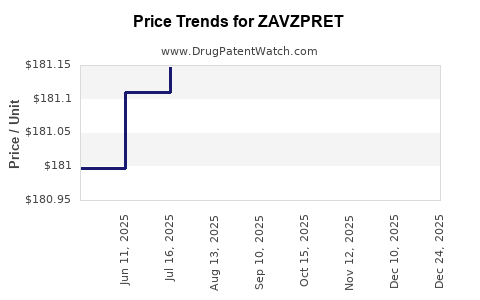
Drug Prices: Drug price information for ZAVZPRET
What excipients (inactive ingredients) are in ZAVZPRET?ZAVZPRET excipients list
DailyMed Link:ZAVZPRET at DailyMed
DrugPatentWatch® Estimated Loss of Exclusivity (LOE) Date for ZAVZPRET
Generic Entry Date for ZAVZPRET*:
Constraining patent/regulatory exclusivity:

NEW CHEMICAL ENTITY

NDA:
Dosage:

SPRAY, METERED;NASAL

*The generic entry opportunity date is the latter of the last compound-claiming patent and the last regulatory exclusivity protection. Many factors can influence early or later generic entry. This date is provided as a rough estimate of generic entry potential and should not be used as an independent source.

Recent Clinical Trials for ZAVZPRET

Identify potential brand extensions & 505(b)(2) entrants

SponsorPhase
Mayo ClinicPHASE4

See all ZAVZPRET clinical trials

US Patents and Regulatory Information for ZAVZPRET

ZAVZPRET is protected by one US patents and one FDA Regulatory Exclusivity.

Based on analysis by DrugPatentWatch, the earliest date for a generic version of ZAVZPRET is ⤷  Start Trial.

This potential generic entry date is based on NEW CHEMICAL ENTITY.

Generics may enter earlier, or later, based on new patent filings, patent extensions, patent invalidation, early generic licensing, generic entry preferences, and other factors.

Applicant Tradename Generic Name Dosage NDA Approval Date TE Type RLD RS Patent No. Patent Expiration Product Substance Delist Req. Exclusivity Expiration
Pfizer ZAVZPRET zavegepant hydrochloride SPRAY, METERED;NASAL 216386-001 Mar 9, 2023 RX Yes Yes ⤷  Start Trial ⤷  Start Trial Y Y ⤷  Start Trial
Pfizer ZAVZPRET zavegepant hydrochloride SPRAY, METERED;NASAL 216386-001 Mar 9, 2023 RX Yes Yes ⤷  Start Trial ⤷  Start Trial ⤷  Start Trial
>Applicant >Tradename >Generic Name >Dosage >NDA >Approval Date >TE >Type >RLD >RS >Patent No. >Patent Expiration >Product >Substance >Delist Req. >Exclusivity Expiration

Expired US Patents for ZAVZPRET

Applicant Tradename Generic Name Dosage NDA Approval Date Patent No. Patent Expiration
Pfizer ZAVZPRET zavegepant hydrochloride SPRAY, METERED;NASAL 216386-001 Mar 9, 2023 ⤷  Start Trial ⤷  Start Trial
>Applicant >Tradename >Generic Name >Dosage >NDA >Approval Date >Patent No. >Patent Expiration

International Patents for ZAVZPRET

See the table below for patents covering ZAVZPRET around the world.

Country Patent Number Title Estimated Expiration
Australia 2003237255 CALCITONIN GENE RELATED PEPTIDE RECEPTOR ANTAGONISTS ⤷  Start Trial
Brazil 0311812 Antagonistas de receptor de peptìdeo relacionado com o gene de calcitonina ⤷  Start Trial
Brazil PI0311812 antagonistas de receptor de peptídeo relacionado com o gene de calcitonina, composição farmacêutica e seu uso ⤷  Start Trial
Canada 2487976 ANTAGONISTES DES RECEPTEURS DU PEPTIDE RELIE AU GENE DE LA CALCITONINE (CALCITONIN GENE RELATED PEPTIDE RECEPTOR ANTAGONISTS) ⤷  Start Trial
China 100558728 ⤷  Start Trial
China 1671711 Calcitonin gene related peptide receptor antagonists ⤷  Start Trial
Cyprus 1118764 ⤷  Start Trial
>Country >Patent Number >Title >Estimated Expiration

ZAVZPRET (zavegepant) Market Dynamics and Financial Trajectory: Pricing, Uptake, Competition, and Exclusivity-at-Risk

Last updated: July 24, 2026

Zavzpret (zavegepant), a CGRP receptor antagonist (gepant) for acute treatment of migraine, is positioned in a crowded acute-therapy market where payor contracting, site-of-care dynamics, and route competition (nasal gepants versus triptans and injectables) will determine near-term revenue. Financial trajectory depends on (1) sustained formulary placement, (2) conversion from self-pay and episodic use to maintenance of repeat prescriptions, and (3) competitive displacement pressure from other gepants and from branded and generic triptans.

When does Zavzpret face exclusivity expiry and generic/biosimilar entry risk?

Answer: Commercial exclusivity timing for Zavezpret is driven by U.S. patent term life plus any regulatory exclusivity attached to the NDA, then accelerated by patent challenges (Paragraph IV) that can trigger earlier generic launch. The practical “entry risk” inflection is the first patent barrier that is successfully attacked.

What exclusivity framework governs Zavezpret in the US?

Key drivers:

  • NDA patent estate: patents covering the active ingredient, solid state/formulation, and clinical use.
  • Regulatory exclusivities (if any): exclusivity attached to the first approval pathway (NDA) and any pediatric exclusivity extensions.
  • Orange Book listings: determine which patents a generic must address in an Abbreviated New Drug Application (ANDA).

What are the generic launch scenarios that could change Zavzpret’s revenue curve?

Generic launch risk typically falls into two buckets:

  1. Non-rare co-existence: At least one strong patent block remains, limiting entry to limited-label or delayed entry.
  2. Full competition: If the core formulation or method-of-use barriers are overcome via Paragraph IV litigation outcomes, multiple ANDAs can launch and force price concessions.

What patents protect Zavzpret and how many are likely Orange Book-listed?

Answer: Orange Book coverage determines how many “hard” barriers exist against ANDA approval. The number and type of listed patents (drug substance, drug product, method-of-use) shapes both the probability of early entry and the likely timing of generic competition.

Which patent categories usually matter most for market dynamics?

  • Drug substance patents: generally control long-horizon generic entry.
  • Drug product/formulation patents: often create practical formulation copying and bioequivalence strategy hurdles.
  • Method-of-use patents: can restrict label until generic litigation resolves.

What is “Orange Book status” relevant to investors?

Investors and licensors focus on:

  • Whether key patents expire earlier than any exclusivity cap.
  • Whether multiple patents expire on staggered dates, which can extend revenue through partial “at-risk” periods.

What formulation and delivery-system factors affect Zavzpret’s competitiveness?

Answer: Route and device experience drive real-world adoption for acute migraine. For Zavzpret, nasal delivery creates a segment-specific advantage versus oral triptans and oral gepants when patients want faster, needle-free dosing.

How does nasal dosing change payer and patient uptake?

  • Patients accept nasal dosing if it matches onset expectations and is easy to self-administer.
  • Payers often prefer therapies that reduce ER/urgent care utilization, but this depends on evidence strength and claims data showing reduced acute care.

What are the main tolerability and switching drivers?

  • CGRP antagonists compete where triptans are contraindicated or poorly tolerated.
  • Switching from triptans occurs when patients experience inadequate response or adverse effects.

What is Zavzpret’s market positioning versus triptans and other acute migraine options?

Answer: Zavzpret competes in the acute migraine market against:

  • Triptans (oral, subcutaneous, and nasal forms)
  • Other gepants in the acute setting (route and regimen differentiation)
  • CGRP-targeting approaches where applicable by label and onset

How do payors typically segment acute migraine formularies?

  • Step edits: require trial of preferred triptans first unless contraindicated.
  • Clinical prior authorization: may restrict access based on migraine frequency, prior triptan response, or cardiovascular risk factors.
  • Quantity limits: can constrain uptake in low-adherence real-world patterns.

How does route-of-administration compare commercially?

  • Nasal gepants can win share where patients prefer needle-free, rapid onset dosing.
  • Injectables win when onset needs are high and patients accept self-injection.
  • Oral therapies win where cost and convenience drive adherence.

How strong is the competitive threat from other gepants and what does that do to pricing?

Answer: Competitive pressure from other acute gepants typically drives:

  • Negotiated net price compression
  • Greater reliance on rebates for formulary placement
  • Increased payer leverage over distribution and access

What happens to net pricing as the category matures?

  • Early-category products often face less immediate price pressure but must still secure payor contracts.
  • As multiple gepants gain share, payors use “therapeutic class competition” to demand rebates.

How does head-to-head adoption translate into financial trajectory?

Net revenue trajectory usually follows:

  • Contracted volume growth (new-to-brand and switchers)
  • Continuation persistence (refill frequency)
  • Reduced average price from formulary tier changes

What financial trajectory is most consistent with acute-migraine launch dynamics?

Answer: For acute migraine brands, revenue typically follows a launch-to-penetration curve:

  • Year 1 to early years: strong uptake in high-need subpopulations (prior triptan failures or contraindications) and uneven broader penetration.
  • Mid phase: growth becomes payor-driven with net price and channel mix dominating top-line variability.
  • Late phase: competition drives volume deceleration and price compression unless label expansion or new indications are achieved.

What KPIs matter most for Zavezpret’s trajectory?

  • Share of prescriptions and share of new starts
  • Net price per unit and payer mix (commercial versus Medicare versus Medicaid)
  • Persistence: repeat use in subsequent migraine episodes
  • Real-world patient pathways: switch rates from triptans and oral gepants

What revenue risks increase as competition rises?

  • Higher rebate intensity and formulary downgrades
  • Greater “fail-first” restrictions in PA policies
  • Patient migration to cheaper alternatives where coverage changes

How do FDA status and labeling scope affect commercial performance?

Answer: Label breadth and administration guidance shape patient eligibility and payer willingness to cover. Clinical data that expand effective populations increase addressable usage.

What regulatory and labeling items move the revenue needle?

  • Indication coverage: whether use is limited by prior therapy requirements
  • Dosing frequency and maximum daily guidance: impacts total units per patient
  • Contraindication language: affects payer approvals and neurologist prescribing patterns

What litigation or settlement outcomes could accelerate Zavzpret’s erosion?

Answer: Patent litigation outcomes determine the timing of at-risk launch and the likelihood of settlement-triggered “brand-payment-for-delay” structures or consent-to-sue resolutions that control generic timing.

What patterns in migraine patent litigation usually matter?

  • If settlement agreements set a fixed launch date, branded revenue is protected until that date.
  • If litigation is resolved in favor of generics on key patents, near-term revenue can drop quickly once multiple ANDAs are ready.

How do multiple Paragraph IV filings affect the brand?

Multiple challenges raise the probability that at least one legal path succeeds, forcing:

  • earlier price concessions
  • more aggressive contracting to lock in volume
  • accelerated lifecycle management (new formulations, line extensions)

How many companies are likely positioned to challenge or enter, and what does that mean?

Answer: Generic and co-marketing threats increase as multiple ANDA filers prepare for entry at different patent-expiry milestones. This raises the likelihood of rapid post-launch competition if key patents fall.

What entry readiness implies for the brand’s “last-mile” revenue

  • If ANDA readiness is high, payors can switch quickly after the earliest valid approval date.
  • If readiness is staggered, the brand may face sequential pricing erosion rather than a single step-function decline.

What licensing and contracting dynamics shape Zavezpret’s net sales?

Answer: In acute migraine, net revenue is heavily driven by:

  • managed care contracting and rebate structures
  • Medicare Part D formulary placement
  • pharmacy benefit manager leverage

Typical contracting levers that impact revenue trajectory

  • Preferred tier placement and exclusion of competing products
  • rebate ramps tied to formulary performance
  • contract terms that align to quarterly volume and switching targets

What is the most likely “commercial inflection” to watch for Zavzpret?

Answer: The most actionable inflection points are:

  1. Any Orange Book-driven litigation outcomes that change generic launch timing
  2. Any PA/step-therapy tightening by top payors
  3. Net price declines from formulary tier changes or competitive contracting pressure
  4. Any evidence-driven label changes that expand eligible patient populations

Key Takeaways

  • Zavzpret’s revenue trajectory is payor- and competition-driven, not solely innovation-driven, because acute migraine is managed heavily through formularies and prior authorization.
  • The primary financial inflection is the Orange Book patent landscape plus litigation outcomes that determine whether generic entry is accelerated.
  • Nasdaq-to-wall-street style revenue expectations in acute migraine hinge on repeat use, persistence, and net price after contracting.
  • Category maturity typically compresses net price; long-term upside requires durable formulary placement and conversion of triptan-eligible and triptan-inadequate patients.

FAQs

1) What payor actions most commonly reduce Zavzpret net sales in acute migraine?
Formulary downgrades, tightened step edits, and increased rebate requirements tied to category competition.

2) How does nasal delivery influence patient persistence for acute migraine therapies?
Ease of self-administration and perceived onset practicality drive refill rates and repeat dosing behavior.

3) What Orange Book patent types tend to delay generic competition the longest for acute CGRP antagonists?
Drug substance patents and broad drug product/formulation patents that directly constrain ANDA design.

4) How do Paragraph IV outcomes map to expected timing of generic launch for Zavzpret?
A successful challenge on early-expiring key patents shifts the launch timeline to the earliest legally available date.

5) Which competitive set is most likely to affect Zavzpret pricing within 12 to 24 months of new entries?
Other acute gepants and any nasally delivered or self-injectable alternatives that achieve formulary parity through contracting.

References

  1. FDA Orange Book: Approved Drug Products with Therapeutic Equivalence Evaluations. U.S. Food and Drug Administration.
  2. FDA Drug Approval Package: Zavzpret (zavegepant). U.S. Food and Drug Administration.
  3. FDA Labeling for Zavzpret (zavegepant). U.S. Food and Drug Administration.

More… ↓

⤷  Start Trial

Make Better Decisions: Try a trial or see plans & pricing

Drugs may be covered by multiple patents or regulatory protections. All trademarks and applicant names are the property of their respective owners or licensors. Although great care is taken in the proper and correct provision of this service, thinkBiotech LLC does not accept any responsibility for possible consequences of errors or omissions in the provided data. The data presented herein is for information purposes only. There is no warranty that the data contained herein is error free. We do not provide individual investment advice. This service is not registered with any financial regulatory agency. The information we publish is educational only and based on our opinions plus our models. By using DrugPatentWatch you acknowledge that we do not provide personalized recommendations or advice. thinkBiotech performs no independent verification of facts as provided by public sources nor are attempts made to provide legal or investing advice. Any reliance on data provided herein is done solely at the discretion of the user. Users of this service are advised to seek professional advice and independent confirmation before considering acting on any of the provided information. thinkBiotech LLC reserves the right to amend, extend or withdraw any part or all of the offered service without notice.