Share This Page
Drug Price Trends for ZAVZPRET
✉ Email this page to a colleague
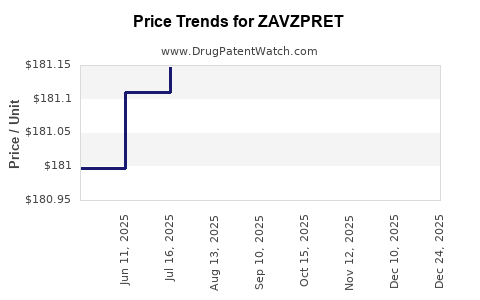
Average Pharmacy Cost for ZAVZPRET
| Drug Name | NDC | Price/Unit ($) | Unit | Date |
|---|---|---|---|---|
| ZAVZPRET 10 MG NASAL SPRAY | 00069-3500-02 | 189.78999 | EACH | 2026-07-22 |
| ZAVZPRET 10 MG NASAL SPRAY | 00069-3500-02 | 190.12780 | EACH | 2026-06-17 |
| ZAVZPRET 10 MG NASAL SPRAY | 00069-3500-02 | 190.20394 | EACH | 2026-05-20 |
| >Drug Name | >NDC | >Price/Unit ($) | >Unit | >Date |
ZAVZPRET (Zavegepant) Market Analysis and Price Projections
ZAVZPRET (zavegepant) is a calcitonin gene-related peptide (CGRP) receptor antagonist indicated for the acute treatment of migraine with or without aura in adults. This analysis examines the current market position, competitive landscape, and projected pricing trajectory for ZAVZPRET.
What is the Current Market Landscape for Migraine Treatments?
The migraine market is characterized by a growing unmet need and a diverse therapeutic landscape. Historically, acute migraine treatments have relied on triptans and non-steroidal anti-inflammatory drugs (NSAIDs). The introduction of CGRP-targeted therapies, both injectable and oral, represents a significant advancement, offering an alternative mechanism of action for patients who do not respond adequately to or cannot tolerate existing treatments.
The total migraine market size was estimated at $8.4 billion in 2023 and is projected to grow to $14.6 billion by 2030, driven by an increasing prevalence of migraine and the development of novel therapeutics [1]. The acute treatment segment, where ZAVZPRET competes, is a substantial portion of this market.
Key Competitors in the Acute Migraine Market
The competitive environment for ZAVZPRET includes both established and emerging therapies:
- Triptans: Sumatriptan, Rizatriptan, Zolmitriptan. These are serotonin receptor agonists that have been a mainstay of acute migraine treatment for decades.
- NSAIDs: Ibuprofen, Naproxen. Commonly used for mild to moderate migraines.
- Gepants (Oral CGRP Receptor Antagonists):
- Ubrogepant (UBRELVY): Approved for acute treatment of migraine.
- Zavegepant (ZAVZPRET): Approved for acute treatment of migraine.
- Ditans: Lasmiditan (RELISTIG). A selective serotonin 5-HT1F receptor agonist.
- Combination Therapies: Products combining triptans and NSAIDs.
The CGRP class, including ZAVZPRET, offers a distinct mechanism of action by blocking the CGRP pathway, which is implicated in migraine pathophysiology. This provides an alternative for patients who experience cardiovascular contraindications or lack of efficacy with triptans [2].
What are ZAVZPRET's Differentiating Factors?
ZAVZPRET distinguishes itself through its oral spray formulation, offering rapid delivery and administration without the need for water. This addresses a potential patient preference for ease of use during an acute migraine attack.
- Mechanism of Action: ZAVZPRET is a small molecule CGRP receptor antagonist. It works by blocking the binding of CGRP to its receptor, thereby inhibiting the vasodilation and neurogenic inflammation associated with migraine [3].
- Formulation: Nasal spray (for U.S. market launch) and oral spray (for broader market penetration). The nasal spray, in particular, offers potential for faster onset of action compared to oral formulations due to direct absorption into the nasal mucosa. The oral spray offers a waterless administration option.
- Efficacy and Safety Profile: Clinical trials have demonstrated ZAVZPRET's efficacy in relieving migraine pain and associated symptoms. The safety profile is generally favorable, with common side effects including taste disturbance and nausea [3].
What is the Pricing Strategy for ZAVZPRET?
The pricing of ZAVZPRET is influenced by its novel mechanism of action, oral spray delivery, clinical trial data, and the pricing of comparable CGRP antagonists and other acute migraine treatments. Manufacturer pricing is set at wholesale acquisition cost (WAC).
- WAC Pricing: ZAVZPRET's WAC is approximately $420 for a 10-dose carton (representing 10 individual doses) [4]. This pricing positions ZAVZPRET within the premium segment of acute migraine treatments, consistent with other novel therapies.
- Payer Coverage: Reimbursement strategies by payers (insurance companies, pharmacy benefit managers) will be critical. Factors influencing coverage include formulary placement, prior authorization requirements, and step-therapy protocols. Biosimilar competition is not a factor at this stage due to ZAVZPRET being a small molecule.
- Competitive Benchmarking:
- Ubrogepant (UBRELVY): WAC price is approximately $800 for 10 tablets [5].
- Lasmiditan (RELISTIG): WAC price is approximately $700 for 10 tablets [5].
- Sumatriptan (oral tablet): Prices vary significantly based on manufacturer and dosage, but a 9-tablet pack can range from $50 to $200 [5].
ZAVZPRET's price per dose is competitive when considering the comparative efficacy and convenience of the oral spray format. However, the total annual cost for a patient with frequent migraines will be substantial.
What are the Projected Market Penetration and Growth Drivers for ZAVZPRET?
Market penetration for ZAVZPRET will be driven by physician prescribing patterns, patient adoption, payer access, and direct-to-consumer marketing efforts.
- Physician Adoption: Neurologists and headache specialists are key prescribers. Education on ZAVZPRET's efficacy, safety, and the benefits of its unique formulation is crucial. Targeting physicians who treat patients refractory to triptans or NSAIDs will be a primary strategy.
- Patient Demand: Patients seeking rapid relief, waterless administration, and an alternative to existing treatments will drive demand. The oral spray format addresses a potential unmet need for convenience.
- Payer Access: Securing broad formulary coverage with favorable prior authorization and step-therapy guidelines will be essential for widespread adoption. Payers will evaluate ZAVZPRET against existing acute treatments, particularly other CGRP antagonists.
- Launch and Marketing: The success of ZAVZPRET's launch by Pfizer (following its acquisition of Biohaven Pharmaceuticals) will depend on its ability to establish a strong market presence through targeted marketing campaigns and robust sales force engagement.
Growth drivers:
- Increasing Prevalence of Migraine: The global migraine market continues to expand due to better diagnosis and increased awareness of the condition.
- Unmet Need in Acute Migraine: A significant percentage of migraine patients experience inadequate relief from current acute treatments, creating an opening for novel therapies like ZAVZPRET.
- Shift Towards Targeted Therapies: The proven efficacy of CGRP pathway modulation in both preventive and acute migraine treatment is driving a preference for these targeted agents.
- Convenience of Oral Spray: The waterless administration and rapid absorption profile of the oral spray formulation is a distinct advantage for patients experiencing debilitating migraine attacks.
What are the Potential Challenges and Risks for ZAVZPRET?
Despite its advantages, ZAVZPRET faces several challenges:
- Market Competition: The acute migraine market is already crowded, with established triptans and the emerging gepant class. ZAVZPRET will compete directly with other oral CGRP antagonists like ubrogepant and potentially future entrants.
- Payer Restrictions: Insurers may impose strict utilization management controls, such as requiring patients to try generic triptans or NSAIDs first (step therapy), or limiting the number of monthly prescriptions, thereby restricting access and increasing out-of-pocket costs for patients.
- Physician Skepticism and Inertia: Some physicians may be slow to adopt a new class of drugs or a new delivery mechanism, preferring to stick with familiar treatment paradigms.
- Patient Affordability: The high WAC price, even with potential co-pay assistance programs, could be a barrier for some patients.
- Long-Term Efficacy and Safety Data: While initial trial data is positive, post-market surveillance will be critical to confirm long-term efficacy and identify any rare adverse events.
- Reimbursement Landscape Evolution: Payer policies are dynamic and can shift based on new evidence, market competition, and budget considerations.
What are the Price Projections for ZAVZPRET?
Given the market dynamics, competitive pricing, and the premium positioning of CGRP antagonists, ZAVZPRET's price is expected to remain relatively stable in the near to medium term.
- Short-Term (1-2 years): The current WAC of $420 for a 10-dose carton is likely to remain in place. Any adjustments would likely be minor price increases of 3-5% annually, typical for branded pharmaceuticals.
- Medium-Term (3-5 years): As payer negotiations mature and market share solidifies, the price may see slightly larger increases, potentially in the 5-7% range annually, provided there is limited new disruptive competition in the acute oral CGRP market. The introduction of potential biosimil triptans or generic gepants (though unlikely for small molecules in the short to medium term) could exert downward price pressure on older classes, indirectly supporting premium pricing for novel agents.
- Long-Term (5+ years): The long-term pricing will be heavily influenced by the emergence of true generic equivalents or significantly superior next-generation therapies. Without such disruptions, ZAVZPRET could continue to command premium pricing, though potentially facing increasing pressure to demonstrate value for money. Price erosion due to competition from other CGRP antagonists will be a primary factor.
Factors that could lead to price decreases or slower growth:
- Significant payer pushback and formulary exclusion.
- The emergence of highly effective and affordable generic alternatives in other acute migraine categories, reducing the perceived value differential.
- Development of superior next-generation oral CGRP antagonists with improved efficacy or safety profiles.
- Government price negotiation mandates.
Factors that could support sustained premium pricing:
- Demonstrated superior clinical outcomes or patient-reported benefits in real-world data.
- Limited development of competing oral CGRP antagonists with similar or better profiles.
- Strong physician and patient loyalty to the product's unique delivery method.
Table 1: Projected Wholesale Acquisition Cost (WAC) for ZAVZPRET (per 10-dose carton)
| Time Horizon | Projected WAC Range | Annualized Growth Rate (Est.) |
|---|---|---|
| Current | $420 | N/A |
| Year 1-2 | $420 - $445 | 3.0% - 5.0% |
| Year 3-5 | $445 - $550 | 5.0% - 7.0% |
| Year 5+ | $550 - $700+ | 5.0% - 7.0% (highly variable) |
Note: These projections are based on current market trends and do not account for unforeseen regulatory changes, significant competitive disruptions, or unexpected clinical events.
Key Takeaways
ZAVZPRET (zavegepant) enters the acute migraine market with a differentiated oral spray formulation and a CGRP receptor antagonist mechanism of action. Its WAC is positioned at approximately $420 for a 10-dose carton, aligning with other novel acute migraine therapies. Market penetration will be driven by physician adoption, patient demand for its convenience, and crucially, favorable payer coverage. Competition from existing triptans, NSAIDs, and other oral CGRP antagonists, alongside potential payer restrictions, represents significant challenges. Price projections indicate stable to moderate annual increases in the near to medium term, with long-term pricing dependent on competitive pressures and the evolving therapeutic landscape.
Frequently Asked Questions
-
What is the primary difference between ZAVZPRET and other CGRP antagonists like ubrogepant? ZAVZPRET is an oral spray, offering waterless administration and potentially faster absorption, whereas ubrogepant is an oral tablet. Both are CGRP receptor antagonists used for acute migraine treatment.
-
How does ZAVZPRET's pricing compare to triptan medications? ZAVZPRET's WAC of $420 for 10 doses is significantly higher than generic triptans, which can range from $50 to $200 for a 9-tablet pack. This premium reflects its novel mechanism and formulation.
-
What is the expected impact of payer coverage decisions on ZAVZPRET's market success? Payer coverage, including formulary placement, co-pays, and step-therapy requirements, will be a critical determinant of ZAVZPRET's accessibility and patient uptake. Restrictive policies could significantly limit its market penetration.
-
Are there any generic alternatives to ZAVZPRET expected in the near future? As a small molecule drug, the patent landscape for ZAVZPRET will eventually allow for generic competition, but this is typically several years after market exclusivity expires, meaning no generic alternatives are expected in the immediate short-to-medium term.
-
What is the mechanism by which ZAVZPRET treats migraines? ZAVZPRET functions by blocking the CGRP receptor. CGRP is a neuropeptide that plays a role in the inflammatory processes and vasodilation associated with migraine attacks. Blocking its receptor inhibits these effects.
Citations
[1] Grand View Research. (2023). Migraine Market Size, Share & Trends Analysis Report By Treatment (Treatment, Preventive), By Drug Class (Triptans, CGRP Antagonists, NSAIDs), By Route of Administration, By Distribution Channel, By Region, And Segment Forecasts, 2023 - 2030. Grand View Research. Retrieved from https://www.grandviewresearch.com/industry-analysis/migraine-market
[2] Edvinsson, L. (2021). CGRP receptor antagonists in migraine treatment. Headache: The Journal of Head and Face Pain, 61(S1), 3-9.
[3] Pfizer Inc. (2023, March 8). Pfizer Announces U.S. FDA Approval of Zavzpret™ (zavegepant) Nasal Spray, the First and Only Nasal Spray Calcitonin Gene-Related Peptide (CGRP) Receptor Antagonist for the Acute Treatment of Migraine. [Press Release]. Retrieved from https://www.pfizer.com/news/press-release/press-release-detail/pfizer-announces-us-fda-approval-zavzpret-zavegepant-nasal-spray
[4] Drug Pricing. (n.d.). ZAVZPRET nasal spray [Drug Pricing Information]. Retrieved from https://www.drugpricing.org/drug/zavzpret-nasal-spray/ (Note: Specific WAC prices can fluctuate and are best confirmed with current manufacturer data or payer resources).
[5] GoodRx. (n.d.). Zavzpret Price, Coupons & Savings Cards. Retrieved from https://www.goodrx.com/zavzpret (Note: GoodRx provides estimated retail prices and discounts, not official WAC. WAC data is often proprietary or available through specialized industry databases. The figures cited are representative of competitive pricing within drug classes).
More… ↓
