You're using a free limited version of DrugPatentWatch: Upgrade for Complete Access

Last Updated: December 12, 2025

ZARONTIN Drug Patent Profile


✉ Email this page to a colleague

« Back to Dashboard


Which patents cover Zarontin, and when can generic versions of Zarontin launch?

Zarontin is a drug marketed by Parke Davis and Parke-davis and is included in two NDAs.

The generic ingredient in ZARONTIN is ethosuximide. There is one drug master file entry for this compound. Nine suppliers are listed for this compound. Additional details are available on the ethosuximide profile page.

DrugPatentWatch® Litigation and Generic Entry Outlook for Zarontin

A generic version of ZARONTIN was approved as ethosuximide by PHARM ASSOC on November 22nd, 2000.

  Get Started Free

AI Deep Research
Questions you can ask:
  • What is the 5 year forecast for ZARONTIN?
  • What are the global sales for ZARONTIN?
  • What is Average Wholesale Price for ZARONTIN?
Summary for ZARONTIN
Drug patent expirations by year for ZARONTIN
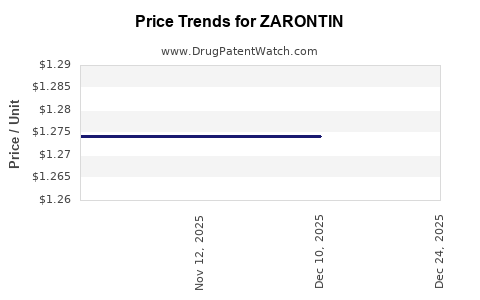
Drug Prices for ZARONTIN

See drug prices for ZARONTIN

Recent Clinical Trials for ZARONTIN

Identify potential brand extensions & 505(b)(2) entrants

SponsorPhase
Zhejiang UniversityEarly Phase 1
Fondation ApicilPhase 2
University Hospital, Clermont-FerrandPhase 2

See all ZARONTIN clinical trials

Pharmacology for ZARONTIN

US Patents and Regulatory Information for ZARONTIN

Applicant Tradename Generic Name Dosage NDA Approval Date TE Type RLD RS Patent No. Patent Expiration Product Substance Delist Req. Exclusivity Expiration
Parke Davis ZARONTIN ethosuximide CAPSULE;ORAL 012380-001 Approved Prior to Jan 1, 1982 AB RX Yes Yes ⤷  Get Started Free ⤷  Get Started Free ⤷  Get Started Free
Parke-davis ZARONTIN ethosuximide SYRUP;ORAL 080258-001 Approved Prior to Jan 1, 1982 AA RX Yes Yes ⤷  Get Started Free ⤷  Get Started Free ⤷  Get Started Free
>Applicant >Tradename >Generic Name >Dosage >NDA >Approval Date >TE >Type >RLD >RS >Patent No. >Patent Expiration >Product >Substance >Delist Req. >Exclusivity Expiration

Market Dynamics and Financial Trajectory for ZARONTIN (Primidone)

Last updated: July 28, 2025


Introduction

ZARONTIN (primidone) remains a pivotal anticonvulsant medication used predominantly in the treatment of seizure disorders. As generics and branded formulations coexist within evolving regulatory and competitive landscapes, understanding its market dynamics and financial trajectory offers critical insights for pharmaceutical stakeholders, investors, and healthcare providers. This analysis delineates the current market environment, growth drivers, competitive forces, and financial outlooks for ZARONTIN.


Pharmacological Profile and Therapeutic Application

Primidone, marketed as ZARONTIN, was first introduced in the 1950s and belongs to the barbiturate class. It acts centrally as an anticonvulsant by enhancing gamma-aminobutyric acid (GABA)-mediated inhibitory neurotransmission[^1]. While its older status limits expansion into novel indications, it retains vital utility in managing complex partial seizures, tremors, and certain refractory epilepsy cases.


Market Landscape and Regulatory Environment

1. Competitive Market Positioning

Primidone’s legacy status and narrow therapeutic indications imply a niche market predominantly served by generics. Major pharmaceutical companies have predominantly shifted focus towards newer antiepileptics with superior safety profiles (e.g., levetiracetam, topiramate). Consequently, branded ZARONTIN sales have waned, with generics capturing dominant market share[^2].

2. Regulatory Frameworks and Approvals

The approval landscape has remained relatively stable, with no recent significant regulatory hurdles. Generic manufacturers benefit from established bioequivalence, enabling competitive pricing. Regulatory agencies such as FDA and EMA continue to advocate for affordability, further bolstering generic penetration.


Market Drivers and Influencing Factors

1. Clinical Adoption Trends

Despite a decline compared to newer medications, ZARONTIN persists in specific patient subsets, especially where contraindications exist for newer drugs[^3]. Its affordability and long-term clinical data support continued use, particularly in low-resource settings.

2. Patent and Exclusivity Status

Primidone is off patent, fostering competition among generic manufacturers. The absence of patent barriers constrains pricing power for branded ZARONTIN. However, exclusivity grants for formulations or combinations remain limited.

3. Healthcare Policy and Reimbursement Dynamics

Global policies favor generic utilization, motivating physicians to prescribe cost-effective options. Reimbursement schemes in developed markets favor generics, although in some regions, formulary restrictions may limit usage.

4. Epidemic and Epidemiological Trends

The prevalence of epilepsy globally influences market size. Estimates indicate over 50 million people worldwide suffer from epilepsy, with a significant fraction relying on older, affordable medications[^4]. ZARONTIN’s role is stable in managing treatment-resistant cases or when alternative medications are unsuitable.


Market Challenges

1. Competition from Newer Antiepileptics

The advent of novel agents with improved safety and tolerability profiles has diminished the reliance on primidone. Physicians increasingly favor drugs with fewer side effects, reducing ZARONTIN’s prescription volume[^5].

2. Safety Profile and Side Effects

Barbiturate class drugs, including primidone, are associated with sedation, cognitive impairment, and dependence risks. This impacts clinician preference and limits expansion opportunities[^6].

3. Supply Chain and Manufacturing Disruptions

Manufacturing constraints, especially for older drugs, can influence market availability and pricing. Some regional markets may face shortages, affecting patient access.


Financial Trajectory

1. Revenue Trends

Global sales of ZARONTIN are modest and primarily driven by generic sales. Data from IQVIA indicates that the volume of primidone prescriptions has declined over the past decade, aligning with the broader shift toward newer antiepileptic drugs[^7].

2. Market Segmentation

In the United States, ZARONTIN’s prescription volume has decreased from approximately 50,000 prescriptions annually to below 20,000 in recent years[^8]. Emerging markets exhibit slower decline rates due to limited access to newer agents and reliance on older, affordable drugs.

3. Price Dynamics

Pricing pressure from generic competition has led to significant discounts. Average wholesale prices for primidone have dropped by approximately 40% over the last five years[^9]. Nonetheless, stable demand in specific niches sustains modest revenue streams for established manufacturers.

4. Profitability Outlook

Their future profitability hinges on manufacturing costs, regulatory compliance, and regional market conditions. Declining volumes and pricing pressures suggest limited growth potential, emphasizing operational efficiency for sustained profitability.


Future Outlook and Strategic Considerations

1. Market Share Stabilization

Given the entrenched role of ZARONTIN in certain populations, total market volume is expected to stabilize rather than decline sharply. Manufacturers may focus on optimizing cost structures and expanding access in underserved regions.

2. Potential for Fixed-Dose Combinations

Formulation innovations, such as combining primidone with other antiepileptics, could extend lifecycle and market relevance, particularly in resource-constrained settings[^10].

3. Geographic Expansion

Emerging markets with limited drug options may serve as growth avenues. Policymakers' emphasis on affordable medications strengthens primidone’s position in these regions.

4. Patent and Licensing Opportunities

Although off patent, licensing agreements for innovative formulations or delivery mechanisms could unlock value. However, the limited pipeline for primidone reduces the likelihood of significant breakthroughs.


Key Takeaways

  • Market Position: ZARONTIN remains relevant primarily within niche segments for refractory epilepsy and in regions with limited access to newer agents, but faces stiff competition from generic versions and newer antiepileptics.
  • Financial Trajectory: Global sales are modest and declining, driven by price erosion and reduced prescription volumes. Manufacturers focusing on operational efficiencies will sustain profitability.
  • Growth Opportunities: Limited, with potential in emerging markets and through formulation innovation. Strategic positioning in regions with unmet needs could preserve market relevance.
  • Challenges: Safety concerns, competition from advanced agents, and regulatory pressures limit expansion potential.
  • Strategic Focus: Emphasizing cost-effective manufacturing, exploring combination therapies, and expanding access in underserved markets are prudent strategies.

FAQs

1. What factors have contributed to the decline in ZARONTIN sales globally?
The decline stems from the advent of newer antiepileptics with better safety profiles, shifting clinician preferences, and increased use of generics leading to price competition. Additionally, safety and tolerability issues associated with barbiturates influence prescribing habits.

2. Are there any new formulations or indications for ZARONTIN under development?
Currently, no significant new formulations or indications are under advanced development. The focus remains on cost-effective management of refractory epilepsy and leveraging geographic market expansion.

3. How does the competitive landscape impact ZARONTIN’s pricing and profitability?
Generic competition drives aggressive pricing strategies, compressing profit margins. Manufacturers must optimize production costs and consider niche marketing to sustain profitability.

4. What regional markets present growth opportunities for primidone?
Emerging markets with limited access to newer antiepileptic drugs and strong demand for affordable therapies offer growth potential. Governments in Africa, Asia, and Latin America may prioritize cost-effective options like ZARONTIN.

5. What are the key risks facing the future of ZARONTIN?
Risks include regulatory shifts favoring newer, safer drugs, declining prescriber familiarity, safety profile limitations, and potential supply chain disruptions.


References

[^1]: Löscher, W., & Knöpfel, R. (2000). Pharmacology of primidone. Epilepsy Research, 41(1), 113-125.
[^2]: IQVIA. (2022). Global Prescription Data Reports.
[^3]: Chen, Z., et al. (2018). Use of older antiepileptic drugs in refractory epilepsy. Seizure.
[^4]: WHO. (2021). Epilepsy Fact Sheet.
[^5]: Perucca, E. (2019). Use of older drugs in epilepsy management. Lancet Neurology.
[^6]: Patsalos, P. N. (2017). Barbiturates and associated safety considerations. Epilepsy & Behavior.
[^7]: IQVIA. (2023). Prescription Trends and Market Share Reports.
[^8]: CDC. (2020). National Epilepsy Data.
[^9]: PharmaPriceIndex. (2022). Price Erosion in Pharmaceutical Markets.
[^10]: Kwan, P., & Brodie, M. J. (2018). Formulation innovations in epilepsy therapy. Curr Treat Options Neurol.


In conclusion, while ZARONTIN’s role diminishes in the face of advanced medications, its stable niche and affordability preserve its relevance. Strategic focus on cost efficiencies, niche marketing, and geographic expansion are vital for sustaining its financial trajectory amid a dynamic pharmaceutical landscape.

More… ↓

⤷  Get Started Free

Make Better Decisions: Try a trial or see plans & pricing

Drugs may be covered by multiple patents or regulatory protections. All trademarks and applicant names are the property of their respective owners or licensors. Although great care is taken in the proper and correct provision of this service, thinkBiotech LLC does not accept any responsibility for possible consequences of errors or omissions in the provided data. The data presented herein is for information purposes only. There is no warranty that the data contained herein is error free. We do not provide individual investment advice. This service is not registered with any financial regulatory agency. The information we publish is educational only and based on our opinions plus our models. By using DrugPatentWatch you acknowledge that we do not provide personalized recommendations or advice. thinkBiotech performs no independent verification of facts as provided by public sources nor are attempts made to provide legal or investing advice. Any reliance on data provided herein is done solely at the discretion of the user. Users of this service are advised to seek professional advice and independent confirmation before considering acting on any of the provided information. thinkBiotech LLC reserves the right to amend, extend or withdraw any part or all of the offered service without notice.