Last updated: September 7, 2026
Ethosuximide is a mature, low-cost antiseizure medicine used primarily for childhood absence seizures. Its U.S. commercial market is generic, concentrated in a small number of suppliers, and lacks meaningful patent protection or brand-driven pricing power. Revenue growth is unlikely to come from volume expansion. The principal commercial risks are manufacturing interruptions, limited supplier capacity, and periodic shortages of capsules or oral solution.
What is the current market position of ethosuximide?
Ethosuximide is an established small-molecule antiepileptic approved for absence seizures, also called petit mal seizures. It is sold primarily as:
| Dosage form |
Common strength |
Commercial role |
| Capsule |
250 mg |
Main solid oral generic product |
| Oral solution |
250 mg/5 mL |
Important for pediatric patients and patients unable to swallow capsules |
| Brand capsule or solution |
Zarontin historically |
Limited or uncertain commercial relevance relative to generics |
The drug has a narrow clinical indication. It is not a broad-spectrum antiseizure medicine and has limited use in focal seizures, generalized tonic-clonic seizures, or status epilepticus. Its commercial demand therefore tracks the relatively small absence-seizure population rather than the broader epilepsy market.
The FDA labeling identifies ethosuximide as indicated for the control of absence seizures. The label also warns that the medicine is ineffective against other major seizure types and can worsen generalized tonic-clonic seizures in some patients if used without appropriate clinical management (U.S. Food and Drug Administration [FDA], n.d.-a).
How large is the ethosuximide market?
No major manufacturer publicly reports standalone global revenue for ethosuximide. Public company filings generally group the product within broader generic pharmaceutical revenue, preventing a reliable company-by-company market-share calculation.
The market is best characterized as a niche, low-value prescription segment with stable underlying demand:
- Patient volume is limited by the prevalence of absence epilepsy.
- Treatment duration can be long, supporting recurring prescription demand.
- Generic substitution keeps unit prices low.
- Pediatric use supports continued demand for oral solution.
- Product availability can vary because relatively few manufacturers have commercial incentives to maintain multiple presentations.
Third-party market reports may publish global ethosuximide market estimates, but their methodologies and product definitions vary. Reported values are not directly comparable unless they specify whether they include only active pharmaceutical ingredient sales, finished-dose products, hospital procurement, retail prescriptions, and branded products.
What drives ethosuximide demand?
Demand is influenced by four factors:
- Diagnosis of childhood absence epilepsy. Ethosuximide remains a targeted treatment when absence seizures are the principal seizure type.
- Clinical preference for a narrow-spectrum medicine. The drug can be preferred when clinicians want to avoid the broader adverse-effect profiles associated with some alternatives.
- Pediatric formulation requirements. Oral solution demand is commercially important even though total volume is smaller than capsule demand.
- Therapeutic substitution. Valproate and lamotrigine compete in absence epilepsy, especially when patients have additional generalized seizure types.
The absence-seizure population limits the ceiling for market expansion. Greater diagnosis or treatment persistence could support demand, but no obvious product innovation is positioned to create a large new market.
When does ethosuximide lose exclusivity?
Ethosuximide has no meaningful remaining U.S. market exclusivity. Its original small-molecule exclusivity and any early patents expired decades ago. The FDA does not identify a current new chemical entity exclusivity period for the drug.
| Exclusivity category |
Current position |
| New chemical entity exclusivity |
Expired |
| Orphan-drug exclusivity |
Not applicable to the established product |
| Pediatric exclusivity |
No current effect |
| Generic exclusivity |
No current first-filer exclusivity identified as a material market barrier |
| Brand patent protection |
No commercially relevant live patent estate identified |
| Biosimilar exclusivity |
Not applicable |
There is therefore no single upcoming “loss of exclusivity” date. The commercial transition to generic competition occurred long ago.
What patents protect ethosuximide?
No active U.S. patent estate appears to provide meaningful protection for the core ethosuximide molecule. The original composition-of-matter protection is historical and expired before the current generic market structure was established.
The FDA Orange Book remains the principal reference for patents and regulatory exclusivity associated with approved products. A current commercial review should distinguish between:
- patents listed for a specific NDA;
- patents covering a formulation or method of use;
- expired patents retained in historical records; and
- patents that are not listed because they do not meet Orange Book listing requirements.
Ethosuximide does not have the patent profile of a modern branded antiseizure product. There is no recognized high-value formulation patent blocking generic capsules or solution, and no substantial method-of-use estate appears to restrict ordinary prescribing of the drug (FDA, n.d.-b).
What formulations are protected by ethosuximide patents?
The principal commercial formulations are conventional oral capsules and oral solution. Their manufacturing processes use established pharmaceutical technology. There is no widely recognized extended-release, transdermal, implantable, or specialty-delivery platform generating a separate exclusivity position.
Formulation risk is operational rather than legal. The oral solution requires appropriate excipient control, stability testing, packaging, and taste acceptability. Those requirements can create practical manufacturing barriers without creating durable patent protection.
What is the FDA regulatory status of ethosuximide?
Ethosuximide is an FDA-approved prescription drug available through abbreviated new drug applications for generic products. FDA-approved labeling identifies the 250 mg capsule and 250 mg/5 mL oral solution presentations.
Generic products must demonstrate pharmaceutical equivalence and bioequivalence to the applicable reference product. The commercial market is therefore governed primarily by ANDA approvals, manufacturing capacity, quality compliance, and distribution rather than by branded clinical development.
The FDA therapeutic-equivalence framework is relevant because an AB-rated generic can generally be substituted for the reference product under state pharmacy laws, subject to local substitution rules and prescriber instructions (FDA, n.d.-c).
What is the Orange Book status of ethosuximide?
Ethosuximide is not commercially protected by a current Orange Book patent barrier comparable to those affecting newer branded drugs. Historical NDA and reference-product records may remain relevant for regulatory identification, but they do not create current market exclusivity.
The practical Orange Book conclusion is:
- generic entry is established;
- no material patent expiry event is pending;
- Paragraph IV litigation is not a central market issue;
- future competition depends on ANDA approvals and supply economics.
Applicants entering the market would not generally need to design around a live molecule patent. Their principal legal exposure would relate to product-specific patents, labeling, manufacturing processes, or ordinary ANDA litigation risk if a patent were listed against a particular reference product.
Which companies are challenging ethosuximide patents?
No significant current Paragraph IV campaign is associated with ethosuximide. This reflects the drug’s age and the absence of an economically important patent barrier.
The competitive field is more likely to change through:
- new ANDA approvals;
- supplier exits;
- manufacturing transfers;
- contract-manufacturing arrangements;
- wholesaler sourcing decisions; and
- shortage-driven purchasing.
For a low-revenue generic, filing a Paragraph IV challenge would offer limited upside because there is no major branded market to unlock. The relevant legal strategy is usually ordinary generic entry rather than patent litigation.
What patent litigation affects ethosuximide?
Ethosuximide does not have a prominent contemporary U.S. patent-litigation profile comparable to high-revenue branded antiseizure drugs. No material litigation event is known to be shaping generic entry, pricing, or supplier concentration.
The litigation risk is therefore low relative to regulatory and manufacturing risk. Product-liability claims, labeling disputes, quality actions, and supply-contract disputes would be more commercially plausible than a large-scale patent dispute.
No major settlement agreement appears to govern the timing of generic ethosuximide entry. The market does not depend on a negotiated patent settlement between a brand company and a first generic entrant.
How does ethosuximide compare with competing antiseizure drugs?
| Drug |
Role in absence seizures |
Commercial position |
Competitive effect on ethosuximide |
| Ethosuximide |
Targeted treatment for absence seizures |
Mature generic niche |
Baseline therapy when absence seizures predominate |
| Valproate |
Broad-spectrum antiseizure treatment |
Mature generic with broader use |
Strong substitute when multiple seizure types exist |
| Lamotrigine |
Alternative for absence seizures and other seizure types |
Mature generic |
Competes where broader coverage is needed |
| Levetiracetam |
Broad antiseizure use, not a direct absence-seizure equivalent |
Large generic market |
Competes for broader epilepsy treatment but is less targeted |
| Clobazam and other agents |
Used in selected seizure syndromes |
Generic or branded depending on product |
Limited direct substitution |
Ethosuximide’s clinical advantage is specificity. Its commercial disadvantage is that patients with mixed seizure types may require a broader agent. The product can therefore retain a stable niche without gaining substantial share of the overall epilepsy market.
What are the major manufacturing and supply risks?
Manufacturing risk is the most important near-term commercial variable. A small market can support only a limited number of suppliers, and low prices reduce the incentive to maintain redundant production lines.
Key risk points include:
- limited active pharmaceutical ingredient sources;
- dependence on a small number of finished-dose manufacturers;
- oral-solution manufacturing and packaging complexity;
- low inventory economics;
- quality-control remediation;
- site transfers;
- raw-material shortages; and
- wholesaler concentration.
FDA drug-shortage records have historically included intermittent availability issues for certain antiseizure products and presentations. A shortage in ethosuximide can have a disproportionate clinical effect because switching a pediatric patient to another formulation or medicine requires prescriber review and seizure monitoring (FDA, n.d.-d).
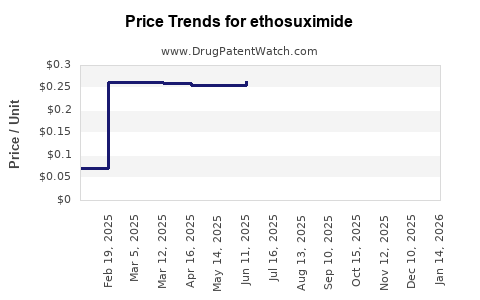
Supply instability can also create temporary price increases even when long-term market pricing remains low. Those increases are not evidence of durable pricing power.
What is the financial trajectory for ethosuximide?
The financial trajectory is mature and defensive rather than growth-oriented.
Historical phase: brand development and market establishment
The product originated as an older branded antiseizure medicine. Its commercial value was based on clinical utility and a targeted indication, not on a large addressable population.
Generic phase: price erosion and volume stability
After generic entry, competition reduced unit prices. Prescription demand remained relatively stable because patients with confirmed absence epilepsy may remain on treatment for extended periods. The result is a low-revenue, recurring product with limited margin expansion.
Current phase: supply-constrained niche
Current economics depend on supplier participation. A manufacturer with an approved product and reliable supply can maintain a useful niche position even without patent protection. However, the absolute revenue opportunity remains modest because the underlying patient population is small and generic pricing is low.
Forward outlook: flat to modestly volatile
The most likely financial trajectory is:
| Metric |
Outlook |
| Prescription volume |
Stable, with modest demographic and diagnostic variation |
| Net price |
Low and pressured by generic competition |
| Gross margin |
Vulnerable to API, compliance, and packaging costs |
| Revenue growth |
Limited; mostly supply- or price-driven |
| Brand revenue |
Minimal or unavailable as a separately reported category |
| R&D investment |
Unlikely without a differentiated formulation or delivery system |
| M&A value |
Based on supply reliability and portfolio fit, not patent value |
A manufacturer could obtain temporary revenue gains from a competitor shortage, but those gains would be difficult to sustain once supply normalizes or new competitors enter.
Is ethosuximide exposed to biosimilar competition?
No. Ethosuximide is a synthetic small molecule, not a biologic. Biosimilar pathways do not apply. Competitive pressure comes from conventional generic manufacturers using the ANDA pathway.
This distinction matters for investors and licensing teams. The asset has no biosimilar lifecycle strategy, no biologic manufacturing moat, and no interchangeability framework comparable to insulin, monoclonal antibodies, or other complex biologics.
What generic launch scenarios exist for ethosuximide?
Three scenarios are commercially relevant:
Base case: stable generic supply
Existing suppliers continue production, prices remain low, and market revenue changes mainly with prescription volume. This is the most likely scenario.
Upside case: supplier consolidation
One or more competitors exit, allowing remaining suppliers to capture additional volume and temporarily improve pricing. The upside would be constrained by the small total market and the possibility of new entrants.
Downside case: shortage or manufacturing interruption
A manufacturing problem affects capsules or oral solution. Wholesalers ration inventory, pharmacies substitute between suppliers or formulations, and patients may require clinical conversion to another antiseizure medicine.
The shortage scenario has greater clinical significance than financial upside. A supplier with reliable supply may gain institutional and pharmacy preference, but regulatory scrutiny and customer-service obligations also increase.
How strong is the ethosuximide patent estate?
The patent estate is weak for commercial purposes because core composition protection has expired and no substantial current formulation or method-of-use barrier is evident.
| Patent factor |
Assessment |
| Core molecule protection |
Expired |
| Current U.S. exclusivity |
None of material commercial importance |
| Formulation protection |
Limited or non-material |
| Method-of-use protection |
No significant current barrier identified |
| Generic entry risk |
High, but already realized |
| Biosimilar risk |
Not applicable |
| Manufacturing know-how |
More relevant than patents |
| Litigation leverage |
Low |
The strongest defensible advantage is operational: validated manufacturing, consistent quality, reliable inventory, and established distribution.
Key Takeaways
- Ethosuximide is a mature generic treatment for absence seizures.
- Its U.S. market has no material remaining brand exclusivity or core patent protection.
- No major Paragraph IV campaign, patent settlement, or contemporary patent dispute drives market access.
- The product is not exposed to biosimilar competition.
- Revenue is recurring but limited by the small absence-seizure population and low generic pricing.
- Oral solution supply is strategically important because of pediatric use.
- Manufacturing reliability, API access, quality compliance, and distribution are more important than intellectual property.
- Financial performance is likely to remain flat, with temporary volatility caused by shortages, supplier exits, or price changes.
- A manufacturer’s commercial value lies in supply continuity and portfolio integration rather than in patent-based pricing power.
FAQs About Ethosuximide Commercialization and Exclusivity
Does ethosuximide have a current U.S. brand monopoly?
No. The market is predominantly generic, and the original brand-era exclusivity has expired.
Is Zarontin still commercially important?
Zarontin has historical brand recognition, but generic ethosuximide determines most current market economics. Public filings do not provide a reliable standalone revenue figure for the brand.
Can a company obtain market exclusivity by launching a new ethosuximide formulation?
Potentially, but a new formulation would require a distinct regulatory and commercial proposition. Any resulting patent would protect only the qualifying formulation or use, not the unmodified ethosuximide molecule.
Is ethosuximide a candidate for a 505(b)(2) reformulation?
It could be evaluated for a differentiated delivery system, pediatric formulation, or tolerability improvement. The commercial case would be difficult because the underlying generic product is inexpensive and clinically established.
What is the main investment risk for an ethosuximide manufacturer?
The primary risk is not patent expiry. It is low market value combined with supply-chain exposure, including API availability, manufacturing interruptions, quality remediation, and limited ability to pass through cost increases.
References
-
U.S. Food and Drug Administration. (n.d.-a). Ethosuximide prescribing information. DailyMed, U.S. National Library of Medicine. https://dailymed.nlm.nih.gov/
-
U.S. Food and Drug Administration. (n.d.-b). Approved drug products with therapeutic equivalence evaluations. https://www.fda.gov/drugs/drug-approvals-and-databases/orange-book
-
U.S. Food and Drug Administration. (n.d.-c). Orange Book: Approved drug products with therapeutic equivalence evaluations. https://www.accessdata.fda.gov/scripts/cder/ob/
-
U.S. Food and Drug Administration. (n.d.-d). Drug shortages database. https://www.accessdata.fda.gov/scripts/drugshortages/
-
U.S. National Library of Medicine. (n.d.). DailyMed: Current medication labeling. https://dailymed.nlm.nih.gov/