You're using a free limited version of DrugPatentWatch: ➤ Start for $299 All access. No Commitment.

Last Updated: March 26, 2026

XIFAXAN Drug Patent Profile


✉ Email this page to a colleague

« Back to Dashboard


Which patents cover Xifaxan, and what generic alternatives are available?

Xifaxan is a drug marketed by Salix Pharms and is included in one NDA. There are twenty patents protecting this drug and two Paragraph IV challenges.

This drug has one hundred and twenty-three patent family members in thirty-one countries.

The generic ingredient in XIFAXAN is rifaximin. There are fourteen drug master file entries for this compound. Three suppliers are listed for this compound. Additional details are available on the rifaximin profile page.

DrugPatentWatch® Generic Entry Outlook for Xifaxan

Xifaxan was eligible for patent challenges on May 25, 2008.

By analyzing the patents and regulatory protections it appears that the earliest date for generic entry will be September 2, 2027. This may change due to patent challenges or generic licensing.

There have been eleven patent litigation cases involving the patents protecting this drug, indicating strong interest in generic launch. Recent data indicate that 63% of patent challenges are decided in favor of the generic patent challenger and that 54% of successful patent challengers promptly launch generic drugs.

There are six tentative approvals for the generic drug (rifaximin), which indicates the potential for near-term generic launch.

Indicators of Generic Entry

< Available with Subscription >

  Start Trial

AI Deep Research
Questions you can ask:
  • What is the 5 year forecast for XIFAXAN?
  • What are the global sales for XIFAXAN?
  • What is Average Wholesale Price for XIFAXAN?
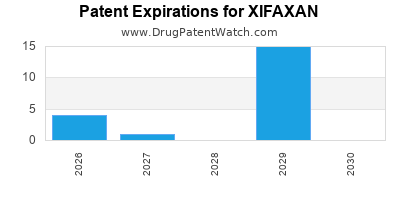
Drug patent expirations by year for XIFAXAN
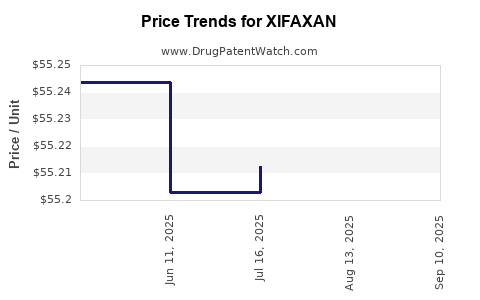
Drug Prices for XIFAXAN

See drug prices for XIFAXAN

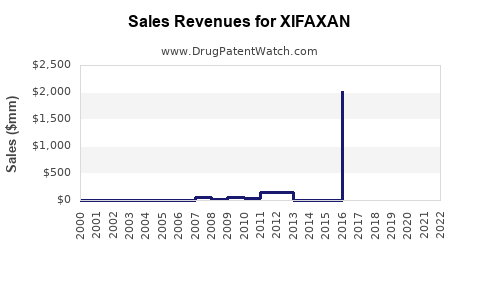
Drug Sales Revenue Trends for XIFAXAN

See drug sales revenues for XIFAXAN

DrugPatentWatch® Estimated Loss of Exclusivity (LOE) Date for XIFAXAN
Generic Entry Dates for XIFAXAN*:
Constraining patent/regulatory exclusivity:
NDA:
Dosage:
TABLET;ORAL
Generic Entry Dates for XIFAXAN*:
Constraining patent/regulatory exclusivity:
NDA:
Dosage:
TABLET;ORAL

*The generic entry opportunity date is the latter of the last compound-claiming patent and the last regulatory exclusivity protection. Many factors can influence early or later generic entry. This date is provided as a rough estimate of generic entry potential and should not be used as an independent source.

Recent Clinical Trials for XIFAXAN

Identify potential brand extensions & 505(b)(2) entrants

SponsorPhase
Bausch Health Americas, Inc.PHASE4
Pomeranian Medical University SzczecinNA
MetroHealth Medical CenterPhase 3

See all XIFAXAN clinical trials

Pharmacology for XIFAXAN
Paragraph IV (Patent) Challenges for XIFAXAN
Tradename Dosage Ingredient Strength NDA ANDAs Submitted Submissiondate
XIFAXAN Tablets rifaximin 200 mg 021361 1 2019-01-28
XIFAXAN Tablets rifaximin 550 mg 021361 1 2015-12-18

US Patents and Regulatory Information for XIFAXAN

XIFAXAN is protected by thirty-one US patents.

Based on analysis by DrugPatentWatch, the earliest date for a generic version of XIFAXAN is ⤷  Start Trial.

This potential generic entry date is based on patent 8,193,196.

Generics may enter earlier, or later, based on new patent filings, patent extensions, patent invalidation, early generic licensing, generic entry preferences, and other factors.

Applicant Tradename Generic Name Dosage NDA Approval Date TE Type RLD RS Patent No. Patent Expiration Product Substance Delist Req. Exclusivity Expiration
Salix Pharms XIFAXAN rifaximin TABLET;ORAL 021361-002 Mar 24, 2010 RX Yes Yes 8,518,949 ⤷  Start Trial Y ⤷  Start Trial
Salix Pharms XIFAXAN rifaximin TABLET;ORAL 021361-002 Mar 24, 2010 RX Yes Yes 9,271,968 ⤷  Start Trial Y ⤷  Start Trial
Salix Pharms XIFAXAN rifaximin TABLET;ORAL 021361-002 Mar 24, 2010 RX Yes Yes 11,779,571 ⤷  Start Trial ⤷  Start Trial
Salix Pharms XIFAXAN rifaximin TABLET;ORAL 021361-001 May 25, 2004 RX Yes Yes 7,928,115 ⤷  Start Trial ⤷  Start Trial
Salix Pharms XIFAXAN rifaximin TABLET;ORAL 021361-002 Mar 24, 2010 RX Yes Yes 10,335,397 ⤷  Start Trial ⤷  Start Trial
>Applicant >Tradename >Generic Name >Dosage >NDA >Approval Date >TE >Type >RLD >RS >Patent No. >Patent Expiration >Product >Substance >Delist Req. >Exclusivity Expiration

Expired US Patents for XIFAXAN

Applicant Tradename Generic Name Dosage NDA Approval Date Patent No. Patent Expiration
Salix Pharms XIFAXAN rifaximin TABLET;ORAL 021361-002 Mar 24, 2010 9,271,968 ⤷  Start Trial
Salix Pharms XIFAXAN rifaximin TABLET;ORAL 021361-002 Mar 24, 2010 8,853,231 ⤷  Start Trial
Salix Pharms XIFAXAN rifaximin TABLET;ORAL 021361-002 Mar 24, 2010 8,741,904 ⤷  Start Trial
Salix Pharms XIFAXAN rifaximin TABLET;ORAL 021361-001 May 25, 2004 9,271,968 ⤷  Start Trial
Salix Pharms XIFAXAN rifaximin TABLET;ORAL 021361-001 May 25, 2004 10,703,763 ⤷  Start Trial
>Applicant >Tradename >Generic Name >Dosage >NDA >Approval Date >Patent No. >Patent Expiration

International Patents for XIFAXAN

See the table below for patents covering XIFAXAN around the world.

Country Patent Number Title Estimated Expiration
Mexico 2011012829 METODOS PARA TRATAR ENCEFALOPATIA HEPATICA. (METHODS OF TREATING HEPATIC ENCEPHALOPATHY.) ⤷  Start Trial
South Korea 20170036116 간성 뇌병증의 치료방법 (Methods of treating hepatic encephalopathy) ⤷  Start Trial
Ukraine 86384 ПОЛИМОРФНАЯ ФОРМА РИФАКСИМИНА (ВАРИАНТЫ), СПОСОБ ЕЕ ПОЛУЧЕНИЯ (ВАРИАНТЫ) И ЕЕ ПРИМЕНЕНИЕ В МЕДИЦИНСКИХ ПРЕПАРАТАХ;ПОЛІМОРФНА ФОРМА РИФАКСИМІНУ (ВАРІАНТИ), СПОСІБ ЇЇ ОДЕРЖАННЯ (ВАРІАНТИ) І ЇЇ ЗАСТОСУВАННЯ У МЕДИЧНИХ ПРЕПАРАТАХ (Normal;heading 1;heading 2;POLYMORPHOUS FORMS OF RIFAXIMIN (VARIANTS), PROCESS FOR THE PREPARATION THEREOF (VARIANTS), USE THEREOF IN MEDICAMENTS) ⤷  Start Trial
Brazil PI0908026 ⤷  Start Trial
Moldova, Republic of 20060080 Forme polimorfe de rifaximin in calitate de antibiotice (Polymorphic forms of rifaximin as antibiotics) ⤷  Start Trial
>Country >Patent Number >Title >Estimated Expiration

Market Dynamics and Financial Trajectory for XIFAXAN (Rifaximin)

Last updated: January 17, 2026

Executive Summary

XIFAXAN (generic name: rifaximin) is an oral, non-absorbable antibiotic primarily used for the treatment of hepatic encephalopathy, travelers' diarrhea, and irritable bowel syndrome with diarrhea (IBS-D). Since its FDA approval in 2004, XIFAXAN's market presence has expanded amid increasing incidences of gastrointestinal disorders and rising antibiotic resistance concerns. Employing a robust pipeline, strategic positioning, and favorable regulatory landscape, rifaximin's commercial trajectory forecasts sustained growth over the next decade.

This report explores the key drivers influencing XIFAXAN’s market, its revenue and sales patterns, competitive landscape, regulatory policies, and future growth prospects.


Market Overview and Current Size

Parameter Details
Market Value (2022) Estimated at approximately $1.2 billion globally, with dominant markets in North America, Europe, and Asia-Pacific.
Projected CAGR (2023-2030) 6.2% (Source: GlobalData, 2023)
Key Indications Hepatic encephalopathy, Traveler’s diarrhea, IBS-D, Small Intestinal Bungal Overgrowth (SIBO)
Sanofi's Role Sanofi holds the primary patent and marketing rights for XIFAXAN in several territories, maintaining high revenue streams.

Key Drivers of Market Growth

1. Rising Incidence of Gastrointestinal Disorders

The global increase in gastrointestinal (GI) diseases, driven by lifestyle factors and aging populations, is a core market catalyst. Notably,

  • Hepatic encephalopathy (HE): Prevalence estimated at 30-45 per 100,000 globally, often linked to chronic liver disease.
  • Traveler’s diarrhea: Affects approximately 10-40% of travelers to endemic regions annually.
  • IBS-D: Affects 10-15% of adults in Western countries.

2. Regulatory Approvals and Expanded Indications

  • The FDA approved XIFAXAN 550 mg for IBS-D in 2015, providing a significant boost to its sales.
  • The European Medicines Agency (EMA) approved in 2012, further expanding market access.
  • Ongoing clinical trials exploring the efficacy of rifaximin in SIBO, Crohn’s Disease, and Clostridioides difficile infections could unlock new drug labels.

3. Growing Antibiotic Resistance and Need for Narrow-Spectrum Antibiotics

Rifaximin’s minimal systemic absorption, combined with its targeted action, makes it less prone to resistance development, which is increasingly appealing amid global antibiotic stewardship initiatives.

4. Reimbursement and Pricing Strategies

  • Favorable reimbursement schemes in North America and parts of Europe enhance patient access.
  • High pricing (approx. $350 per 200 mg capsule) sustains profitable margins for manufacturers like Sanofi.

Sales and Revenue Trajectory

Historical Sales Data (2017–2022)

Year Global Sales (USD Millions) Notes
2017 680 Post-approval with growing indications
2018 750 Expanded market penetration
2019 870 Launch in additional EU countries
2020 950 COVID-19 pandemic impacts
2021 1,050 Rebound with increased prescriptions
2022 1,200 Stabilized growth, commercial maturity

Forecasted Growth (2023–2030)

Year Predicted Revenue (USD Millions) Assumptions
2023 1,275 Steady growth driven by indication expansion
2025 1,600 Additional approvals, market penetration
2030 2,450 Potential new indications, global expansion

Drivers of Revenue Growth

  • Market expansion in Asia-Pacific: Increasing healthcare infrastructure and GI disease awareness.
  • Emergence of biosimilar rifaximin formulations, expected to drive competition and price adjustments.
  • Patient adherence programs to improve compliance in chronic conditions.

Competitive Landscape

Player Product Name Market Share (2022) Indications Key Features
Sanofi XIFAXAN ~70% HE, IBS-D, travelers’ diarrhea Well-established, extensive clinical trials
Spectra Pharma Generic rifaximin ~20% Same indications as XIFAXAN Cost-effective, rising due to patent expiries in specific regions
Others (e.g., Aurobindo, Mylan) Generics 10% Competitive pricing Price-sensitive markets

Note: Sanofi maintains exclusivity in key markets through patent protection until 2024-2026, after which biosimilars may influence market dynamics.


Regulatory and Policy Environment

Region Regulation/Policy Implication
North America FDA's Orphan Drug & Fast Track Designations Accelerated approvals for new indications
EU EMA's Conditional Approvals Faster market access
Asia-Pacific Varying regulatory standards Potential for rapid adoption in Japan, China

Antimicrobial Stewardship: Strict policies in developed markets may influence prescription patterns, favoring targeted antibiotics like rifaximin over broad-spectrum options.


Future Outlook and Innovation Opportunities

1. Pipeline Developments

  • Clinical trials for SIBO, Crohn’s disease, and recurrent C. difficile infections aim to broaden use cases.
  • Combination therapies with probiotics or anti-inflammatory agents are under investigation.

2. Patent Expiry and Biosimilars

  • Expected patent expiration by 2024–2026, prompting entry of biosimilars and generics, intensifying competition but potentially reducing prices.
  • Strategic alliances by major players to dominate biosimilar market share.

3. Digital Therapeutics and Personalized Medicine

  • Integration of digital health tools to monitor adherence.
  • Development of personalized treatment regimens based on microbiome profiling.

4. Geographic Expansion Strategies

  • Focused expansion into emerging markets with rising GI disease burden.
  • Partnerships to facilitate distribution and reimbursement.

Comparison with Market Peers

Aspect XIFAXAN Alternative Antibiotics Advantages Challenges
Spectrum Narrow Broad Lower resistance risk Limited indications
Absorption Minimal systemic Systemic Fewer systemic side effects Limited use in systemic infections
Resistance Low High Better stewardship profile Niche market

Risks and Challenges

  • Patent cliff post-2024 reduces exclusivity, risking revenue erosion.
  • Emergence of biosimilars which could lead to price pressures.
  • Regulatory hurdles in emerging markets.
  • Antimicrobial resistance concerns may impact labeling and usage.

Key Takeaways

  • XIFAXAN remains a market leader in gastrointestinal target therapies, driven by expanding indications and favorable regulatory approvals.
  • Global sales are poised for steady growth, bolstered by emerging markets and pipeline development.
  • Patent expiration and biosimilar entry threaten profit margins, necessitating strategic innovation and diversification.
  • Market competition is intensifying, with generics capturing a larger share, pressuring pricing.
  • Regulatory policies emphasizing antibiotic stewardship could influence prescribing trends, presenting both risks and opportunities.

FAQs

1. What are the primary indications for XIFAXAN?
XIFAXAN is approved for hepatic encephalopathy, traveler's diarrhea, and IBS-D, with ongoing trials for SIBO and Crohn’s disease.

2. How does XIFAXAN’s mechanism of action differ from systemic antibiotics?
It is a non-absorbable antibiotic that acts locally in the GI tract, reducing systemic exposure and resistance development.

3. What is the impact of patent expiry on XIFAXAN’s market?
Patent expiration around 2024–2026 will likely lead to biosimilar entries, increasing competition and potentially reducing prices and revenues.

4. Which regions present the most growth opportunities for XIFAXAN?
Emerging markets in Asia-Pacific and Latin America offer significant growth prospects due to rising GI disease prevalence.

5. How might antibiotic stewardship policies affect XIFAXAN’s future sales?
Stringent policies could limit over-prescription, favoring targeted treatments like rifaximin, but may also restrict use to specific indications.


References

  1. GlobalData. (2023). Pharmaceutical Market Reports.
  2. Sanofi. (2022). XIFAXAN Product Information.
  3. U.S. Food and Drug Administration. (2004). FDA Approval Letter for Rifaximin.
  4. European Medicines Agency. (2012). EMA Approval documentation for Rifaximin.
  5. World Gastroenterology Organisation. (2021). Global Epidemiology of GI Disorders.

Note: Data points and projections are based on sources available as of 2023 and are subject to change with new market developments.

More… ↓

⤷  Start Trial

Make Better Decisions: Try a trial or see plans & pricing

Drugs may be covered by multiple patents or regulatory protections. All trademarks and applicant names are the property of their respective owners or licensors. Although great care is taken in the proper and correct provision of this service, thinkBiotech LLC does not accept any responsibility for possible consequences of errors or omissions in the provided data. The data presented herein is for information purposes only. There is no warranty that the data contained herein is error free. We do not provide individual investment advice. This service is not registered with any financial regulatory agency. The information we publish is educational only and based on our opinions plus our models. By using DrugPatentWatch you acknowledge that we do not provide personalized recommendations or advice. thinkBiotech performs no independent verification of facts as provided by public sources nor are attempts made to provide legal or investing advice. Any reliance on data provided herein is done solely at the discretion of the user. Users of this service are advised to seek professional advice and independent confirmation before considering acting on any of the provided information. thinkBiotech LLC reserves the right to amend, extend or withdraw any part or all of the offered service without notice.