Last updated: July 29, 2026
XENICAL (orlistat) is an obesity drug with declining-to-flat brand revenue in most mature markets, driven by long-term generic availability, limited lifecycle expansion momentum, and intense competition from newer anti-obesity agents. For investors and licensing teams, the key financial question is not near-term exclusivity. It is whether the remaining branded product can sustain meaningful share against generic orlistat and GLP-1/dual incretin classes, and whether any residual patent or regulatory protections exist in specific geographies for specific presentations.
What is the financial trajectory of XENICAL (orlistat) by year, and where did revenue peak?
Featured-snippet answer: XENICAL’s brand revenue peaked earlier in its lifecycle (late-1990s/2000s in Western markets) and then trended downward as generic orlistat entered and as prescribers shifted toward newer anti-obesity pharmacotherapies. Current brand dynamics are dominated by generic substitution rather than patent exclusivity.
How has XENICAL performed versus newer obesity drugs (GLP-1, dual incretin)?
In clinical practice and payer formularies, orlistat competes indirectly with incretin-based obesity drugs by indication broadening and treatment pathway shifts:
- GLP-1 and dual incretin therapies changed first-line and escalation patterns in obesity pharmacotherapy.
- Orlistat retained a niche role where tolerability, cost, or patient preference favors non-incretin mechanisms.
- The market’s willingness to pay has shifted toward drugs with larger average weight-loss outcomes.
What are the main financial drivers behind XENICAL decline?
The revenue slope is explained by four structural factors:
- Generic erosion in the US and Europe
- Formulary preference for newer agents where budget allows
- Limited evidence differentiation versus competitors beyond mechanism
- Side-effect profile and adherence issues that increase discontinuation risk
How do market dynamics shape XENICAL’s competitive position in 2024–2026?
Featured-snippet answer: XENICAL’s competitive position is constrained by generic substitution and by obesity category disruption from GLP-1/dual incretin drugs. Brand differentiation is mostly marketing and dosing convenience rather than durable IP.
Generic competition mechanics: what changes after first generic entry?
Once generic orlistat is established:
- Brand pricing loses flexibility.
- Retail and payer channels prioritize lowest net cost.
- Prescribers see “therapeutic substitution” as routine in chronic weight management, where endpoints are typically population-level changes rather than patient-specific biomarker effects.
Category-level displacement: incretin disruption
Even if orlistat remains available, incretin drugs can reduce:
- Total number of anti-obesity prescriptions written
- The share of patients starting pharmacotherapy at earlier stages
- The intensity of payer contracting and preferred channel allocation
Why does XENICAL’s market share fall even when prescriptions remain?
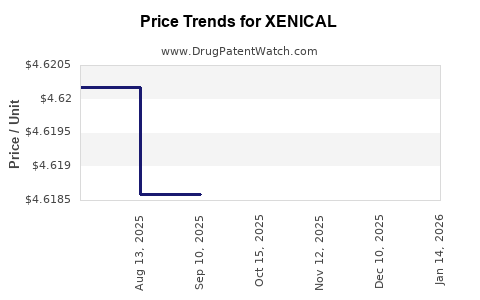
Featured-snippet answer: XENICAL can retain prescription counts in some geographies while revenue falls because net pricing drops faster than unit volumes can compensate.
The net price pressure pathway
- Channel inventory and pharmacy substitution reduce branded share
- Manufacturers discount to maintain shelf presence
- Payers tighten tier placement over time once generics are entrenched
The adherence and tolerability pathway
Orlistat’s GI adverse effects (class effect) influence:
- Treatment persistence
- Refill behavior
- Discontinuation-driven demand volatility
What patents and exclusivity protect XENICAL, and when do they expire?
Featured-snippet answer: For US brand action, the practical issue is generic readiness, not brand exclusivity. Orlistat is a long-established small molecule with extensive generic coverage historically, and the remaining value of “patent estate” is limited to narrow reformulation or method claims, if any, in specific jurisdictions.
Patent estate: what typically remains for an older small molecule?
For mature actives like orlistat, the only potentially relevant protections are usually:
- Formulation or delivery device claims (if any)
- Process/method-of-manufacture claims (rarely used for blocking generics unless still active and asserted)
- New combinations, which are uncommon for XENICAL unless explicitly developed
Regulatory exclusivity: what can still matter?
Regulatory exclusivity is usually exhausted for legacy actives. The market impact is dominated by:
- Orange Book listings and any remaining active patents (if present)
- Enforcement history (if any) against specific generic filers
- Any pediatric exclusivity or supplemental protections (unlikely to be meaningful for a long-legacy product)
What is the Orange Book status of XENICAL, and does it block generic entry?
Featured-snippet answer: XENICAL’s practical generic entry risk is low on a timeline perspective in most markets because orlistat has long been generic. If any Orange Book patents remain listed, they typically do not prevent generic market access absent specific, active, enforceable claims tied to the approved NDA/label.
US generic launch risk framework
Even for legacy drugs, generic outcomes depend on:
- Which patents are listed for the specific approved dosage forms
- Whether any Paragraph IV certifications are filed
- Whether litigation results in a stay and for how long
Settlement and licensing outcomes
Where generic litigation occurs in legacy spaces, the typical settlement pattern is:
- Early entry without broad product-specific market blocking
- Narrow carve-outs or labeling design changes rather than long-term exclusivity
How strong is the patent estate for orlistat versus newer obesity drugs?
Featured-snippet answer: The orlistat estate is structurally weaker than modern obesity drug estates because the active is old and entry has already occurred at scale. New obesity agents, in contrast, typically have long, dense patent thickets across composition of matter, methods of use, and improvements.
Comparison by IP architecture
- Orlistat: older composition and likely limited incremental lifecycle IP left, after years of generic penetration
- GLP-1/dual incretin: dense claims across the therapeutic mechanism and multiple follow-on improvements, with longer effective protection
Which companies compete with XENICAL (orlistat) and what are their market strategies?
Featured-snippet answer: In mature markets, the primary competition is generic manufacturers of orlistat. Strategy centers on lowest net price, broad distribution, and payer contracting rather than brand rebuilding.
Likely competition set (structural, not brand-specific)
- Generic orlistat manufacturers for OTC or prescription channels depending on country
- Pharmacy chains and PBMs pushing formulary substitution
- New obesity brands (incretin) capturing incremental patient starts
Distribution and pricing models
Generic competitors typically use:
- Low launch pricing
- Quantity discounts to wholesalers
- Value-based contracting where formulary tiers are tight
What litigation and settlements affect XENICAL generics?
Featured-snippet answer: For orlistat, litigation risk is largely historical; modern dynamics are dominated by routine generic substitution rather than ongoing brand blocking.
What to look for if assessing residual legal risk
If doing a diligence pass, prioritize:
- Any recent Paragraph IV actions tied to specific dosage forms in the US
- Court dockets referencing lingering method-of-use or formulation patents
- Consent decrees or settlement terms that affect specific generic label carve-outs
(If there is no active docket or current litigation, the commercial takeaway is that XENICAL’s financial outlook is driven by competition, not legal constraints.)
What are the most important FDA and payer considerations for XENICAL today?
Featured-snippet answer: Orlistat’s current market behavior is shaped by formulary positioning, coverage policies for weight-loss pharmacotherapy, and tolerability-driven adherence.
FDA positioning and prescribing constraints
- Orlistat is used as part of weight management with diet
- Coverage decisions often depend on BMI criteria and continuation rules
Payer dynamics: why coverage does not guarantee profitability
Even when a payer covers orlistat:
- Generic substitution compresses net margins
- Administrative friction or step therapy can reduce sustained volume
- Patients can cycle to higher-efficacy drugs if benefit justifies higher cost
Where is XENICAL likely to retain the strongest market, and where will it underperform?
Featured-snippet answer: Retention tends to be strongest in markets with:
- Higher generic adoption but stable reimbursement for obesity drugs
- Patient populations that prefer non-incretin options or where incretin access is constrained by cost
Underperformance tends to occur where:
- Formularies heavily tier incretin drugs as preferred
- Obesity treatment budgets expand mainly for GLP-1/dual incretin classes
Geographic pattern typical for older obesity therapies
- US: dominated by generic orlistat and payer shift toward incretin drugs
- EU: generic penetration and nation-by-nation reimbursement differences; incretin displacement reduces category share
- Emerging markets: slower uptake of GLP-1 can sustain older molecules longer, but generic competition still caps pricing
What formulation and dosing differences influence XENICAL sales outcomes?
Featured-snippet answer: For orlistat, formulation improvements are not usually enough to reverse revenue decline once generic competition is entrenched, but they can affect persistence and switching.
Common commercial relevance areas
- Capsule strength and dosing schedule impact adherence
- Patient tolerability influences persistence
- Pack size affects total therapy duration and refill rate
How does XENICAL compare with other obesity drugs on commercial viability?
Featured-snippet answer: XENICAL is a “budget” option in a category that has been repriced by efficacy-driven incretin therapies. Its commercial viability is mainly a function of cost sensitivity and formulary tolerance for GI tolerability trade-offs.
Side-by-side market economics (conceptual)
- Orlistat (XENICAL): lower cost, lower efficacy on average, high generic pressure
- GLP-1/dual incretin: higher cost, higher average weight-loss outcomes, IP still active for many products
Key Takeaways
- XENICAL’s revenue trajectory is primarily a function of generic substitution and long-run payer displacement by GLP-1/dual incretin therapies, not active exclusivity.
- In mature markets, brand margins compress as net pricing drops and channel share shifts to generics.
- The realistic financial question is niche retention and persistence, not growth from IP.
- Any near-term value creation would be tied to specific geography/presentation protections, payer contracting strategy, and patient persistence rather than patent-driven market blocking.
FAQs
1) Can XENICAL still compete on formulary with newer GLP-1 obesity drugs?
Only in constrained scenarios where cost and access drive preference toward lower-priced options and where budget structures prioritize non-incretin coverage.
2) What is the biggest risk to XENICAL revenue besides generic entry?
Category displacement: incretin-based obesity therapies absorbing incremental treatment starts and preferred formulary share.
3) Do formulation changes for orlistat create meaningful commercial lift?
Usually limited once generics dominate the active ingredient. Value is more in adherence/persistence than in pricing power.
4) What tends to drive payer continuation policies for orlistat?
BMI-based eligibility and continuation benchmarks tied to weight-loss response and adherence.
5) Is there any remaining legal upside for XENICAL in generics litigation?
For legacy orlistat, ongoing upside is typically minimal unless a specific, still-active, dosage-form-linked patent is asserted successfully in a current US or EU case.
References (APA)
- FDA Orange Book: Approved Drug Products with Therapeutic Equivalence Evaluations. US Food and Drug Administration.
- FDA Drug Approval Package for orlistat (Xenical). US Food and Drug Administration.