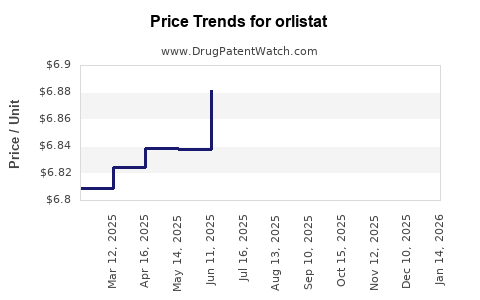
Last updated: September 8, 2026
Orlistat is a mature obesity drug whose commercial value has shifted from branded prescription sales to low-cost generic and over-the-counter channels. Roche’s Xenical generated peak annual sales of roughly CHF 1 billion in the early 2000s, but revenue declined sharply after adverse-effect publicity, reimbursement pressure, generic entry and the arrival of newer anti-obesity medicines. The core U.S. composition patent expired in 2010, eliminating the principal exclusivity barrier. Orlistat remains FDA-approved and commercially available, but its growth prospects are limited by poor tolerability and competition from GLP-1-based therapies.
What is orlistat and how is it used?
Orlistat is a gastrointestinal lipase inhibitor that reduces absorption of dietary fat. It acts locally in the gastrointestinal tract by inhibiting pancreatic and gastric lipases, causing unabsorbed triglycerides to pass through the intestine.
| Product |
Active ingredient |
Strength |
Regulatory status |
Primary channel |
| Xenical |
Orlistat |
120 mg |
Prescription |
Obesity treatment |
| alli |
Orlistat |
60 mg |
FDA-approved OTC product |
Weight loss and weight management |
| Generic orlistat |
Orlistat |
120 mg and, in some markets, 60 mg |
Approved in multiple jurisdictions |
Prescription and pharmacy channels |
The FDA approved Xenical in 1999 for chronic weight management in adults with obesity or overweight patients with associated risk factors. The agency approved alli, a lower-dose version, for nonprescription use in 2007 (U.S. Food and Drug Administration [FDA], 1999, 2007).
Orlistat is generally used with a reduced-calorie diet. Its principal adverse effects are gastrointestinal and include oily spotting, fecal urgency, increased defecation and steatorrhea. These effects become more pronounced when patients consume high-fat meals.
When did Xenical lose exclusivity?
The principal U.S. composition patent protecting orlistat was U.S. Patent No. 5,274,143, assigned to Roche-related entities. The patent was filed before the 1995 U.S. patent-term transition and expired in December 2010 based on the applicable patent term. The patent covered orlistat and related pharmaceutical compositions.
| Milestone |
Date |
| Xenical approved in the United States |
April 23, 1999 |
| Core U.S. orlistat patent |
U.S. 5,274,143 |
| Core patent expiration |
December 2010 |
| alli approved for OTC use in the United States |
February 2007 |
| Generic prescription competition |
Began around the 2010 patent-expiration period |
Patent-term restoration and regulatory exclusivity provided only limited additional protection compared with the commercial life of the brand. By the time the principal patent expired, Xenical had already experienced several years of declining sales.
What patents protect orlistat today?
The core active-ingredient patent estate has expired in the United States and major European markets. Current protection is therefore more likely to arise from jurisdiction-specific secondary patents, trademarks, product presentation, manufacturing know-how or regulatory barriers rather than from a broad composition patent.
Composition and formulation patents
The historical core patent protected the active compound and pharmaceutical formulations. Later filings in the orlistat field addressed matters such as:
- dosage forms and capsule compositions;
- combinations with vitamins or dietary supplements;
- modified-release or controlled-release delivery;
- reduced-fat dietary regimens;
- manufacturing processes and purification;
- packaging and administration instructions.
These patents generally have less commercial reach than the original composition patent. They do not prevent a generic manufacturer from marketing a conventional immediate-release orlistat capsule when the relevant claims have expired or are not infringed.
Method-of-use patents
Method-of-use claims may cover treatment of obesity, weight reduction, weight maintenance or metabolic conditions. Their practical value is limited because:
- obesity treatment is an established use;
- many indications overlap with the original label;
- generic manufacturers can use Section viii statements or labeling strategies where permitted;
- enforcement requires proof that the marketed product induces infringement.
The remaining commercial relevance of method patents depends on claim scope, jurisdiction and whether the FDA-approved label includes the patented use.
Manufacturing and API barriers
Orlistat is a lipase inhibitor derived from the natural product lipstatin. Industrial production involves fermentation-related starting materials or semi-synthetic routes, chiral intermediates and purification controls. Manufacturing is more technically demanding than producing a simple achiral small molecule, but the process is established and commercially reproducible.
Manufacturing know-how can affect cost, yield and impurity control. It is not equivalent to an active patent barrier. Generic competition remains feasible because suppliers can use non-infringing processes and source API from multiple manufacturing regions.
What is the Orange Book status of Xenical and alli?
Xenical was listed in the FDA Orange Book as an approved prescription drug. The historical listings included patent information associated with the branded product and its approved use. The core patent has expired, and generic orlistat approvals removed the principal Orange Book barrier to entry.
alli was approved as an OTC product through an NDA rather than through the standard prescription generic framework. Its commercial protection depended more heavily on brand recognition, consumer marketing, distribution and product positioning than on an enduring composition patent.
A current commercial assessment should distinguish among:
- expired Xenical patents;
- any surviving formulation or use listings;
- OTC regulatory status for alli;
- trademarks and trade dress;
- generic 120 mg approvals;
- country-specific marketing authorizations.
The expiry of the main composition patent does not automatically eliminate every patent claim in every jurisdiction, but it materially reduced the U.S. entry risk for conventional orlistat products.
Were there Paragraph IV challenges to Xenical?
Generic manufacturers had a clear incentive to challenge or bypass the principal Xenical patent as it approached expiry. The commercial impact of the U.S. patent expiry was more important than any single Paragraph IV case because the product had already entered the late stage of its lifecycle.
The relevant generic pathway was an abbreviated new drug application under the Hatch-Waxman Act. A manufacturer could certify that the listed patent had expired, was invalid, was unenforceable or would not be infringed. Once the core patent expired, the principal litigation leverage declined sharply.
No ongoing patent dispute has the market significance that would restore Xenical-style exclusivity. The current risk profile is ordinary generic competition rather than a branded patent-defense cycle.
What is the FDA regulatory status of orlistat?
Orlistat remains an FDA-approved small-molecule obesity treatment. It is not a biologic and therefore has no biosimilar pathway.
| Regulatory issue |
Orlistat position |
| FDA drug category |
Small-molecule drug |
| Prescription product |
Xenical 120 mg |
| OTC product |
alli 60 mg |
| Generic pathway |
ANDA for qualifying prescription products |
| Biosimilar exposure |
None |
| Main safety concern |
Gastrointestinal adverse events |
| Key monitoring issue |
Fat-soluble vitamin absorption and rare serious hepatic events |
Patients taking prescription orlistat are generally advised to use a multivitamin because the drug can reduce absorption of fat-soluble vitamins. The FDA label also addresses potential liver injury, kidney-related effects and interactions with drugs including cyclosporine, levothyroxine and warfarin (FDA, 2018).
The FDA’s 2007 OTC authorization expanded access but also placed greater emphasis on consumer labeling and dietary counseling. OTC availability broadened the potential patient base while reducing prescription reimbursement economics.
How did orlistat’s financial trajectory develop?
Orlistat followed a conventional blockbuster-to-generic trajectory, but its decline began before patent expiry.
Roche revenue trajectory
Roche’s annual reports show that Xenical generated approximately CHF 1 billion or more per year during its early commercial period. Sales then declined through the 2000s as the obesity market became more competitive and physicians and patients reacted to tolerability concerns.
| Period |
Commercial position |
Financial direction |
| 1999-2001 |
New prescription obesity product |
Rapid growth |
| 2002-2004 |
Established global brand |
Approximately CHF 1 billion-plus annual sales at peak |
| 2005-2007 |
Declining prescriptions and reimbursement pressure |
Sustained decline |
| 2008-2010 |
Mature brand before patent expiry |
Sharp erosion |
| After 2010 |
Generic entry and loss of core exclusivity |
Branded revenue compressed |
| 2015 onward |
Mature, low-growth product class |
Generic and OTC economics dominate |
Roche’s later financial reporting placed less emphasis on Xenical as a growth product. The company’s portfolio shifted toward oncology, immunology and diagnostics, while orlistat became commercially immaterial relative to its newer assets (Roche, 2001-2011).
Why revenue declined before patent expiry
The primary drivers were:
- gastrointestinal tolerability;
- high discontinuation rates;
- limited long-term adherence;
- reimbursement restrictions;
- increasing use of diet, exercise and bariatric surgery;
- competition from newer pharmacological approaches;
- negative consumer perception;
- lower pricing after OTC and generic competition.
The 2007 OTC launch of alli expanded the category but did not reverse the long-term erosion of Xenical. OTC sales also produced lower net revenue per patient than prescription branded sales.
How does orlistat compare with newer obesity drugs?
Orlistat has a low acquisition cost, but its clinical and commercial profile is weaker than newer incretin-based medicines.
| Attribute |
Orlistat |
Semaglutide obesity products |
Tirzepatide obesity products |
| Drug class |
Lipase inhibitor |
GLP-1 receptor agonist |
GIP/GLP-1 receptor agonist |
| Administration |
Oral capsule |
Injectable |
Injectable |
| Weight-loss efficacy |
Modest |
Substantially higher in pivotal trials |
Substantially higher in pivotal trials |
| Primary tolerability issue |
Oily stool and urgency |
Nausea and gastrointestinal effects |
Nausea and gastrointestinal effects |
| Patent position |
Core patents expired |
Active, valuable patent estates |
Active, valuable patent estates |
| Price position |
Low |
High |
High |
| Generic risk |
Immediate and established |
Limited before patent expiry |
Limited before patent expiry |
Semaglutide and tirzepatide have changed prescriber and payer expectations for efficacy. Orlistat remains relevant for patients who require an inexpensive oral option, cannot access injectable therapy or prefer a non-systemic mechanism. Its market position is defensive rather than expansionary.
What is the competitive landscape for generic orlistat?
Generic competition is fragmented by country and dosage form. Manufacturers can compete through:
- 120 mg prescription capsules;
- 60 mg OTC products;
- pharmacy distribution;
- private-label weight-management products;
- online and discount channels;
- API supply and contract manufacturing.
The product has limited differentiation at the active-ingredient level. Competition therefore centers on price, supply reliability, regulatory compliance, packaging and distribution.
The main branded reference products remain important for medical familiarity, but they do not have the pricing power associated with patented obesity drugs. In the United States, the core commercial contest is between low-cost generic prescription products and OTC alternatives rather than between multiple differentiated branded orlistat products.
What generic launch scenarios exist for orlistat?
Low-price generic scenario
Generic manufacturers maintain supply at low prices, and orlistat remains available as a basic obesity-treatment option. This is the most likely long-term scenario in mature markets.
OTC erosion scenario
Consumers shift from branded alli to store-brand or online alternatives. Brand value declines while the active ingredient remains available through multiple channels.
Specialty-use scenario
Orlistat retains limited use among patients who cannot use injectable incretin medicines because of cost, contraindications, access barriers or treatment preference.
Decline scenario
Prescribers increasingly choose semaglutide, tirzepatide or other anti-obesity therapies. Orlistat becomes a low-volume generic product with limited promotional support.
What licensing deals affect orlistat?
Orlistat’s major commercial history is associated with Roche’s Xenical franchise and the later OTC commercialization of alli. The field does not have a current licensing structure comparable with newer obesity drugs, where originators license regional rights, co-commercialize products or negotiate large manufacturing agreements.
The commercial value of any remaining orlistat license is likely tied to:
- local registration rights;
- OTC distribution;
- private-label supply;
- API procurement;
- formulation or manufacturing know-how.
Because the active ingredient is off patent, licensing economics are generally distribution- and supply-based rather than exclusivity-based.
How strong is the orlistat patent estate?
The patent estate is weak for blocking conventional generic entry and stronger only in narrow, jurisdiction-specific areas.
| Patent category |
Current commercial strength |
| Core composition |
Low; expired in major markets |
| Standard capsule formulation |
Low to moderate, depending on jurisdiction |
| Method of use |
Limited and claim-dependent |
| Manufacturing process |
Potentially relevant but design-around risk is high |
| Trademark and brand |
Moderate for consumer recognition, weak against generics |
| Regulatory exclusivity |
Expired |
| Biosimilar protection |
Not applicable |
The estate should be classified as a mature generic portfolio, not an active innovation franchise.
What is the revenue exposure for manufacturers?
Roche has limited current revenue exposure to orlistat compared with its major oncology and immunology products. The product no longer drives group-level valuation or pipeline strategy.
For generic manufacturers, orlistat is unlikely to be a material revenue driver unless bundled into a broader portfolio of low-cost medicines. Profitability depends on manufacturing scale, procurement and distribution efficiency. For OTC distributors, the product can generate incremental category revenue, but its low price and weak repeat adherence constrain lifetime customer value.
The larger financial exposure is indirect: orlistat competes with high-value obesity therapies for patients, payer budgets and physician attention. As obesity treatment becomes a major pharmaceutical market, inexpensive legacy products may capture volume but not equivalent revenue.
What patent litigation and settlement risks remain?
Current litigation risk is concentrated in three areas:
- disputes over secondary formulation or process patents;
- patent challenges involving specific branded or private-label products;
- regulatory disputes over labeling, OTC promotion or manufacturing compliance.
A broad injunction against conventional generic orlistat would require a surviving, enforceable patent with commercially meaningful claims. The expired core composition patent cannot support that type of market exclusion.
There is no material biosimilar litigation risk because orlistat is a chemically synthesized small molecule. The central legal question for a new entrant is whether its formulation, manufacturing process and labeling avoid any unexpired local claims.
What geographic markets remain attractive?
Orlistat has the strongest residual commercial potential in markets where:
- obesity treatment budgets are limited;
- injectable medicines are inaccessible;
- generic dispensing is well established;
- OTC weight-loss products have consumer demand;
- regulators permit broad pharmacy distribution.
High-income markets offer greater access to newer incretin therapies but also stronger pricing pressure and more demanding consumer expectations. Emerging markets may support higher unit volumes, although pricing, counterfeit risk, reimbursement limitations and regulatory fragmentation can reduce margins.
The product’s geographic opportunity is therefore volume-led. It is not a premium-price expansion opportunity.
Key Takeaways
- Orlistat’s core U.S. patent protection ended in 2010.
- Xenical generated roughly CHF 1 billion or more annually at its early peak, followed by a prolonged decline.
- alli expanded OTC access but did not restore the prescription brand’s former economics.
- Generic competition is established, and conventional orlistat has limited differentiation.
- Orlistat is a small molecule, so biosimilar risk does not apply.
- The remaining IP value is concentrated in narrow formulations, processes, trademarks and local regulatory rights.
- GLP-1 and GIP/GLP-1 therapies have reduced orlistat’s strategic importance because they deliver greater weight loss despite higher cost and injection requirements.
- Future orlistat revenue is likely to come from low-cost generic, OTC and private-label channels.
FAQs About Orlistat Market and Patent Risk
Is orlistat still profitable for pharmaceutical companies?
It can be profitable at low manufacturing cost and high distribution volume, but it is unlikely to produce blockbuster economics. Generic and OTC pricing limits margins.
Can a company launch generic orlistat without a license from Roche?
In markets where core patents and regulatory exclusivities have expired, a company generally does not need a Roche license to market a non-infringing generic product. Local patent and regulatory rules still govern launch timing.
Does alli have patent protection against store-brand orlistat?
Brand and trademark rights can prevent confusingly similar branding, but they do not generally prevent lawful sale of the active ingredient by competitors after core patent expiry.
Is orlistat included in the modern obesity-drug market?
Yes, but it occupies the low-cost legacy segment. The fastest market growth and highest revenue are concentrated in GLP-1 and related incretin therapies.
Could new formulation patents revive orlistat sales?
A new formulation could create limited exclusivity if it provides a clinically meaningful, patentable advantage. It would not automatically restore broad protection for standard orlistat capsules.
References
-
Roche. (2001-2011). Annual report. F. Hoffmann-La Roche Ltd.
-
U.S. Food and Drug Administration. (1999). Xenical (orlistat) prescribing information. U.S. Department of Health and Human Services.
-
U.S. Food and Drug Administration. (2007). FDA approves alli, first over-the-counter weight-loss drug. U.S. Department of Health and Human Services.
-
U.S. Food and Drug Administration. (2018). Xenical (orlistat) prescribing information. U.S. Department of Health and Human Services.
-
U.S. Patent No. 5,274,143. (1993). Tetrahydrolipstatin, a process for its preparation and pharmaceutical compositions containing it. United States Patent and Trademark Office.
-
U.S. Food and Drug Administration. (2024). Approved drug products with therapeutic equivalence evaluations: Orange Book. U.S. Department of Health and Human Services.