You're using a free limited version of DrugPatentWatch: Upgrade for Complete Access

Last Updated: December 19, 2025

XALKORI Drug Patent Profile


✉ Email this page to a colleague

« Back to Dashboard


When do Xalkori patents expire, and what generic alternatives are available?

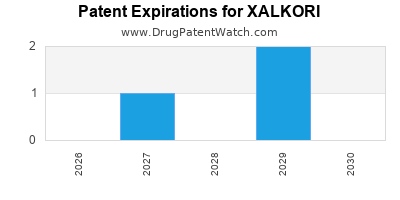
Xalkori is a drug marketed by Pf Prism Cv and is included in two NDAs. There are five patents protecting this drug.

This drug has one hundred and fifty-two patent family members in forty-eight countries.

The generic ingredient in XALKORI is crizotinib. One supplier is listed for this compound. Additional details are available on the crizotinib profile page.

DrugPatentWatch® Generic Entry Outlook for Xalkori

Xalkori was eligible for patent challenges on August 26, 2015.

By analyzing the patents and regulatory protections it appears that the earliest date for generic entry will be November 6, 2029. This may change due to patent challenges or generic licensing.

Indicators of Generic Entry

< Available with Subscription >

  Get Started Free

AI Deep Research
Questions you can ask:
  • What is the 5 year forecast for XALKORI?
  • What are the global sales for XALKORI?
  • What is Average Wholesale Price for XALKORI?
Summary for XALKORI
International Patents:152
US Patents:5
Applicants:1
NDAs:2
Finished Product Suppliers / Packagers: 1
Raw Ingredient (Bulk) Api Vendors: 74
Clinical Trials: 51
Patent Applications: 2,992
Drug Prices: Drug price information for XALKORI
What excipients (inactive ingredients) are in XALKORI?XALKORI excipients list
DailyMed Link:XALKORI at DailyMed
Drug patent expirations by year for XALKORI
Drug Prices for XALKORI

See drug prices for XALKORI

DrugPatentWatch® Estimated Loss of Exclusivity (LOE) Date for XALKORI
Generic Entry Dates for XALKORI*:
Constraining patent/regulatory exclusivity:
NDA:
Dosage:
CAPSULE;ORAL
Generic Entry Dates for XALKORI*:
Constraining patent/regulatory exclusivity:
NDA:
Dosage:
CAPSULE, PELLETS;ORAL

*The generic entry opportunity date is the latter of the last compound-claiming patent and the last regulatory exclusivity protection. Many factors can influence early or later generic entry. This date is provided as a rough estimate of generic entry potential and should not be used as an independent source.

Recent Clinical Trials for XALKORI

Identify potential brand extensions & 505(b)(2) entrants

SponsorPhase
Han Xu, M.D., Ph.D., FAPCR, Sponsor-Investigator, IRB ChairPhase 2/Phase 3
Zai Lab (Shanghai) Co., Ltd.Phase 3
Bristol-Myers SquibbPhase 3

See all XALKORI clinical trials

US Patents and Regulatory Information for XALKORI

XALKORI is protected by seven US patents and three FDA Regulatory Exclusivities.

Based on analysis by DrugPatentWatch, the earliest date for a generic version of XALKORI is ⤷  Get Started Free.

This potential generic entry date is based on patent 8,217,057.

Generics may enter earlier, or later, based on new patent filings, patent extensions, patent invalidation, early generic licensing, generic entry preferences, and other factors.

Applicant Tradename Generic Name Dosage NDA Approval Date TE Type RLD RS Patent No. Patent Expiration Product Substance Delist Req. Exclusivity Expiration
Pf Prism Cv XALKORI crizotinib CAPSULE;ORAL 202570-002 Aug 26, 2011 RX Yes Yes 8,217,057 ⤷  Get Started Free Y Y ⤷  Get Started Free
Pf Prism Cv XALKORI crizotinib CAPSULE;ORAL 202570-001 Aug 26, 2011 RX Yes No ⤷  Get Started Free ⤷  Get Started Free ⤷  Get Started Free
Pf Prism Cv XALKORI crizotinib CAPSULE;ORAL 202570-001 Aug 26, 2011 RX Yes No 8,217,057 ⤷  Get Started Free Y Y ⤷  Get Started Free
Pf Prism Cv XALKORI crizotinib CAPSULE;ORAL 202570-001 Aug 26, 2011 RX Yes No ⤷  Get Started Free ⤷  Get Started Free ⤷  Get Started Free
Pf Prism Cv XALKORI crizotinib CAPSULE;ORAL 202570-001 Aug 26, 2011 RX Yes No 7,858,643 ⤷  Get Started Free Y Y ⤷  Get Started Free
>Applicant >Tradename >Generic Name >Dosage >NDA >Approval Date >TE >Type >RLD >RS >Patent No. >Patent Expiration >Product >Substance >Delist Req. >Exclusivity Expiration

Expired US Patents for XALKORI

Applicant Tradename Generic Name Dosage NDA Approval Date Patent No. Patent Expiration
Pf Prism Cv XALKORI crizotinib CAPSULE;ORAL 202570-001 Aug 26, 2011 8,785,632 ⤷  Get Started Free
Pf Prism Cv XALKORI crizotinib CAPSULE, PELLETS;ORAL 217581-002 Sep 7, 2023 7,230,098 ⤷  Get Started Free
Pf Prism Cv XALKORI crizotinib CAPSULE, PELLETS;ORAL 217581-003 Sep 7, 2023 7,230,098 ⤷  Get Started Free
Pf Prism Cv XALKORI crizotinib CAPSULE, PELLETS;ORAL 217581-003 Sep 7, 2023 8,785,632 ⤷  Get Started Free
Pf Prism Cv XALKORI crizotinib CAPSULE, PELLETS;ORAL 217581-001 Sep 7, 2023 7,230,098 ⤷  Get Started Free
>Applicant >Tradename >Generic Name >Dosage >NDA >Approval Date >Patent No. >Patent Expiration

EU/EMA Drug Approvals for XALKORI

Company Drugname Inn Product Number / Indication Status Generic Biosimilar Orphan Marketing Authorisation Marketing Refusal
Pfizer Europe MA EEIG Xalkori crizotinib EMEA/H/C/002489XALKORI as monotherapy is indicated for:The first‑line treatment of adults with anaplastic lymphoma kinase (ALK)‑positive advanced non‑small cell lung cancer (NSCLC)The treatment of adults with previously treated anaplastic lymphoma kinase (ALK)‑positive advanced non‑small cell lung cancer (NSCLC)The treatment of adults with ROS1‑positive advanced non‑small cell lung cancer (NSCLC)The treatment of paediatric patients (age ≥6 to Authorised no no no 2012-10-23
>Company >Drugname >Inn >Product Number / Indication >Status >Generic >Biosimilar >Orphan >Marketing Authorisation >Marketing Refusal

International Patents for XALKORI

When does loss-of-exclusivity occur for XALKORI?

Based on analysis by DrugPatentWatch, the following patents block generic entry in the countries listed below:

Argentina

Patent: 7964
Estimated Expiration: ⤷  Get Started Free

Australia

Patent: 06323025
Estimated Expiration: ⤷  Get Started Free

Brazil

Patent: 0619420
Estimated Expiration: ⤷  Get Started Free

Canada

Patent: 32283
Estimated Expiration: ⤷  Get Started Free

China

Patent: 1326175
Estimated Expiration: ⤷  Get Started Free

Cyprus

Patent: 13843
Estimated Expiration: ⤷  Get Started Free

Denmark

Patent: 63302
Estimated Expiration: ⤷  Get Started Free

Hong Kong

Patent: 26477
Estimated Expiration: ⤷  Get Started Free

Israel

Patent: 1971
Estimated Expiration: ⤷  Get Started Free

Japan

Patent: 63619
Estimated Expiration: ⤷  Get Started Free

Patent: 07153893
Estimated Expiration: ⤷  Get Started Free

New Zealand

Patent: 8289
Estimated Expiration: ⤷  Get Started Free

Poland

Patent: 63302
Estimated Expiration: ⤷  Get Started Free

Portugal

Patent: 63302
Estimated Expiration: ⤷  Get Started Free

Russian Federation

Patent: 87650
Estimated Expiration: ⤷  Get Started Free

Patent: 08120338
Estimated Expiration: ⤷  Get Started Free

Slovenia

Patent: 63302
Estimated Expiration: ⤷  Get Started Free

South Africa

Patent: 0804374
Estimated Expiration: ⤷  Get Started Free

South Korea

Patent: 1146852
Estimated Expiration: ⤷  Get Started Free

Patent: 080074950
Estimated Expiration: ⤷  Get Started Free

Spain

Patent: 02419
Estimated Expiration: ⤷  Get Started Free

Taiwan

Patent: 89902
Estimated Expiration: ⤷  Get Started Free

Generics may enter earlier, or later, based on new patent filings, patent extensions, patent invalidation, early generic licensing, generic entry preferences, and other factors.

See the table below for additional patents covering XALKORI around the world.

Country Patent Number Title Estimated Expiration
Norway 20071290 ⤷  Get Started Free
Taiwan 200727899 Method of treating abnormal cell growth ⤷  Get Started Free
Iceland 7990 Amínóheteróarýl efnasambönd sem prótín kínasa hindrar ⤷  Get Started Free
China 101326175 ⤷  Get Started Free
South Africa 200700127 Enantiomerically pure aminoheteroaryl compounds as protein kinase inhibitors ⤷  Get Started Free
>Country >Patent Number >Title >Estimated Expiration

Supplementary Protection Certificates for XALKORI

Patent Number Supplementary Protection Certificate SPC Country SPC Expiration SPC Description
1786785 C300587 Netherlands ⤷  Get Started Free PRODUCT NAME: CRIZOTINIB, DESGEWENST IN DE VORM VAN EEN FARMACEUTISCH AANVAARDBAAR ZOUT, HYDRAAT OF SOLVAAT; REGISTRATION NO/DATE: EU/1/12/793/001-004 20121023
1786785 449 Finland ⤷  Get Started Free
1786785 PA2013005 Lithuania ⤷  Get Started Free PRODUCT NAME: CRIZOTINIBUM; REGISTRATION NO/DATE: EU/1/12/793/001 - EU/1/12/793/004 20121023
1786785 2013C/021 Belgium ⤷  Get Started Free DETAILS ASSIGNMENT: CHANGE OF OWNER(S), OTHER
1786785 C01786785/01 Switzerland ⤷  Get Started Free FORMER OWNER: PFIZER INC., US
>Patent Number >Supplementary Protection Certificate >SPC Country >SPC Expiration >SPC Description

Market Dynamics and Financial Trajectory for XALKORI

Last updated: July 27, 2025

Introduction

XALKORI (crizotinib) is an oral prescription medication developed by Pfizer for the treatment of ALK-positive and ROS1-positive non-small cell lung cancer (NSCLC). Since its approval in 2011, XALKORI has established a significant footprint within targeted cancer therapies, driven by evolving market demands, competitive landscape shifts, and expanding indications. This analysis explores the key market dynamics shaping XALKORI’s commercial trajectory and its financial outlook amid a rapidly transforming oncology landscape.

Market Overview

The global oncology therapeutic market has experienced exponential growth, rooted in increased cancer prevalence, advances in targeted therapies, and personalized medicine approaches. Lung cancer remains the leading cause of cancer-related mortality worldwide, with NSCLC accounting for approximately 85% of cases[1]. The identification of molecular subtypes such as ALK and ROS1 mutations has catalyzed the development of tailored therapies like XALKORI, which specifically inhibits these oncogenic drivers.

According to IQVIA, the global lung cancer drug market is projected to reach USD 26 billion by 2027, growing at a compound annual growth rate (CAGR) of approximately 12%[2]. XALKORI’s positioning within this market depends heavily on its clinical efficacy, safety profile, competition, and the increasing adoption of molecular testing.

Key Market Drivers

1. Expanding Indications and Label Expansion

Initially approved for ALK-positive metastatic NSCLC, XALKORI has received subsequent approvals for ROS1-positive NSCLC and as a first-line therapy for ALK-positive tumors. Recently, the U.S. FDA approved XALKORI for adult patients with ALK-positive metastatic NSCLC as an initial treatment based on clinical trial data demonstrating superior progression-free survival (PFS) compared to chemotherapy[3].

This broadening of indications enhances market penetration and revenue potential. Additionally, ongoing clinical trials investigating XALKORI in central nervous system (CNS) metastases and neoadjuvant settings could unlock further labels, augmenting its market value.

2. Competitive Landscape

XALKORI faces competition from next-generation ALK inhibitors such as Alectinib (by Roche/Genentech), Brigatinib (AstraZeneca), and Lorlatinib (Pfizer, successor to crizotinib). These agents, characterized by improved central nervous system (CNS) activity and resistance profiles, are increasingly preferred as first-line therapies[4].

However, XALKORI retains popularity in regions where newer agents are delayed or unavailable due to cost or logistical constraints. Its well-established safety profile and existing market presence maintain its relevance, though clinical guidelines now favor superior agents in certain scenarios.

3. Molecular Diagnostics and Patient Identification

The growth of companion diagnostics is integral to XALKORI’s success. Accurate, cost-effective molecular testing ensures appropriate patient selection, directly impacting sales volume. The proliferation of Next-Generation Sequencing (NGS) panels enhances detection rates of ALK and ROS1 mutations, facilitating timely therapy initiation.

4. Pricing and Reimbursement Dynamics

Pricing strategies influence market penetration, especially in cost-sensitive regions. In the U.S., XALKORI's launch price was approximately USD 11,000 per month[5], with price adjustments over time. Insurance coverage and reimbursement policies significantly impact access, especially where biosimilars or alternative treatments are available.

The evolution of value-based pricing models and biosimilar entry post-patent expiry could modulate XALKORI’s revenue stream. As Pfizer’s patent protection expires in key territories around 2027, generic or biosimilar competition is anticipated, exerting downward pressure on pricing.

Financial Trajectory and Revenue Projections

Historical Performance

Pfizer's oncology portfolio, including XALKORI, contributed appreciably to revenue, with annual sales reaching USD 750 million in 2021[6]. While XALKORI’s sales experienced growth fueled by expanded indications, the advent of competition has tempered its trajectory in recent years.

In 2022, XALKORI sales declined marginally, reflecting competition and evolving treatment paradigms. Nonetheless, continued growth in emerging markets and indications could bolster revenue.

Forecasting Future Revenue

Several factors influence future financial performance:

  • Market Penetration: Increased adoption in line with guidelines emphasizing molecular testing. The expansion of clinical indications in earlier lines of therapy will also deepen market penetration.

  • Competition pressures: The entry of next-generation inhibitors that offer improved efficacy and resistance profiles may erode XALKORI’s market share, especially in first-line settings.

  • Patent expiration and biosimilar competition: Patent expiry around 2027 opens opportunities for biosimilars, likely resulting in substantial price erosion.

  • Geographic expansion: Emerging markets, where molecular diagnostics are gaining traction, present growth opportunities, albeit at lower price points.

  • Regulatory and clinical developments: Approval of novel combinations or diagnostic tools could extend XALKORI’s lifecycle, positively impacting sales.

Given these dynamics, industry analysts project a gradual decline in peak sales over the next five years, but with potential stabilization in select markets due to value-added indications and diagnostics. A conservative estimate suggests that Pfizer could see XALKORI generate USD 300–500 million annually by 2025, declining further post-patent expiry but with possible revenue from biosimilar adoption.

Strategic Considerations

Pfizer's strategic focus includes diversifying the portfolio through next-generation ALK inhibitors, combination therapies, and exploring indications beyond NSCLC—such as ROS1-positive non-small cell cancers and neuroblastoma. These efforts aim to offset revenue declines associated with patent expiry.

Additionally, investing in companion diagnostics and expanding global access, particularly in emerging markets, remains crucial for maintaining market share.

Challenges and Opportunities

  • Resistance Mechanisms: Resistance mutations diminish long-term efficacy; developing third-generation inhibitors or combination strategies could sustain relevance.

  • Guideline Shifts: Evolving clinical guidelines favor newer agents, necessitating strategic repositioning or co-development.

  • Pricing Pressures: Biosimilar entry post-2027 will challenge profitability, urging Pfizer to explore value-based pricing models.

  • Regulatory Approvals: New indications or combination approvals can stimulate sales, offering revenue diversification.

Conclusion

XALKORI remains a pivotal targeted therapy in ALK-positive and ROS1-positive NSCLC. While current market dynamics favor newer inhibitors with improved profiles, XALKORI’s established clinical foundation and ongoing indications ensure steady revenue streams. The impending patent expiry necessitates strategic adaptation to sustain financial performance, including investments in next-generation therapies and diagnostic integration.

Pfizer’s ability to innovate within its oncology portfolio, leverage expanding diagnostics, and adapt to competitive pressures will shape XALKORI’s long-term financial trajectory.

Key Takeaways

  • XALKORI’s market success hinges on its expanding indications, clinical efficacy, and diagnostic integration, amidst stiff competition from next-generation ALK inhibitors.
  • The global oncology market's growth, particularly for lung cancer therapies, provides a fertile environment for continued sales, especially in emerging markets.
  • Patent expiration around 2027 poses significant price erosion risks; biosimilar competition is imminent, demanding strategic pivots.
  • Continued innovation in combination therapies and diagnostic tools presents opportunities to extend XALKORI’s relevance.
  • Pfizer’s diversification into next-generation ALK inhibitors and other targeted therapies aims to buffer revenue declines from XALKORI’s impending patent cliff.

FAQs

1. When is XALKORI's patent expected to expire, and what are the implications?
Pfizer's patent protection for XALKORI is anticipated to expire around 2027 in key markets. Post-expiry, biosimilar competition is expected to lead to significant price reductions, impacting revenue streams.

2. How does XALKORI compare to other ALK inhibitors in clinical efficacy?
While XALKORI was the first approved ALK inhibitor and remains effective, newer agents like Alectinib and Lorlatinib demonstrate superior CNS penetration and resistance profiles, often becoming preferred first-line options.

3. What role do diagnostics play in XALKORI's market success?
Molecular diagnostic testing is crucial for identifying eligible patients, directly influencing treatment initiation rates. The proliferation of NGS panels increases detection of ALK and ROS1 mutations, expanding XALKORI’s potential market.

4. Are there ongoing clinical developments that could impact XALKORI?
Yes, ongoing trials investigating XALKORI in combination therapies, in CNS metastases, and other indications may extend its use. However, competition from next-generation inhibitors remains a primary concern.

5. How is Pfizer positioning XALKORI amid emerging competition?
Pfizer is diversifying its portfolio with subsequent ALK inhibitors like Lorlatinib, investing in diagnostics, and exploring new indications to prolong XALKORI’s market relevance and financial sustainability.


References

  1. Global Cancer Observatory (GCO). (2022). Estimated Incidence of Lung and Bronchus Cancers.
  2. IQVIA. (2022). The Future of Oncology Market Report.
  3. U.S. Food & Drug Administration (FDA). (2021). FDA Approves XALKORI for First-Line Treatment of ALK-Positive Metastatic Non-Small Cell Lung Cancer.
  4. Shaw AT, et al. (2020). Diagnosis and management of ALK-positive non-small cell lung cancer. N Engl J Med.
  5. Price List, Pfizer Inc. (2022).
  6. Pfizer Earnings Reports. (2021).

More… ↓

⤷  Get Started Free

Make Better Decisions: Try a trial or see plans & pricing

Drugs may be covered by multiple patents or regulatory protections. All trademarks and applicant names are the property of their respective owners or licensors. Although great care is taken in the proper and correct provision of this service, thinkBiotech LLC does not accept any responsibility for possible consequences of errors or omissions in the provided data. The data presented herein is for information purposes only. There is no warranty that the data contained herein is error free. We do not provide individual investment advice. This service is not registered with any financial regulatory agency. The information we publish is educational only and based on our opinions plus our models. By using DrugPatentWatch you acknowledge that we do not provide personalized recommendations or advice. thinkBiotech performs no independent verification of facts as provided by public sources nor are attempts made to provide legal or investing advice. Any reliance on data provided herein is done solely at the discretion of the user. Users of this service are advised to seek professional advice and independent confirmation before considering acting on any of the provided information. thinkBiotech LLC reserves the right to amend, extend or withdraw any part or all of the offered service without notice.