Last Updated: October 1, 2026

WINLEVI Drug Patent Profile


✉ Email this page to a colleague

« Back to Dashboard


When do Winlevi patents expire, and when can generic versions of Winlevi launch?

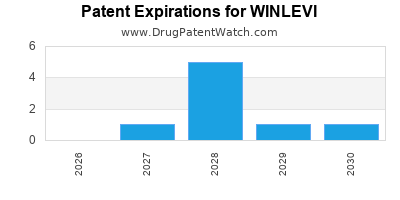
Winlevi is a drug marketed by Sun Pharm and is included in one NDA. There are eight patents protecting this drug and one Paragraph IV challenge.

The generic ingredient in WINLEVI is clascoterone. There is one drug master file entry for this compound. One supplier is listed for this compound. Additional details are available on the clascoterone profile page.

DrugPatentWatch® Generic Entry Outlook for Winlevi

Winlevi was eligible for patent challenges on August 26, 2024.

By analyzing the patents and regulatory protections it appears that the earliest date for generic entry will be July 25, 2030. This may change due to patent challenges or generic licensing.

There have been three patent litigation cases involving the patents protecting this drug, indicating strong interest in generic launch. Recent data indicate that 63% of patent challenges are decided in favor of the generic patent challenger and that 54% of successful patent challengers promptly launch generic drugs.

Indicators of Generic Entry

< Available with Subscription >

  Start Trial

AI Deep Research
Questions you can ask:
  • What is the 5 year forecast for WINLEVI?
  • What are the global sales for WINLEVI?
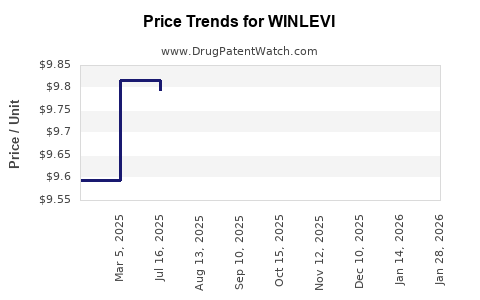
  • What is Average Wholesale Price for WINLEVI?
DrugPatentWatch® Estimated Loss of Exclusivity (LOE) Date for WINLEVI
Generic Entry Date for WINLEVI*:
Constraining patent/regulatory exclusivity:
NDA:
Dosage:

CREAM;TOPICAL

*The generic entry opportunity date is the latter of the last compound-claiming patent and the last regulatory exclusivity protection. Many factors can influence early or later generic entry. This date is provided as a rough estimate of generic entry potential and should not be used as an independent source.

Recent Clinical Trials for WINLEVI

Identify potential brand extensions & 505(b)(2) entrants

SponsorPhase
Sun Pharmaceutical Industries LimitedPHASE2
Narrows Institute for Biomedical ResearchPHASE2
Sun Pharmaceutical Industries LimitedPHASE4

See all WINLEVI clinical trials

Pharmacology for WINLEVI
Paragraph IV (Patent) Challenges for WINLEVI
Tradename Dosage Ingredient Strength NDA ANDAs Submitted Submissiondate
WINLEVI Cream clascoterone 1% 213433 1 2024-08-26

US Patents and Regulatory Information for WINLEVI

WINLEVI is protected by eight US patents.

Based on analysis by DrugPatentWatch, the earliest date for a generic version of WINLEVI is ⤷  Start Trial.

This potential generic entry date is based on patent ⤷  Start Trial.

Generics may enter earlier, or later, based on new patent filings, patent extensions, patent invalidation, early generic licensing, generic entry preferences, and other factors.

Applicant Tradename Generic Name Dosage NDA Approval Date TE Type RLD RS Patent No. Patent Expiration Product Substance Delist Req. Exclusivity Expiration
Sun Pharm WINLEVI clascoterone CREAM;TOPICAL 213433-001 Aug 26, 2020 RX Yes Yes ⤷  Start Trial ⤷  Start Trial Y ⤷  Start Trial
Sun Pharm WINLEVI clascoterone CREAM;TOPICAL 213433-001 Aug 26, 2020 RX Yes Yes ⤷  Start Trial ⤷  Start Trial ⤷  Start Trial
Sun Pharm WINLEVI clascoterone CREAM;TOPICAL 213433-001 Aug 26, 2020 RX Yes Yes ⤷  Start Trial ⤷  Start Trial Y ⤷  Start Trial
Sun Pharm WINLEVI clascoterone CREAM;TOPICAL 213433-001 Aug 26, 2020 RX Yes Yes ⤷  Start Trial ⤷  Start Trial ⤷  Start Trial
>Applicant >Tradename >Generic Name >Dosage >NDA >Approval Date >TE >Type >RLD >RS >Patent No. >Patent Expiration >Product >Substance >Delist Req. >Exclusivity Expiration

International Patents for WINLEVI

When does loss-of-exclusivity occur for WINLEVI?

Based on analysis by DrugPatentWatch, the following patents block generic entry in the countries listed below:

Argentina

Patent: 2235
Estimated Expiration: ⤷  Start Trial

Patent: 1202
Estimated Expiration: ⤷  Start Trial

Patent: 1351
Estimated Expiration: ⤷  Start Trial

Australia

Patent: 08285784
Estimated Expiration: ⤷  Start Trial

Brazil

Patent: 0814163
Estimated Expiration: ⤷  Start Trial

Canada

Patent: 91445
Estimated Expiration: ⤷  Start Trial

Patent: 71025
Estimated Expiration: ⤷  Start Trial

Patent: 71039
Estimated Expiration: ⤷  Start Trial

China

Patent: 1743316
Estimated Expiration: ⤷  Start Trial

Patent: 3450304
Estimated Expiration: ⤷  Start Trial

Patent: 4861023
Estimated Expiration: ⤷  Start Trial

Croatia

Patent: 0140421
Estimated Expiration: ⤷  Start Trial

Patent: 0151174
Estimated Expiration: ⤷  Start Trial

Patent: 0151298
Estimated Expiration: ⤷  Start Trial

Patent: 0191143
Estimated Expiration: ⤷  Start Trial

Denmark

Patent: 73891
Estimated Expiration: ⤷  Start Trial

Patent: 03004
Estimated Expiration: ⤷  Start Trial

Patent: 03005
Estimated Expiration: ⤷  Start Trial

Patent: 66175
Estimated Expiration: ⤷  Start Trial

European Patent Office

Patent: 73891
Estimated Expiration: ⤷  Start Trial

Patent: 03004
Estimated Expiration: ⤷  Start Trial

Patent: 03005
Estimated Expiration: ⤷  Start Trial

Patent: 66175
Estimated Expiration: ⤷  Start Trial

Patent: 21298
Estimated Expiration: ⤷  Start Trial

Finland

Patent: 0250037
Estimated Expiration: ⤷  Start Trial

France

Patent: C1053
Estimated Expiration: ⤷  Start Trial

Hungary

Patent: 26206
Estimated Expiration: ⤷  Start Trial

Patent: 26507
Estimated Expiration: ⤷  Start Trial

Patent: 44237
Estimated Expiration: ⤷  Start Trial

Patent: 500052
Estimated Expiration: ⤷  Start Trial

Italy

Patent: 20071616
Estimated Expiration: ⤷  Start Trial

Japan

Patent: 46992
Estimated Expiration: ⤷  Start Trial

Patent: 08944
Estimated Expiration: ⤷  Start Trial

Patent: 74645
Estimated Expiration: ⤷  Start Trial

Patent: 10535173
Estimated Expiration: ⤷  Start Trial

Patent: 13163683
Estimated Expiration: ⤷  Start Trial

Patent: 16014045
Estimated Expiration: ⤷  Start Trial

Lithuania

Patent: 66175
Estimated Expiration: ⤷  Start Trial

Mexico

Patent: 3238
Estimated Expiration: ⤷  Start Trial

Patent: 3701
Estimated Expiration: ⤷  Start Trial

Patent: 1802
Estimated Expiration: ⤷  Start Trial

Patent: 10001256
Estimated Expiration: ⤷  Start Trial

Patent: 19003639
Estimated Expiration: ⤷  Start Trial

Netherlands

Patent: 1358
Estimated Expiration: ⤷  Start Trial

New Zealand

Patent: 9437
Estimated Expiration: ⤷  Start Trial

Patent: 0767
Estimated Expiration: ⤷  Start Trial

Patent: 5953
Estimated Expiration: ⤷  Start Trial

Norway

Patent: 25055
Estimated Expiration: ⤷  Start Trial

Poland

Patent: 73891
Estimated Expiration: ⤷  Start Trial

Patent: 03004
Estimated Expiration: ⤷  Start Trial

Patent: 03005
Estimated Expiration: ⤷  Start Trial

Patent: 66175
Estimated Expiration: ⤷  Start Trial

Portugal

Patent: 73891
Estimated Expiration: ⤷  Start Trial

Patent: 03004
Estimated Expiration: ⤷  Start Trial

Patent: 03005
Estimated Expiration: ⤷  Start Trial

Patent: 66175
Estimated Expiration: ⤷  Start Trial

Russian Federation

Patent: 82190
Patent: КРИСТАЛЛИЧЕСКИЕ ФОРМЫ КОРТЕКСОЛОН-17α-ПРОПИОНАТА И СПОСОБЫ ИХ ПОЛУЧЕНИЯ (CRYSTALLINE FORMS OF CORTEXOLONE-17?-PROPIONATE AND METHOD FOR PREPARING THEM)
Estimated Expiration: ⤷  Start Trial

Patent: 99452
Patent: КРИСТАЛЛИЧЕСКАЯ СОЛЬВАТНАЯ ФОРМА КОРТЕКСОЛОН-17альфа-ПРОПИОНАТА, СПОСОБ ЕЕ ПОЛУЧЕНИЯ И ФАРМАЦЕВТИЧЕСКАЯ КОМПОЗИЦИЯ НА ЕЕ ОСНОВЕ (CRYSTALLINE SOLVATE FORM OF CORTEXOLONE-17alpha-PROPIONATE, A PREPARATION METHOD THEREOF AND A PHARMACEUTICAL COMPOSITION BASED THEREON)
Estimated Expiration: ⤷  Start Trial

Patent: 10107599
Patent: ФЕРМЕНТАТИВНЫЙ СПОСОБ ПОЛУЧЕНИЯ 17-МОНОЭФИРОВ КОРТЕКСОЛОНА И/ИЛИ ИХ 9,11-ДЕГИДРОПРОИЗВОДНЫХ (CRYSTALLINE FORMS OF CORTEXOLONE-17?-PROPIONATE AND METHOD FOR PREPARING THEM)
Estimated Expiration: ⤷  Start Trial

Patent: 12113839
Patent: КРИСТАЛЛИЧЕСКАЯ СОЛЬВАТНАЯ ФОРМА КОРТЕКСОЛОН-17АЛЬФА-ПРОПИОНАТА И СПОСОБ ЕЕ ПОЛУЧЕНИЯ (CRYSTALLINE SOLVATE FORM OF CORTEXOLONE-17alpha-PROPIONATE, A PREPARATION METHOD THEREOF AND A PHARMACEUTICAL COMPOSITION BASED THEREON)
Estimated Expiration: ⤷  Start Trial

Serbia

Patent: 310
Patent: ENZIMATSKI POSTUPAK ZA DOBIJANJE KORTEKSOLON-17-ALFA-PROPIONATA U KRISTALNOM OBLIKU III (ENZYMATIC PROCESS FOR OBTAINING CORTEXOLONE-17-ALPHA-PROPIONATE IN CRYSTALLINE FORM III)
Estimated Expiration: ⤷  Start Trial

Patent: 354
Patent: KORTEKSOLON-17ALFA-PROPIONAT U KRISTALNOM OBLIKU I (CORTEXOLONE-17ALPHA-PROPIONATE IN CRYSTALLINE FORM I)
Estimated Expiration: ⤷  Start Trial

Patent: 361
Patent: KORTEKSOLON-17ALFA-PROPIONAT U KRISTALNOM HIDRATNOM OBLIKU IV (CORTEXOLONE-17ALPHA-PROPIONATE IN HYDRATE CRYSTALLINE FORM IV)
Estimated Expiration: ⤷  Start Trial

Patent: 950
Patent: FARMACEUTSKE KOMPOZICIJE KOJE SADRŽE KORTEKSOLON-17-ALFA-PROPIONAT (PHARMACEUTICAL COMPOSITIONS CONTAINING CORTEXOLONE-17-ALPHA-PROPIONATE)
Estimated Expiration: ⤷  Start Trial

Slovenia

Patent: 73891
Estimated Expiration: ⤷  Start Trial

Patent: 03004
Estimated Expiration: ⤷  Start Trial

Patent: 03005
Estimated Expiration: ⤷  Start Trial

Patent: 66175
Estimated Expiration: ⤷  Start Trial

South Africa

Patent: 1000587
Patent: ENZYMATIC PROCESS FOR OBTAINING 17 ALPHA-MONOESTERS OF CORTEXOLONE AND/OR ITS 9,11-DEHYDRODERIVATIVES
Estimated Expiration: ⤷  Start Trial

Patent: 1100133
Patent: ENZYMATIC PROCESS FOR OBTAINING 17 ALPHA-MONOESTERS OF CORTEXOLONE AND/OR ITS 9,11-DEHYDRODERIVATIVES
Estimated Expiration: ⤷  Start Trial

South Korea

Patent: 1495192
Estimated Expiration: ⤷  Start Trial

Patent: 100044845
Estimated Expiration: ⤷  Start Trial

Spain

Patent: 62946
Estimated Expiration: ⤷  Start Trial

Patent: 51910
Estimated Expiration: ⤷  Start Trial

Patent: 54934
Estimated Expiration: ⤷  Start Trial

Patent: 32326
Estimated Expiration: ⤷  Start Trial

Turkey

Patent: 1909129
Estimated Expiration: ⤷  Start Trial

Generics may enter earlier, or later, based on new patent filings, patent extensions, patent invalidation, early generic licensing, generic entry preferences, and other factors.

See the table below for additional patents covering WINLEVI around the world.

Country Patent Number Title Estimated Expiration
Argentina 072235 ⤷  Start Trial
Argentina 111202 ⤷  Start Trial
Argentina 111351 ⤷  Start Trial
Australia 2008285784 ⤷  Start Trial
Brazil PI0814163 ⤷  Start Trial
Canada 2691445 ⤷  Start Trial
>Country >Patent Number >Title >Estimated Expiration

Supplementary Protection Certificates for WINLEVI

Patent Number Supplementary Protection Certificate SPC Country SPC Expiration SPC Description
2503005 C20250037 Finland ⤷  Start Trial
2503005 CA 2025 00047 Denmark ⤷  Start Trial PRODUCT NAME: CLASCOTERONE AND CRYSTALLINE FORMS THEREOF; REG. NO/DATE: EU/1/25/1927 20251017
2503005 301358 Netherlands ⤷  Start Trial PRODUCT NAME: CLASCOTERON; REGISTRATION NO/DATE: EU/1/25/1927 20251021
2503005 2025C/551 Belgium ⤷  Start Trial PRODUCT NAME: CLASCOTERON EN KRISTALLIJNE VORMEN DAARVAN; AUTHORISATION NUMBER AND DATE: EU/1/25/1927 20251021
2503005 CR 2025 00047 Denmark ⤷  Start Trial PRODUCT NAME: CLASCOTERONE AND CRYSTALLINE FORMS THEREOF; REG. NO/DATE: EU/1/25/1927 20251017
2503005 854 Finland ⤷  Start Trial
>Patent Number >Supplementary Protection Certificate >SPC Country >SPC Expiration >SPC Description

WINLEVI Market Dynamics, Financial Trajectory, Patent Position, and Generic Risk

Last updated: August 18, 2026

WINLEVI, a 1% clascoterone cream marketed by Sun Pharmaceutical Industries, is the first FDA-approved topical androgen-receptor inhibitor for acne vulgaris. Its commercial opportunity depends on converting patients from established generic topical therapies, maintaining reimbursement despite a branded price, and expanding clascoterone into additional dermatology indications.

The product has a differentiated mechanism and a long patent runway relative to its 2021 U.S. launch. Its main commercial constraints are payer coverage, physician adoption, the low cost of generic acne treatments, and the absence of a currently approved second indication. Sun Pharma has not publicly reported a fully separated WINLEVI revenue line in its consolidated filings, making external prescription and partner disclosures more useful than audited brand-level revenue.

What is WINLEVI and how does clascoterone work?

WINLEVI is a topical cream containing 1% clascoterone, also known as cortexolone 17-alpha-propionate. The FDA approved it on August 27, 2020, for the topical treatment of acne vulgaris in patients aged 12 years and older. Sun Pharma launched the product in the United States in late 2021.[1,2]

Clascoterone acts locally as an androgen receptor inhibitor. Androgen signaling contributes to sebaceous gland activity and acne-related inflammation. WINLEVI is therefore positioned differently from:

  • Retinoids such as tretinoin and adapalene, which regulate keratinization.
  • Benzoyl peroxide, which reduces Cutibacterium acnes and inflammation.
  • Topical antibiotics, which face resistance and duration-of-use limitations.
  • Oral isotretinoin, which is reserved for severe or refractory acne.

The product is used twice daily as a thin layer to affected areas. Its topical route allows Sun Pharma to target patients and prescribers seeking a non-antibiotic, non-retinoid acne treatment.[1]

How large is the WINLEVI market?

WINLEVI competes in a large acne-treatment market, but its addressable branded segment is much smaller than the total acne population.

Acne affects a substantial majority of adolescents and many adults, yet most patients receive low-cost generic therapy. The commercial market is segmented by disease severity, age, sex, treatment tolerance, insurance status, and willingness to pay for newer products.

WINLEVI’s target market

The strongest commercial segments are likely to include:

  1. Patients with inadequate response to generic retinoids or benzoyl peroxide.
  2. Patients who cannot tolerate retinoid irritation.
  3. Patients requiring a non-antibiotic topical option.
  4. Adult women with hormonally influenced acne.
  5. Dermatology patients receiving combination regimens.

WINLEVI is less likely to replace first-line generic therapy across the entire acne market. Its practical role is as an add-on or switch product for patients with persistent disease, tolerability problems, or a preference for a newer branded treatment.

Market access and pricing

The product’s commercial performance is highly sensitive to formulary placement. Generic tretinoin, adapalene, and benzoyl peroxide are inexpensive, while WINLEVI carries a branded prescription price. Insurance coverage, prior authorization, copay assistance, and pharmacy substitution therefore affect demand materially.

Sun Pharma has used commercial support programs and patient savings initiatives to reduce out-of-pocket costs. These measures can increase prescription volume but may reduce realized net price. The financial model depends on the balance between gross prescription growth, payer rebates, patient assistance, and specialty-pharmacy economics.

What are WINLEVI’s reported sales and financial trajectory?

Sun Pharma’s public financial reporting does not consistently provide a separate audited WINLEVI net-sales line. The company reports broader U.S. specialty, dermatology, and branded portfolios, while Cassiopea and Cosmo have disclosed partner-related economics in their corporate reporting.

The available financial picture indicates a product in commercial ramp-up rather than a mature branded franchise.

Indicator Commercial implication
FDA approval Established regulatory validity for acne
U.S. launch Began in late 2021
Revenue stage Early growth product during the first commercial years
Reporting structure Brand-level revenue is not consistently separated by Sun Pharma
Principal growth driver New patient starts and dermatologist adoption
Main pressure Generic substitution and payer controls
Long-term upside Additional clascoterone indications, particularly hair loss

Cosmo’s disclosures identify WINLEVI-related royalties and commercial economics as a contributor to the Cassiopea business. Those disclosures confirm product monetization but do not provide a complete public substitute for Sun Pharma’s U.S. brand sales because royalty revenue is only a percentage of underlying product sales.[3,4]

Revenue trajectory scenarios

Base case

WINLEVI grows through gradual dermatologist adoption and repeat use, but remains a specialty dermatology product. Growth moderates as the early-adopter pool declines and payers impose tighter controls.

Upside case

Sun Pharma expands coverage, improves patient affordability, increases combination use, and obtains approval for a second indication. A hair-loss indication would materially enlarge the opportunity because androgen signaling is central to androgenetic alopecia.

Downside case

Payers place WINLEVI behind generic retinoids and benzoyl peroxide. Patients discontinue because of cost or limited incremental benefit. Prescribers reserve the product for later-line use, limiting annual treatment volume.

What patents protect WINLEVI?

WINLEVI’s intellectual-property position includes formulation, composition, and use-based protection around topical clascoterone. The FDA Orange Book is the primary reference for patents listed against NDA 213433.[5]

Core patent protection

The commonly cited core U.S. patent for WINLEVI is U.S. Patent No. 10,881,659. Public patent databases and commercial patent analyses associate this patent with protection extending into 2032, before any patent-term adjustment or extension analysis.[6]

The patent estate is important because the product has no conventional small-molecule NCE exclusivity remaining after the FDA’s five-year exclusivity period. The NCE period is expected to expire in August 2025, subject to the precise FDA regulatory exclusivity record and any applicable pediatric extension.[1,5]

Protection type WINLEVI relevance
FDA approval August 27, 2020
NCE exclusivity Expected to run through August 2025
Core composition/formulation patent Extends into the early 2030s based on publicly cited patent data
Orange Book Relevant for ANDA patent-certification and Paragraph IV analysis
Method-of-use rights Potentially relevant to acne treatment and later indications
Geographic scope U.S. rights are commercially controlled through Sun Pharma’s agreement with Cassiopea

The exact enforceability of the estate depends on claim scope, prosecution history, terminal disclaimers, patent-term adjustment, Orange Book listings, and any later-issued patents. A listed patent does not guarantee market exclusivity if an ANDA applicant succeeds in litigation or obtains a favorable non-infringement or invalidity outcome.

What is the Orange Book status of WINLEVI?

WINLEVI is approved under NDA 213433. The Orange Book identifies the approved drug product and any patents submitted by the NDA holder for listing.[1,5]

The NCE exclusivity period is separate from patent protection. Once NCE exclusivity expires, an ANDA applicant may be able to file a generic application, subject to the certifications required for listed patents.

Potential ANDA pathways include:

  • Paragraph I certification if no patent is listed.
  • Paragraph II certification if a listed patent has expired.
  • Paragraph III certification accepting delayed launch until patent expiration.
  • Paragraph IV certification asserting that a listed patent is invalid, unenforceable, or not infringed.

For WINLEVI, Paragraph IV activity would be commercially meaningful because the product’s differentiation is concentrated in the active ingredient, formulation, and topical delivery system. Generic competition could emerge before the stated patent expiry if the applicant prevails in litigation or reaches a settlement permitting an earlier launch.

When does WINLEVI lose exclusivity?

WINLEVI does not lose all exclusivity on one date.

The key dates are:

Event Timing
FDA approval August 27, 2020
Commercial launch Late 2021
Expected NCE expiration August 2025
Core patent expiration commonly cited April 2032, before any applicable adjustment
Potential generic entry After patent settlement, litigation victory, or patent expiry

NCE expiry is the earliest major regulatory opening for ANDA filing and potential Paragraph IV challenges. It does not itself authorize immediate generic launch if valid listed patents remain in force.

A patent-term extension, pediatric exclusivity, patent-term adjustment, litigation stay, or settlement could change the effective date. The commercial generic-entry date will depend on the Orange Book record and any court or settlement outcome.

Which companies are challenging WINLEVI?

No major public Paragraph IV challenge or material WINLEVI patent litigation was identified in the principal public FDA, company, and litigation disclosures reviewed through mid-2024.

The most likely future challengers are large generic dermatology companies with topical manufacturing capabilities, including firms such as Viatris, Teva, Sandoz, Perrigo, Amneal, and privately held topical manufacturers. A challenge would require more than reproducing clascoterone as an active ingredient. The applicant would need to address the cream formulation, bioequivalence pathway, manufacturing controls, and listed patent claims.

The absence of a disclosed challenge does not eliminate future risk. The NCE expiry in 2025 creates a natural point for ANDA filings and Paragraph IV certifications.

What formulations are protected by WINLEVI patents?

WINLEVI’s formulation is commercially important because clascoterone is delivered as a topical 1% cream rather than an oral androgen receptor inhibitor.

Formulation-related barriers can include:

  • Concentration of clascoterone.
  • Cream vehicle and excipient composition.
  • Drug uniformity and physical stability.
  • Release and permeation characteristics.
  • Manufacturing process and scale-up controls.
  • Container-closure compatibility.
  • Microbiological quality and shelf life.

A generic applicant may challenge formulation claims even if it does not copy every excipient. The scope of any resulting litigation would turn on claim construction and whether the proposed generic falls within the listed claims.

Does WINLEVI have method-of-use or hair-loss patent value?

WINLEVI’s approved indication is acne vulgaris. Clascoterone has also been investigated for androgenetic alopecia, commonly called male-pattern hair loss. Hair-loss development could create a second commercial pathway and extend the value of the active ingredient beyond acne.

The hair-loss opportunity is strategically important because:

  • The patient population is substantially larger than the prescription acne segment.
  • Treatment is chronic, supporting recurring revenue.
  • Androgen receptor biology is directly relevant to the disease.
  • A second indication could support new method-of-use patents and regulatory exclusivity.
  • Dermatologists already familiar with WINLEVI would be a natural prescriber base.

Cassiopea and Cosmo have reported development work involving clascoterone for scalp hair loss. Approval is not guaranteed, and a successful hair-loss program would require separate clinical, regulatory, manufacturing, and commercial execution.[3,4]

How does WINLEVI compare with competing acne drugs?

Product or class Mechanism Status Commercial advantage Main limitation
WINLEVI Topical androgen receptor inhibition Branded FDA-approved product Novel mechanism, non-antibiotic Cost and limited brand history
Tretinoin Retinoid Mostly generic Low price, established efficacy Irritation and adherence
Adapalene Retinoid Generic and OTC Broad access, low price Irritation and variable response
Benzoyl peroxide Antimicrobial and keratolytic Generic and OTC Low cost, familiar use Dryness and irritation
Topical clindamycin Antibiotic Generic Familiar physician use Resistance concerns
Spironolactone Oral antiandrogen Generic, off-label for acne Low cost, useful in selected women Systemic exposure and monitoring
Isotretinoin Oral retinoid Generic Strong efficacy in severe acne Significant safety and monitoring burden

WINLEVI’s strongest competitive claim is mechanism differentiation. Its weakest point is economic substitution: most competing treatments are inexpensive, familiar, and supported by long clinical experience.

What manufacturing and intellectual-property barriers affect generic entry?

Topical generic drugs can be more difficult to develop than simple oral tablets. A potential WINLEVI generic must demonstrate pharmaceutical equivalence and satisfy FDA requirements for topical product performance.

Relevant barriers include:

  • Complex semisolid formulation development.
  • Demonstration of comparable active-ingredient distribution.
  • Manufacturing consistency across batches.
  • In vitro release testing and, where required, clinical or pharmacokinetic studies.
  • Stability under commercial storage conditions.
  • Facility inspection and quality-system compliance.
  • Patent risk involving composition, formulation, and use claims.

These barriers can delay competition, but they are not equivalent to biologic barriers. WINLEVI is a small-molecule topical product, so it does not have biosimilar risk in the technical sense. The relevant threat is ANDA-based generic competition, not a 351(k) biosimilar pathway.

What licensing deals govern WINLEVI?

Cassiopea developed clascoterone and licensed U.S. and Canadian commercial rights to Sun Pharma. Sun Pharma is responsible for commercializing WINLEVI in the United States, while Cassiopea and its parent Cosmo participate through milestone, royalty, and related economic arrangements disclosed in company filings.[3,4]

The arrangement gives Sun Pharma control over the commercial launch and distribution platform. It gives Cassiopea and Cosmo exposure to product growth without bearing the full cost of U.S. commercialization.

The strategic value of the agreement depends on:

  • Royalty rates and milestone obligations.
  • Sun Pharma’s promotional investment.
  • Geographic rights outside the United States and Canada.
  • Development responsibility for hair-loss indications.
  • Ownership of follow-on patents and formulations.
  • Termination and reversion provisions.

What generic entry risks exist for WINLEVI?

The generic-entry risk is moderate in the near term and rises after NCE expiry.

Near-term risk

Before the core patent expiry, a generic entrant would likely need to challenge listed patents or negotiate a settlement. The absence of publicly identified litigation through mid-2024 reduces immediate disruption risk but does not eliminate filing risk after August 2025.

Medium-term risk

The first Paragraph IV challenge could trigger the statutory 30-month stay for the relevant ANDA, assuming the patent holder brings timely litigation. The stay would delay approval, not necessarily prevent a generic launch after the applicable period.

Long-term risk

If the core patent survives through 2032 and no settlement permits earlier entry, WINLEVI could retain a protected U.S. market for more than a decade after launch. If formulation and method-of-use claims are weak, generic manufacturers could obtain earlier entry by designing around individual claims.

How strong is the WINLEVI patent estate?

WINLEVI has a stronger position than a product protected only by regulatory exclusivity because its commercial protection extends through listed patent rights into the early 2030s. Its estate is less secure than a broad composition-of-matter estate covering a new molecular entity across multiple formulations and indications.

The principal strengths are:

  • Novel active ingredient in an approved acne product.
  • Distinct topical mechanism.
  • Formulation and use-based protection.
  • Sun Pharma’s established U.S. dermatology infrastructure.
  • Potential follow-on value in hair loss.

The principal weaknesses are:

  • Generic applicants can target a small-molecule topical product through the ANDA pathway.
  • The total patent estate appears narrower than those of blockbuster systemic drugs with multiple composition, formulation, and manufacturing patents.
  • The commercial product currently relies heavily on one approved indication.
  • Generic acne alternatives are widely available at low cost.

Key Takeaways

  • WINLEVI is the first FDA-approved topical androgen receptor inhibitor for acne.
  • Sun Pharma launched it in the United States in late 2021 under rights licensed from Cassiopea.
  • Brand-level Sun Pharma revenue is not consistently disclosed, but partner disclosures indicate an active royalty-generating commercial product.
  • The product’s commercial growth depends on payer coverage, patient affordability, and dermatologist adoption.
  • NCE exclusivity is expected to expire in August 2025.
  • The principal publicly cited U.S. patent extends into the early 2030s, commonly reported to April 2032 before any adjustment.
  • No major public Paragraph IV challenge was identified through mid-2024.
  • WINLEVI faces generic rather than biosimilar risk.
  • Hair-loss development is the main potential catalyst for a larger market and additional intellectual-property value.
  • Generic competition is unlikely to be immediate solely because NCE exclusivity expires, but ANDA filings and Paragraph IV litigation risk increase from 2025 onward.

FAQs

Is WINLEVI a biologic or a small-molecule drug?

WINLEVI is a small-molecule topical drug containing clascoterone. Future competition would use the ANDA generic pathway rather than the FDA biosimilar pathway.

Is clascoterone approved for hair loss?

No. WINLEVI is FDA-approved for acne vulgaris. Clascoterone has been investigated for androgenetic alopecia, but that use requires separate regulatory approval.

Can WINLEVI be substituted automatically by a generic?

Automatic substitution generally depends on an FDA-approved therapeutically equivalent generic and state pharmacy-substitution rules. No approved generic substitution was identified in the reviewed public records through mid-2024.

What is the principal investment risk for WINLEVI?

The main risk is slower-than-expected branded adoption because patients and payers can substitute low-cost generic acne therapies. The next major legal risk is a Paragraph IV challenge after NCE exclusivity expires.

What would most improve WINLEVI’s financial trajectory?

The strongest potential drivers are broader insurance coverage, sustained refill rates, improved patient affordability, approval in androgenetic alopecia, and additional patents covering follow-on formulations or uses.

References

  1. U.S. Food and Drug Administration. (2020). WINLEVI (clascoterone) cream, 1%: Prescribing information. https://www.accessdata.fda.gov
  2. Sun Pharmaceutical Industries Ltd. (2022). Annual report 2021-22. https://www.sunpharma.com
  3. Cosmo Pharmaceuticals N.V. (2024). Annual report 2023. https://www.cosmopharma.com
  4. Cassiopea S.p.A. (2021). WINLEVI commercial and corporate disclosures. https://www.cassiopea.com
  5. U.S. Food and Drug Administration. (2024). Approved drug products with therapeutic equivalence evaluations: Orange Book. https://www.fda.gov/drugs/drug-approvals-and-databases/orange-book-data-files
  6. U.S. Patent and Trademark Office. (2021). U.S. Patent No. 10,881,659. https://patents.google.com/patent/US10881659B2/en

More… ↓

⤷  Start Trial

DrugChatter Q&A for WINLEVI

Make Better Decisions: Try a trial or see plans & pricing

Drugs may be covered by multiple patents or regulatory protections. All trademarks and applicant names are the property of their respective owners or licensors. Although great care is taken in the proper and correct provision of this service, thinkBiotech LLC does not accept any responsibility for possible consequences of errors or omissions in the provided data. The data presented herein is for information purposes only. There is no warranty that the data contained herein is error free. We do not provide individual investment advice. This service is not registered with any financial regulatory agency. The information we publish is educational only and based on our opinions plus our models. By using DrugPatentWatch you acknowledge that we do not provide personalized recommendations or advice. thinkBiotech performs no independent verification of facts as provided by public sources nor are attempts made to provide legal or investing advice. Any reliance on data provided herein is done solely at the discretion of the user. Users of this service are advised to seek professional advice and independent confirmation before considering acting on any of the provided information. thinkBiotech LLC reserves the right to amend, extend or withdraw any part or all of the offered service without notice.