Last updated: October 21, 2026
Wellbutrin SR is the sustained-release formulation of bupropion hydrochloride, an antidepressant and smoking-cessation-related active ingredient. Its U.S. brand economics have largely ended because core formulation and regulatory exclusivity periods expired years ago. The market is now generic-led, with value concentrated in low-cost bupropion SR prescriptions, manufacturing scale, supply reliability, and pharmacy-channel access rather than brand pricing power.
What is Wellbutrin SR and who owns the product?
Wellbutrin SR contains bupropion hydrochloride in a sustained-release tablet. The product was developed and commercialized by GlaxoSmithKline, historically under the Wellbutrin franchise. The product is distinct from:
- Wellbutrin IR, the immediate-release formulation
- Wellbutrin XL, the once-daily extended-release formulation
- Zyban, the bupropion product approved for smoking cessation
- Generic bupropion hydrochloride SR products
Wellbutrin SR was approved by the U.S. Food and Drug Administration in the 1990s under New Drug Application 020358. The drug was approved for major depressive disorder. Bupropion is also used in other FDA-approved products and combination products, but those approvals do not automatically confer rights to Wellbutrin SR.
| Product |
Active ingredient |
Release profile |
Principal U.S. use |
Market status |
| Wellbutrin SR |
Bupropion hydrochloride |
Sustained release |
Major depressive disorder |
Mature brand and generic market |
| Wellbutrin XL |
Bupropion hydrochloride |
Extended release |
Major depressive disorder |
Separate formulation and approval |
| Zyban |
Bupropion hydrochloride |
Sustained or extended release depending on product |
Smoking cessation |
Separate branded indication |
| Generic bupropion SR |
Bupropion hydrochloride |
Sustained release |
Major depressive disorder |
Principal U.S. supply source |
The commercially relevant asset today is the bupropion SR market, not the original Wellbutrin SR brand.
When did Wellbutrin SR lose exclusivity?
Wellbutrin SR lost meaningful U.S. exclusivity after expiration of the patents covering bupropion and its sustained-release delivery technology. Generic competition became commercially relevant in the early 2000s.
The principal patent timeline is summarized below. Patent numbers and dates reflect publicly available U.S. patent and FDA records; product-level exclusivity can vary by listing, patent-term adjustment, pediatric extension, and regulatory status.
| Milestone |
Approximate timing |
Commercial effect |
| Original bupropion composition patents |
1980s to 1990s |
Protected the active ingredient and early product |
| Wellbutrin SR FDA approval |
1990s |
Established the sustained-release branded product |
| Sustained-release formulation patents |
Early to mid-1990s filings |
Protected release profile and tablet technology |
| First meaningful generic entry |
Early 2000s |
Initiated brand erosion |
| Core patent expiry |
Early to mid-2010s at the latest for key formulation rights |
Removed remaining major patent barriers |
| Current market |
2020s |
Generic-dominated, low-price market |
A frequently cited patent in the bupropion SR estate is U.S. Patent No. 5,427,798, covering sustained-release bupropion formulations. The patent was assigned to Burroughs Wellcome, later part of GlaxoSmithKline, and had a term that placed expiration in the early 2010s after applicable term adjustments. Earlier bupropion patents had already expired before that point.
The patent estate no longer provides a practical basis for maintaining Wellbutrin SR brand pricing in the United States.
What patents protect Wellbutrin SR?
The original patent estate covered several layers:
- Bupropion as a chemical compound.
- Pharmaceutical compositions containing bupropion hydrochloride.
- Sustained-release formulations.
- Tablet excipient systems and release characteristics.
- Methods of treating depression and related conditions.
The most commercially important layer was sustained release. A generic manufacturer did not need to reproduce the original brand tablet in every respect. It needed to demonstrate pharmaceutical equivalence and bioequivalence to the reference-listed drug, subject to FDA requirements.
Current commercial protection is therefore based mainly on:
- FDA approval status
- Manufacturing quality
- Drug-supply continuity
- State and federal purchasing contracts
- Wholesaler relationships
- Formulary and pharmacy substitution
- Cost structure
Patent protection is no longer the primary barrier.
What is the Orange Book status of Wellbutrin SR?
Wellbutrin SR was listed in the FDA Orange Book as a reference product for abbreviated new drug applications. The Orange Book identifies approved products, therapeutic equivalence evaluations, patents submitted by applicants, and regulatory exclusivity where applicable.
The relevant Orange Book considerations are:
| Issue |
Wellbutrin SR position |
| Reference-listed drug |
Historically yes |
| ANDA generic pathway |
Available |
| Current blocking patent |
No commercially meaningful unexpired core patent is generally associated with the mature U.S. market |
| Paragraph IV relevance |
Primarily historical |
| Therapeutic equivalence |
Generic products may receive FDA therapeutic-equivalence ratings if they meet applicable requirements |
| Substitution economics |
Strongly favors generics |
Orange Book status should be reviewed at the specific strength and dosage-form level because FDA listings can differ by product, strength, marketing status, and applicant. The existence of a reference-listed drug does not preserve brand exclusivity after patent and regulatory exclusivity expire (FDA, 2024a).
Which companies challenged Wellbutrin SR patents?
Generic companies historically challenged branded bupropion patents through Paragraph IV certifications and related litigation. The market included large generic manufacturers such as:
- Teva Pharmaceuticals
- Watson Pharmaceuticals, later Actavis and part of Teva’s broader competitive set
- Impax Laboratories
- Sandoz
- Mylan
- Par Pharmaceutical
- Anchen Pharmaceuticals
- Other ANDA sponsors
Paragraph IV certifications assert that a listed patent is invalid, unenforceable, or will not be infringed by the proposed generic. These challenges can trigger litigation under the Hatch-Waxman Act and may create a 30-month stay of FDA approval, subject to statutory conditions (FDA, 2024b).
The major commercial effect of the historic challenges was the acceleration of generic entry. With the relevant patent estate now expired, Paragraph IV litigation is no longer the principal market variable for ordinary bupropion SR tablets.
What was the litigation and settlement history?
Bupropion has been involved in multiple patent and product-liability disputes. The most commercially significant patent disputes concerned generic entry against Wellbutrin SR and Wellbutrin XL.
The legal issues included:
- Validity of sustained-release formulation patents
- Infringement by generic release profiles
- Bioequivalence and pharmacokinetic performance
- Alleged manipulation of generic competition timing
- Product switching between SR and XL dosage forms
- Antitrust claims involving generic delay
The U.S. Federal Trade Commission investigated and litigated issues involving delayed generic entry and agreements in the pharmaceutical industry, including disputes involving bupropion products. In the Wellbutrin XL context, the FTC challenged conduct relating to access to samples and generic bioequivalence testing. Those issues were separate from the basic patent expiration of Wellbutrin SR but affected the broader bupropion competitive landscape (FTC, 2013).
No active U.S. settlement agreement is likely to preserve commercial exclusivity for the original Wellbutrin SR brand. Historical settlements, where applicable, have limited relevance to current launch timing because the principal patents have expired.
How large is the Wellbutrin SR market?
Public companies generally do not report Wellbutrin SR revenue as a standalone line item. Revenue is typically aggregated into broader categories such as central nervous system products, mature products, generics, or established pharmaceuticals.
The market’s economic profile is clear even without a product-level revenue disclosure:
| Market phase |
Pricing |
Competitive structure |
Revenue profile |
| Brand exclusivity |
High |
Originator-led |
High revenue per prescription |
| Early generic entry |
Falling |
Brand plus limited generics |
Rapid erosion |
| Mature generic phase |
Low |
Multiple suppliers |
High volume, low margin |
| Current market |
Commodity-like |
Generic manufacturers and distributors |
Revenue tied to volume and supply discipline |
Bupropion remains widely prescribed because it has differentiated clinical characteristics, including lower propensity for sexual adverse effects than many serotonergic antidepressants and utility in patients for whom activating effects are acceptable. Those clinical factors support demand for the molecule, but they do not support premium pricing for the old Wellbutrin SR brand.
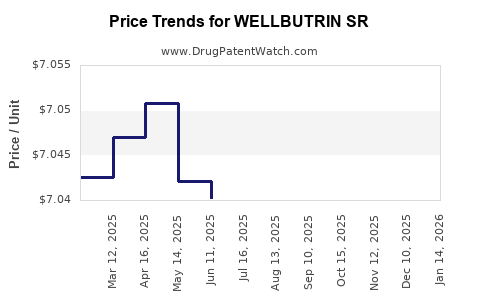
Retail pricing varies by strength, pharmacy, insurance channel, geographic market, manufacturer, and coupon availability. Generic bupropion SR commonly trades at a small fraction of historical brand prices.
What is the financial trajectory for Wellbutrin SR?
The financial trajectory has four stages.
1. Brand growth
During the protected period, Wellbutrin SR generated branded revenue from depression treatment. The franchise benefited from physician familiarity, the bupropion mechanism, and differentiation from serotonergic antidepressants.
2. Generic erosion
Generic approval reduced the brand’s ability to sustain premium pricing. Pharmacies and payers substituted therapeutically equivalent products, reducing branded volume and net price.
3. Portfolio migration
Commercial value shifted from Wellbutrin SR to the broader bupropion franchise, particularly Wellbutrin XL and generic formulations. Once-daily XL dosing provided a differentiated product position, although XL also faced generic competition.
4. Mature generic economics
The current market has low revenue per unit and modest margins. Profitability depends on:
- Manufacturing cost
- Capacity utilization
- Active pharmaceutical ingredient sourcing
- FDA compliance
- Product availability
- Contract pricing
- Wholesale discounts
- Recalls and remediation costs
A manufacturer with excess capacity or a temporary competitor shortage can increase volume and revenue. That upside is usually temporary because additional generic suppliers can enter or increase production.
What generic entry risks exist today?
The main risk is not a new Paragraph IV challenge. It is price compression and supply competition.
Current risks include:
- Additional generic approvals
- Wholesaler inventory normalization
- Pharmacy purchasing consolidation
- Contract repricing
- FDA warning letters or manufacturing interruptions
- Active pharmaceutical ingredient shortages
- Recalls caused by dissolution or content-uniformity failures
- Substitution toward bupropion XL or other antidepressants
- Reduced reimbursement for older generic products
The market can still experience shortages. A shortage may improve near-term pricing for manufacturers with available product, but it does not create durable exclusivity.
How does Wellbutrin SR compare with Wellbutrin XL?
Wellbutrin XL has historically had stronger commercial positioning because once-daily dosing is convenient and the product was supported by a distinct formulation and approval. Wellbutrin SR requires more frequent dosing and is more exposed to low-cost generic substitution.
| Factor |
Wellbutrin SR |
Wellbutrin XL |
| Dosing frequency |
Typically twice daily |
Once daily |
| Formulation |
Sustained release |
Extended release |
| Generic competition |
Established |
Established |
| Brand differentiation |
Limited |
Greater convenience |
| Patent significance today |
Expired core estate |
Expired or materially weakened core estate |
| Revenue opportunity |
Low-margin mature generic |
Broader franchise and formulation competition |
The products are not interchangeable merely because both contain bupropion hydrochloride. FDA therapeutic-equivalence ratings and prescribing instructions apply to the specific dosage form and strength.
What manufacturing and intellectual-property barriers remain?
Manufacturing barriers are more important than patent barriers. Bupropion SR tablets must meet release, dissolution, stability, content-uniformity, and bioequivalence requirements. Sustained-release products can be difficult to develop because small changes in excipients, compression, coating, or particle characteristics can alter exposure.
The principal operational barriers are:
- Controlled release over the required dosing interval
- Reproducible dissolution
- Consistent active-ingredient particle properties
- Stability through shelf life
- Reliable API procurement
- FDA-compliant manufacturing
- Validation of process changes
- Avoidance of dose-dumping behavior
These barriers can support temporary supply advantages but are unlikely to support long-term monopoly pricing absent new patents or regulatory exclusivity.
What is the geographic coverage of Wellbutrin SR rights?
U.S. patent rights have expired for the core bupropion SR estate. Other jurisdictions had separate patent terms, regulatory pathways, and market-entry dates. Patent expiry and generic availability therefore vary by country.
Key geographic distinctions include:
- United States: mature generic market with FDA-approved products
- European Union: national or regional authorization structures and country-specific reimbursement
- Canada: separate approval and patent-linkage rules
- Emerging markets: variable patent enforcement, local manufacturing, and tender pricing
International market value is generally driven by reimbursement and tender access rather than the historic U.S. brand franchise.
What is the competitive outlook for bupropion SR?
The competitive landscape is mature and fragmented. No single generic manufacturer has a durable patent-protected position. Competition is based on cost, manufacturing reliability, customer contracts, and product availability.
The strongest commercial opportunities are likely to arise from:
- Supply disruptions at competitors
- Low-cost API access
- Efficient high-volume tablet manufacturing
- Contract wins with large pharmacy purchasers
- Portfolio bundling with other CNS generics
- Regulatory approval of additional strengths or markets
- Reliable supply during shortage conditions
The weakest investment thesis is a return to premium Wellbutrin SR pricing. The product has moved from an innovation asset to an established generic medicine.
What is the FDA regulatory status of Wellbutrin SR?
Bupropion hydrochloride SR is an FDA-established product class with approved branded and generic histories. The reference product pathway is governed by the original NDA, while generic products rely on ANDAs demonstrating pharmaceutical equivalence and bioequivalence.
Regulatory diligence should focus on:
- Current marketing status of the specific NDA
- Strength-specific Orange Book entries
- Therapeutic-equivalence codes
- ANDA approvals
- FDA shortage records
- Manufacturing-site compliance
- Labeling differences
- Product recalls and enforcement actions
FDA approval does not guarantee commercial success. In this market, approval is necessary but often insufficient for attractive returns.
Key Takeaways
- Wellbutrin SR is bupropion hydrochloride in a sustained-release tablet.
- The original U.S. patent estate has expired, removing the basis for durable brand exclusivity.
- The U.S. market is generic-led and price-sensitive.
- Core value has shifted from patents to manufacturing, supply continuity, and contracting.
- Product-level revenue is not separately reported by the principal originator or generic companies.
- Historical Paragraph IV litigation and settlements shaped generic entry but are no longer the main commercial issue.
- Wellbutrin XL had stronger convenience-based differentiation, but it also faces generic competition.
- Current financial upside is tied to volume, shortages, efficient production, and market share rather than branded pricing.
- The principal risks are price compression, supply interruptions, FDA compliance events, and reimbursement pressure.
FAQs
Is Wellbutrin SR still sold as a branded product?
The U.S. market is principally supplied by generic bupropion hydrochloride SR products. Brand marketing and regulatory status can vary by strength and jurisdiction.
Does Wellbutrin SR have active U.S. patent protection?
The core U.S. patents covering bupropion and its sustained-release formulation have expired. No ordinary patent-based barrier is expected to prevent generic competition.
Can generic bupropion SR be substituted for Wellbutrin SR?
Substitution depends on the specific FDA therapeutic-equivalence rating, dosage strength, prescription requirements, and applicable state pharmacy law.
Is bupropion SR more commercially valuable than bupropion XL?
Historically, XL had stronger convenience differentiation. SR is a mature, lower-price product with substantial generic competition.
What could increase bupropion SR manufacturer revenue?
Temporary shortages, competitor recalls, contract wins, lower manufacturing costs, expanded geographic distribution, and higher prescription volume can improve revenue. These factors do not recreate long-term patent exclusivity.
References
- U.S. Food and Drug Administration. (2024a). Approved drug products with therapeutic equivalence evaluations: Orange Book. https://www.fda.gov/drugs/drug-approvals-and-databases/orange-book
- U.S. Food and Drug Administration. (2024b). Abbreviated new drug application submissions: Refuse-to-receive standards. https://www.fda.gov/drugs/abbreviated-new-drug-application-anda
- U.S. Food and Drug Administration. (2024c). Wellbutrin SR prescribing information. U.S. Department of Health and Human Services.
- Federal Trade Commission. (2013). Federal Trade Commission v. Actavis, Inc. and related pharmaceutical competition materials. https://www.ftc.gov
- U.S. Patent and Trademark Office. (2024). Patent full-text and image database. https://patents.google.com
- GlaxoSmithKline plc. (2000s). Annual reports and product disclosures. https://www.gsk.com/investors/financial-results/