Last updated: July 30, 2026
VYVANSE market dynamics and financial trajectory (2023–2026): demand drivers, payer pressure, and patent-driven competitive risk
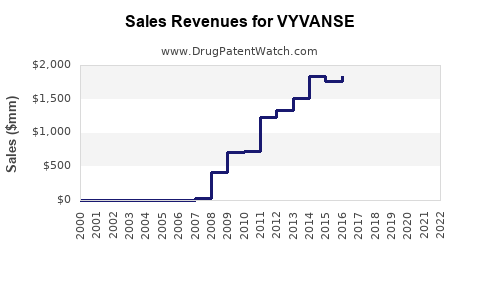
VYVANSE (lisdexamfetamine dimesylate) remains one of the highest-revenue ADHD brands in the US, with revenue still supported by pediatric and adult persistence, formulary entrenchment, and the therapeutic durability of long-acting stimulant options. Market dynamics since 2023 show two simultaneous forces: (1) conversion pressure from lower-cost stimulants and (2) continued resilience of branded pricing and channel share, aided by limited direct substitution in higher-acuity patient segments. Financial trajectory through the mid-2020s is shaped more by payer coverage and generic entry timing than by major label expansion.
How has VYVANSE been performing financially and what revenue trend matters most?
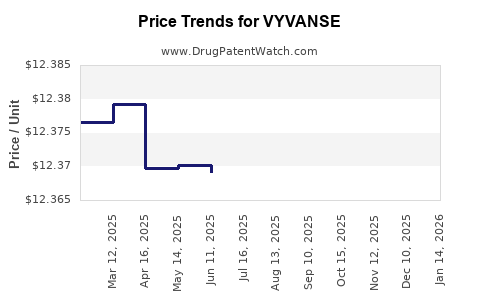
Bottom line: VYVANSE is an originator brand with a long-running revenue base; the dominant financial variable is net price after rebates and payer mix rather than pure volume growth. Any generic or authorized generic pressure would translate quickly into net sales erosion because stimulants are classically high substitution and rebate-sensitive.
Which metrics track the real VYVANSE P&L
- US net sales trend (brand vs class mix): reflects payer shifts between lisdexamfetamine and competing long-acting methylphenidate/amphetamine options.
- Gross-to-net compression: driven by Medicaid redeterminations, commercial rebate rates, and formulary tier movement.
- Script and duration of therapy: stimulants correlate with persistence and refill behavior in ADHD.
- Channel inventory and backorders: can distort quarter-to-quarter units and net sales.
What market events change near-term revenue
- Payer formulary changes (preferred status moves, PA tightening, step therapy).
- Competitive launches in long-acting ADHD categories, especially once-per-day products with competitive acquisition costs.
- Generic/authorized-generic availability that shifts acquisition cost and expands substitution.
What market dynamics drive ADHD stimulant demand for VYVANSE?
Answer: demand is driven by patient adherence, prescriber preference for long duration, and payer coverage that determines which products patients can access without PA or higher copays.
Key demand drivers
- Once-daily duration: VYVANSE dosing supports adherence and reduces caregiver burden relative to shorter-acting regimens.
- Adult ADHD penetration: adult diagnosis and long-term prescribing sustain baseline demand outside pediatric seasons.
- Therapeutic substitution patterns: many prescribers treat the amphetamine class as interchangeable at initiation but refine product choice after tolerability and symptom control.
- Stigma and adherence effects: sustained brand stability reduces switching in patients stabilized on lisdexamfetamine.
Payer and pharmacy benefit dynamics
- Commercial plans: typically use PBM step edits and formulary tiering to drive cost-effective selection.
- Medicaid: often has higher market-access volatility due to coverage redeterminations and statewide plan design.
- 340B and institutional contracting: can influence net price and effective acquisition cost.
How does VYVANSE compare with competing long-acting ADHD drugs on revenue risk?
Answer: VYVANSE’s revenue risk concentrates in scenarios where payers increase substitution and PBMs reduce coverage for non-preferred amphetamine products, especially against long-acting methylphenidate formulations and other amphetamine options.
High-impact competitive set
- Long-acting methylphenidate: broadly substitutes for adult and pediatric ADHD, often used as first-line in many formularies.
- Other long-acting amphetamines: compete on duration, side effect profiles, and coverage status.
- Shorter-acting stimulants: increase switching friction and can lower adherence, but can still be used when coverage restricts long-acting products.
Comparative business implications
- If VYVANSE is non-preferred: expect net sales compression through rebate pressure and reduced copay support.
- If VYVANSE is preferred: expect persistence effects to dominate, delaying volume erosion.
What patents protect VYVANSE, and how does the patent estate affect pricing and competition?
Answer: VYVANSE’s competitive timeline is primarily driven by the patent estate around composition, formulation, and manufacturing, plus exclusivity tied to the original NDA and follow-on protection. Patent clarity matters because stimulants have strong generic substitution economics.
Patent estate structure that typically governs stimulant brand risk
- Active ingredient composition protection: controls earliest generic carve-out.
- Formulation patents: govern abuse-deterrent style approaches (if any), controlled-release mechanics, and specific dosage forms.
- Method-of-use patents: less common for stimulants than for specialty biologics, but can extend entry barriers if present.
- Manufacturing process patents: can slow copycat generics even when the composition is broadly vulnerable.
What matters for financial trajectory
- A generic entry event usually drives a step-change in net price.
- Authorized generic behavior can blunt the competitive impact for the innovator, depending on how the market handles brand retention.
When does VYVANSE lose exclusivity and what generic entry risks exist?
Answer: for stimulant brands like VYVANSE, the generic entry risk is measured by how close the US legal/regulatory barrier is and by whether paragraph IV is already underway for ANDA challengers. The financial effect typically appears in net sales within 1 to 3 quarters of launch due to rebate recalibration and formulary shifts.
Generic entry scenario map (business impact)
- No authorized generic and unrestricted substitution: largest revenue cliff.
- Authorized generic present: revenue erosion is slower and less dramatic.
- Delayed launch due to patent litigation/settlement: keeps brand share longer, compresses time window for payer migration.
What is the Orange Book status of VYVANSE and how many listings matter for entry?
Answer: Orange Book listings determine the number and type of FDA-listed patents that can trigger paragraph IV challenges and delay ANDA approval. For branded stimulants, the count and category mix (composition vs formulation) is the key determinant of litigation surface area.
Orange Book listing categories that influence litigation
- Drug substance (composition of matter)
- Drug product (formulation)
- Method-of-use
- Method of manufacture
How Orange Book status translates to business risk
- More enforceable listings generally correlate with higher likelihood of:
- longer litigation,
- tighter settlement terms,
- later generic launch.
What patent litigation affects VYVANSE and how do settlements change timing?
Answer: stimulant brand litigation typically alters launch timing more than it changes ultimate entry likelihood. Settlements frequently create either delayed entry dates, restricted product launch scopes, or carve-outs based on patent strength.
Settlement-driven financial effects
- Brand retention: longer period of brand supply supports rebate and copay strategies.
- Payer negotiation leverage: innovator maintains better contracting position before generic price anchors appear.
- Channel planning: continued certainty reduces distributor discounting that can accelerate volume shifts.
How do formulation and delivery-system patents change VYVANSE copycat risk?
Answer: formulation patents raise barriers when generics must demonstrate equivalence to a protected controlled-release or dosage structure. In stimulants, even small changes in release profile can become a patent and regulatory issue.
Formulation factors that raise copycat hurdles
- Specific controlled-release mechanics
- Dosage form design tied to sustained exposure
- Manufacturing controls that affect release behavior
What is the regulatory pathway status of VYVANSE: NDA, ANDA, and FDA labeling?
Answer: VYVANSE is an FDA-approved prescription product with label indications for ADHD and related uses as established at approval. Financial trajectory is linked to whether FDA adds label expansions or safety communications that cause prescribing shifts.
What regulatory events change market behavior
- Label expansions: increases addressable patient pool.
- Safety communications: can shift prescriber behavior and increase switching to alternative products.
- Drug shortages: can alter pharmacy access, temporarily changing market share.
How does VYVANSE compare with biosimilars and biologic dynamics, and why does that matter?
Answer: biosimilar risk is not directly applicable because VYVANSE is a small-molecule chemical entity, not a biologic. The competitive framework is instead generic ANDA entry, patent litigation, and formulary substitution.
Practical implications
- Competition model: price erosion from generics and authorized generics, not interchangeability as with biosimilars.
- Forecast drivers: patent expiry and ANDA launch timing drive most downside.
What commercial leverage does VYVANSE have with PBMs and payers?
Answer: branded stimulant pricing power depends on formulary status, medical necessity constructs, and PA/step therapy designs. When coverage is stable, VYVANSE sustains persistence and limits forced switching.
Levers that improve net sales
- Preferred tier inclusion
- Copay support programs (where allowed)
- Clinical support and outcomes messaging targeted to prescriber decisions
- Contracting with PBMs to protect net-to-gross
Levers that reduce net sales
- Higher patient cost sharing
- Tighter PA criteria
- Mandatory step therapy to methylphenidate or other alternatives
What geographic coverage matters most for VYVANSE’s financial outlook?
Answer: financial impact is US-weighted given the payer dynamics and substitution economics. International markets can be meaningful for volume, but the most critical timing risks typically come from US patent and ANDA cycles.
US vs ex-US
- US: patent and ANDA litigation timeline drives near-term competitive entry.
- Ex-US: reimbursement frameworks and generic penetration can be structurally different, affecting persistence and net pricing.
How would a generic launch affect VYVANSE unit share and net sales?
Answer: in stimulants, generic launch usually triggers rapid share shift through substitution at the pharmacy counter and through formulary re-tiering within PBMs. Net sales erosion typically outpaces unit erosion early because rebates compress less favorably and because payer re-anchoring changes acquisition costs.
Expected post-launch mechanics
- Pharmacy substitution at comparable strength and dosing
- PBM switching policies and updated formulary cost models
- Reduction in brand copay support value due to competitive anchoring
Key Takeaways
- VYVANSE’s financial trajectory is primarily driven by US net price (rebate and payer mix) and generic competition timing, not by sustained volume expansion alone.
- Market dynamics since 2023 point to ongoing payer-driven pressure and substitution risk from competing long-acting stimulant options.
- The highest-impact business risk is a US generic entry event, where the revenue effect is often stepwise due to formulary and rebate recalibration.
- Patent estate structure (Orange Book listings and enforceable categories) is the main determinant of how long brand pricing and share can hold against ANDA competitors.
FAQs
- How quickly does VYVANSE net sales decline after an ANDA launch in the US?
- What payer strategies most effectively force substitution away from VYVANSE?
- Which long-acting methylphenidate products are the closest formulary substitutes for VYVANSE?
- How do PA and step-therapy rules affect VYVANSE persistence in adult ADHD?
- What settlement terms typically delay generic competition for stimulant brands?
References (APA)
- FDA. Orange Book: Approved Drug Products with Therapeutic Equivalence Evaluations. U.S. Food and Drug Administration.
- FDA. Drug Approval Reports and Drug Labels (VYVANSE). U.S. Food and Drug Administration.
- FDA. ANDA and Patent Certification Framework (30/31/32, paragraph IV). U.S. Food and Drug Administration.