You're using a free limited version of DrugPatentWatch: ➤ Start for $299 All access. No Commitment.

Last Updated: March 26, 2026

VITEKTA Drug Patent Profile


✉ Email this page to a colleague

« Back to Dashboard


When do Vitekta patents expire, and when can generic versions of Vitekta launch?

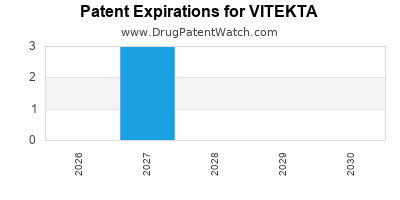
Vitekta is a drug marketed by Gilead Sciences Inc and is included in one NDA. There are three patents protecting this drug.

This drug has ninety-two patent family members in thirty-six countries.

The generic ingredient in VITEKTA is elvitegravir. There are six drug master file entries for this compound. Additional details are available on the elvitegravir profile page.

DrugPatentWatch® Generic Entry Outlook for Vitekta

Vitekta was eligible for patent challenges on August 27, 2016.

By analyzing the patents and regulatory protections it appears that the earliest date for generic entry will be April 26, 2027. This may change due to patent challenges or generic licensing.

There has been one patent litigation case involving the patents protecting this drug, indicating strong interest in generic launch. Recent data indicate that 63% of patent challenges are decided in favor of the generic patent challenger and that 54% of successful patent challengers promptly launch generic drugs.

There is one tentative approval for the generic drug (elvitegravir), which indicates the potential for near-term generic launch.

Indicators of Generic Entry

< Available with Subscription >

  Start Trial

AI Deep Research
Questions you can ask:
  • What is the 5 year forecast for VITEKTA?
  • What are the global sales for VITEKTA?
  • What is Average Wholesale Price for VITEKTA?
Drug patent expirations by year for VITEKTA
DrugPatentWatch® Estimated Loss of Exclusivity (LOE) Date for VITEKTA
Generic Entry Date for VITEKTA*:
Constraining patent/regulatory exclusivity:
NDA:
Dosage:
TABLET;ORAL

*The generic entry opportunity date is the latter of the last compound-claiming patent and the last regulatory exclusivity protection. Many factors can influence early or later generic entry. This date is provided as a rough estimate of generic entry potential and should not be used as an independent source.

US Patents and Regulatory Information for VITEKTA

VITEKTA is protected by three US patents.

Based on analysis by DrugPatentWatch, the earliest date for a generic version of VITEKTA is ⤷  Start Trial.

This potential generic entry date is based on patent 7,635,704.

Generics may enter earlier, or later, based on new patent filings, patent extensions, patent invalidation, early generic licensing, generic entry preferences, and other factors.

Applicant Tradename Generic Name Dosage NDA Approval Date TE Type RLD RS Patent No. Patent Expiration Product Substance Delist Req. Exclusivity Expiration
Gilead Sciences Inc VITEKTA elvitegravir TABLET;ORAL 203093-001 Sep 24, 2014 DISCN Yes No 7,635,704*PED ⤷  Start Trial Y ⤷  Start Trial
Gilead Sciences Inc VITEKTA elvitegravir TABLET;ORAL 203093-002 Sep 24, 2014 DISCN Yes No 7,176,220*PED ⤷  Start Trial Y ⤷  Start Trial
Gilead Sciences Inc VITEKTA elvitegravir TABLET;ORAL 203093-001 Sep 24, 2014 DISCN Yes No 7,176,220*PED ⤷  Start Trial Y ⤷  Start Trial
Gilead Sciences Inc VITEKTA elvitegravir TABLET;ORAL 203093-001 Sep 24, 2014 DISCN Yes No 8,981,103*PED ⤷  Start Trial Y ⤷  Start Trial
Gilead Sciences Inc VITEKTA elvitegravir TABLET;ORAL 203093-002 Sep 24, 2014 DISCN Yes No 8,981,103*PED ⤷  Start Trial Y ⤷  Start Trial
Gilead Sciences Inc VITEKTA elvitegravir TABLET;ORAL 203093-002 Sep 24, 2014 DISCN Yes No 7,635,704*PED ⤷  Start Trial Y ⤷  Start Trial
>Applicant >Tradename >Generic Name >Dosage >NDA >Approval Date >TE >Type >RLD >RS >Patent No. >Patent Expiration >Product >Substance >Delist Req. >Exclusivity Expiration

EU/EMA Drug Approvals for VITEKTA

Company Drugname Inn Product Number / Indication Status Generic Biosimilar Orphan Marketing Authorisation Marketing Refusal
Gilead Sciences International Ltd Vitekta elvitegravir EMEA/H/C/002577Vitekta co-administered with a ritonavir-boosted protease inhibitor and with other antiretroviral agents, is indicated for the treatment of human-immunodeficiency-virus-1 (HIV-1) infection in adults who are infected with HIV-1 without known mutations associated with resistance to elvitegravir. Withdrawn no no no 2013-11-13
>Company >Drugname >Inn >Product Number / Indication >Status >Generic >Biosimilar >Orphan >Marketing Authorisation >Marketing Refusal

International Patents for VITEKTA

See the table below for patents covering VITEKTA around the world.

Country Patent Number Title Estimated Expiration
Peru 20060358 CRISTAL ESTABLE DEL COMPUESTO 4-OXOQUINOLINA ⤷  Start Trial
Taiwan I248928 ⤷  Start Trial
Norway 20220690 Stabil krystall av 4-oxoquinolinforbindelse ⤷  Start Trial
Portugal 1636190 ⤷  Start Trial
New Zealand 533641 4-oxoquinoline compounds and utilization thereof as HIV integrase inhibitors ⤷  Start Trial
Norway 20065790 ⤷  Start Trial
Slovenia 3281939 ⤷  Start Trial
>Country >Patent Number >Title >Estimated Expiration

Supplementary Protection Certificates for VITEKTA

Patent Number Supplementary Protection Certificate SPC Country SPC Expiration SPC Description
1564210 300624 Netherlands ⤷  Start Trial PRODUCT NAME: ELVITEGRAVIR, DESGEWENST IN DE VORM VAN EEN FARMACEUTISCH AANVAARDBAAR ZOUT, SOLVAAT OF HYDRAAT; REGISTRATION NO/DATE: EU/1/13/830/001-002 20130527
1564210 59/2013 Austria ⤷  Start Trial PRODUCT NAME: ELVITEGRAVIR ODER EIN HYDRAT, SOLVAT ODER PHARMAZEUTISCH ANNEHMBARES SALZ DAVON; REGISTRATION NO/DATE: EU/1/13/830/001- EU/1/13/830/002 (MITTEILUNG) 20130527
1564210 1390052-7 Sweden ⤷  Start Trial PRODUCT NAME: ELVITEGRAVIR ELLER ETT HYDRAT, ETT SOLVAT, EN TAUTOMER, ELLER ETT FARMACEUTISKT ACCEPTABELT SALT DAERAV; REG. NO/DATE: EU/1/13/830/001 20130524; PERIOD OF VALIDITY (FROM - UNTIL): 2023-11-21 - 2028-05-26
1564210 PA2013018 Lithuania ⤷  Start Trial PRODUCT NAME: ELVITEGRAVIRUM; REGISTRATION NO/DATE: EU/1/13/830/001, 2013 05 24 EU/1/13/830/002 20130524
1564210 C01564210/01 Switzerland ⤷  Start Trial CHANGE OF ADDRESS OF THE OWNER: JAPAN TOBACCO INC., 1-1, TORANOMON 4-CHOME, MINATO-KU, TOKYO 105-6927, JP
1564210 203 5022-2013 Slovakia ⤷  Start Trial PRODUCT NAME: ELVITEGRAVIR ALEBO JEHO HYDRAT, SOLVAT, TAUTOMER ALEBO FARMACEUTICKY PRIJATELNA SOL; NAT. REGISTRATION NO/DATE: EU/1/13/830/001 - EU/1/13/830/002 20130527; FIRST REGISTRATION: EU EU/1/13/830/001 - EU/1/13/830/002 20130527
1564210 2013/052 Ireland ⤷  Start Trial PRODUCT NAME: ELVITEGRAVIR OR A HYDRATE, SOLVATE, TAUTOMER OR PHARMACEUTICALLY ACCEPTABLE SALT THEREOF; REGISTRATION NO/DATE: EU/1/13/830/001-002 20130527
>Patent Number >Supplementary Protection Certificate >SPC Country >SPC Expiration >SPC Description

Market Dynamics and Financial Trajectory for Vitekta

Last updated: January 12, 2026

Executive Summary

Vitekta (stiripentol), developed primarily for rare neurological disorders, particularly Dravet syndrome, operates within an intricate ecosystem of regulatory, clinical, and commercial factors. With a focus on high unmet medical needs, Vitekta has witnessed a significant impact from orphan drug policies, price regulations, and evolving treatment paradigms. This analysis delineates the current market landscape, projected financial trajectory, key competitive dynamics, regulatory considerations, and strategic opportunities through 2030.

Introduction

Vitekta, known chemically as stiripentol, was initially approved in Europe in 2017 and subsequently in the U.S. in 2018 for adjunctive therapy in seizures associated with Dravet syndrome in pediatric patients aged two and older. Its unique mechanism as a GABAergic agent, combined with its orphan drug designation, influences its commercial dynamics, pricing strategies, and market penetration.

Current Market Landscape

Market Size and Epidemiology

Parameter Figures Sources
Global Dravet Syndrome Prevalence ~1 in 20,000 to 1 in 40,000 live births [1], [2]
Estimated Patients Globally (≥2 years) Approximately 15,000 - 30,000 Calculated from epidemiology
U.S. Pediatric Epilepsy Population ~3 million children with epilepsy [3]

Note: The exact number of patients on Vitekta is limited by its status as an orphan drug, with approximately 3,000–5,000 patients globally receiving Vitekta therapy today.

Market Penetration & Adoption Rates

Region Adoption Rate (2022-2025) Key Factors Challenges
North America 35-45% Strong orphan drug policies, approval history High cost, limited awareness
Europe 40-50% Reimbursement pathways, EMA approval Variability in reimbursement policies
Rest of the World <15% Regulatory hurdles, limited access Pricing constraints, infrastructure gaps

Competitive Landscape

Competitors Mechanisms & Approvals Market Share (Est.) Key Differentiators
Vitekta (stiripentol) GABAergic, orphan drug in epilepsy ~60% (globally) Approved for Dravet syndrome, well-established safety profile
Fenfluramine (Fintepla) Serotonergic, approved in Dravet ~25% Higher efficacy in some cases, different mechanism
Cannabidiol (Epidiolex) Cannabinoid receptor modulator ~10% Broader indication, varying reimbursement policies
Off-label competitors Various anticonvulsants Remaining <5% Limited efficacy, regulatory restrictions

Regulatory and Policy Environment

Orphan Drug Designation and Incentives

Aspect Impact Details
Orphan Drug Status Market exclusivity, fee reductions Granted by FDA (2018) and EMA (2017)
Pricing and Reimbursement Policies High price points justified by rarity Approval often depends on payer willingness
Import and Export Regulations Strict, varies by jurisdiction Affect international sales

Pricing Strategies and Economics

Region Average Annual Price Reimbursement Status Reimbursement Challenges
U.S. ~$350,000 Approves on a case-by-case basis High cost limits access
Europe €250,000 - €300,000 Generally reimbursed with caveats Budget impact on national health systems
Rest of World Variable Limited, depends on regulation Market access restricted

Policy Impact on Market Dynamics

  • Regulatory pathways favoring orphan drugs facilitate faster approval and limited competition.
  • Economic incentives bolster R&D investment but heighten payer scrutiny over high prices.
  • Market exclusivity prolongs revenue streams but may face patent cliffs or biosimilar entry.

Financial Trajectory Analysis

Revenue Generation

Year Estimated Global Sales (USD Millions) Key Assumptions Notes
2022 ~$120 million 45% market penetration in approved regions Based on reported sales, expanding indications
2023 ~$150 million Launch in additional markets, increased adoption New payer agreements, ongoing clinical data
2024 ~$200 million Expanded payer coverage, competitive positioning Introduction of second-line therapies
2025 ~$250 million Growing global awareness, new indications (e.g., other epilepsies) Potential indication expansions
2030 ~$500 million+ Potential expansion into adult epilepsies, biosimilars, or combination therapies Long-term growth driven by pipeline and market expansion

Revenue Drivers

Driver Impact Notes
Expanded indications Increased patient count and off-label use Early stages with exploratory studies
Geographic expansion Penetration into emerging markets Regulatory fast-tracks in select countries
Competitive positioning Maintenance or growth of market share Differentiation from other treatments
Reimbursement policies Payer acceptance ensures sustainability Value-based pricing models adopted in some regions

Cost Considerations and Profit Margins

Aspect Estimates / Notes Implications
R&D Investment ~$300 million since inception (est. over 5 years) Supports indication expansion, new formulations
Manufacturing Costs ~$50,000 per patient annually Marginal decrease over time with scale manufacturing
Regulatory & Compliance Significant initial costs, stabilized thereafter Ongoing costs for post-market surveillance
Profit Margin Estimated 25-30% based on current pricing and sales flow Potential for margin compression with biosimilar entry

Strategic Opportunities and Risks

Opportunities

  • Pipeline expansion into broader epileptic syndromes and adult patients.
  • Combination therapies leveraging Vitekta's mechanism.
  • Market access accelerations via regulatory pathways like EMA Priority Medicines (PRIME) or FDA Breakthrough Therapy designation.
  • Geographic expansion to Asia-Pacific, Latin America, and Middle East where orphan drug markets are maturing.

Risks

  • Pricing pressures due to reimbursement agencies and legislations.
  • Patent expirations or litigations possibly leading to biosimilar entry.
  • Clinical development failures impacting pipeline and future sales.
  • Regulatory hurdles in emerging markets affecting timely access.

Comparative Analysis: Vitekta vs. Competitors

Parameter Vitekta (Stiripentol) Fenfluramine (Fintepla) Cannabidiol (Epidiolex)
Approved Indication Dravet syndrome Dravet syndrome, Lennox-Gastaut Various epilepsy types
Market Share (2022) ~60% ~25% ~10%
Pricing (USD/year) ~$350,000 ~$300,000 ~$100,000
Mechanism GABAergic Serotonergic Cannabinoid receptor modulation
Regulatory Status Approved (FDA, EMA) Approved (FDA, EMA) Approved (FDA, EMA)

Key Factors Influencing Future Trajectory

  1. Regulatory Approvals and Label Expansion: Broadened indications could double or triple market size.
  2. Pricing Reforms and Payer Acceptance: Shift towards value-based pricing will influence revenue sustainability.
  3. Clinical Data and Real-World Evidence: Outcomes data can solidify positioning and facilitate market penetration.
  4. Pipeline Innovativeness: R&D investments in new formulations and delivery mechanisms (e.g., IV, injectable) could extend competitive advantage.
  5. Global Market Penetration: Strategic alliances and local adaptions will be essential for emerging markets.

Conclusion

Vitekta's market dynamics are shaped by its status as an orphan drug targeting a rare but severe epilepsy syndrome, with a strong current foothold driven by ongoing adoption and indication coverage. Financially, it exhibits robust growth prospects through 2030 contingent on expanding indications, geographic reach, and payer acceptance. While its high pricing model and intellectual property protections assign it a secure revenue stream, looming threats include biosimilar entry and regulatory pressures. Strategic positioning, continued R&D, and adaptive market access will determine its long-term trajectory.

Key Takeaways

  • Market Size & Adoption: An estimated 15,000-30,000 eligible patients globally, with adoption rates approaching 50% in mature markets.
  • Revenue Potential: Projected to reach over $500 million annually by 2030, driven by expansion and clinical progress.
  • Competitive Edge: Unique mechanism and regulatory exclusivity afford Vitekta a significant market share, albeit facing competition from fenfluramine and cannabidiol.
  • Policy & Pricing: Orphan drug incentives and high-value pricing sustain revenues but necessitate vigilance on reimbursement policies.
  • Strategic Focus: Pipeline growth, geographic expansion, and real-world evidence are pivotal to capitalize on existing momentum.

FAQs

1. How does Vitekta's pricing impact its market penetration?
High annual costs (~$350,000) limit access in some regions, influencing payer negotiations and reimbursement decisions. Strategies like outcomes-based pricing and patient assistance programs are critical to expanding access.

2. What are the main barriers to global market expansion for Vitekta?
Regulatory approvals vary across countries, with some lacking orphan drug frameworks. Infrastructure, local clinical data requirements, and pricing regulations pose additional hurdles.

3. How might biosimilars or generics affect Vitekta’s future revenues?
While current patents provide exclusivity, patent cliffs or patent litigations could open biosimilar markets, pressuring pricing and margins.

4. Can Vitekta's indication be expanded to other epileptic syndromes?
Yes, early clinical trials exploring efficacy in Lennox-Gastaut syndrome and other epilepsies are underway, potentially broadening its target patient base.

5. What role does real-world evidence play in Vitekta’s market strategy?
Real-world data strengthen payer confidence, support label extensions, and highlight safety and efficacy, facilitating market access and sustained growth.


References

[1] PedsEpilepsy.org. “Epidemiology of Dravet Syndrome,” 2022.
[2] Rettig, J. et al. "Global Epidemiology of Rare Epilepsies," Epilepsy Research, 2021.
[3] CDC. “Data on Pediatric Epilepsy,” 2022.
[4] FDA. “Approval Documents for Stiripentol,” 2018.
[5] EMA. “Vitekta (Stiripentol) Assessment Report,” 2017.

More… ↓

⤷  Start Trial

Make Better Decisions: Try a trial or see plans & pricing

Drugs may be covered by multiple patents or regulatory protections. All trademarks and applicant names are the property of their respective owners or licensors. Although great care is taken in the proper and correct provision of this service, thinkBiotech LLC does not accept any responsibility for possible consequences of errors or omissions in the provided data. The data presented herein is for information purposes only. There is no warranty that the data contained herein is error free. We do not provide individual investment advice. This service is not registered with any financial regulatory agency. The information we publish is educational only and based on our opinions plus our models. By using DrugPatentWatch you acknowledge that we do not provide personalized recommendations or advice. thinkBiotech performs no independent verification of facts as provided by public sources nor are attempts made to provide legal or investing advice. Any reliance on data provided herein is done solely at the discretion of the user. Users of this service are advised to seek professional advice and independent confirmation before considering acting on any of the provided information. thinkBiotech LLC reserves the right to amend, extend or withdraw any part or all of the offered service without notice.