Share This Page
VIBRAMYCIN Drug Patent Profile
✉ Email this page to a colleague
Which patents cover Vibramycin, and when can generic versions of Vibramycin launch?
Vibramycin is a drug marketed by Pfizer and is included in four NDAs.
The generic ingredient in VIBRAMYCIN is doxycycline calcium. There are three drug master file entries for this compound. Additional details are available on the doxycycline calcium profile page.
AI Deep Research
Questions you can ask:
- What is the 5 year forecast for VIBRAMYCIN?
- What are the global sales for VIBRAMYCIN?
- What is Average Wholesale Price for VIBRAMYCIN?
Summary for VIBRAMYCIN
| US Patents: | 0 |
| Applicants: | 1 |
| NDAs: | 4 |
| Raw Ingredient (Bulk) Api Vendors: | 177 |
| Clinical Trials: | 22 |
| Patent Applications: | 3,675 |
| Drug Prices: | Drug price information for VIBRAMYCIN |
| DailyMed Link: | VIBRAMYCIN at DailyMed |

Recent Clinical Trials for VIBRAMYCIN
Identify potential brand extensions & 505(b)(2) entrants
| Sponsor | Phase |
|---|---|
| Mahidol Oxford Tropical Medicine Research Unit | Phase 2/Phase 3 |
| Lao-Oxford-Mahosot Hospital Wellcome Trust Research Unit | Phase 2/Phase 3 |
| University of Iowa | Phase 4 |
US Patents and Regulatory Information for VIBRAMYCIN
| Applicant | Tradename | Generic Name | Dosage | NDA | Approval Date | TE | Type | RLD | RS | Patent No. | Patent Expiration | Product | Substance | Delist Req. | Exclusivity Expiration |
|---|---|---|---|---|---|---|---|---|---|---|---|---|---|---|---|
| Pfizer | VIBRAMYCIN | doxycycline hyclate | CAPSULE;ORAL | 050007-001 | Approved Prior to Jan 1, 1982 | DISCN | Yes | No | ⤷ Start Trial | ⤷ Start Trial | ⤷ Start Trial | ||||
| Pfizer | VIBRAMYCIN | doxycycline hyclate | INJECTABLE;INJECTION | 050442-002 | Approved Prior to Jan 1, 1982 | DISCN | Yes | No | ⤷ Start Trial | ⤷ Start Trial | ⤷ Start Trial | ||||
| Pfizer | VIBRAMYCIN | doxycycline hyclate | CAPSULE;ORAL | 050007-002 | Approved Prior to Jan 1, 1982 | DISCN | Yes | No | ⤷ Start Trial | ⤷ Start Trial | ⤷ Start Trial | ||||
| >Applicant | >Tradename | >Generic Name | >Dosage | >NDA | >Approval Date | >TE | >Type | >RLD | >RS | >Patent No. | >Patent Expiration | >Product | >Substance | >Delist Req. | >Exclusivity Expiration |
EU/EMA Drug Approvals for VIBRAMYCIN
| Company | Drugname | Inn | Product Number / Indication | Status | Generic | Biosimilar | Orphan | Marketing Authorisation | Marketing Refusal |
|---|---|---|---|---|---|---|---|---|---|
| Pfizer Limited | Doxirobe | Doxycycline | EMEA/V/C/000044Treatment of periodontal disease in dogs.Periodontal pocket probing depths >=4 mm are evidence of disease that may be responsive to treatment with the Doxirobe Gel. Use of this product as directed should result in attachment level gains, periodontal pocket depth reductions, local antimicrobial effect and improved gingival health. Noticeable improvements in these parameters should be evident within 2-4 weeks following treatment. The response in individual dogs is dependent on the severity of the condition and rigor of adjunctive therapy. | Withdrawn | no | no | no | 1999-09-16 | |
| >Company | >Drugname | >Inn | >Product Number / Indication | >Status | >Generic | >Biosimilar | >Orphan | >Marketing Authorisation | >Marketing Refusal |
VIBRAMYCIN Market Dynamics, Patent Status, and Financial Trajectory
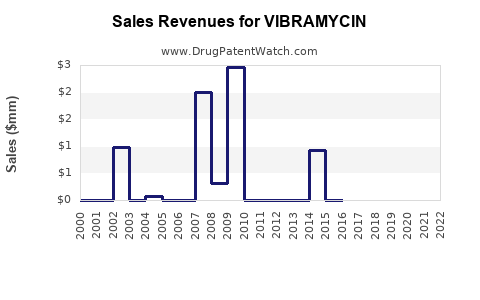
Vibramycin is the legacy Pfizer brand for doxycycline, primarily doxycycline hyclate. Its commercial position has shifted from branded pharmaceutical to mature generic antibiotic. The brand no longer drives the U.S. doxycycline market, while generic doxycycline remains widely used in infectious disease, dermatology, malaria prophylaxis, and inflammatory skin conditions. Public filings do not report a separate current revenue line for Vibramycin, so the financial trajectory must be assessed through brand discontinuation, generic substitution, prescription demand, pricing history, and doxycycline market structure.
What is Vibramycin and who owns the brand?
Vibramycin is a tetracycline-class antibiotic containing doxycycline. Pfizer commercialized the product in multiple oral and injectable presentations, including doxycycline hyclate capsules, tablets, oral suspension, and injection products. Doxycycline is approved for a broad group of bacterial infections and for noninfectious uses such as acne and rosacea management.
The brand’s economic value is now limited because:
- Doxycycline is available from numerous generic manufacturers.
- Core composition and formulation patents expired decades ago.
- FDA-approved generic products have replaced branded Vibramycin in most U.S. channels.
- Pfizer does not separately disclose Vibramycin revenue in current annual reports.
- Hospital and pharmacy purchasing is highly price-sensitive for mature antibiotics.
The relevant commercial asset is therefore the doxycycline molecule and its generic supply base, not the Vibramycin trademark alone.
Vibramycin product profile
| Attribute | Detail |
|---|---|
| Brand | Vibramycin |
| Active ingredient | Doxycycline |
| Principal salt | Doxycycline hyclate |
| Drug class | Tetracycline antibiotic |
| Original brand company | Pfizer |
| Main dosage forms | Capsules, tablets, oral suspension, injection |
| U.S. market status | Mature generic market; legacy branded products have limited commercial relevance |
| Principal uses | Bacterial infections, acne, rosacea, malaria prophylaxis, selected inflammatory conditions |
| Biosimilar relevance | None; doxycycline is a small-molecule drug |
| Current competitive basis | Generic price, supply reliability, dosage form, contracting, and regulatory compliance |
When did Vibramycin lose exclusivity?
Vibramycin lost meaningful market exclusivity many years ago. Doxycycline was introduced in the 1960s, and generic competition developed after expiration of the relevant composition and product patents. The Hatch-Waxman framework later enabled abbreviated new drug applications for doxycycline products, allowing generic manufacturers to rely on the reference drug’s safety and efficacy record.
The commercial exclusivity timeline is therefore different from the regulatory history of individual products:
| Event | Approximate timing | Commercial effect |
|---|---|---|
| Doxycycline introduced | 1960s | Pfizer established the original branded franchise |
| Core patent protection | Primarily expired in the 1980s or earlier, depending on patent and jurisdiction | Composition-level exclusivity ended |
| Generic approvals | Developed over subsequent decades | Branded price premium declined |
| Generic market expansion | 1990s onward | Vibramycin became a mature brand |
| Generic price disruption | 2013-2017 period | Doxycycline prices rose sharply in certain presentations before later normalization |
| Current market | 2020s | Generic doxycycline dominates U.S. volume |
The exact expiration date depends on the patent, salt, dosage form, and country. There is no current patent term that supports a broad, molecule-level Vibramycin monopoly in the United States.
What patents protect Vibramycin and doxycycline?
The original doxycycline patent estate is expired. Current competitive barriers are commercial and operational rather than based on basic-molecule patent protection.
Composition patents
The principal composition-level protection for doxycycline dates to the early development of the molecule. These rights expired decades ago. Any pediatric or regulatory exclusivity that applied to specific approvals also has long since expired.
Formulation patents
Some doxycycline formulations have historically received separate patent protection or regulatory differentiation. Examples include:
- Delayed-release tablets designed to reduce gastrointestinal irritation.
- Modified-release products combining immediate-release and delayed-release fractions.
- Specialized oral suspensions.
- Combination products.
- Formulations engineered to reduce food effects or improve tolerability.
These rights protect particular products rather than doxycycline generally. They do not restore exclusivity to conventional doxycycline hyclate capsules or tablets.
Method-of-use patents
Doxycycline has extensive therapeutic use history. Conventional uses such as treatment of susceptible infections, acne, and malaria prophylaxis are generally associated with mature clinical practice and do not create a broad current patent barrier.
Narrow method-of-use patents could apply to particular dosing regimens, subpopulations, inflammatory conditions, or combination therapies. Their commercial effect depends on whether they are listed in the FDA Orange Book, whether generic labels include the protected indication, and whether a manufacturer can use a section viii statement to omit the method of use.
Orange Book status
The FDA Orange Book is the controlling U.S. reference for patents listed against approved drug products. For a legacy Vibramycin product, the relevant question is whether an active brand NDA remains listed and whether unexpired patents are associated with that NDA.
The practical Orange Book position is:
- Conventional doxycycline hyclate products are not protected by an active molecule-level patent.
- Generic doxycycline manufacturers generally compete without confronting a current Vibramycin composition patent.
- Any listed formulation patent must be analyzed product by product.
- A discontinued brand presentation may have little strategic value even if historical Orange Book records remain accessible.
FDA Orange Book records and FDA drug-discontinuation information should be reviewed by NDA and dosage form rather than by the Vibramycin trademark alone [1, 2].
What is the FDA regulatory status of Vibramycin?
Doxycycline remains an FDA-approved active ingredient. The regulatory status of a specific Vibramycin presentation is separate from the status of doxycycline as a molecule.
Legacy branded products may appear in FDA records as discontinued, withdrawn, or no longer commercially marketed. FDA classifications distinguish between a product being discontinued for commercial reasons and a product being withdrawn for safety or efficacy concerns. A discontinued brand does not imply that doxycycline has lost approval or that generic doxycycline products are unavailable.
The U.S. market includes approved generic presentations such as:
- Doxycycline hyclate capsules.
- Doxycycline hyclate delayed-release tablets.
- Doxycycline monohydrate capsules or tablets.
- Doxycycline oral suspension.
- Injectable doxycycline products.
Doxycycline monohydrate and doxycycline hyclate are different salts and may have different tolerability, dissolution, labeling, and manufacturing characteristics. They compete within the same therapeutic market but are not automatically interchangeable in every regulatory or clinical context.
How large is the doxycycline market?
Public financial reporting does not provide a reliable standalone global revenue figure for Vibramycin. Pfizer reports products in broader business segments and does not identify current Vibramycin sales as a material separate line item.
The broader doxycycline market is supported by several demand segments:
| Demand segment | Commercial characteristics |
|---|---|
| Acne and rosacea | High outpatient volume; often recurring therapy; dermatology demand supports branded and generic differentiation |
| Respiratory and urinary infections | Generic-driven and price-sensitive |
| Tick-borne disease | Demand influenced by epidemiology and seasonal outbreaks |
| Sexually transmitted infections | Public-health and outpatient demand |
| Malaria prophylaxis | Travel and military use; episodic demand |
| Hospital infections | Injectable supply and wholesaler reliability matter more than brand |
| Veterinary use | Separate regulatory and distribution channels; material but distinct from human sales |
Doxycycline has retained demand because it is inexpensive relative to newer antibiotics, has broad clinical utility, and is included in treatment protocols for several common infections. Its market is less exposed to antibiotic stewardship than drugs reserved for multidrug-resistant infections, although stewardship still limits unnecessary use.
Why did doxycycline prices rise despite generic competition?
Doxycycline experienced substantial price volatility during the 2010s. Generic competition did not prevent price increases because the market had a limited number of active suppliers for some strengths and dosage forms. Consolidation, manufacturing interruptions, limited API sources, and wholesaler inventory practices increased vulnerability to supply shocks.
The commercial lessons are important:
- Generic markets can experience sharp price increases when supplier concentration is high.
- Capsules, tablets, and liquids can have different supplier counts.
- Doxycycline hyclate and doxycycline monohydrate are not perfect substitutes from a manufacturing and regulatory perspective.
- Shortages can create temporary pricing power without creating durable patent exclusivity.
- New entrants can face low product-development risk but meaningful quality-system and supply-chain requirements.
The 2013 period also generated antitrust litigation concerning alleged price coordination and market conduct involving doxycycline manufacturers. The litigation highlighted the gap between nominal generic competition and effective competition in a concentrated market [3].
Which companies compete with Vibramycin?
The competitive landscape is dominated by generic manufacturers rather than by a single branded successor.
Potential competitors have included large generic companies and specialty suppliers such as:
- Teva Pharmaceuticals.
- Mylan, now part of Viatris.
- Sandoz.
- Amneal Pharmaceuticals.
- Hikma Pharmaceuticals.
- Heritage Pharmaceuticals.
- Rising Pharmaceuticals.
- Zydus Pharmaceuticals.
- Apotex.
- Other regional and contract manufacturers.
The active supplier set varies by dosage form, strength, country, and time period. A company may hold an FDA approval without maintaining continuous commercial supply. Procurement departments therefore evaluate both approved-label competition and actual market availability.
How strong is the Vibramycin patent estate?
The Vibramycin patent estate is weak as a current exclusivity platform.
| Patent factor | Assessment |
|---|---|
| Core molecule | Expired |
| Conventional doxycycline hyclate products | Mature generic competition |
| Legacy brand trademark | Limited value without commercial distribution |
| Delayed-release formulations | Potentially stronger, but product-specific |
| Method-of-use claims | Narrow and indication-dependent |
| Manufacturing know-how | Relevant to quality, yield, impurities, and supply reliability |
| Regulatory barriers | Moderate for new entrants; low relative to novel drugs |
| Litigation leverage | Limited for conventional products; higher for differentiated formulations |
The strongest defensible positions in doxycycline are not basic composition claims. They are more likely to involve differentiated delivery, tolerability, combination products, manufacturing processes, or narrow clinical applications.
What patent litigation affects Vibramycin and doxycycline?
The main legal risks are generic-market antitrust disputes, formulation patent litigation, and supply-related commercial disputes. There is no active, broad patent litigation that recreates the original Vibramycin monopoly over conventional doxycycline.
Past doxycycline litigation included antitrust claims involving alleged coordination, supply restrictions, and pricing conduct among generic manufacturers. The cases attracted attention because doxycycline prices increased sharply while the product remained a mature generic medicine [3].
For a new doxycycline entrant, the primary legal review should cover:
- Active Orange Book listings for the target reference product.
- Paragraph IV certifications against any unexpired formulation patents.
- Label carve-outs under section viii.
- Antitrust exposure in a concentrated supplier market.
- Manufacturing and quality claims involving API or finished-dose supply.
- State and federal procurement requirements.
Are there Paragraph IV challenges to Vibramycin?
Paragraph IV litigation is unlikely to create significant exposure for conventional Vibramycin-type doxycycline products because the relevant core patents are expired. Paragraph IV risk can still arise against newer reference products with delayed-release, modified-release, combination, or other differentiated formulations.
A generic applicant must distinguish between:
- A standard doxycycline product with no meaningful unexpired patent barrier.
- A specific branded formulation with active patents.
- A product whose listed patents can be addressed through a label carve-out.
- A product that requires a full patent challenge before launch.
The risk profile is therefore formulation-specific rather than molecule-wide.
Are there biosimilar risks for Vibramycin?
Biosimilars do not apply to Vibramycin. Doxycycline is a chemically synthesized small-molecule drug, and generic applicants use the abbreviated new drug application pathway rather than the biologics license application and biosimilar pathway.
Competitive pressure comes from:
- ANDA-approved generic doxycycline.
- Alternate doxycycline salts.
- Modified-release formulations.
- Other tetracyclines.
- Non-antibiotic dermatology therapies.
- Alternative antibiotics selected under local treatment guidelines.
What is the financial trajectory for Vibramycin?
The brand-level financial trajectory has four phases.
1. Branded growth
Vibramycin initially benefited from Pfizer’s originator position, broad indications, physician familiarity, and established distribution.
2. Patent expiry and generic substitution
Once core protection expired, pharmacy benefit managers, hospitals, and government purchasers shifted volume toward lower-cost generic doxycycline. The brand lost pricing power and likely became commercially marginal.
3. Generic price volatility
Doxycycline prices increased in selected markets during the 2010s because of supplier concentration and shortages. These increases benefited available generic suppliers, not necessarily the discontinued Vibramycin brand.
4. Mature-market normalization
The current market is characterized by low-cost generic supply, periodic shortages, differentiated formulation niches, and limited brand economics. Revenue opportunities remain for manufacturers with reliable supply, approved dosage-form breadth, and efficient API procurement.
No current public filing supports a defensible standalone Vibramycin revenue estimate. Pfizer’s reporting structure does not identify it as a material current product, and generic doxycycline sales are distributed among multiple private and public manufacturers.
What generic launch scenarios exist for doxycycline?
| Launch scenario | Expected outcome |
|---|---|
| Standard capsule or tablet | Low patent risk; price competition likely |
| Delayed-release tablet | Higher development and formulation risk; potentially better margin |
| Oral suspension | Smaller market; supply reliability can support contracts |
| Injectable product | Higher manufacturing and quality requirements; hospital opportunity |
| New salt or differentiated dosage form | Regulatory and substitution analysis required |
| Narrow indication strategy | Possible differentiation, but limited market size |
| Shortage-driven entry | Attractive near-term pricing but volatile sustainability |
A generic manufacturer can improve economics by entering a dosage form with fewer suppliers, maintaining multiple strengths, securing API redundancy, and demonstrating consistent fill rates. The market remains vulnerable to price compression once several suppliers return.
How does Vibramycin compare with other tetracyclines?
| Drug | Market position | Main competitive issue |
|---|---|---|
| Doxycycline | Broad, mature generic market | Price and supply reliability |
| Minocycline | Generic; strong dermatology history | Safety, tolerability, and generic substitution |
| Tetracycline | Older generic | Availability and dosing limitations |
| Sarecycline | Branded dermatology product | Differentiation versus low-cost doxycycline |
| Eravacycline | Branded hospital antibiotic | Higher-acuity use and price |
| Omadacycline | Branded modern tetracycline | Novelty, reimbursement, and adoption |
Doxycycline’s advantage is breadth of use and low cost. Its weakness is limited pricing power and exposure to generic competition. Branded newer tetracyclines can obtain higher prices but must justify them against a familiar, inexpensive standard of care.
Key Takeaways
- Vibramycin is the legacy Pfizer brand for doxycycline, especially doxycycline hyclate.
- The brand has little current U.S. exclusivity value because core doxycycline patents expired decades ago.
- Generic doxycycline dominates volume and determines market pricing.
- Formulation-specific patents may still matter for delayed-release, modified-release, or combination products.
- Paragraph IV risk is limited for conventional doxycycline but can remain material for differentiated formulations.
- Doxycycline is not subject to biosimilar competition.
- Price volatility during the 2010s reflected supplier concentration and shortages, not renewed molecule-level patent protection.
- Pfizer does not publicly report a standalone current Vibramycin revenue figure.
- The strongest commercial opportunities are in reliable supply, injectable products, differentiated delivery, and underserved dosage forms.
- The principal risks are price erosion, supplier concentration, manufacturing disruptions, and narrow formulation patents.
FAQs
Is Vibramycin still sold in the United States?
Doxycycline remains widely available in the United States through generic products. The commercial availability of a specific Vibramycin-branded presentation depends on its FDA marketing and discontinuation status.
Is doxycycline hyclate protected by a current patent?
The core doxycycline hyclate molecule is not protected by an active broad composition patent. Specific formulations can have separate patent positions.
Can a generic company launch doxycycline without a Paragraph IV challenge?
For a conventional product with no unexpired relevant patent, the applicant may not need to challenge an active patent. The filing strategy depends on the target reference product and current Orange Book listings.
Why is doxycycline sometimes expensive if it is generic?
Limited suppliers, API shortages, manufacturing interruptions, and dosage-form-specific competition can produce temporary price increases in a mature generic market.
Does Vibramycin have a meaningful residual brand premium?
Usually not in the U.S. outpatient market. Generic substitution, payer controls, and the age of the product have reduced the economic value of the legacy trademark.
References
-
U.S. Food and Drug Administration. (2024). Approved drug products with therapeutic equivalence evaluations. FDA. https://www.fda.gov/drugs/drug-approvals-and-databases/orange-book-data-files
-
U.S. Food and Drug Administration. (2024). Drugs@FDA: FDA-approved drugs. FDA. https://www.accessdata.fda.gov/scripts/cder/daf/
-
U.S. District Court for the Eastern District of Pennsylvania. (2013). In re: Doxycycline Antitrust Litigation, MDL No. 2763. PACER and publicly reported federal court records.
-
U.S. Food and Drug Administration. (2024). Doxycycline drug labeling and product information. FDA. https://www.accessdata.fda.gov/scripts/cder/daf/
-
Pfizer Inc. (2024). Annual report. Pfizer Investor Relations. https://investors.pfizer.com/financials/annual-reports/default.aspx
More… ↓
