Last Updated: November 5, 2026

VIBERZI Drug Patent Profile


✉ Email this page to a colleague

« Back to Dashboard


When do Viberzi patents expire, and what generic alternatives are available?

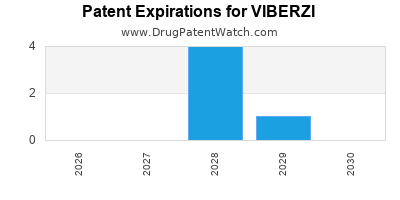
Viberzi is a drug marketed by Abbvie and is included in one NDA. There are fourteen patents protecting this drug and one Paragraph IV challenge.

The generic ingredient in VIBERZI is eluxadoline. There is one drug master file entry for this compound. One supplier is listed for this compound. Additional details are available on the eluxadoline profile page.

DrugPatentWatch® Generic Entry Outlook for Viberzi

Viberzi was eligible for patent challenges on May 27, 2019.

By analyzing the patents and regulatory protections it appears that the earliest date for generic entry will be March 14, 2033. This may change due to patent challenges or generic licensing.

There have been twenty-two patent litigation cases involving the patents protecting this drug, indicating strong interest in generic launch. Recent data indicate that 63% of patent challenges are decided in favor of the generic patent challenger and that 54% of successful patent challengers promptly launch generic drugs.

There are two tentative approvals for the generic drug (eluxadoline), which indicates the potential for near-term generic launch.

Indicators of Generic Entry

< Available with Subscription >

  Start Trial

AI Deep Research
Questions you can ask:
  • What is the 5 year forecast for VIBERZI?
  • What are the global sales for VIBERZI?
  • What is Average Wholesale Price for VIBERZI?
DrugPatentWatch® Estimated Loss of Exclusivity (LOE) Date for VIBERZI
Generic Entry Date for VIBERZI*:
Constraining patent/regulatory exclusivity:
NDA:
Dosage:

TABLET;ORAL

*The generic entry opportunity date is the latter of the last compound-claiming patent and the last regulatory exclusivity protection. Many factors can influence early or later generic entry. This date is provided as a rough estimate of generic entry potential and should not be used as an independent source.

Recent Clinical Trials for VIBERZI

Identify potential brand extensions & 505(b)(2) entrants

SponsorPhase
Temple UniversityPhase 2/Phase 3
University of North Carolina, Chapel HillPhase 2
AllerganPhase 2

See all VIBERZI clinical trials

Pharmacology for VIBERZI
Paragraph IV (Patent) Challenges for VIBERZI
Tradename Dosage Ingredient Strength NDA ANDAs Submitted Submissiondate
VIBERZI Tablets eluxadoline 75 mg and 100 mg 206940 6 2019-05-28

US Patents and Regulatory Information for VIBERZI

VIBERZI is protected by fifteen US patents.

Based on analysis by DrugPatentWatch, the earliest date for a generic version of VIBERZI is ⤷  Start Trial.

This potential generic entry date is based on patent 9,675,587.

Generics may enter earlier, or later, based on new patent filings, patent extensions, patent invalidation, early generic licensing, generic entry preferences, and other factors.

Applicant Tradename Generic Name Dosage NDA Approval Date TE Type RLD RS Patent No. Patent Expiration Product Substance Delist Req. Exclusivity Expiration
Abbvie VIBERZI eluxadoline TABLET;ORAL 206940-002 May 27, 2015 RX Yes Yes 11,160,792 ⤷  Start Trial Y ⤷  Start Trial
Abbvie VIBERZI eluxadoline TABLET;ORAL 206940-001 May 27, 2015 RX Yes No 9,115,091 ⤷  Start Trial Y Y ⤷  Start Trial
Abbvie VIBERZI eluxadoline TABLET;ORAL 206940-002 May 27, 2015 RX Yes Yes 8,691,860 ⤷  Start Trial Y ⤷  Start Trial
Abbvie VIBERZI eluxadoline TABLET;ORAL 206940-002 May 27, 2015 RX Yes Yes 7,741,356 ⤷  Start Trial Y Y ⤷  Start Trial
Abbvie VIBERZI eluxadoline TABLET;ORAL 206940-001 May 27, 2015 RX Yes No 11,007,179 ⤷  Start Trial Y ⤷  Start Trial
Abbvie VIBERZI eluxadoline TABLET;ORAL 206940-001 May 27, 2015 RX Yes No 11,160,792 ⤷  Start Trial Y ⤷  Start Trial
>Applicant >Tradename >Generic Name >Dosage >NDA >Approval Date >TE >Type >RLD >RS >Patent No. >Patent Expiration >Product >Substance >Delist Req. >Exclusivity Expiration

Expired US Patents for VIBERZI

Applicant Tradename Generic Name Dosage NDA Approval Date Patent No. Patent Expiration
Abbvie VIBERZI eluxadoline TABLET;ORAL 206940-002 May 27, 2015 9,700,542 ⤷  Start Trial
Abbvie VIBERZI eluxadoline TABLET;ORAL 206940-002 May 27, 2015 8,772,325 ⤷  Start Trial
Abbvie VIBERZI eluxadoline TABLET;ORAL 206940-001 May 27, 2015 8,609,709 ⤷  Start Trial
Abbvie VIBERZI eluxadoline TABLET;ORAL 206940-001 May 27, 2015 10,213,415 ⤷  Start Trial
Abbvie VIBERZI eluxadoline TABLET;ORAL 206940-002 May 27, 2015 9,205,076 ⤷  Start Trial
Abbvie VIBERZI eluxadoline TABLET;ORAL 206940-002 May 27, 2015 8,609,709 ⤷  Start Trial
>Applicant >Tradename >Generic Name >Dosage >NDA >Approval Date >Patent No. >Patent Expiration

EU/EMA Drug Approvals for VIBERZI

Company Drugname Inn Product Number / Indication Status Generic Biosimilar Orphan Marketing Authorisation Marketing Refusal
Allergan Pharmaceuticals International Limited Truberzi eluxadoline EMEA/H/C/004098Truberzi is indicated in adults for the treatment of irritable bowel syndrome with diarrhoea (IBS D). Withdrawn no no no 2016-09-19
>Company >Drugname >Inn >Product Number / Indication >Status >Generic >Biosimilar >Orphan >Marketing Authorisation >Marketing Refusal

International Patents for VIBERZI

When does loss-of-exclusivity occur for VIBERZI?

Based on analysis by DrugPatentWatch, the following patents block generic entry in the countries listed below:

Australia

Patent: 14241076
Patent: Opioid receptor modulator dosage formulations
Estimated Expiration: ⤷  Start Trial

Brazil

Patent: 2015022753
Patent: formulações de dosagens de moduladores de receptor opióide
Estimated Expiration: ⤷  Start Trial

Canada

Patent: 06472
Patent: FORMULATIONS PHARMACEUTIQUES DE MODULATEUR DES RECEPTEURS AUX OPIOIDES (OPIOID RECEPTOR MODULATOR DOSAGE FORMULATIONS)
Estimated Expiration: ⤷  Start Trial

China

Patent: 5228629
Patent: Opioid receptor modulator dosage formulations
Estimated Expiration: ⤷  Start Trial

Patent: 0917159
Patent: 阿片样物质受体调节剂剂型 (Opioid receptor modulator dosage formulations)
Estimated Expiration: ⤷  Start Trial

Cyprus

Patent: 20892
Estimated Expiration: ⤷  Start Trial

Denmark

Patent: 68351
Estimated Expiration: ⤷  Start Trial

Eurasian Patent Organization

Patent: 1559
Patent: ДОЗИРОВАННЫЕ ПРЕПАРАТЫ В КАЧЕСТВЕ МОДУЛЯТОРОВ ОПИОИДНОГО РЕЦЕПТОРА (OPIOID RECEPTOR MODULATOR DOSAGE FORMULATIONS)
Estimated Expiration: ⤷  Start Trial

Patent: 1591768
Patent: ДОЗИРОВАННЫЕ ПРЕПАРАТЫ В КАЧЕСТВЕ МОДУЛЯТОРОВ ОПИОИДНОГО РЕЦЕПТОРА (OPIOID RECEPTOR MODULATOR DOSAGE FORMULATIONS)
Estimated Expiration: ⤷  Start Trial

European Patent Office

Patent: 68351
Patent: FORMULATIONS PHARMACEUTIQUES DE MODULATEUR DES RÉCEPTEURS AUX OPIOÏDES (OPIOID RECEPTOR MODULATOR DOSAGE FORMULATIONS)
Estimated Expiration: ⤷  Start Trial

Patent: 56321
Patent: FORMULATIONS DE DOSAGE DE MODULATEUR DU RÉCEPTEUR OPIOÏDE (OPIOID RECEPTOR MODULATOR DOSAGE FORMULATIONS)
Estimated Expiration: ⤷  Start Trial

Patent: 65131
Patent: FORMULATIONS DE DOSAGE DE MODULATEUR DU RÉCEPTEUR OPIOÏDE (OPIOID RECEPTOR MODULATOR DOSAGE FORMULATIONS)
Estimated Expiration: ⤷  Start Trial

Hong Kong

Patent: 18514
Patent: 阿片受體調節劑劑型 (OPIOID RECEPTOR MODULATOR DOSAGE FORMULATIONS)
Estimated Expiration: ⤷  Start Trial

Hungary

Patent: 42748
Estimated Expiration: ⤷  Start Trial

Israel

Patent: 1561
Patent: פורמולציה למינון מאפנן קולטן אופיאויד (Opioid receptor modulator dosage formulations)
Estimated Expiration: ⤷  Start Trial

Patent: 8718
Patent: פורמולציה למינון מאפנן קולטן אופיאויד (Opioid receptor modulator dosage formulations)
Estimated Expiration: ⤷  Start Trial

Japan

Patent: 49225
Estimated Expiration: ⤷  Start Trial

Patent: 66975
Estimated Expiration: ⤷  Start Trial

Patent: 16516694
Patent: オピオイド受容体モジュレーターの投与製剤
Estimated Expiration: ⤷  Start Trial

Patent: 19014744
Patent: オピオイド受容体モジュレーターの投与製剤 (DOSAGE FORMULATIONS OF OPIOID RECEPTOR MODULATOR)
Estimated Expiration: ⤷  Start Trial

Poland

Patent: 68351
Estimated Expiration: ⤷  Start Trial

Portugal

Patent: 68351
Estimated Expiration: ⤷  Start Trial

Slovenia

Patent: 68351
Estimated Expiration: ⤷  Start Trial

South Korea

Patent: 2435440
Estimated Expiration: ⤷  Start Trial

Patent: 150140681
Patent: 오피오이드 수용체 조절인자 투여 제제 (OPIOID RECEPTOR MODULATOR DOSAGE FORMULATIONS)
Estimated Expiration: ⤷  Start Trial

Spain

Patent: 93374
Estimated Expiration: ⤷  Start Trial

Taiwan

Patent: 1444590
Patent: Opioid receptor modulator dosage formulations
Estimated Expiration: ⤷  Start Trial

Patent: 48071
Estimated Expiration: ⤷  Start Trial

Turkey

Patent: 1815953
Estimated Expiration: ⤷  Start Trial

Generics may enter earlier, or later, based on new patent filings, patent extensions, patent invalidation, early generic licensing, generic entry preferences, and other factors.

See the table below for additional patents covering VIBERZI around the world.

Country Patent Number Title Estimated Expiration
Australia 2014241076 ⤷  Start Trial
Brazil 112015022753 ⤷  Start Trial
Canada 2906472 ⤷  Start Trial
Canada 3254178 ⤷  Start Trial
China 105228629 ⤷  Start Trial
China 110917159 ⤷  Start Trial
>Country >Patent Number >Title >Estimated Expiration

Supplementary Protection Certificates for VIBERZI

Patent Number Supplementary Protection Certificate SPC Country SPC Expiration SPC Description
1725537 CA 2017 00008 Denmark ⤷  Start Trial PRODUCT NAME: ELUXADOLIN ELLER EN FARMACEUTISK ACCEPTABEL ENANTIOMER, DIASTEREOMER, RACEMAT ELLER SALT DERAF; REG. NO/DATE: EU/1/16/1126 20160921
1725537 300865 Netherlands ⤷  Start Trial PRODUCT NAME: ELUXADOLINE OF EEN FARMACEUTISCH AANVAARDBAAR ENANTIOMEER,DIASTEREOMEER, RACEMAAT OF ZOUT DAARVAN; REGISTRATION NO/DATE: EU/1/16/1126 20160921
1725537 PA2017005 Lithuania ⤷  Start Trial PRODUCT NAME: ELUKSADOLINAS ARBA JO FARMACINIU POZIURIU PRIIMTINAS ENANTIOMERAS, DIASTEREOMERAS, RACEMATAS ARBA DRUSKA; REGISTRATION NO/DATE: EU/1/16/1126 20160919
1725537 122017000009 Germany ⤷  Start Trial PRODUCT NAME: ELUXADOLIN ODER EIN PHARMAZEUTISCH AKZEPTABLES SALZ DAVON; REGISTRATION NO/DATE: EU/1/16/1126 20160919
2176234 122017000010 Germany ⤷  Start Trial PRODUCT NAME: ELUXADOLIN; REGISTRATION NO/DATE: EU/1/16/1126 20160919
1725537 1790007-7 Sweden ⤷  Start Trial PRODUCT NAME: ELUXADOLINE OR A PHARMACEUTICALLY ACCEPTABLE ENANTIOMER, DIASTEREOMER, RACEMATE OR SALT THEREOF; REG. NO/DATE: EU/1/16/1126 20160921
>Patent Number >Supplementary Protection Certificate >SPC Country >SPC Expiration >SPC Description

Viberzi Market Dynamics, Financial Trajectory, Patent Protection and Generic Risk

Last updated: October 27, 2026

Viberzi, the brand name for eluxadoline, is an oral, schedule IV drug approved by the U.S. Food and Drug Administration for irritable bowel syndrome with diarrhea, or IBS-D, in adults. Its commercial trajectory has been limited by a narrow label, safety restrictions involving the gallbladder and pancreas, competition from Xifaxan and low-cost symptomatic therapies, and the absence of a large international market.

AbbVie inherited Viberzi through its 2019 acquisition of Allergan. The product generated roughly $100 million to $120 million in annual sales before the acquisition but was not a major contributor to AbbVie's post-2020 financial results. Viberzi remains exposed to generic entry through the ANDA pathway, although its commercial decline reduces the financial value of late-stage patent litigation.

What is Viberzi and how does eluxadoline work?

Viberzi contains eluxadoline, a mixed opioid receptor modulator that acts primarily at peripheral mu-opioid receptors, with activity at delta-opioid receptors. It is designed to reduce bowel contractions and fluid secretion while improving diarrhea and abdominal symptoms associated with IBS-D.

The FDA approved Viberzi on May 27, 2015. The labeled dose is 100 mg twice daily for eligible adults, with a lower 75 mg twice-daily dose for selected patients, including some patients without a gallbladder and those unable to tolerate the higher dose.[1]

Viberzi is distinct from Xifaxan, which is rifaximin, and from common antidiarrheal products such as loperamide.

Product Active ingredient Primary IBS-D role Key commercial distinction
Viberzi Eluxadoline Reduces diarrhea and bowel urgency Controlled opioid-modulating drug
Xifaxan Rifaximin Treats IBS-D symptoms and recurrence Antibiotic with separate approved indications
Imodium Loperamide Symptomatic diarrhea control Low-cost, largely over-the-counter alternative
Lotronex Alosetron Severe diarrhea-predominant IBS in selected women Restricted use because of serious gastrointestinal risks

How large is the Viberzi market?

Viberzi operates in a fragmented IBS-D market rather than a single-drug market. Prescribers select among prescription therapies, over-the-counter antidiarrheals, dietary interventions, and off-label drugs.

The main commercial constraints are:

  • IBS-D is a chronic but heterogeneous condition.
  • Many patients use inexpensive symptomatic therapies before moving to prescription drugs.
  • Xifaxan has stronger recognition in the U.S. IBS-D market.
  • Viberzi is unsuitable for patients without a gallbladder, patients with certain alcohol-use patterns, and patients with several pancreatic, hepatic, or biliary conditions.
  • Safety warnings increased prescribing friction and patient screening requirements.

Viberzi's initial market opportunity was based on an unmet need for a non-antibiotic prescription treatment that could address diarrhea, urgency, and abdominal pain. The addressable population narrowed after safety restrictions were added to the prescribing information.

What were Viberzi’s sales and financial trajectory?

Allergan reported Viberzi sales in the approximate range of $100 million to $120 million annually during its principal commercial period. Public company reporting did not establish Viberzi as a material revenue driver compared with Allergan's larger products, including Botox, Restasis, Linzess, and several central nervous system and eye-care brands.

Year Approximate reported Viberzi revenue Commercial interpretation
2016 $59 million Early post-launch expansion
2017 $110 million Increased prescription adoption before later safety pressure
2018 $116 million Peak or near-peak commercial period
2019 $110 million to $115 million Mature product with limited growth
2020 onward Not consistently reported as a standalone brand Low materiality within AbbVie reporting

The exact figures vary by reporting presentation and fiscal-period treatment in Allergan filings. After AbbVie acquired Allergan, Viberzi was not presented as a separately material revenue line in the way that AbbVie's core immunology and aesthetics products were reported.[2]

What caused Viberzi revenue growth to stall?

Viberzi's growth was constrained by safety-related restrictions and competitive positioning.

In 2017, the FDA warned that Viberzi should not be used in patients without a gallbladder after reports of serious pancreatitis, including deaths. The agency also emphasized risks associated with alcohol use, biliary obstruction, sphincter of Oddi dysfunction, and pancreatitis.[3]

The 2017 warning materially reduced the eligible patient population. Patients without a gallbladder represent a significant portion of the IBS-D population, making the restriction commercially important.

In 2019, the FDA reported additional deaths and serious adverse events associated with Viberzi use in patients without a gallbladder. The agency instructed healthcare professionals to stop prescribing Viberzi to those patients and stated that the product should not be used in that population.[4]

The result was a product with a smaller target population, greater prescriber screening burden, and increased competition from Xifaxan and nonprescription options.

What is the FDA regulatory status of Viberzi?

Viberzi remains an FDA-approved treatment for IBS-D in adults, but its prescribing restrictions are substantial.

Regulatory issue Status
FDA approval Approved May 27, 2015
Indication IBS-D in adults
Dosage form Oral tablets
Controlled substance Schedule IV in the United States
Gallbladder status Contraindicated in patients without a gallbladder
Alcohol-related restrictions Avoid excessive alcohol use; label includes specific contraindications and warnings
Major safety concerns Pancreatitis, sphincter of Oddi spasm, constipation, biliary complications
Regulatory pathway New drug application, not biologic licensing

Viberzi's controlled-substance status creates additional prescribing, dispensing, and compliance requirements. It also differentiates the product from rifaximin and most over-the-counter IBS-D products.[5]

What patents protect Viberzi?

Viberzi's core intellectual property is based on composition-of-matter and related pharmaceutical patents covering eluxadoline and its use in gastrointestinal disorders. The relevant patent estate can include:

  • Eluxadoline chemical composition claims.
  • Pharmaceutical composition claims.
  • Treatment claims for IBS and diarrhea.
  • Dosing and administration claims.
  • Salt, polymorph, or formulation claims where applicable.
  • Manufacturing and intermediate claims.

The most commercially important protection is the core active-ingredient patent. Method-of-use patents generally provide narrower protection because generic applicants can attempt to omit or carve out patented indications through a section viii statement.

Viberzi is a small-molecule drug. It therefore does not receive the biosimilar framework protections that apply to biologics such as monoclonal antibodies. Generic manufacturers can pursue approval through an abbreviated new drug application, subject to patent certifications and applicable exclusivity.

A current Orange Book review is required to determine the precise live patent list, expiration dates, pediatric exclusivity adjustments, and any changes caused by terminal disclaimers or patent-term extension. The Orange Book remains the controlling commercial reference for listed U.S. patents and exclusivity.[6]

When does Viberzi lose exclusivity?

Viberzi's practical exclusivity is determined by three separate factors:

  1. FDA regulatory exclusivity.
  2. Patent expiration.
  3. The timing and outcome of ANDA challenges.

Viberzi's five-year new chemical entity exclusivity expired well before the current commercial period. The principal remaining barrier is patent protection, not FDA exclusivity.

The first generic-launch date cannot be determined solely from the original FDA approval date. It depends on:

  • The expiration of each listed patent.
  • Whether an applicant files a Paragraph IV certification.
  • Whether the patent holder brings litigation within 45 days.
  • Whether the litigation triggers a 30-month stay.
  • Whether the parties settle.
  • Whether the generic applicant obtains a judgment of invalidity, unenforceability, or non-infringement.
  • Whether the applicant uses a section viii carve-out for method-of-use claims.

Have generic manufacturers filed Paragraph IV challenges to Viberzi?

Publicly visible commercial information does not identify a major, widely reported Viberzi Paragraph IV litigation campaign comparable to the challenges involving blockbuster drugs such as Humira, Revlimid, or Eliquis.

The absence of a prominent litigation record does not eliminate generic risk. Viberzi's limited annual sales may reduce the incentive for a large ANDA manufacturer to fund aggressive litigation, but low development cost for an oral small molecule can still support a later generic filing.

A generic applicant could pursue several strategies:

  • Challenge composition patents under Paragraph IV.
  • Wait for patent expiration and file under Paragraph III.
  • File a section viii statement against method-of-use claims.
  • Target a lower-cost launch after the branded market has contracted.
  • Enter through a settlement that provides a future launch date.

What formulation patents protect Viberzi?

Viberzi is marketed as an oral tablet rather than an extended-release injectable, transdermal system, or complex delivery device. This limits the commercial value of formulation patents relative to products with sophisticated delivery technology.

Potential formulation claims may cover:

  • Tablet composition.
  • Excipient selection.
  • Stability.
  • Manufacturing process.
  • Dosage strength.
  • Solid-state characteristics.

For generic competition, formulation patents are most relevant if they are listed in the Orange Book and if they prevent a therapeutically substitutable tablet from reaching the market. A generic manufacturer may avoid some formulation claims by using a different excipient system or manufacturing route, provided the product satisfies FDA equivalence requirements.

What method-of-use patents cover Viberzi?

Method-of-use protection may cover treatment of IBS-D, reduction of diarrhea, or specific dosing regimens. These patents are commercially narrower than composition patents.

A generic applicant can sometimes pursue a label that excludes a patented indication. That strategy is more difficult when the remaining unpatented indication is central to the product's commercial use or when the FDA-approved label would still encourage infringement.

Because Viberzi has one principal approved indication, method-of-use carve-outs may be less commercially powerful than they are for drugs with multiple independent indications.

How strong is the Viberzi patent estate?

Viberzi's patent estate is moderate from a technical perspective but less valuable commercially than it was during the product's growth period.

Factors supporting patent strength

  • A small-molecule composition patent can block direct substitution until expiration.
  • Eluxadoline has a defined chemical entity rather than a broad mixture.
  • A branded oral tablet can be protected by composition and manufacturing claims.
  • Controlled-substance and safety requirements may raise operational hurdles for some generic entrants.

Factors weakening practical exclusivity

  • The core product has a narrow market.
  • The principal indication is concentrated in IBS-D.
  • Generic manufacturers can use the ANDA pathway.
  • Method-of-use patents may be vulnerable to label carve-outs.
  • Viberzi lacks the complex biologic manufacturing barriers associated with antibody products.
  • Safety restrictions reduce the economic value of prolonging exclusivity.

Patent strength and commercial strength are separate. Viberzi may retain enforceable claims while generating insufficient revenue to justify extensive litigation.

Which companies compete with Viberzi?

The competitive landscape is led by Xifaxan, manufactured by Salix Pharmaceuticals, a division of Bausch Health, and by inexpensive symptomatic treatments.

Competitor Company Competitive position
Xifaxan Bausch Health/Salix Main branded prescription competitor for IBS-D
Loperamide Multiple manufacturers Low-cost symptomatic alternative
Alosetron Generic and branded sources Option for selected women with severe IBS-D
Antispasmodics Multiple manufacturers Used for abdominal pain and cramping
Dietary and behavioral therapy Various providers Common first-line or adjunctive approach

Xifaxan benefits from broader prescriber familiarity and a commercial platform spanning hepatic encephalopathy, travelers' diarrhea, and IBS-D. Viberzi's narrower indication and safety restrictions limit its competitive reach.

Are biosimilars a risk for Viberzi?

No. Viberzi is a chemically synthesized small molecule, not a biologic. Biosimilar competition is therefore irrelevant.

The relevant threat is generic substitution through the ANDA pathway. Generic competition would likely produce sharper price compression than biosimilar competition because FDA-approved therapeutically equivalent tablets can receive pharmacy substitution subject to state law and payer policy.

What licensing deals affect Viberzi?

Viberzi was developed through a chain of transactions involving Furiex Pharmaceuticals, Forest Laboratories, Actavis, and Allergan. Forest Laboratories acquired Furiex in 2014, and Actavis acquired Forest Laboratories the same year. Actavis later adopted the Allergan name. AbbVie acquired Allergan in 2019.[7]

The transaction history matters because rights to Viberzi were consolidated through corporate acquisitions rather than through a major later-stage licensing deal. No publicly reported licensing transaction has made Viberzi a material standalone asset after the AbbVie-Allergan transaction.

What litigation and settlement risks affect Viberzi?

Viberzi's most important legal exposure has been product-liability risk linked to pancreatitis and biliary complications, not a highly visible patent battle.

The FDA safety communications increased the likelihood of:

  • Personal-injury claims.
  • Failure-to-warn allegations.
  • Medical monitoring claims.
  • Regulatory scrutiny of promotional materials.
  • Insurance and reserve exposure.

A major patent settlement would be economically rational only if expected generic erosion were large enough to justify the legal expense. Given Viberzi's declining revenue profile, a future generic entrant may prefer a lower-cost challenge or delayed entry rather than protracted litigation.

What generic launch scenarios exist for Viberzi?

Scenario 1: Delayed generic entry after patent expiry

This is the simplest pathway. A manufacturer files an ANDA with a Paragraph III certification and launches after the last relevant patent expires.

Scenario 2: Paragraph IV challenge

A challenger alleges that listed patents are invalid, unenforceable, or not infringed. Litigation could delay launch through the 30-month stay, unless resolved earlier.

Scenario 3: Section viii carve-out

A generic applicant omits patented method-of-use language from its labeling. This approach is more viable when the remaining label supports a commercially meaningful non-infringing use.

Scenario 4: Settlement with a negotiated launch date

The patent holder and generic applicant agree to a future entry date. The economic value of this structure depends on the remaining brand revenue and the strength of the asserted patents.

The most likely commercial outcome is gradual erosion rather than a high-value, first-day generic shock. Viberzi's prescription base and revenue scale are smaller than those of major chronic-care blockbusters.

What is Viberzi’s geographic coverage?

Viberzi's commercial significance is concentrated in the United States. The product has not developed the broad global revenue base associated with multinational therapies for diabetes, oncology, immunology, or cardiovascular disease.

Geographic limitations reduce:

  • International royalty potential.
  • Manufacturing scale.
  • Global supply-chain leverage.
  • The value of non-U.S. patent estates.
  • The ability to offset U.S. generic erosion with overseas growth.

The United States remains the primary market for assessing Viberzi's patents, FDA status, payer position, and generic-entry risk.

What manufacturing and intellectual-property barriers protect Viberzi?

Viberzi's manufacturing barriers are modest compared with biologics and complex drug-device products. The active ingredient is a small molecule delivered in a conventional tablet. Generic manufacturers must still establish:

  • Pharmaceutical equivalence.
  • Bioequivalence.
  • Appropriate controls for a controlled substance.
  • Manufacturing compliance.
  • Stability and impurity controls.
  • Compliance with applicable FDA labeling requirements.

These requirements create regulatory cost but do not represent a durable barrier comparable to proprietary cell lines, antibody production systems, inhaler devices, or long-acting injectable technology.

Key Takeaways

  • Viberzi is eluxadoline, an FDA-approved oral treatment for IBS-D.
  • Allergan's Viberzi revenue reached roughly $100 million to $120 million annually before the AbbVie acquisition.
  • The product's commercial trajectory was weakened by pancreatitis and gallbladder-related safety restrictions.
  • Patients without a gallbladder are contraindicated from using Viberzi.
  • Viberzi is a schedule IV controlled substance.
  • The product has no biosimilar risk because it is a small molecule.
  • Generic risk arises through ANDA filings, Paragraph IV challenges, section viii carve-outs, and post-expiry entry.
  • The core patent estate is more important legally than commercially because annual revenue has declined and is no longer separately material in AbbVie's public reporting.
  • Xifaxan, loperamide, alosetron, antispasmodics, and dietary interventions constrain Viberzi's market share.
  • The United States is the principal market for Viberzi revenue, regulatory status, and patent analysis.

FAQs

Is Viberzi still being marketed in the United States?

Viberzi remains an FDA-approved product for adult IBS-D, subject to its boxed warnings, contraindications, and controlled-substance requirements. Its commercial visibility is lower than during the Allergan growth period.

Can patients without a gallbladder take Viberzi?

No. The FDA labeling contraindicates Viberzi in patients without a gallbladder because of the risk of serious pancreatitis and sphincter of Oddi complications.

Is Viberzi more exposed to generic competition than Xifaxan?

Viberzi has the structural profile of a conventional small-molecule generic candidate. Xifaxan also faces generic risk, but its broader commercial platform and patent disputes have produced a different competitive and litigation profile.

Does Viberzi have pediatric exclusivity?

Viberzi was approved for adults with IBS-D. Its principal commercial exclusivity has been based on new chemical entity and patent protection rather than a major pediatric-exclusivity strategy.

What would most likely reduce Viberzi’s remaining value?

A therapeutically equivalent generic tablet, a successful Paragraph IV challenge, a major payer shift toward lower-cost alternatives, or further safety-related prescribing restrictions would reduce the product's remaining value.

References

  1. U.S. Food and Drug Administration. (2015). FDA approves Viberzi to treat irritable bowel syndrome with diarrhea. https://www.fda.gov
  2. Allergan plc. (2019). Annual report for the year ended December 31, 2019.
  3. U.S. Food and Drug Administration. (2017). FDA warns about increased risk of serious pancreatitis with Viberzi in patients without a gallbladder. https://www.fda.gov
  4. U.S. Food and Drug Administration. (2019). FDA warns about increased risk of serious pancreatitis with Viberzi. https://www.fda.gov
  5. U.S. Drug Enforcement Administration. (2016). Schedules of controlled substances: Placement of eluxadoline into schedule IV. Federal Register.
  6. U.S. Food and Drug Administration. (n.d.). Approved drug products with therapeutic equivalence evaluations, Orange Book. https://www.fda.gov
  7. AbbVie Inc. (2019). AbbVie completes acquisition of Allergan. https://news.abbvie.com

More… ↓

⤷  Start Trial

Make Better Decisions: Try a trial or see plans & pricing

Drugs may be covered by multiple patents or regulatory protections. All trademarks and applicant names are the property of their respective owners or licensors. Although great care is taken in the proper and correct provision of this service, thinkBiotech LLC does not accept any responsibility for possible consequences of errors or omissions in the provided data. The data presented herein is for information purposes only. There is no warranty that the data contained herein is error free. We do not provide individual investment advice. This service is not registered with any financial regulatory agency. The information we publish is educational only and based on our opinions plus our models. By using DrugPatentWatch you acknowledge that we do not provide personalized recommendations or advice. thinkBiotech performs no independent verification of facts as provided by public sources nor are attempts made to provide legal or investing advice. Any reliance on data provided herein is done solely at the discretion of the user. Users of this service are advised to seek professional advice and independent confirmation before considering acting on any of the provided information. thinkBiotech LLC reserves the right to amend, extend or withdraw any part or all of the offered service without notice.