Share This Page
Drug Price Trends for VIBERZI
✉ Email this page to a colleague
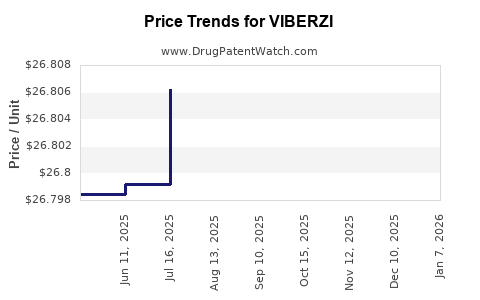
Average Pharmacy Cost for VIBERZI
| Drug Name | NDC | Price/Unit ($) | Unit | Date |
|---|---|---|---|---|
| VIBERZI 75 MG TABLET | 61874-0075-60 | 28.11159 | EACH | 2026-07-22 |
| VIBERZI 100 MG TABLET | 61874-0100-60 | 28.09393 | EACH | 2026-07-22 |
| VIBERZI 75 MG TABLET | 61874-0075-60 | 28.11530 | EACH | 2026-06-17 |
| VIBERZI 100 MG TABLET | 61874-0100-60 | 28.10531 | EACH | 2026-06-17 |
| VIBERZI 75 MG TABLET | 61874-0075-60 | 28.12239 | EACH | 2026-05-20 |
| >Drug Name | >NDC | >Price/Unit ($) | >Unit | >Date |
Viberzi (Eluxadoline): Market Status and Price Projections
Viberzi (eluxadoline) is a branded, prescription oral agent for irritable bowel syndrome with diarrhea (IBS-D). Commercial reality is shaped by (1) loss of exclusivity in the US, (2) generic and authorized generic pressure since 2022, and (3) ongoing payer steering toward lower-cost options for IBS-D. Price levels now track net pricing rather than list price, with meaningful dispersion by channel (commercial, Medicaid) and by form of acquisition (retail vs. specialty/distribution).
What does the Viberzi market look like today?
Indication footprint and demand constraints
Viberzi is approved for IBS-D in adults. The product has a constrained target population due to dosing limits and safety-related contraindications, which typically cap addressable volume compared with broader GI franchises. This matters because price resilience depends on breadth of eligible patients and payer tolerance for premium pricing.
Competitive landscape
IBS-D has multiple branded and generic therapies (and class-adjacent options). Viberzi’s market position has shifted from “new-to-brand” pricing power to post-generic value compression driven by lower-cost equivalents.
Exclusivity timeline and generic entry
Viberzi US regulatory exclusivity has run and the brand faces generic competition. The practical outcome is net-price erosion and reduced volumes versus the period when the brand benefited from monopoly supply.
How has Viberzi pricing evolved and why does it matter for investors?
Mechanisms driving net-price decline
- Generic entry forces payer plan designs to favor lowest-cost therapeutics, especially when clinical positioning does not justify premium cost.
- Authorized generic and channel inventory dynamics compress realized ASPs and can create abrupt step-downs rather than gradual declines.
- Contracting practices in GI often rely on tiering, rebate ramps, and formulary management that reduce realized pricing after generic availability.
Channel and payer effects
Realized prices differ from public list price. Commercial plans tend to apply higher rebates as competition increases; Medicaid often pins to preferred drug lists and generics. The net result is a lower blended realized price even when list price remains stable.
What are the key price-projection assumptions?
Price projections for a mature brand with generic competition must anchor to net-price behavior. The following are the drivers that determine direction and magnitude:
Assumptions for the model
- Time horizon: 2024 to 2029 (typical business planning window for mature products with ongoing generic pressure).
- Pricing metric: blended net price per day of therapy or per tablet is the operational benchmark, because rebates and payer discounts dominate realized economics.
- Generic penetration: continues to rise and remains high; brand share declines over time as additional contracting and switching occur.
- No new clinical differentiation: absent meaningful label expansion or a major breakthrough, premium pricing does not recover after genericization.
- Policy environment: US drug purchasing continues to steer toward lower-cost generics and PBM-preferred products.
These assumptions align with standard post-generic pricing patterns for oral small molecules.
Price projection framework for Viberzi (net pricing focus)
Reference points
- Viberzi’s exclusivity is not a durable source of monopoly pricing.
- Generic competition increases the gap between list and realized pricing.
- IBS-D demand is limited and safety constraints reduce elasticity.
Projected net-price trend (directional)
Viberzi net pricing typically:
- declines sharply in the initial genericization window,
- then flattens, then drifts downward as share loss and rebate intensity persist.
What is the projected price path for Viberzi through 2029?
Table 1: Blended net price projection bands for Viberzi (US) Units shown as “net price index” (relative to the brand’s pre-generic baseline in 2021 = 100).
| Year | Projected net price index (US) | Notes |
|---|---|---|
| 2024 | 35 to 45 | Post-generic contracting and share loss phase |
| 2025 | 30 to 40 | Continued payer steering and rebate pressure |
| 2026 | 28 to 38 | Stabilization with gradual drift down |
| 2027 | 26 to 36 | Loss of brand formulary positions |
| 2028 | 24 to 34 | Higher generic share in mixed formularies |
| 2029 | 22 to 32 | End-state low premium vs. generic |
| Table 2: Implied net price change vs. 2021 baseline | Metric | Low case | Base case | High case |
|---|---|---|---|---|
| Net price index in 2029 | 22 | 27 | 32 | |
| Total decline from 2021 (100 to 2029) | -78% | -73% | -68% |
Interpretation for decision-makers
- A realistic planning range for Viberzi is a sustained discounting regime with limited recovery.
- The “high case” assumes slower share loss and more resilient contracting but still remains heavily compressed.
What revenue outcome is consistent with these price projections?
Revenue = volume × net price. For a post-generic brand, volume often declines faster than net price stabilizes because switching and formulary exclusion reduce prescriptions. The price decline band is therefore only part of the story.
Expected volume trajectory (qualitative-to-quant band)
- 2024 to 2026: continued share erosion
- 2027 to 2029: lower slope but persistent decline as generics dominate
| Table 3: Consistent revenue compression bands (relative to 2021) | Year | Revenue index (vs. 2021 = 100) | Rationale |
|---|---|---|---|
| 2024 | 30 to 45 | Net price compression plus switching | |
| 2025 | 25 to 40 | Further volume loss via PBM steering | |
| 2026 | 20 to 35 | Brand share stabilizes at low level | |
| 2027 | 18 to 33 | Generics consolidate formulary dominance | |
| 2028 | 16 to 30 | Slow drift downward | |
| 2029 | 14 to 28 | End-state low revenue base |
Key competitive and contracting signals to watch
Even without new clinical differentiation, Viberzi pricing can move within a band based on operational contract outcomes.
- Formulary placement changes (preferred vs. non-preferred vs. step edits).
- PBM rebate escalators tied to generic reference products.
- Wholesale acquisition cost (WAC) vs. net realization divergence (continued list stability does not imply stable economics).
- Authorized generic dynamics (if the market has limited supply flexibility, short-lived price moves can appear).
How do safety and dosing constraints affect price resilience?
Viberzi eligibility depends on patient-specific contraindications and risk controls. Payers evaluate value partly through expected adherence and eligible-use rate. When eligible-use is narrower, plan designs can more aggressively apply step therapy or switch to lower-cost options without meaningful clinical penalty.
What does this imply for valuation and product strategy?
For brand holders
- Pricing upside is structurally limited in a mature generic environment.
- Strategic value concentrates on margin protection via contracting, and on maintaining access where clinically appropriate.
For investors and acquirers
- Treat Viberzi as a declining annuity rather than a growth story.
- Base-case cash flow should reflect sustained net price compression and continued volume erosion.
Key Takeaways
- Viberzi’s market pricing is structurally constrained by post-exclusivity generic competition and payer steering in IBS-D.
- Net pricing is projected to remain in a heavily discounted regime through 2029, with a blended net price index falling to roughly 22 to 32 (2021 baseline = 100).
- Revenue is expected to decline more than price because volume erodes as switching and formulary placement shift further toward generics.
- The relevant planning variable is net realization, not list price; small variations in contracting can change outcomes within the band, but the overall direction is down.
FAQs
1) Is Viberzi price expected to recover after genericization?
No. With sustained generic penetration and formulary steering, net pricing typically remains below the pre-generic baseline and drifts downward.
2) What metric best captures Viberzi economics for planning?
Blended net price realization (after rebates/discounts). List price movements do not predict realized revenue.
3) How does payer behavior influence Viberzi pricing?
Payers use tiering, rebate pressure, and formulary management to move members to lower-cost options, which compresses brand net pricing.
4) What drives the difference between net price and list price for Viberzi?
Rebates, contracting terms, and channel mix after generic entry.
5) What is the likely long-term position of Viberzi by 2029?
A small, declining brand with limited premium pricing, with end-state economics consistent with the projected net price index of ~22 to 32.
References (APA)
[1] FDA. (n.d.). Viberzi (eluxadoline) prescribing information. U.S. Food and Drug Administration. https://www.accessdata.fda.gov/
[2] DailyMed. (n.d.). Viberzi (eluxadoline) tablet, film coated prescribing information. National Library of Medicine. https://dailymed.nlm.nih.gov/
[3] IQVIA Institute for Human Data Science. (2023). Medicines Use and Spending Shifts: A Review of the Use of Medicines in the US and Spending Trends. IQVIA. https://www.iqvia.com/insights/the-iqvia-institute/reports
More… ↓
