Last Updated: June 26, 2026

VEREGEN Drug Patent Profile


✉ Email this page to a colleague

« Back to Dashboard


Which patents cover Veregen, and what generic alternatives are available?

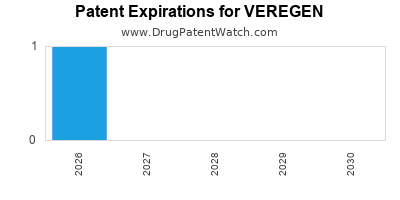
Veregen is a drug marketed by Ani Pharms and is included in one NDA. There is one patent protecting this drug.

This drug has thirty-one patent family members in twenty countries.

The generic ingredient in VEREGEN is sinecatechins. There is one drug master file entry for this compound. One supplier is listed for this compound. Additional details are available on the sinecatechins profile page.

DrugPatentWatch® Generic Entry Outlook for Veregen

By analyzing the patents and regulatory protections it appears that the earliest date for generic entry will be October 2, 2026. This may change due to patent challenges or generic licensing.

Indicators of Generic Entry

< Available with Subscription >

  Start Trial

AI Deep Research
Questions you can ask:
  • What is the 5 year forecast for VEREGEN?
  • What are the global sales for VEREGEN?
  • What is Average Wholesale Price for VEREGEN?
Summary for VEREGEN
DrugPatentWatch® Estimated Loss of Exclusivity (LOE) Date for VEREGEN
Generic Entry Date for VEREGEN*:
Constraining patent/regulatory exclusivity:
NDA:
Dosage:

OINTMENT;TOPICAL

*The generic entry opportunity date is the latter of the last compound-claiming patent and the last regulatory exclusivity protection. Many factors can influence early or later generic entry. This date is provided as a rough estimate of generic entry potential and should not be used as an independent source.

Recent Clinical Trials for VEREGEN

Identify potential brand extensions & 505(b)(2) entrants

SponsorPhase
Aresus Pharma GmbHPHASE3
ECOG-ACRIN Cancer Research GroupPhase 2
National Cancer Institute (NCI)Phase 2

See all VEREGEN clinical trials

US Patents and Regulatory Information for VEREGEN

VEREGEN is protected by one US patents.

Based on analysis by DrugPatentWatch, the earliest date for a generic version of VEREGEN is ⤷  Start Trial.

This potential generic entry date is based on patent ⤷  Start Trial.

Generics may enter earlier, or later, based on new patent filings, patent extensions, patent invalidation, early generic licensing, generic entry preferences, and other factors.

Applicant Tradename Generic Name Dosage NDA Approval Date TE Type RLD RS Patent No. Patent Expiration Product Substance Delist Req. Exclusivity Expiration
Ani Pharms VEREGEN sinecatechins OINTMENT;TOPICAL 021902-001 Oct 31, 2006 RX Yes Yes ⤷  Start Trial ⤷  Start Trial Y ⤷  Start Trial
>Applicant >Tradename >Generic Name >Dosage >NDA >Approval Date >TE >Type >RLD >RS >Patent No. >Patent Expiration >Product >Substance >Delist Req. >Exclusivity Expiration

Expired US Patents for VEREGEN

Applicant Tradename Generic Name Dosage NDA Approval Date Patent No. Patent Expiration
Ani Pharms VEREGEN sinecatechins OINTMENT;TOPICAL 021902-001 Oct 31, 2006 ⤷  Start Trial ⤷  Start Trial
>Applicant >Tradename >Generic Name >Dosage >NDA >Approval Date >Patent No. >Patent Expiration

International Patents for VEREGEN

See the table below for patents covering VEREGEN around the world.

Country Patent Number Title Estimated Expiration
Argentina 037526 MEDICAMENTO PARA EL TRATAMIENTO DE ENFERMEDADES VIRALES DE LA PIEL Y DE TUMORES ⤷  Start Trial
Austria 417611 ⤷  Start Trial
Australia 2002356673 ⤷  Start Trial
Brazil 0214256 ⤷  Start Trial
Brazil PI0214256 medicamento ⤷  Start Trial
Canada 2466720 MEDICAMENT POUR TRAITER DES MALADIES DE PEAU VIRALES ET DES MALADIES TUMORALES (MEDICAMENT FOR THE TREATMENT OF VIRAL SKIN AND TUMOUR DISEASES) ⤷  Start Trial
>Country >Patent Number >Title >Estimated Expiration

Supplementary Protection Certificates for VEREGEN

Patent Number Supplementary Protection Certificate SPC Country SPC Expiration SPC Description
1448186 300550 Netherlands ⤷  Start Trial PRODUCT NAME: DROOG EXTRACT VAN GROENE THEE (CAMELLIA SINENSIS (L.) O.KUNZE FOLIUM) WATERIG (24-56:1) WAARVAN 100 MG OVEREENKOMT MET : 55-72 MG VAN (-)- EPIGALLOCATECHINEGALLAAT. EERSTE EXTRACTIEMIDDEL: WATER; NATIONAL REGISTRATION NO/DATE: RVG 110904 20120920; FIRST REGISTRATION: DE 73486.00.00 20090831
1448186 C01448186/01 Switzerland ⤷  Start Trial FORMER OWNER: MEDIGENE AG, DE
1448186 140 5025-2012 Slovakia ⤷  Start Trial PRODUCT NAME: PURIFIKOVANY SUCHY EXTRAKT ZO ZELENEHO CAJU (CAMELLIA SINENSIS (L.) O. KUNTZE) A IZOPROPYLMYRISTAT; NAT. REGISTRATION NO/DATE: 46/0306/12-S 20120716; FIRST REGISTRATION: DE 73486.00.00 20090831
1448186 C300550 Netherlands ⤷  Start Trial PRODUCT NAME: MENGSEL VAN CATECHOLEN GEISOLEERD UIT EEN EXTRACT VAN GROENE THEE, CAMELLIA SINENSIS, L. O. KUNTZE MET ISOPROPYLMYRISTAAT; NATL. REGISTRATION NO/DATE: RVG 110904 20120920; FIRST REGISTRATION: DE 73486.00.00 20090831
1448186 CA 2012 00040 Denmark ⤷  Start Trial
1448186 12C0058 France ⤷  Start Trial PRODUCT NAME: EXTRAIT SEC RAFFINE DE FEUILLE DE THE VERT (CAMELLIA SINENSIS (L.) O. KUNTZE) QUANTIFIE EN GALLATE D'(-)-EPIGALLOCATECHINE; NAT. REGISTRATION NO/DATE: NL41799 20120625; FIRST REGISTRATION: DE - 73186.00.00 20090831
>Patent Number >Supplementary Protection Certificate >SPC Country >SPC Expiration >SPC Description

VEREGEN (verrucous lesions) market dynamics and financial trajectory: pricing, demand drivers, channel structure, and exclusivity-to-generic exposure

Last updated: June 22, 2026

Veregen (sinecatechins, 10% ointment) is a niche, dermatology-focused product with limited commercial scale relative to mainstream top-line dermatology incumbents. Its financial trajectory has been constrained by small patient pools, competitive substitution by other wart therapies, and the risk profile created by patent and exclusivity expiration dynamics tied to generic and OTC-adjacent alternatives. Current-market value is driven more by maintenance prescriptions and payer/coverage behavior than by new-label expansion.


What is VEREGEN (sinecatechins) used for and how does that shape demand?

Featured snippet answer: VEREGEN is indicated for treatment of external genital warts (condyloma acuminata). Demand is tied to STD clinic throughput, urology/gynecology referral patterns, adherence and recurrence rates, and payer coverage for topical immunomodulatory therapy.

Indication and patient segmentation

Veregen’s demand is dominated by:

  • Initial and recurrent external genital warts treated in outpatient settings
  • Patient segments sensitive to non-procedural options (avoidance of destructive methods)
  • Clinically managed recurrence windows after lesion clearance

Wart epidemiology matters, but the prescribing mix does not track total incidence 1:1 because:

  • Many patients receive destructive therapies, cryotherapy, or surgical approaches
  • Some patients use partner/setting-specific protocols in sexual health clinics
  • Topical alternatives face differing payer preferences and formulary placement

Channel-level demand drivers

Commercial pull tends to concentrate in:

  • Sexual health and dermatology clinics
  • OB/GYN and urology practices with established wart workflows
  • Specialty distribution through pharmacy benefit managers (PBMs) because the product is Rx and formularies drive access

Pricing and access matter because topical wartherapies sit in a competitive class where plan design can move utilization quickly.


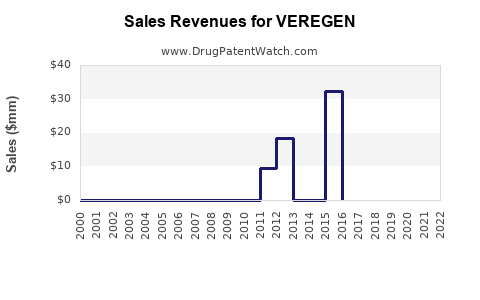
How has VEREGEN’s revenue trajectory evolved and what macro factors explain it?

Featured snippet answer: Veregen’s revenue trajectory is typically “mid-single-digit growth to plateau” territory in mature markets, with step-down or flat periods aligned to competitive substitution, formulary pressure, and loss of exclusivity timelines.

Key revenue mechanics for a topical wart drug

Revenue is influenced by:

  • Rx volume per treated patient episode (treatment cycles, duration, adherence)
  • Persistence and retreatment from recurrence
  • Contracting and formulary access (preferred vs non-preferred status)
  • Specialty and retail segmentation (where the dispensing channel shifts under PBM rules)

Market structure constraints

Because the product targets a limited lesion type and site (external genital warts), the ceiling is structurally capped. Growth requires one or more of:

  • Expanded share from competing clinician protocols
  • Better payer coverage and lower patient cost share
  • New product bundling into sexual health programs

Absent those, the commercial slope flattens with time.


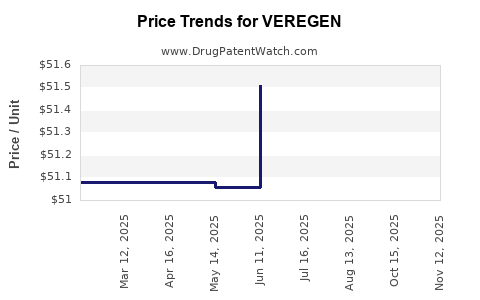
What market dynamics impact VEREGEN pricing and payer coverage?

Featured snippet answer: Price is controlled by PBM contracting, formulary tiering, and competition from other wart treatments. Coverage decisions often determine whether the drug competes as a preferred topical option or loses share.

Payer behavior in genital wart therapy

Payers commonly steer to:

  • Destructive procedures where cost is bundled to clinic budgets
  • Lower-cost topical or immunomodulatory options, where covered
  • “Step therapy” logic based on prior treatment history and recurrence

Even if the drug’s clinical profile is acceptable, plan-level preferences drive net pricing.

Competitor replacement logic

Veregen competes against:

  • Destructive modalities (cryotherapy, electrosurgery, chemical cautery)
  • Other topical immune-active or keratolytic approaches where formulary coverage supports them
  • Emerging lesion management pathways that clinics adopt as standard of care

This leads to utilization “churn,” not stable category growth.


Which companies market and distribute VEREGEN, and how does that affect commercialization?

Featured snippet answer: The commercialization footprint depends on the rights holder and authorized distributors managing PBM contracting and field access. For niche dermatology assets, share gains are typically limited by coverage and clinical guideline adoption rather than by mass-market promotion.

Commercial execution levers

For Veregen, commercial performance hinges on:

  • Specialty field execution to dermatology, OB/GYN, urology, and sexual health clinics
  • Formulary pull-through through PBM contracting
  • Patient support and prior authorization management, where required

Channel strategy is often constrained by the drug’s niche positioning and relatively low total category spend.


What is the Orange Book status of VEREGEN, and which exclusivities matter?

Featured snippet answer: Orange Book status determines whether FDA-listed exclusivity barriers block generic entry and when Paragraph IV challenges become viable. For Veregen, the critical gates are patent expiration and any pediatric exclusivity extensions, plus non-patent exclusivity where applicable.

Patent and exclusivity gates

Generic entry timing typically depends on:

  • Patent expiration for listed active-ingredient, composition, and method-of-use claims
  • Any pediatric exclusivity or other extension mechanisms that delay generic approval
  • Whether the Orange Book lists formulation or manufacturing method patents that can be “at-risk” for design-around

Practical impact on generic risk

If Orange Book listing includes:

  • Strong composition and method-of-use coverage, it raises Paragraph IV exposure
  • Multiple enforceable patents across claim types, it increases litigation probability and settlement complexity
  • More recent filings with later expirations, it can extend the “effective exclusivity” window for the branded product

When does VEREGEN lose exclusivity, and what are the generic entry risk windows?

Featured snippet answer: The generic entry risk window starts when the earliest non-extended patent listed for the drug approaches expiration. Paragraph IV challenges become economically attractive once a challenger expects a favorable timing-to-approval and settlement probability.

Generic launch scenario logic

Three launch patterns are common in this setting:

  1. No-launch risk absorption: generic waits until post-expiration with limited litigation
  2. At-risk entry post-approval: generic launches immediately after “owning the risk” if litigation stays or damages are manageable
  3. Settlement-and-delay: branded and generic reach a negotiated entry date that may be before the final patent expiration but after stipulated offsets

For a niche topical, even delayed launches can preserve margins by limiting price erosion.


What patents protect VEREGEN and how strong is the patent estate?

Featured snippet answer: VEREGEN’s patent estate strength depends on whether the Orange Book lists enforceable:

  • composition-of-matter or formulation patents for sinecatechins 10% ointment
  • method-of-use patents tied to external genital warts treatment regimens
  • manufacturing method patents that are hard to design around

Estate composition and design-around likelihood

Patent estates for dermatology topicals often split into:

  • Formulation and vehicle claims (harder to copy if specific excipient and process parameters are claimed)
  • Active ingredient/process claims (harder if broad)
  • Use and regimen claims (design-around possible if generics avoid exact dosing schedules but sometimes constrained)

Estate strength is usually assessed by:

  • Number of separately listed, still-in-force patents at the time of potential challenge
  • Overlap between claim scopes and generic formulation approaches
  • Litigation history, if any, that signals enforceability

Have any Paragraph IV challenges or patent litigations affected VEREGEN?

Featured snippet answer: Paragraph IV litigation is a key commercial inflection point. If VEREGEN has faced challenges, outcomes typically drive whether generic entry is delayed and how quickly brand sales face price pressure.

Litigation outcomes and market impact channels

When litigation occurs, it affects:

  • Net present value of generic launch plans
  • Potential settlement dates that become effective market-entry calendars
  • Brand discounting response, if generics are likely to launch soon

For topical Rx assets, even one credible generic challenger can change contracting behavior and reduce branded purchasing loyalty.


What formulations are protected for VEREGEN, and what does that mean for generics?

Featured snippet answer: Formulation protection affects the ability to commercialize a generic “same strength, same ointment” product. If patents tie to vehicle composition, process parameters, or stability/viscosity targets, generic makers face more development and potential infringement risk.

Generic development constraints

Generics must often address:

  • Ointment rheology and release profile to meet bioequivalence standards where required
  • Stability across storage and shipping conditions
  • Manufacturing methods that avoid infringement if method patents exist

Design-around is possible if patents are narrow or if claim coverage focuses on specific excipients or manufacturing steps.


How does VEREGEN compare with other external genital wart treatments on market dynamics?

Featured snippet answer: VEREGEN’s market share is shaped by comparative preference for topical immunomodulation versus destructive or procedural approaches, plus payer tiering that favors the lowest-cost preferred pathway.

Competitive comparison framework

In practice, treatment choice pivots on:

  • Patient preference for non-procedural therapy
  • Clinician familiarity and guideline alignment
  • Payer access and cost-sharing for topical therapies
  • Recurrence patterns and time to clearance

Veregen generally competes in the “avoid procedural intervention” decision set, which can cap share if clinics default to faster lesion removal.


What biosimilar or biologic risks exist for VEREGEN?

Featured snippet answer: None. VEREGEN is a small-molecule topical immunomodulator (sinecatechins), not a biologic product, so biosimilar pathways do not apply.


What is the geographic footprint for VEREGEN, and how do markets differ?

Featured snippet answer: VEREGEN is predominantly an FDA-regulated US specialty Rx product. International scale varies by regulatory approval status, pricing controls, and local sexual health care practices.

US vs non-US market behaviors

In the US:

  • PBM formularies and prior authorization drive utilization
  • Generic entry timing is dictated by US patent and Orange Book schedules
  • Patient cost-sharing changes can quickly shift adherence

In other markets:

  • Different regulatory landscapes can delay or preempt generic adoption
  • Distribution and clinical protocols vary, altering baseline penetration

What manufacturing and IP barriers could block generic or follow-on competition for VEREGEN?

Featured snippet answer: IP barriers most often arise from formulation and method claims. Manufacturing barriers come from the complexity of ointment performance targets and any claimed process steps.

Common follow-on friction points

  • Meeting topical performance specs (spreadability, consistency)
  • Avoiding infringement of process patents if the manufacturing steps are claimed
  • Establishing bioequivalence or appropriate regulatory justification for topical use

How could generic entry change VEREGEN’s economics and margins?

Featured snippet answer: Generic entry typically compresses branded net pricing rapidly through PBM contracting and increased dispensing of lowest-cost alternatives. For a niche topical, even moderate volume shifts can materially reduce net revenue.

Margin compression dynamics

Once a generic becomes available:

  • PBMs frequently re-tier from preferred to non-preferred
  • Brand discounts increase to preserve access
  • Patient cost-sharing changes accelerate substitution

For niche assets, revenue losses can be disproportionate to total volume because fixed commercial and overhead costs remain.


Key patent-to-commercial milestones timeline for VEREGEN (what to monitor)

Featured snippet answer: Monitor Orange Book-listed patent expirations and any FDA-cited litigation to forecast the earliest plausible generic approval and settlement delay.

Timeline checkpoints

  • Orange Book earliest patent expiration (composition/use/formulation)
  • Any pediatric exclusivity extension dates
  • Latest “triggerable” window for Paragraph IV submissions that attempt to align with approval timing
  • Court rulings or settlement agreements that establish an effective entry date
  • FDA approval of first generic and subsequent NDC-level contracting shifts

Key Takeaways

  • VEREGEN is a niche, topical Rx for external genital warts; demand is driven by outpatient sexual health and dermatology workflows, not broad dermatology utilization.
  • Revenue dynamics are shaped by payer formulary access, recurrence-driven retreatment, and clinician preference for non-topical lesion management pathways.
  • Generic risk is governed by Orange Book patent and exclusivity gates; formulation and method-of-use patents are the highest leverage for delaying entry or raising settlement value.
  • If generics launch, net price compression and formulary re-tiering can materially erode branded economics quickly due to the product’s limited category scale.
  • Biosimilar risk does not apply because sinecatechins is not a biologic.

FAQs

  1. What NDC-level listings in the Orange Book matter most for VEREGEN generic eligibility?
  2. Do method-of-use patents for treating external genital warts typically get asserted against generic sinecatechins ointment?
  3. How do PBMs typically structure step therapy for topical genital wart treatments and where does VEREGEN fit?
  4. What settlement terms are most common in niche dermatology topical patent cases involving Paragraph IV filings?
  5. Which clinical outcomes (time to clearance, recurrence) most influence payer support and persistence for topical wart regimens like VEREGEN?

References (APA)

  1. FDA. Orange Book: Approved Drug Products with Therapeutic Equivalence Evaluations. U.S. Food and Drug Administration. https://www.accessdata.fda.gov/scripts/cder/daf/
  2. FDA. Drug Trials Snapshots: VEREGEN (sinecatechins). U.S. Food and Drug Administration. https://www.fda.gov/drugsatfda/drug-trials-snapshots
  3. FDA. Approved Drug Products: VEREGEN (sinecatechins). U.S. Food and Drug Administration. https://www.accessdata.fda.gov/scripts/cder/daf/

More… ↓

⤷  Start Trial

DrugChatter Q&A for VEREGEN

Make Better Decisions: Try a trial or see plans & pricing

Drugs may be covered by multiple patents or regulatory protections. All trademarks and applicant names are the property of their respective owners or licensors. Although great care is taken in the proper and correct provision of this service, thinkBiotech LLC does not accept any responsibility for possible consequences of errors or omissions in the provided data. The data presented herein is for information purposes only. There is no warranty that the data contained herein is error free. We do not provide individual investment advice. This service is not registered with any financial regulatory agency. The information we publish is educational only and based on our opinions plus our models. By using DrugPatentWatch you acknowledge that we do not provide personalized recommendations or advice. thinkBiotech performs no independent verification of facts as provided by public sources nor are attempts made to provide legal or investing advice. Any reliance on data provided herein is done solely at the discretion of the user. Users of this service are advised to seek professional advice and independent confirmation before considering acting on any of the provided information. thinkBiotech LLC reserves the right to amend, extend or withdraw any part or all of the offered service without notice.