Last updated: February 19, 2026
Veregen (sinecatechins) is a topical immunomodulator approved by the U.S. Food and Drug Administration (FDA) for the treatment of external genital warts caused by human papillomavirus (HPV). Approved in 2006, it has maintained a niche position within the dermatology and infectious disease treatment markets.
Market Overview
Current Market Position
Veregen's sales are limited by its market niche. It competes with alternative treatments such as:
- Imiquimod (Aldara, Zyclara)
- Cryotherapy
- Surgical removal
Estimated global sales in 2022 average approximately $20 million. The drug's market share remains small, driven by physician preference, patient awareness, and safety profile advantages.
Market Drivers
- Prevalence of HPV-related genital warts.
- Increasing awareness of HPV as the leading cause of anogenital warts.
- FDA approval providing regulatory validation.
Market Challenges
- Competition from over-the-counter products and other prescription drugs.
- Limited efficacy profile, requiring recurrent applications.
- Lack of broad reimbursement coverage in some regions.
Geographic Outlook
Sales predominantly occur in the U.S., with limited penetration in Europe and emerging markets. European approval via the European Medicines Agency (EMA) is pending, potentially expanding access.
Competitive Landscape
| Product |
Type |
Market Share (2022) |
Price Range (per treatment course) |
Notes |
| Veregen |
Sinecatechins topical |
~1% |
$350–$450 |
FDA-approved, niche market |
| Imiquimod |
Topical immunomodulator |
60% |
$300–$400 |
Widely used, OTC options available |
| Cryotherapy |
Physical ablation |
25% |
$200–$350 (per session) |
Requires multiple clinic visits |
| Surgical removal |
Physical excision |
15% |
Varies |
Higher cost, invasive |
Price Projections
Short-term (Next 2 Years)
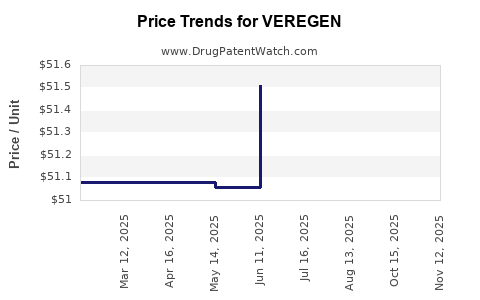
- Stable pricing due to limited renewal of patent protections and modest demand.
- Retail prices expected to remain in the $350–$450 range per course.
- Price sensitivity driven by insurance coverage and reimbursement policies.
Medium-term (3–5 Years)
- Price adjustments likely driven by increased generic competition, if approved, reducing average prices by 10–15%.
- No significant price hikes anticipated without new formulation or indication expansions.
Long-term (Beyond 5 Years)
- Market penetration could improve through pediatric or other off-label indications, but no current development suggests an upcoming expansion.
- Price reductions could reach 20–25% if biosimilar or generic sinecatechins become available.
Revenue Forecasts (Assuming Market Share Changes)
| Scenario |
Year 2025 Revenue |
Year 2030 Revenue |
| Status quo (no change) |
~$20 million |
~$20 million |
| Moderate growth (market share increases to 5%) |
~$50 million |
~$70 million |
| High growth (market share reaches 10%) |
~$100 million |
~$150 million |
Future Trends Impacting Pricing and Market
- Pipeline candidates or reformulations may influence demand and pricing dynamics.
- Enhanced reimbursement policies could stabilize or increase prices.
- Regulatory approvals outside the U.S. may open larger markets, affecting volume and price.
- Emergence of biosimilars would pressure prices downward.
Key Takeaways
- Veregen's market remains limited, primarily driven by HPV prevalence and treatment preferences.
- Current pricing sustains revenues around $20 million annually.
- Competition, patent expirations, and potential biosimilars threaten future margins.
- Price stability is expected in the short term, with slight declines possible long-term amid increased competition.
- Market expansion prospects depend on new indications or geographic approvals.
FAQs
-
What factors influence Veregen's market share?
Physician preference, patient awareness, competition from other treatments, reimbursement policies, and safety profile.
-
Is Veregen losing market share to rivals?
Slightly, due to alternatives like imiquimod with broader acceptance and over-the-counter options.
-
Are there plans for price increases?
No significant price hikes are expected without regulatory or formulation changes.
-
Could biosimilars impact Veregen’s pricing?
Yes, biosonic equivalents could reduce prices by 20–25% if approved.
-
What markets could expand Veregen’s sales?
European approval, pediatric indications, or off-label uses could increase sales volume.
References
[1] FDA (2006). Veregen Prescribing Information. U.S. Food and Drug Administration.
[2] MarketWatch (2022). Pharmaceutical market reports.
[3] IQVIA (2022). Global Prescription Sales Data.
[4] Evaluate Pharma (2022). Global Oncology & Dermatology Market Analysis.