Last Updated: September 28, 2026

VEOZAH Drug Patent Profile


✉ Email this page to a colleague

« Back to Dashboard


When do Veozah patents expire, and what generic alternatives are available?

Veozah is a drug marketed by Astellas and is included in one NDA. There are four patents protecting this drug.

The generic ingredient in VEOZAH is fezolinetant. There is one drug master file entry for this compound. One supplier is listed for this compound. Additional details are available on the fezolinetant profile page.

DrugPatentWatch® Generic Entry Outlook for Veozah

Veozah will be eligible for patent challenges on May 12, 2027. This date may extended up to six months if a pediatric exclusivity extension is applied to the drug's patents.

By analyzing the patents and regulatory protections it appears that the earliest date for generic entry will be April 4, 2031. This may change due to patent challenges or generic licensing.

Indicators of Generic Entry

< Available with Subscription >

  Start Trial

AI Deep Research
Questions you can ask:
  • What is the 5 year forecast for VEOZAH?
  • What are the global sales for VEOZAH?
  • What is Average Wholesale Price for VEOZAH?
Summary for VEOZAH
US Patents:4
Applicants:1
NDAs:1
Finished Product Suppliers / Packagers: 1
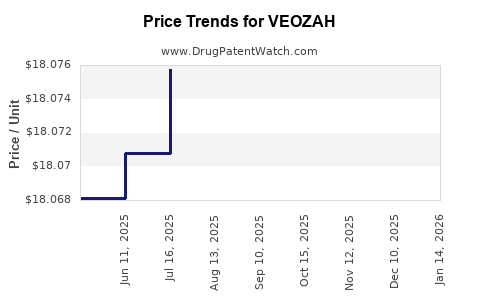
Drug Prices: Drug price information for VEOZAH
What excipients (inactive ingredients) are in VEOZAH?VEOZAH excipients list
DailyMed Link:VEOZAH at DailyMed
DrugPatentWatch® Estimated Loss of Exclusivity (LOE) Date for VEOZAH
Generic Entry Date for VEOZAH*:
Constraining patent/regulatory exclusivity:
NDA:
Dosage:

TABLET;ORAL

*The generic entry opportunity date is the latter of the last compound-claiming patent and the last regulatory exclusivity protection. Many factors can influence early or later generic entry. This date is provided as a rough estimate of generic entry potential and should not be used as an independent source.

Pharmacology for VEOZAH

US Patents and Regulatory Information for VEOZAH

VEOZAH is protected by four US patents and one FDA Regulatory Exclusivity.

Based on analysis by DrugPatentWatch, the earliest date for a generic version of VEOZAH is ⤷  Start Trial.

This potential generic entry date is based on patent 8,871,761.

Generics may enter earlier, or later, based on new patent filings, patent extensions, patent invalidation, early generic licensing, generic entry preferences, and other factors.

Applicant Tradename Generic Name Dosage NDA Approval Date TE Type RLD RS Patent No. Patent Expiration Product Substance Delist Req. Exclusivity Expiration
Astellas VEOZAH fezolinetant TABLET;ORAL 216578-001 May 12, 2023 RX Yes Yes 10,836,768 ⤷  Start Trial ⤷  Start Trial
Astellas VEOZAH fezolinetant TABLET;ORAL 216578-001 May 12, 2023 RX Yes Yes 8,871,761 ⤷  Start Trial Y ⤷  Start Trial
Astellas VEOZAH fezolinetant TABLET;ORAL 216578-001 May 12, 2023 RX Yes Yes 9,987,274 ⤷  Start Trial ⤷  Start Trial
Astellas VEOZAH fezolinetant TABLET;ORAL 216578-001 May 12, 2023 RX Yes Yes 9,422,299 ⤷  Start Trial Y Y ⤷  Start Trial
Astellas VEOZAH fezolinetant TABLET;ORAL 216578-001 May 12, 2023 RX Yes Yes ⤷  Start Trial ⤷  Start Trial ⤷  Start Trial
>Applicant >Tradename >Generic Name >Dosage >NDA >Approval Date >TE >Type >RLD >RS >Patent No. >Patent Expiration >Product >Substance >Delist Req. >Exclusivity Expiration

International Patents for VEOZAH

When does loss-of-exclusivity occur for VEOZAH?

Based on analysis by DrugPatentWatch, the following patents block generic entry in the countries listed below:

Australia

Patent: 11234398
Estimated Expiration: ⤷  Start Trial

Brazil

Patent: 2012025101
Estimated Expiration: ⤷  Start Trial

Canada

Patent: 93313
Estimated Expiration: ⤷  Start Trial

China

Patent: 2906093
Estimated Expiration: ⤷  Start Trial

Croatia

Patent: 0170712
Estimated Expiration: ⤷  Start Trial

Cyprus

Patent: 20307
Estimated Expiration: ⤷  Start Trial

Denmark

Patent: 52920
Estimated Expiration: ⤷  Start Trial

Eurasian Patent Organization

Patent: 3161
Patent: НОВЫЕ СОЕДИНЕНИЯ КАК СЕЛЕКТИВНЫЕ АНТАГОНИСТЫ РЕЦЕПТОРА NK3, ФАРМАЦЕВТИЧЕСКАЯ КОМПОЗИЦИЯ И МЕТОДЫ ИХ ИСПОЛЬЗОВАНИЯ ПРИ НАРУШЕНИЯХ, ОПОСРЕДОВАННЫХ NK3 РЕЦЕПТОРАМИ (TRIAZOLOPYRAZINE COMPOUNDS AS NK3 RECEPTOR SELECTIVE ANTAGONISTS, PHARMACEUTICAL COMPOSITION AND METHODS FOR USE IN NK3 RECEPTORS MEDIATED DISORDERS)
Estimated Expiration: ⤷  Start Trial

Patent: 1290940
Patent: ТРИАЗОЛОПИРАЗИНОВЫЕ СОЕДИНЕНИЯ КАК СЕЛЕКТИВНЫЕ АНТАГОНИСТЫ РЕЦЕПТОРА NK3, ФАРМАЦЕВТИЧЕСКАЯ КОМПОЗИЦИЯ И МЕТОДЫ ИХ ИСПОЛЬЗОВАНИЯ ПРИ НАРУШЕНИЯХ, ОПОСРЕДОВАННЫХ NK3 РЕЦЕПТОРАМИ (TRIAZOLOPYRAZINE COMPOUNDS AS NK3 RECEPTOR SELECTIVE ANTAGONISTS, PHARMACEUTICAL COMPOSITION AND METHODS FOR USE IN NK3 RECEPTORS MEDIATED DISORDERS)
Estimated Expiration: ⤷  Start Trial

European Patent Office

Patent: 52920
Patent: NOUVEAUX COMPOSÉS ANTAGONISTES SÉLECTIFS DU RÉCEPTEUR NK-3, COMPOSITION PHARMACEUTIQUE ET PROCÉDÉ POUR UNE UTILISATION DANS DES TROUBLES MÉDIÉS PAR LES RÉCEPTEURS NK-3 (NOVEL NK-3 RECEPTOR SELECTIVE ANTAGONIST COMPOUNDS, PHARMACEUTICAL COMPOSITION AND METHODS FOR USE IN NK-3 RECEPTORS MEDIATED DISORDERS)
Estimated Expiration: ⤷  Start Trial

Patent: 76171
Patent: NOUVEAUX COMPOSÉS ANTAGONISTES SÉLECTIFS DU RÉCEPTEUR NK-3, COMPOSITION PHARMACEUTIQUE ET PROCÉDÉ POUR UNE UTILISATION DANS DES TROUBLES MÉDIÉS PAR LES RÉCEPTEURS NK-3 (NOVEL NK-3 RECEPTOR SELECTIVE ANTAGONIST COMPOUNDS, PHARMACEUTICAL COMPOSITION AND METHODS FOR USE IN NK-3 RECEPTORS MEDIATED DISORDERS)
Estimated Expiration: ⤷  Start Trial

Hungary

Patent: 32770
Estimated Expiration: ⤷  Start Trial

Japan

Patent: 22911
Estimated Expiration: ⤷  Start Trial

Patent: 13523697
Patent: 新規のNK−3受容体選択的アンタゴニスト化合物、医薬組成物、及びNK−3受容体媒介疾患における使用方法
Estimated Expiration: ⤷  Start Trial

Lithuania

Patent: 52920
Estimated Expiration: ⤷  Start Trial

Mexico

Patent: 2161
Patent: COMPUESTOS ANTAGONISTAS SELECTIVOS DE RECEPTOR NK-3 NOVEDOSOS, COMPOSICION FARMACEUTICA Y METODOS PARA UTILIZARSE EN TRASTORNOS TRANSMITIDOS POR RECEPTORES NK-3. (NOVEL NK-3 RECEPTOR SELECTIVE ANTAGONIST COMPOUNDS, PHARMACEUTICAL COMPOSITION AND METHODS FOR USE IN NK-3 RECEPTORS MEDIATED DISORDERS.)
Estimated Expiration: ⤷  Start Trial

Patent: 12011132
Patent: COMPUESTOS ANTAGONISTAS SELECTIVOS DE RECEPTOR NK-3 NOVEDOSOS, COMPOSICION FARMACEUTICA Y METODOS PARA UTILIZARSE EN TRASTORNOS TRANSMITIDOS POR RECEPTORES NK-3. (NOVEL NK-3 RECEPTOR SELECTIVE ANTAGONIST COMPOUNDS, PHARMACEUTICAL COMPOSITION AND METHODS FOR USE IN NK-3 RECEPTORS MEDIATED DISORDERS.)
Estimated Expiration: ⤷  Start Trial

Poland

Patent: 52920
Estimated Expiration: ⤷  Start Trial

Portugal

Patent: 52920
Estimated Expiration: ⤷  Start Trial

San Marino

Patent: 01700282
Estimated Expiration: ⤷  Start Trial

Serbia

Patent: 997
Patent: NOVA JEDINJENJA SELEKTIVNI ANTAGONISTI NK-3 RECEPTORA, FARMACEUTSKA KOMPOZICIJA I POSTUPCI ZA UPOTREBU KOD POREMEĆAJA POSREDOVANIH SA NK-3 RECEPTORIMA (NOVEL NK-3 RECEPTOR SELECTIVE ANTAGONIST COMPOUNDS, PHARMACEUTICAL COMPOSITION AND METHODS FOR USE IN NK-3 RECEPTORS MEDIATED DISORDERS)
Estimated Expiration: ⤷  Start Trial

Slovenia

Patent: 52920
Estimated Expiration: ⤷  Start Trial

South Korea

Patent: 1878888
Estimated Expiration: ⤷  Start Trial

Patent: 130021384
Patent: 신규한 NK-3 수용체 선택적 길항제 화합물, NK-3 수용체 매개형 질환에 사용되기 위한 의약 조성물 및 방법 (-3 -3 NOVEL NK-3 RECEPTOR SELECTIVE ANTAGONIST COMPOUNDS PHARMACEUTICAL COMPOSITION AND METHODS FOR USE IN NK-3 RECEPTORS MEDIATED DISORDERS)
Estimated Expiration: ⤷  Start Trial

Spain

Patent: 27688
Estimated Expiration: ⤷  Start Trial

Generics may enter earlier, or later, based on new patent filings, patent extensions, patent invalidation, early generic licensing, generic entry preferences, and other factors.

See the table below for additional patents covering VEOZAH around the world.

Country Patent Number Title Estimated Expiration
Australia 2014242906 ⤷  Start Trial
Brazil 112015024907 ⤷  Start Trial
Canada 2907809 ⤷  Start Trial
China 105229008 ⤷  Start Trial
Cyprus 1119576 ⤷  Start Trial
Cyprus 2024019 ⤷  Start Trial
Denmark 2948455 ⤷  Start Trial
>Country >Patent Number >Title >Estimated Expiration

Supplementary Protection Certificates for VEOZAH

Patent Number Supplementary Protection Certificate SPC Country SPC Expiration SPC Description
2948455 301272 Netherlands ⤷  Start Trial DETAILS ASSIGNMENT: CHANGE OF OWNER(S), CHANGE OF LEGAL ENTITY
2948455 CA 2024 00017 Denmark ⤷  Start Trial PRODUCT NAME: FEZOLINETANT; REG. NO/DATE: EU/1/23/1771 20231212
2948455 CR 2024 00017 Denmark ⤷  Start Trial PRODUCT NAME: FEZOLINETANT; REG. NO/DATE: EU/1/23/1771 20231212
2948455 PA2024513 Lithuania ⤷  Start Trial PRODUCT NAME: FEZOLINETANTAS; REGISTRATION NO/DATE: C(2023)8783 20231207
2948455 LUC00342 Luxembourg ⤷  Start Trial PRODUCT NAME: FEZOLINETANT; AUTHORISATION NUMBER AND DATE: EU/1/23/1771 20231212
2948455 2024C/523 Belgium ⤷  Start Trial PRODUCT NAME: FEZOLINETANT; AUTHORISATION NUMBER AND DATE: EU/1/23/1771 20231212
2948455 122024000025 Germany ⤷  Start Trial PRODUCT NAME: FEZOLINETANT; REGISTRATION NO/DATE: EU/1/23/1771 20231207
>Patent Number >Supplementary Protection Certificate >SPC Country >SPC Expiration >SPC Description

VEOZAH Market Dynamics and Financial Trajectory: Fezolinetant Sales, Competition, and Generic Risk

Last updated: August 19, 2026

VEOZAH, the brand name for fezolinetant, is Astellas Pharma’s nonhormonal treatment for moderate-to-severe vasomotor symptoms associated with menopause. The product targets women who cannot use, do not want, or have not adequately responded to hormone therapy.

Astellas reported approximately ¥12.8 billion in VEOZAH sales for fiscal 2023, its first commercial year. The company forecast roughly ¥40 billion in fiscal 2024 sales, implying more than threefold growth from the initial launch base. The trajectory depends on physician adoption, insurance coverage, persistence, liver-monitoring requirements, and competition from established hormone therapies and emerging nonhormonal treatments (Astellas Pharma, 2024a).

What is VEOZAH and which patients does it target?

VEOZAH contains fezolinetant, a selective neurokinin 3 receptor antagonist. It reduces menopausal vasomotor symptoms, including hot flashes and night sweats, without using estrogen or progestin.

The FDA approved VEOZAH on May 12, 2023, for moderate-to-severe vasomotor symptoms caused by menopause (FDA, 2023). The treatment is taken orally at a once-daily 45 mg dose.

VEOZAH product profile

Attribute VEOZAH detail
Active ingredient Fezolinetant
Drug class Neurokinin 3 receptor antagonist
Dosage form Oral tablet
Approved dose 45 mg once daily
Primary indication Moderate-to-severe menopausal vasomotor symptoms
FDA approval May 12, 2023
U.S. manufacturer Astellas Pharma US
Hormonal therapy No
Biosimilar exposure None
Primary competitive products Estrogen therapies, hormone replacement therapy, paroxetine, elinzanetant and other nonhormonal agents

The product’s commercial positioning is based on a large untreated or undertreated patient population and the demand for nonhormonal options. VEOZAH does not carry the breast-cancer and cardiovascular risk profile associated with some hormone therapies, but it also does not replace hormone therapy for every patient.

How large is the VEOZAH market opportunity?

The U.S. menopause market includes tens of millions of women, but the addressable market for prescription treatment is smaller. Commercial opportunity depends on symptom severity, willingness to seek treatment, contraindications to hormone therapy, and reimbursement.

Clinical and market research has consistently indicated that vasomotor symptoms affect a substantial majority of menopausal women, while only a minority receive prescription treatment. This creates a large theoretical market but also signals a patient-acquisition challenge. Many women tolerate symptoms, use over-the-counter products, receive low-cost generic hormone therapy, or do not remain in treatment long enough to generate sustained revenue.

Addressable-market drivers

The strongest demand drivers are:

  1. Patient preference for nonhormonal treatment.
  2. Concern about hormone therapy risks.
  3. Primary-care physician involvement in menopause treatment.
  4. Increased menopause-related healthcare awareness.
  5. Commercial insurance coverage for a branded oral product.
  6. Use in women with contraindications to estrogen-containing therapy.

The principal market constraint is price. VEOZAH entered a category with inexpensive generic hormone therapies and generic paroxetine. A branded nonhormonal product must demonstrate adequate value to payers and physicians despite the availability of lower-cost alternatives.

What are VEOZAH sales and financial projections?

Astellas reported VEOZAH sales of approximately ¥12.8 billion for fiscal 2023, covering the initial U.S. launch period and early international commercialization. Astellas’ fiscal year ends March 31.

The company’s fiscal 2024 forecast placed VEOZAH sales at approximately ¥40 billion. That forecast represented a sharp increase from the launch year and reflected broader U.S. distribution, international approvals, payer access, and improved prescriber familiarity (Astellas Pharma, 2024a).

VEOZAH financial trajectory

Fiscal period Reported or forecast sales Interpretation
FY2023 Approximately ¥12.8 billion Initial launch year
FY2024 forecast Approximately ¥40 billion Rapid early commercial expansion
Long-term potential Dependent on persistence and market penetration Not equivalent to a guaranteed peak-sales outcome

Astellas has not publicly established VEOZAH as a revenue contributor on the scale of XTANDI, but the product is strategically important because it is a growth asset in a large primary-care and women’s-health market.

Revenue sensitivity

VEOZAH revenue is highly sensitive to four variables:

Variable Positive effect Negative effect
New patient starts Expands prescription volume Limited by low awareness
Treatment persistence Raises annual revenue per patient Discontinuation reduces realized sales
Net price Supports revenue growth Rebates and payer restrictions reduce net sales
Indication expansion Increases addressable population Requires additional clinical and regulatory investment

The most important financial question is whether VEOZAH can convert initial prescribing into durable use. Short treatment duration would materially reduce the product’s annual revenue per patient.

How does VEOZAH compare with hormone replacement therapy and other treatments?

VEOZAH competes against both prescription and nonprescription treatments. The competitive market is fragmented, but low-cost generics create a high hurdle for branded growth.

VEOZAH versus major treatment alternatives

Treatment category Main advantage Main commercial limitation
VEOZAH Nonhormonal, targeted mechanism, once-daily oral dosing Branded price and liver-monitoring burden
Estrogen therapy High efficacy for vasomotor symptoms Hormone-related safety and contraindication concerns
Estrogen-progestin therapy Treats symptoms and protects the endometrium when appropriate Greater complexity and safety concerns
Paroxetine Generic, nonhormonal option Less targeted mechanism and tolerability limitations
Gabapentin Generic and useful in selected patients Sedation and off-label use concerns
Clonidine Low-cost nonhormonal option Modest efficacy and adverse effects
Over-the-counter products Accessibility and low upfront cost Variable evidence and quality

VEOZAH’s commercial advantage is differentiation rather than cost. The product is most likely to gain share among women seeking nonhormonal therapy, those with hormone-therapy concerns, and patients dissatisfied with existing nonhormonal options.

What FDA regulatory requirements affect VEOZAH demand?

The FDA approved VEOZAH with liver-safety monitoring requirements. The product label includes warnings concerning elevations in liver enzymes and rare serious liver injury. Patients require liver-function testing before treatment and during therapy under the approved labeling framework (FDA, 2024).

These requirements affect the commercial model in three ways:

  • They add laboratory and administrative burden.
  • They may reduce prescribing in primary-care settings.
  • They can increase discontinuation if liver enzymes rise or monitoring is incomplete.

In December 2024, the FDA updated the VEOZAH prescribing information to strengthen liver-injury warnings and monitoring recommendations following postmarketing reports. This action increases the importance of safety education and may pressure prescribing growth, particularly among lower-risk patients who have inexpensive alternatives (FDA, 2024).

Regulatory expansion opportunities

Potential growth opportunities include:

  • Expansion into additional menopause-related symptoms.
  • Broader use in patients unable or unwilling to take hormone therapy.
  • International label expansion.
  • Greater adoption by primary-care physicians.
  • Inclusion in payer treatment algorithms after failure or avoidance of hormone therapy.

Each expansion would require additional evidence and would not automatically follow from the existing approval.

When does VEOZAH lose exclusivity?

VEOZAH received U.S. approval as a new chemical entity, which generally provides five years of regulatory exclusivity under the Hatch-Waxman framework. The statutory NCE period would ordinarily run until May 12, 2028, subject to the FDA’s formal exclusivity record and any applicable pediatric extension.

The commercial patent position can extend beyond the five-year NCE period. Small-molecule products may be protected by patents covering the active compound, pharmaceutical compositions, dosage forms, manufacturing processes, and methods of treating menopausal vasomotor symptoms.

Generic entry risk

Generic competition would occur through abbreviated new drug applications, not through a biosimilar pathway. Key risks include:

  • Paragraph IV challenges to listed patents.
  • At-risk launch before final patent resolution.
  • Settlement agreements that establish a licensed generic-entry date.
  • Patent expiration or invalidation.
  • Label carve-outs for method-of-use claims.
  • Substitution pressure from low-cost alternatives.

The first meaningful generic-entry window is unlikely to be determined solely by May 2028 NCE expiry. It will depend on the Orange Book patent listings, patent-term adjustments, litigation outcomes, and any settlements between Astellas and ANDA applicants.

What is the Orange Book status of VEOZAH?

VEOZAH is an FDA-approved small-molecule prescription drug eligible for Orange Book patent listings. Orange Book-listed patents can delay approval of an ANDA for up to 30 months after a Paragraph IV notice, unless the litigation is resolved earlier or the court determines that the stay does not apply.

The commercial relevance of the Orange Book record is greater than the NCE exclusivity date because method-of-use and formulation patents can influence generic labeling and launch timing. A generic applicant may challenge patents, accept a later entry date, or seek approval with patented indications carved out of its label.

Astellas’ ability to maintain branded pricing after 2028 will depend on whether its listed patents cover clinically necessary uses or commercially important formulations. A narrow method-of-use patent estate would provide less protection than broad composition-of-matter coverage.

Which companies are challenging or competing with VEOZAH?

The competitive field includes generic manufacturers, women’s-health companies, and pharmaceutical companies developing next-generation neurokinin antagonists.

Direct and indirect competitors

  • Generic estrogen and estrogen-progestin manufacturers.
  • Generic paroxetine suppliers.
  • Manufacturers of gabapentin and clonidine.
  • Bayer and partners developing elinzanetant.
  • Companies pursuing neurokinin 3 or dual neurokinin 1/3 antagonists.
  • Digital-health and telehealth providers marketing menopause treatment.
  • Compounded-hormone providers and specialty clinics.

Elinzanetant is the most relevant pipeline competitor because it targets the same broad nonhormonal vasomotor-symptom market. A competitor with comparable efficacy but fewer liver-monitoring requirements could pressure VEOZAH’s pricing and payer position.

How strong is the VEOZAH commercial position?

VEOZAH has a strong first-mover position in an FDA-approved, targeted, nonhormonal mechanism. Its commercial strength is lower than its scientific differentiation because the product competes with cheap and familiar treatments.

Commercial strengths

  • First approved neurokinin 3 antagonist for menopausal vasomotor symptoms in the United States.
  • Clear nonhormonal positioning.
  • Large potential patient population.
  • Once-daily oral administration.
  • Astellas’ global regulatory and commercial infrastructure.
  • Potential to expand use through primary-care prescribing.

Commercial weaknesses

  • Branded pricing against generic alternatives.
  • Liver-function monitoring requirements.
  • Limited long-term commercial history.
  • Potential treatment discontinuation.
  • Dependence on patient and physician education.
  • Competition from new nonhormonal agents.
  • Payer controls and prior authorization.

The product’s patent strength is likely more important after 2028 than during the initial launch period. Before that point, regulatory exclusivity and the absence of approved generic fezolinetant provide the principal barrier to direct substitution.

What patent litigation and settlement risks affect VEOZAH?

As of the available public launch-period information, no major VEOZAH Paragraph IV litigation outcome had established a generic launch date. That does not eliminate future litigation risk. Fezolinetant’s commercial value is sufficient to attract ANDA challenges if prescription volume and expected net pricing continue to grow.

Potential litigation issues include:

  • Validity of compound patents.
  • Obviousness of the active ingredient or treatment method.
  • Written-description and enablement challenges.
  • Patent-term calculations.
  • Infringement of method-of-use claims.
  • Carve-out strategies for generic labeling.
  • Settlement terms that create a confidential or delayed launch date.

The most material litigation risk is a successful Paragraph IV challenge that permits generic launch before the end of the commercial patent estate. A less disruptive outcome would be a settlement with entry after patent expiration or under a royalty-bearing license.

What generic launch scenarios exist for VEOZAH?

Scenario 1: Delayed entry after patent expiry

A generic enters after the final listed patent expires. This is the lowest-disruption scenario and gives Astellas time to transition patients, negotiate payer contracts, and defend the brand through services or authorized-generic arrangements.

Scenario 2: Settlement-based entry

Astellas settles with one or more ANDA applicants and permits entry on an agreed date. The settlement may preserve several years of branded revenue while providing the generic company with a defined launch opportunity.

Scenario 3: At-risk launch

An ANDA applicant launches before final patent resolution. This could produce rapid price erosion and expose the applicant to damages if the patents are later upheld.

Scenario 4: Early patent invalidation

A court invalidates or finds noninfringement of key patents. Multiple generic manufacturers could then enter, accelerating substitution and reducing net sales.

For a single-source branded small molecule, the first generic entrant typically captures substantial share through pharmacy substitution, while later entrants intensify price erosion.

What geographic markets matter for VEOZAH?

The United States is the primary revenue market because of its large commercial insurance base and early launch. The European Union adds geographic breadth but faces national reimbursement negotiations, price controls, and slower market access.

The European Commission granted marketing authorization for Veoza in December 2023 for moderate-to-severe vasomotor symptoms associated with menopause (European Medicines Agency, 2023). European uptake is likely to vary by country based on reimbursement, clinical guidelines, and the role of hormone therapy in national practice.

Japan and other Asian markets may offer additional opportunity, but regulatory timing, local clinical requirements, treatment preferences, and pricing controls make these markets less predictable than the United States.

What manufacturing and intellectual-property barriers protect VEOZAH?

Fezolinetant is a chemically synthesized small molecule. Manufacturing is therefore less complex than for a biologic, but generic manufacturers must still demonstrate bioequivalence, establish reliable active-pharmaceutical-ingredient supply, and meet FDA quality requirements.

The main barriers are likely to be:

  • Access to qualified active-ingredient suppliers.
  • Process validation and impurity control.
  • Bioequivalence studies.
  • Patent claims covering synthesis or formulations.
  • Regulatory requirements for a complete ANDA.
  • Commercial scale and distribution.

Manufacturing barriers alone are unlikely to prevent eventual generic competition. Patent and regulatory barriers will have greater importance.

Key Takeaways

  • VEOZAH is Astellas’ once-daily oral fezolinetant product for menopausal vasomotor symptoms.
  • FDA approval occurred on May 12, 2023.
  • Astellas reported approximately ¥12.8 billion in fiscal 2023 VEOZAH sales.
  • The company forecast approximately ¥40 billion in fiscal 2024 sales.
  • Growth depends on nonhormonal-treatment demand, insurance access, persistence, and primary-care adoption.
  • Generic hormone therapies and paroxetine create substantial pricing pressure.
  • Liver-function monitoring and strengthened safety warnings are important commercial constraints.
  • U.S. NCE exclusivity would ordinarily run through May 12, 2028, subject to the FDA’s formal exclusivity record.
  • Future generic timing will depend on Orange Book patents, Paragraph IV litigation, settlements, and patent-term calculations.
  • Elinzanetant and other nonhormonal neurokinin antagonists are the principal emerging competitive risks.
  • VEOZAH has meaningful growth potential, but its long-term financial profile depends on sustained use rather than initial prescription volume.

FAQs

Is VEOZAH expected to become a blockbuster drug?

VEOZAH has a large potential market, but blockbuster status requires sustained annual sales of roughly $1 billion or more. Its path depends on broad reimbursement, repeat use, and differentiation from inexpensive generic treatments.

Does VEOZAH compete with estrogen patches?

Yes. VEOZAH competes indirectly with estrogen patches, oral estrogen, estrogen-progestin therapy, and other hormone treatments. Its principal differentiation is that it does not contain hormones.

Can patients take VEOZAH without liver testing?

The FDA-approved labeling requires liver-function evaluation and monitoring. The specific testing schedule and discontinuation criteria are set out in the current prescribing information.

Will VEOZAH face biosimilar competition?

No. Fezolinetant is a chemically synthesized small molecule. Future competitors would generally file ANDAs as generics rather than biosimilar applications.

What event would most reduce VEOZAH revenue?

The largest risks are a major safety-related prescribing decline, weak treatment persistence, broad payer restrictions, or early generic entry following successful Paragraph IV litigation.

References

Astellas Pharma Inc. (2024a). Financial results for the fiscal year ended March 31, 2024. https://www.astellas.com/

European Medicines Agency. (2023). Veoza: EPAR product information. https://www.ema.europa.eu/

U.S. Food and Drug Administration. (2023). FDA approves first nonhormonal treatment for moderate to severe hot flashes caused by menopause. https://www.fda.gov/

U.S. Food and Drug Administration. (2024). VEOZAH (fezolinetant) prescribing information and safety communications. https://www.fda.gov/

More… ↓

⤷  Start Trial

Make Better Decisions: Try a trial or see plans & pricing

Drugs may be covered by multiple patents or regulatory protections. All trademarks and applicant names are the property of their respective owners or licensors. Although great care is taken in the proper and correct provision of this service, thinkBiotech LLC does not accept any responsibility for possible consequences of errors or omissions in the provided data. The data presented herein is for information purposes only. There is no warranty that the data contained herein is error free. We do not provide individual investment advice. This service is not registered with any financial regulatory agency. The information we publish is educational only and based on our opinions plus our models. By using DrugPatentWatch you acknowledge that we do not provide personalized recommendations or advice. thinkBiotech performs no independent verification of facts as provided by public sources nor are attempts made to provide legal or investing advice. Any reliance on data provided herein is done solely at the discretion of the user. Users of this service are advised to seek professional advice and independent confirmation before considering acting on any of the provided information. thinkBiotech LLC reserves the right to amend, extend or withdraw any part or all of the offered service without notice.