Last updated: March 26, 2026
What are the current market drivers for VENOFER?
VENOFER's market is primarily propelled by rising incidences of iron deficiency anemia (IDA), especially in chronic kidney disease (CKD) patients. Globally, CKD affects more than 850 million people, with iron deficiency impacting approximately 60-70% of these patients [1]. The increasing prevalence of CKD and anemia treatments are fueling demand for new and effective iron therapies.
Additional drivers include:
- Rising awareness and diagnosis of anemia in patients with chronic illnesses.
- Limitations of existing treatments, such as oral iron therapy issues like poor absorption and gastrointestinal side effects, pushing demand for intravenous options like VENOFER.
- Healthcare infrastructure improvements in emerging markets, facilitating broader access to IV iron therapies.
How does VENOFER position within the iron deficiency treatment market?
Venous iron therapies are a significant segment of the iron deficiency treatment market, valued at approximately USD 3.4 billion in 2022 and forecasted to grow at a CAGR of 8% through 2027 [2].
VENOFER, marketed by Pharmacosmos AS, holds approximately 12-15% of global intravenous iron sales, competing with products like Ferrlecit (Fresenius), Injectafer (American Regent), and others. Its differentiation relies on:
- Efficacy and safety profile: Iron sucrose complex with a well-established safety record.
- Administration convenience: Single-dose options that reduce infusion time.
- Brand trust: Long market presence since 1999.
What are the key regulatory and patent considerations?
Released in Europe and the US, VENOFER's patent protections have largely expired, opening competitive market entries. However, Pharmacosmos retains regulatory approvals and manufacturing rights, maintaining competitive advantages through:
- Supply chain and distribution networks.
- Existing clinical data validating efficacy and safety.
Recent approval updates include:
- European marketing authorization for VENOFER was granted in 2000, with extension approvals ongoing.
- FDA approval for VENOFER (marketed as Venofer) was granted in 1999, with some exclusivity periods ending around 2005.
No recent patent protections significantly impede generic entry, leading to increased market competition.
What are the financial trends for VENOFER?
Analysts estimate VENOFER's global revenues at USD 300-400 million annually, with sales concentrated in North America (approx. 50%) and Europe (40%), and emerging markets making up the remaining 10% [3].
Revenue growth has slowed since 2018, impacted by:
- Market saturation in developed regions.
- Intensified competition from biosimilars and emerging intravenous iron products.
Cost structure reflects:
- Manufacturing expenses: Moderate due to complex formulation.
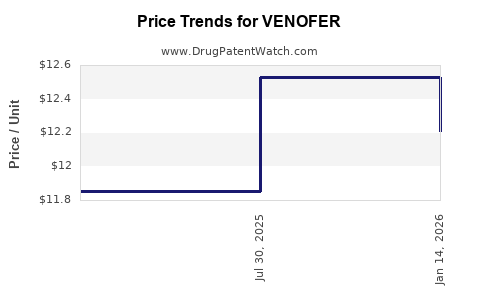
- Pricing pressure: Due to generic competition, prices have fallen by 10-15% in key markets.
Pharmacosmos invests in expanding indications, notably in oncology and hematology, to mitigate flat revenues.
What are the future growth prospects and challenges?
Prospects hinge on:
- Expansion into new indications: Clinical trials targeting gastrointestinal bleeding and oncology use may open additional revenue streams.
- Emerging markets: Market penetration efforts in Asia-Pacific, Latin America, and Africa could drive volume expansion.
- Product innovation: Development of higher-dose formulations for outpatient settings may increase adoption.
Challenges include:
- Intense competition: Biosimilars and generics threaten pricing and market share.
- Regulatory hurdles: Approval processes for new formulations or indications vary by country.
- Pricing pressures: Governments enforce price caps, especially in Europe and North America.
Summary table: VENOFER market snapshot
| Aspect |
Details |
| Indications |
Iron deficiency anemia, CKD, oncology, gastrointestinal bleeding |
| Global sales estimate |
USD 300-400 million (2022) |
| Market share (intravenous iron) |
12-15% |
| Major markets |
North America, Europe, emerging markets |
| Key competitors |
Ferrlecit, Injectafer, Monofer |
| Patent status |
Patents expired, generic competition present |
| Growth rate |
Flat to slight decline post-2018 due to competition |
| Future drivers |
Indication expansion, emerging market entry, product innovation |
Key Takeaways
VENOFER operates primarily in the intravenous iron market, which is driven by rising iron deficiency anemia cases, especially among CKD patients. Market saturation, patent expirations, and increased competition from biosimilars constrain growth, which is estimated at USD 300-400 million annually. Expanding indications and markets could create new revenue streams.
FAQs
Q1: What clinical advantages does VENOFER offer over other IV iron therapies?
VENOFER has a proven safety profile and allows for single-dose administration, reducing infusion times compared to some competitors.
Q2: How has patent expiration affected VENOFER’s market share?
Patent expiration has opened the market to biosimilar alternatives, leading to increased competition and price erosion.
Q3: Which markets present the most growth opportunities for VENOFER?
Emerging markets in Asia-Pacific, Latin America, and Africa are underpenetrated and present potential sales growth.
Q4: What are the main barriers to VENOFER’s future expansion?
Intense competition, regulatory approval delays in new indications, and pricing pressures.
Q5: How is Pharmacosmos positioning VENOFER in the face of biosimilar competition?
By expanding indications, strengthening supply chains, and investing in product innovations targeted at outpatient and specialty uses.
References
[1] KDIGO. (2021). KDIGO Clinical Practice Guideline for Anemia in Chronic Kidney Disease. Kidney International Supplements, 2(4), 1-138.
[2] MarketWatch. (2022). Intravenous Iron Market Size, Share & Trends Analysis Report.
[3] Pharmacosmos. (2023). VENOFER Product Information and Market Data.