Share This Page
URSODIOL Drug Patent Profile
✉ Email this page to a colleague
Which patents cover Ursodiol, and what generic alternatives are available?
Ursodiol is a drug marketed by Abhai Llc, Allied, Amneal Pharms Co, Aurobindo Pharma Ltd, Chartwell Rx, Epic Pharma, Hibrow Hlthcare, Impax Labs Inc, Lannett Co Inc, Lgm Pharma, Quagen, Rising, Strides Pharma, Teva Pharms, Zydus Lifesciences, Epic Pharma Llc, Glenmark Pharms Ltd, Ph Health, and Teva Pharms Usa. and is included in twenty-two NDAs.
The generic ingredient in URSODIOL is ursodiol. There is one drug master file entry for this compound. Thirty suppliers are listed for this compound. Additional details are available on the ursodiol profile page.
DrugPatentWatch® Litigation and Generic Entry Outlook for Ursodiol
A generic version of URSODIOL was approved as ursodiol by EPIC PHARMA on March 14th, 2000.
AI Deep Research
Questions you can ask:
- What is the 5 year forecast for URSODIOL?
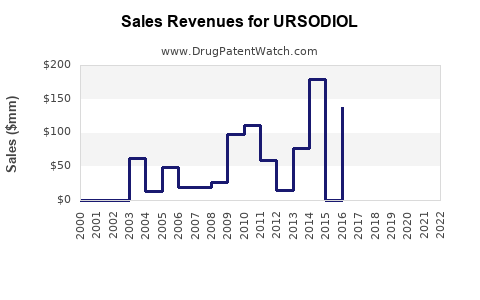
- What are the global sales for URSODIOL?
- What is Average Wholesale Price for URSODIOL?
Summary for URSODIOL
| US Patents: | 0 |
| Applicants: | 19 |
| NDAs: | 22 |
| Finished Product Suppliers / Packagers: | 28 |
| Raw Ingredient (Bulk) Api Vendors: | 1 |
| Clinical Trials: | 39 |
| Patent Applications: | 5,786 |
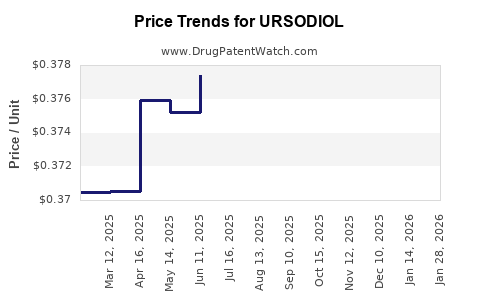
| Drug Prices: | Drug price information for URSODIOL |
| What excipients (inactive ingredients) are in URSODIOL? | URSODIOL excipients list |
| DailyMed Link: | URSODIOL at DailyMed |
Recent Clinical Trials for URSODIOL
Identify potential brand extensions & 505(b)(2) entrants
| Sponsor | Phase |
|---|---|
| Ain Shams University | PHASE4 |
| Amira Adel Fouly | PHASE4 |
| Egyptian Chinese University | PHASE4 |
Pharmacology for URSODIOL
| Drug Class | Bile Acid |
US Patents and Regulatory Information for URSODIOL
| Applicant | Tradename | Generic Name | Dosage | NDA | Approval Date | TE | Type | RLD | RS | Patent No. | Patent Expiration | Product | Substance | Delist Req. | Exclusivity Expiration |
|---|---|---|---|---|---|---|---|---|---|---|---|---|---|---|---|
| Teva Pharms Usa | URSODIOL | ursodiol | TABLET;ORAL | 079184-001 | May 13, 2009 | DISCN | No | No | ⤷ Start Trial | ⤷ Start Trial | ⤷ Start Trial | ||||
| Teva Pharms Usa | URSODIOL | ursodiol | TABLET;ORAL | 079184-002 | May 13, 2009 | DISCN | No | No | ⤷ Start Trial | ⤷ Start Trial | ⤷ Start Trial | ||||
| Abhai Llc | URSODIOL | ursodiol | CAPSULE;ORAL | 210707-001 | May 17, 2018 | AB | RX | No | No | ⤷ Start Trial | ⤷ Start Trial | ⤷ Start Trial | |||
| Epic Pharma Llc | URSODIOL | ursodiol | TABLET;ORAL | 214717-001 | Aug 14, 2024 | AB | RX | No | No | ⤷ Start Trial | ⤷ Start Trial | ⤷ Start Trial | |||
| >Applicant | >Tradename | >Generic Name | >Dosage | >NDA | >Approval Date | >TE | >Type | >RLD | >RS | >Patent No. | >Patent Expiration | >Product | >Substance | >Delist Req. | >Exclusivity Expiration |
Ursodiol Market Dynamics, Patent Exclusivity, Generic Competition, and Financial Trajectory
Ursodiol is a mature, largely generic bile acid drug with durable demand in primary biliary cholangitis (PBC), gallstone dissolution, and selected cholestatic liver disorders. Its commercial trajectory is volume-driven rather than exclusivity-driven. The U.S. market has no meaningful branded patent barrier, no current regulatory exclusivity comparable with newer PBC therapies, and limited manufacturer-level revenue disclosure. Financial value is concentrated in recurring chronic PBC prescriptions, low-cost generic supply, and active pharmaceutical ingredient (API) manufacturing rather than in a single originator brand.
What is ursodiol used for and how large is the market?
Ursodiol, also called ursodeoxycholic acid or UDCA, is a hydrophilic bile acid that reduces the toxicity of endogenous bile acids and improves bile flow. FDA-approved uses include dissolution of radiolucent gallstones in selected patients and treatment of primary biliary cholangitis, formerly called primary biliary cirrhosis [1].
The market has two distinct demand pools:
| Segment | Demand profile | Commercial characteristics |
|---|---|---|
| Primary biliary cholangitis | Chronic, often lifelong therapy | Stable refill demand and greater adherence value |
| Gallstone dissolution | Finite treatment course, generally months | More episodic demand and lower recurring revenue |
| Other cholestatic disorders | Off-label or guideline-supported use varies by condition | Fragmented prescribing and lower predictability |
| Veterinary use | Separate animal-health market | Additional demand for API and finished products |
Ursodiol is usually administered at approximately 13 to 15 mg/kg/day for PBC, divided into doses. Gallstone-dissolution dosing is commonly weight-based and may continue for up to two years, depending on stone response and imaging results [1].
Public market-research estimates for the global ursodeoxycholic acid market vary substantially because some reports measure API sales, others measure finished-dose products, and some include veterinary or non-FDA-approved uses. Published estimates generally place the market in the high hundreds of millions to approximately $1 billion or more annually, with low- to mid-single-digit growth projections. These figures are directional rather than audited market totals.
When did ursodiol lose exclusivity?
Ursodiol lost meaningful U.S. commercial exclusivity years ago. The product was approved in the United States under the Actigall and Urso product lines in the 1990s, and multiple generic manufacturers now market ursodiol capsules and tablets [1][2].
| Exclusivity category | Current position |
|---|---|
| New chemical entity exclusivity | Expired |
| Orphan-drug exclusivity | No current exclusivity protecting standard ursodiol products |
| Pediatric exclusivity | No material current protection identified |
| Patent-based exclusivity | No meaningful active barrier in the current U.S. market |
| FDA generic competition | Established across multiple dosage forms and manufacturers |
| Brand switching risk | High because prescribers and payers can substitute generics |
The commercial consequence is a low average selling price and limited ability for manufacturers to raise prices without losing formulary position. Shortages, API constraints, or a temporary manufacturer withdrawal can still create localized pricing pressure, but those events do not recreate durable exclusivity.
What patents protect ursodiol products?
Current U.S. ursodiol products are protected primarily by manufacturing know-how, quality systems, supply contracts, trademarks, and regulatory execution rather than by enforceable composition-of-matter patents.
The original molecule is old, and standard ursodiol capsules and tablets do not depend on a live compound patent. The FDA Orange Book is the relevant source for listed patents and regulatory exclusivity associated with approved drug products [2]. Current Orange Book listings do not establish a significant patent estate that would delay ordinary generic competition for standard ursodiol products.
Are there formulation patents for ursodiol?
Formulation and delivery claims can theoretically cover particle size, salt selection, suspension systems, taste masking, modified release, or combination products. Those claims are commercially relevant only if they are:
- Valid and enforceable;
- Unexpired;
- Listed or otherwise capable of supporting litigation;
- Narrow enough to exclude competing products; and
- Connected to a product with meaningful clinical or reimbursement demand.
Standard immediate-release ursodiol capsules and tablets have limited formulation differentiation. A manufacturer developing a new liquid, pediatric, modified-release, or combination product could seek protection around excipients, manufacturing processes, or delivery characteristics. Such protection would not block generic copies of conventional ursodiol dosage forms.
Are there method-of-use patents for ursodiol?
Method-of-use opportunities are more plausible than compound patents, but the commercial value is limited by the maturity of the molecule and the breadth of established clinical use. Potential claims could cover a specific patient population, dosing regimen, biomarker-defined disease, or combination treatment.
A method-of-use patent would not necessarily prevent generic manufacturers from selling ursodiol for unpatented indications. FDA labeling, prescribing practice, and state or payer substitution rules determine how effectively a method claim could be enforced in practice.
What is the Orange Book status of ursodiol?
Ursodiol is an established generic market with multiple approved ANDAs and legacy NDAs. The Orange Book records approved products, dosage forms, reference-listed drugs, patent information, and regulatory exclusivity where applicable [2].
The practical Orange Book position is:
- No active compound patent blocks generic ursodiol.
- No current five-year or three-year exclusivity period controls market entry.
- Generic applicants can enter through the ANDA pathway by demonstrating pharmaceutical equivalence and bioequivalence.
- Any applicant-specific paragraph IV certification depends on the patent information listed for the relevant reference product at the time of filing.
- A paragraph IV filing would have limited strategic value unless tied to a newly listed patent or a differentiated product.
FDA’s Drugs@FDA and Orange Book databases identify the relevant reference products and approved generic applications [2][3]. The market is therefore governed by ordinary ANDA competition rather than by a pending branded patent cliff.
Which companies manufacture ursodiol?
Ursodiol is supplied by a broad group of generic pharmaceutical companies. U.S. market participants have included manufacturers and distributors such as Amneal Pharmaceuticals, Rising Pharmaceuticals, Zydus Pharmaceuticals, Teva Pharmaceuticals, Actavis or related legacy entities, and other ANDA holders. Product availability changes by wholesaler, labeler, manufacturing site, and contracting arrangements.
The key competitive variables are:
- API cost and source qualification;
- FDA manufacturing compliance;
- Product availability;
- Wholesale acquisition cost;
- Medicaid and commercial rebate terms;
- Ability to supply both 250 mg and 300 mg strengths;
- Packaging and bottle configuration;
- Pharmacy benefit manager contracts; and
- Shortage management.
Ursodiol is not a market in which one manufacturer typically controls the category. Generic entrants compete on supply reliability and price, while distributors compete on channel access.
How strong is the ursodiol patent estate?
The patent estate is weak for conventional ursodiol products and stronger only for potential differentiated formulations or new clinical-use claims.
| Patent category | Strength for conventional ursodiol | Business relevance |
|---|---|---|
| Composition of matter | Very low | Expired technology |
| Standard capsule formulation | Low | Commodity competition |
| Standard tablet formulation | Low | Commodity competition |
| Novel liquid or pediatric formulation | Potentially moderate | Depends on clinical and commercial adoption |
| Modified release | Potentially moderate | Limited evidence of broad market demand |
| Combination therapy | Variable | Could support a branded niche |
| Manufacturing process | Moderate as know-how, limited as market exclusion | May reduce cost or improve quality |
| Method of use | Variable | Enforcement and labeling limitations reduce value |
Manufacturing know-how can still create practical barriers. A supplier must demonstrate consistent purity, impurity control, dissolution performance, stability, and batch reproducibility. These barriers affect cost and FDA compliance, but they do not generally produce the pricing power associated with a valid blocking patent.
What is the financial trajectory for ursodiol?
Ursodiol revenue is likely to remain stable to modestly growing in units, while nominal pricing remains constrained. The main financial drivers are chronic PBC prevalence, treatment persistence, population aging, generic substitution, API costs, and competition from newer PBC drugs.
Revenue drivers
PBC creates the most valuable demand because patients may remain on treatment for years. The disease predominantly affects women and is often diagnosed in middle age or later. Ursodiol remains the established first-line therapy in major clinical practice guidelines, although biochemical response is incomplete in a meaningful proportion of patients [4].
Gallstone-dissolution demand is less valuable on a per-patient basis because treatment is temporary and only selected patients are appropriate candidates. Surgical management remains common, limiting the addressable market for medical dissolution.
The financial profile can be summarized as follows:
| Driver | Expected effect on ursodiol revenue |
|---|---|
| Chronic PBC treatment | Supports recurring volume |
| Generic substitution | Reduces price and manufacturer margin |
| Aging population | Supports gradual demand growth |
| New PBC therapies | May reduce growth in nonresponders or add combination use |
| API inflation | Pressures gross margin |
| Manufacturing shortages | Can produce temporary price increases |
| Expanded off-label use | Potential upside, but weakly predictable |
| Insurance restrictions | Usually favor low-cost generic supply |
Generic ursodiol manufacturers generally do not report product-specific revenue. Public-company filings tend to aggregate products within broad generic portfolios, making it difficult to isolate ursodiol sales or margins [5]. The product is financially material at the category level but rarely material enough to be separately disclosed by a diversified manufacturer.
How does ursodiol compare with newer PBC drugs?
Ursodiol remains the low-cost foundational therapy, while newer agents target patients with inadequate response or intolerance.
| Drug | Role in PBC | Market position | Exclusivity profile |
|---|---|---|---|
| Ursodiol | First-line therapy | Generic, low-cost | Mature and largely unprotected |
| Obeticholic acid | Previously used for inadequate responders | U.S. PBC approval withdrawn in 2024 | Branded exclusivity ended with withdrawal |
| Elafibranor, Iqirvo | Adjunct or alternative for selected patients | FDA approved in 2024 | Active branded patent and regulatory protections likely |
| Seladelpar, Livdelzi | Treatment for selected PBC patients | FDA approved in 2024 | Active branded protection expected |
| Fibrates | Used in some jurisdictions or off-label settings | Nonuniform regulatory status | Depends on product and jurisdiction |
The FDA announced withdrawal of Ocaliva, or obeticholic acid, from the U.S. market for PBC in 2024 after the confirmatory study did not verify clinical benefit and raised safety concerns [6]. The FDA approved Iqirvo in June 2024 and Livdelzi in August 2024 for PBC-related use in specified patient populations [7][8].
These products expand treatment options but do not eliminate ursodiol’s role. Their higher prices create a market split: ursodiol retains first-line and cost-sensitive use, while newer agents compete for patients with inadequate biochemical response, intolerance, or disease progression.
What generic entry risks exist for ursodiol?
Generic entry risk is already fully realized for conventional ursodiol. The principal commercial risk is therefore not a future patent cliff but continued price erosion and supplier substitution.
Generic launch scenarios
A new ANDA entrant could pursue one of three strategies:
- Enter with conventional 250 mg and 300 mg capsules and compete on price.
- Target supply-constrained channels or regional wholesalers.
- Develop a differentiated liquid, pediatric, or specialty formulation.
The first strategy has the lowest regulatory and commercial risk but also the weakest margin potential. The third strategy may support better pricing, but it requires clinical differentiation, manufacturing investment, and a reimbursement rationale.
Paragraph IV challenges are unlikely to have major category-level consequences unless a new branded formulation obtains listed patents. For ordinary ursodiol, ANDA applicants generally face established generic competition rather than a single originator-controlled barrier.
What patent litigation affects ursodiol?
There is no widely reported, market-defining U.S. patent litigation campaign controlling access to standard ursodiol capsules or tablets. Litigation risk is more likely to arise from:
- A new branded formulation;
- A specialty indication with a narrow method-of-use claim;
- A manufacturing process patent;
- Trade-secret disputes involving API production; or
- FDA regulatory disputes concerning bioequivalence, manufacturing, or approval status.
Any future litigation involving a differentiated ursodiol product would need to be assessed separately from the mature generic market. A lawsuit against one manufacturer would not necessarily restrict supply from other ANDA holders.
What licensing deals affect ursodiol?
Ursodiol has limited licensing value as a standalone molecule because the active ingredient is generic and widely available. Commercial arrangements are more likely to involve:
- API supply agreements;
- Contract manufacturing;
- Regional distribution;
- Private-label pharmacy products;
- Hospital purchasing contracts; and
- Veterinary formulations.
Licensing economics could improve if a company developed a patented delivery system, combination therapy, or biomarker-defined PBC product. Conventional ursodiol does not provide the exclusivity needed for a high-value branded licensing transaction.
What is the FDA regulatory status of ursodiol?
Ursodiol remains FDA-approved in oral dosage forms for gallstone dissolution and PBC. The reference products and approved generics are regulated through NDAs and ANDAs, with bioequivalence and manufacturing requirements applying to generic products [1][2][3].
The regulatory outlook is stable:
- No major safety-driven removal affects conventional ursodiol.
- Generic approval remains available through the ANDA pathway.
- Labeling changes would depend on new safety, efficacy, or postmarketing information.
- A new indication would require evidence adequate for an NDA supplement or an independent NDA, depending on the sponsor’s strategy.
- A new dosage form could generate regulatory differentiation without restoring protection to legacy products.
How does ursodiol’s geographic market compare across regions?
The United States is a mature generic market. Europe, China, Japan, Latin America, and other regions also use UDCA extensively, but regulatory status, reimbursement, branded market share, and prescribing patterns differ.
China is important both as a manufacturing base and as a demand market. Europe has broad use of ursodeoxycholic acid in hepatobiliary disease, with national reimbursement and generic pricing policies influencing revenue. Emerging markets may have higher branded penetration but lower absolute pricing.
Geographic commercial value depends on:
- Local approval requirements;
- API import rules;
- National reimbursement;
- Hospital tendering;
- Domestic manufacturing;
- Pharmacy substitution laws; and
- Presence of local brands.
No single global patent position determines access. The principal barriers are regulatory registration, quality compliance, distribution, and reimbursement.
Key Takeaways
- Ursodiol is a mature generic drug with durable demand, particularly in chronic PBC treatment.
- The U.S. market has no meaningful active patent barrier for conventional ursodiol capsules and tablets.
- Revenue is driven by prescription volume, chronic treatment duration, API economics, and supply reliability.
- Generic price competition limits margins and makes product-specific financial disclosure uncommon.
- Newer PBC therapies such as Iqirvo and Livdelzi may capture selected nonresponders but do not replace ursodiol as the low-cost foundational therapy.
- Formulation, combination, and method-of-use patents could support niche products, but they would not restore exclusivity to standard ursodiol.
- Generic entry risk is already realized; future financial risk is primarily price erosion, supply disruption, and therapeutic substitution.
- Commercial value is greater in API manufacturing, reliable supply, and specialty formulations than in conventional branded resale.
FAQs About Ursodiol Market and Patent Risk
Is ursodiol still profitable for generic manufacturers?
Yes, but profitability depends on scale, API sourcing, manufacturing efficiency, and supply reliability. Conventional product margins are constrained by multiple generic suppliers.
Can a company obtain a new patent on ursodiol?
A company may obtain a patent on a novel formulation, manufacturing process, combination, dosing regimen, or specific method of use if the claims satisfy patentability requirements. It cannot obtain a new composition-of-matter patent on the old molecule itself.
Will new PBC drugs eliminate ursodiol demand?
No. Ursodiol remains the standard low-cost first-line treatment for many PBC patients. New agents primarily compete for patients with inadequate response, intolerance, or progression.
Is ursodiol subject to a current FDA shortage?
Shortage conditions can vary by strength, manufacturer, package size, and time period. A localized supply disruption does not indicate loss of generic approval or creation of market exclusivity.
Does veterinary ursodiol materially change the market outlook?
Veterinary use adds demand for the API and finished products, but it does not materially change the patent position of human ursodiol products. Its financial impact depends on species, formulation, channel, and regional approvals.
References
-
U.S. Food and Drug Administration. (1997). Actigall (ursodiol) prescribing information. FDA.
-
U.S. Food and Drug Administration. (2024). Approved drug products with therapeutic equivalence evaluations, 44th edition: Orange Book. FDA.
-
U.S. Food and Drug Administration. (2024). Drugs@FDA: FDA-approved drugs. FDA.
-
Lindor, K. D., Bowlus, C. L., Boyer, J., Levy, C., & Mayo, M. (2019). Primary biliary cholangitis: 2018 practice guidance from the American Association for the Study of Liver Diseases. Hepatology, 69(1), 394-419.
-
Teva Pharmaceutical Industries Ltd. (2024). Annual report 2023. Teva.
-
U.S. Food and Drug Administration. (2024). FDA withdraws approval of obeticholic acid for primary biliary cholangitis. FDA.
-
U.S. Food and Drug Administration. (2024). FDA approves first treatment for patients with primary biliary cholangitis. FDA.
-
U.S. Food and Drug Administration. (2024). FDA grants accelerated approval to seladelpar for primary biliary cholangitis. FDA.
More… ↓
