Last updated: June 5, 2026
Executive summary
- UNITHROID (levothyroxine sodium) is a long-established, off-patent thyroid hormone product in the US with ongoing competitive pricing pressure from multiple authorized generics and branded/authorized alternatives of levothyroxine.
- The financial trajectory is dominated by (1) net price erosion from generic and authorized-generic competition, (2) mix shift across tablets and strengths, (3) supply continuity risks and distribution contracting, and (4) payer formulary decisions.
- Near-term upside is typically limited unless there is differentiation in reimbursement, contracted pricing, or manufacturing availability that protects share.
How big is the UNITHROID market and what drives unit and dollar demand?
UNITHROID sells in the US primarily as oral levothyroxine replacement therapy for hypothyroidism and related indications where thyroid hormone replacement is indicated. Demand is primarily chronic and volume-stable, with seasonal and prescriber-pattern volatility.
Key market demand drivers
- Chronic prevalence and stable prescribing: Hypothyroidism management yields recurring demand tied to the prevalent patient pool rather than short-cycle product adoption.
- Dose titration and strength mix: Sales are sensitive to shifts in prescribing patterns across microgram strengths, as well as patient titration from initiation to maintenance.
- Payer management: Formularies, preferred product lists, and utilization management shape which levothyroxine product is dispensed.
- Substitution and switching behavior: Pharmacy-level substitution (and patient switching policies) affects relative share between brands and authorized generics.
What parts of the UNITHROID sales mix matter most financially?
- Strength-weighted pricing: Higher microgram strengths can have different reimbursement bands, which influences net sales per prescription.
- Channel mix: Specialty pharmacy vs. retail distribution contracts can drive net price and rebates.
- Contracting with wholesalers and PBMs: Rebates and distribution fees can move net pricing even if wholesale acquisition cost remains stable.
What are the major competitive forces against UNITHROID?
UNITHROID competes in a crowded levothyroxine market where multiple products are available, including authorized generics. Competitive forces are mostly pricing, supply reliability, and payer contracting rather than clinical differentiation.
Competitive pressure sources
- Authorized generic entry and switching: When payer incentives favor lower-cost options, UNITHROID typically faces reduced share.
- Branded competitors in levothyroxine: Other branded levothyroxine products compete where covered formularies remain favorable.
- Generic levothyroxine dispersion: Multiple generic players increase price competition and can widen discounting.
- Supply continuity: Any constraint in manufacturing capacity for a given product can temporarily shift share to competitors, then reverse when supply normalizes.
How has UNITHROID pricing evolved and what does that mean for margins?
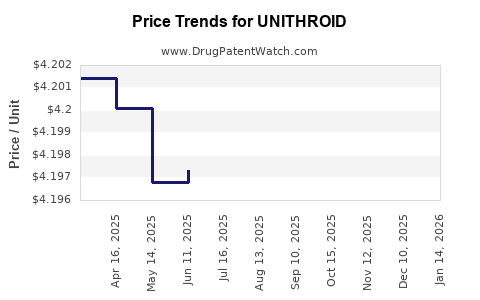
For off-patent products like levothyroxine brands, the economics are usually a function of net pricing and rebate burden. As competition intensifies, gross-to-net declines and net sales per unit falls even if prescription volume is stable.
Financial impact mechanisms
- Net price erosion: Discounting to PBMs and wholesalers reduces net revenue per tablet.
- Rebate escalators: Greater volume discounts and rebates can be required to maintain formulary positioning.
- Channel leakage: Switching at the pharmacy counter (or through substitution) reduces brand share, even in patients with ongoing therapy.
What is the expected financial trajectory for UNITHROID over 3–5 years?
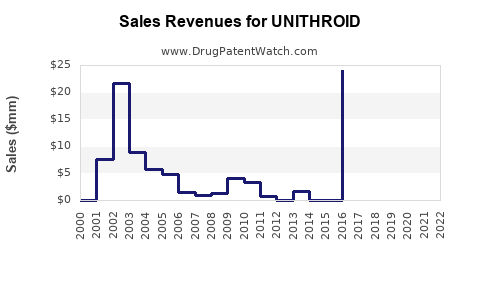
The default trajectory for a mature levothyroxine brand is modest growth at best, with risk of continued net sales decline if contracting shifts further toward lowest-cost products.
Baseline trajectory pattern in mature off-patent therapeutics
- Volume: Typically stable to slightly down, depending on substitution behavior and payer preference.
- Price: More likely to decline than to rise, driven by competition and procurement.
- Operating leverage: Manufacturing and distribution costs generally do not fall proportionally with revenue, squeezing profitability unless there is cost control or contract protection.
Key variables that can bend the trajectory
- Formulary outcomes: Changes in preferred status or placement can move share quickly.
- Supply events: Manufacturing interruptions can create short-term share gains for UNITHROID, followed by reversion.
- Reimbursement changes: Any adjustment in plan formularies or specialty pharmacy steering affects net revenue.
Which payers and formularies most affect UNITHROID net sales?
For chronic therapies, PBMs and large payers drive brand versus generic mix through preferred drug lists, formulary tiering, and rebate structures.
High influence decision points
- Tier placement: Tier changes can move a product from preferred access to restricted or non-preferred tiers.
- Prior authorization and step therapy: Levothyroxine tends to be managed through formulary preference and substitution, but plan-specific rules can still affect access.
- Switching protocols: Plans that require or incentivize generic switching can reduce branded share.
What manufacturing and supply dynamics are relevant to UNITHROID revenue?
Supply is a market-share lever in thyroid hormone because patients are sensitive to product consistency. Any manufacturing deviation or distribution disruption can force switches.
Revenue sensitivity
- Short supply periods: Can create temporary share loss for UNITHROID when patients switch to in-stock alternatives.
- Restoration of supply: Can restore demand, but lingering prescriber preference may slow full recovery.
How does UNITHROID compare with other levothyroxine options financially?
In the US, the comparison set for UNITHROID usually includes:
- Branded levothyroxine products with different prescribing patterns and contracting terms.
- Authorized generics and multiple generics offering different net price outcomes under PBM contracting.
Practical financial comparison
- Net price advantage: Authorized generics often compress net pricing for branded products.
- Contract protection: Where UNITHROID retains formulary or procurement positions, net sales declines can be slower than average.
- Switching inertia: Some patients remain on a product due to perceived stability, which can modestly protect brand volume.
What are the typical cost and revenue levers for UNITHROID versus generics?
- Higher promotional and access costs: Brands often fund additional contracting and market support.
- Lower elasticity among established patients: Chronic therapy reduces patient willingness to switch, but payer rules can override.
- Manufacturing scale: Generic providers can undercut on unit economics, while brand margins depend on net pricing and reimbursement.
What litigation, exclusivity, and regulatory events could affect UNITHROID financials?
UNITHROID is levothyroxine sodium, a mature active ingredient with multiple entrants over time. Financial impacts from IP are usually longer-term and slow relative to pricing competition, unless specific formulation or use patents restrict certain changes.
Revenue-relevant regulatory dynamics
- FDA labeling changes: Labeling can impact prescribing patterns, but levothyroxine generally has stable clinical labeling across products.
- Bioequivalence and product interchangeability: Levothyroxine generics typically compete through equivalence and substitution rules rather than clinical differentiation.
What does the Orange Book and FDA approval landscape imply for UNITHROID competition?
For older products, the practical implication is that competition is constrained more by manufacturing and contracting than by exclusivity. UNITHROID’s ongoing commercial strength depends on the ability to maintain favorable payer coverage and continuity of supply.
Commercial implication
- If no meaningful remaining exclusivity covers core product attributes, the market structure tends toward persistent net price pressure.
How do settlement agreements and Paragraph IV challenges typically affect products like UNITHROID?
For mature off-patent molecules, disputes can exist around specific formulations, strengths, or manufacturing methods. When those disputes resolve, the financial effect is usually a step-change: entry pressure increases, net pricing falls, and share rebalances.
Financial pattern
- Before resolution: Reduced competition supports brand pricing and share.
- After resolution: Authorized generics or new generics compress pricing, often within a few quarters.
What generic entry risks exist for UNITHROID?
For levothyroxine, generic entry is structurally ongoing. The major “entry risk” is less about a single new competitor and more about incremental increases in competitive share via authorized generics and re-contracting that favors lower-cost suppliers.
Risk channels
- PBM switching policies: Even if brand remains available, preferred placement can move.
- Contracting cycles: Annual or biannual bids can shift net price terms materially.
- Supply assurance requirements: Some plans steer to suppliers that meet service-level requirements, affecting brand share.
Is UNITHROID a buy-side or investable story based on financial trajectory alone?
For investors, UNITHROID typically fits the category of mature, low-volatility chronic products where returns are driven by execution on pricing and supply rather than breakthrough growth.
Investment-relevant framing
- Upside: contract protection, supply continuity, and defensive formulary placement.
- Downside: continued net price erosion, authorized generic expansion, and formulary downgrades.
Key takeaways
- UNITHROID’s market dynamics are dominated by chronic demand stability but ongoing pricing compression from authorized generics and competing levothyroxine products.
- Financial trajectory risk is primarily net price erosion from PBM contracting and formulary preference shifts, with supply and channel execution as the main short-term swing factors.
- There is limited differentiation-based upside in a mature levothyroxine segment unless UNITHROID secures sustained favorable coverage and pricing through distribution and payer contracts.
FAQs
-
What drives UNITHROID net sales volatility quarter to quarter?
PBM contract timing, strength mix changes, and supply/distribution continuity.
-
How does switching from UNITHROID to authorized generics affect brand revenue?
It typically reduces unit share and forces net price concessions through rebate and contracting pressure.
-
What payer formulary decisions most impact long-term UNITHROID share?
Preferred tier status, step edits, and PBM rebate-funded positioning.
-
Does UNITHROID face meaningful risk from biosimilars?
No, levothyroxine is a small-molecule drug, not a biologic.
-
What commercial levers can protect UNITHROID margins in a competitive levothyroxine market?
Securing preferred formulary placement, maintaining supply reliability, and optimizing rebate and distribution economics.
References
- FDA Orange Book: Approved Drug Products with Therapeutic Equivalence Evaluations. US Food and Drug Administration. https://www.accessdata.fda.gov/scripts/cder/daf/
- FDA Drug Approvals and Databases: Labeling and approval histories for levothyroxine products. US Food and Drug Administration. https://www.fda.gov/drugs/drug-approvals-and-databases