Last updated: February 24, 2026
What is UNITHROID?
UNITHROID (levothyroxine sodium) is a synthetic thyroid hormone used primarily to treat hypothyroidism. It substitutes for natural thyroid hormone and is classified as a generic drug, with Teva Pharmaceuticals and other manufacturers producing it. FDA approval for Unithroid commenced in the 1960s, with generic availability increasing since 2000.
Market Overview
Market Size and Growth
The global thyroid hormone replacement therapy market, including UNITHROID, is valued at approximately $500 million in 2023. The U.S. accounts for roughly 70% of the market, driven by high hypothyroidism prevalence, estimated at 4.6% of the U.S. population.[1] The compound annual growth rate (CAGR) is projected at 3% through 2028, reflecting steady demand driven by aging populations and improved diagnosis rates.
Key Market Drivers
- Growing prevalence of hypothyroidism: Aging populations and increased awareness contribute to rising diagnoses.
- Market penetration of generic drugs: Cost advantages make UNITHROID a preferred option.
- Development of biosimilars and branded alternatives: Competition influences pricing structures.
Competitive Landscape
Major players include Teva Pharmaceuticals, Mylan, and Sandoz, with multiple generics licensed to different manufacturers. Market entry is limited by complex manufacturing requirements and regulatory barriers, maintaining relatively stable market shares among existing competitors.
Pricing Dynamics and Trends
Current Pricing
- Average wholesale price (AWP): Approx. $0.045 per 50 mcg tablet.
- Retail price: Ranges between $15 to $20 for a 30-day supply of 50 mcg tablets.
- Reimbursement levels: Vary by insurer, with pharmacy benefit managers (PBMs) negotiating discounts.
Historical Price Trends
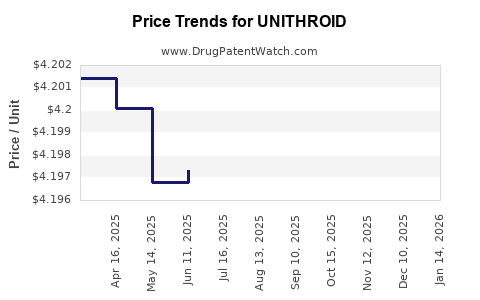
Between 2010 and 2015, prices of UNITHROID remained stable, with minor fluctuations attributed to supply chain issues. Post-2016, generic competition led to a 20% decline in average prices. Currently, the price has stabilized, with small annual adjustments within 2-3%.
Influencing Factors
- Regulatory approvals: Any new formulations or biosimilars could impact pricing.
- Manufacturing costs: Ingredient costs, quality control, and manufacturing scale.
- Market competition: Entry of biosimilar levothyroxines or innovative therapies could force price adjustments.
- Insurance reimbursement policies: Delays in coverage or formulary restrictions affect retail prices and patient access.
Price Projections (2023–2028)
| Year |
Price per 50 mcg tablet |
Notes |
| 2023 |
$0.045 |
Current average price |
| 2024 |
$0.046 |
Slight increase due to inflation and manufacturing costs |
| 2025 |
$0.047 |
Marginal growth as competition stabilizes |
| 2026 |
$0.048 |
Potential entry of biosimilars could stabilize or reduce prices |
| 2027 |
$0.048 |
Market stabilization |
| 2028 |
$0.049 |
Slight natural inflation impact |
In terms of wholesale dollar volume, the total market value for UNITHROID could range between $350 million and $400 million by 2028, assuming stable demand and minimal price erosion.
Regulatory and Policy Impact
The FDA’s evolving policies influence the market:
- Generic Drug User Fee Amendments (GDUFA): Encourages faster generic approvals, which could increase competition.
- Quality standards: Stringent requirements may limit new entrants, supporting current pricing stability.
- Pricing transparency initiatives: Could influence reimbursement negotiations and discount structures.
Key Challenges and Opportunities
Challenges:
- Price sensitivity among payers and patients due to the availability of low-cost generics.
- Potential patent or exclusivity issues that could delay generic entry.
Opportunities:
- Development of controlled-release formulations to improve patient compliance.
- Expansion into emerging markets with increasing healthcare access.
- Potential pipeline of biosimilars impacting efficacy and costs.
Summary
UNITHROID holds a stable position in hypothyroidism treatment with a modest growing market size. The price remains predominantly stable, with incremental increases driven by inflation and manufacturing costs. Competition from biosimilars or new formulations introduces future uncertainty, but current market dynamics suggest limited immediate price erosion.
Key Takeaways
- The global and U.S. markets for thyroid hormone replacement are steady with moderate growth.
- Current average prices per tablet are around $0.045, with retail costs approximately $15-$20 monthly.
- Price projections indicate slight rises through 2028, mainly reflecting inflation and manufacturing factors.
- Competition and regulatory policies shape the future competitive landscape and pricing trends.
- Opportunities exist in formulation innovation and expanding geographic reach.
FAQs
1. What factors influence UNITHROID’s pricing?
Manufacturing costs, generic competition, regulatory policies, and insurer negotiations impact prices.
2. How does generic competition affect UNITHROID prices?
It drives prices down initially; the market has stabilized with minimal further declines.
3. Are biosimilars expected to impact UNITHROID?
Potential biosimilar entry could create downward pressure on prices if approved and adopted.
4. What are the primary demand drivers?
Increased diagnosis of hypothyroidism, aging populations, and patient preference for affordable generics.
5. How do regulatory policies impact the market?
FDA approval processes and quality standards influence new entrants and ongoing competition stability.
References:
[1] National Institutes of Health. (2021). Hypothyroidism - overview. Retrieved from https://www.niddk.nih.gov/health-information/endocrine-diseases/hypothyroidism