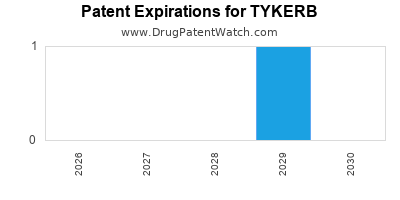
Last updated: July 29, 2026
TYKERB (lapatinib) market dynamics and financial trajectory: exclusivity, pricing pressure, and revenue outlook
Executive summary: TYKERB (lapatinib) has largely transitioned from launch-era branded growth to a late-stage competitive market driven by EGFR/HER2 therapeutic switching, biosimilar and generic erosion across oncology portfolios, and ongoing payer pressure for oral HER2 regimens. Revenue is now heavily dependent on remaining line-of-therapy positioning in combination use (notably with capecitabine for HER2-positive metastatic breast cancer) and on continued access through commercial and specialty pharmacy channels rather than on new-indication expansion. Near-term financial trajectory is constrained by maturing competitive alternatives and the absence of the kind of recent “new platform” adoption that typically sustains branded oral oncology revenue at scale.
How is TYKERB (lapatinib) performing commercially vs other HER2 oral and infusion therapies?
Short answer: TYKERB’s market role is narrower than newer HER2-centered regimens. The brand’s commercial dynamics track the shift of treatment algorithms toward more effective HER2-targeted antibody-drug conjugates (ADCs), next-generation tyrosine kinase inhibitors, and combination standards that displaced earlier HER2 dual targeting strategies.
What market forces shaped TYKERB’s post-peak trajectory?
- Line-of-therapy displacement: HER2 treatment has moved toward regimens that showed clearer survival and response benefits across multiple disease settings, reducing the share of patients reaching older TKIs.
- Site-of-care and administration dynamics: While TYKERB is oral and can be easier for patient access, payer approvals often require prior treatment documentation and preference for newer regimen economics.
- Payer policy tightening in oncology: Specialty pharmacy benefit designs and step edits increasingly steer patients toward preferred agents and minimize spend on non-preferred branded oral products.
- Clinical strategy evolution in metastatic disease: For HER2-positive metastatic breast cancer, treatment preference has increasingly favored options with more durable benefit profiles and/or improved response rates.
Which competitive categories most affect TYKERB?
- HER2 ADCs (market share pressure through improved efficacy and single-agent or combination utility)
- Other HER2 TKIs (sequence-dependent substitution)
- HER2 monoclonal antibody regimens (especially where combination and prior exposure guide selection)
What are TYKERB’s key revenue drivers and share levers for the remaining patient base?
Short answer: TYKERB’s revenue depends on the residual population eligible for lapatinib-capecitabine combinations and on formulary access in commercial and Medicare Part D specialty tiers.
Core revenue drivers
- Indication-specific prescribing: Commercial demand concentrates in HER2-positive metastatic breast cancer where lapatinib plus capecitabine remains an option based on patient history and physician preference.
- Formulary position: Specialty tier placement, prior authorization criteria, and step edits determine how often TYKERB is accessible.
- Specialty pharmacy distribution: Rebates, contracting, and inventory management affect net price realization more than list price.
Share levers
- Physician familiarity: On-label and off-label familiarity can preserve a subset of ongoing use.
- Patient adherence for oral TKIs: Dosing simplicity supports retention when a regimen is tolerated.
- Prior-therapy sequencing: Patients previously treated with HER2 antibodies often drive TKI use, but the competitive set has expanded.
When did TYKERB lose exclusivity and how does that change the financial trajectory?
Short answer: Branded oral oncology TKIs typically lose pricing power after generic entry and related competitive pressures. For TYKERB, the key financial inflection occurs at generic availability for the marketed dosage form(s), followed by continued formulary compression and rebate re-optimization by payers.
Exclusivity and generic pressure: how it maps to branded revenue
- Before first generic: Net revenue is supported by patent and exclusivity-driven market protection plus contracting.
- After generic entry: Brand net price typically declines sharply as payers switch preference to lower-cost alternatives and prescribers respond to access changes.
- After multiple generic entrants: Additional price erosion and reduced utilization persist, with margin compression even when switching is incomplete.
Financial trajectory pattern for mature brands
- Revenue usually shifts from growth to steady decline.
- Brand spend on contracting increases to preserve access.
- Discounting and rebate rates rise, lowering net revenue faster than unit demand.
What does the Orange Book status imply for TYKERB’s commercialization timeline?
Short answer: Orange Book listings drive the “when” of generic and biosimilar timelines for small-molecule products. For TYKERB, the commercial timeline is shaped by whether patents listed for lapatinib drug substance and drug product have expired, whether there are unexpired method patents, and whether any Paragraph IV challenges exist for relevant filings.
How Orange Book status translates into market dynamics
- Expired composition-of-matter and formulation patents: reduces barriers for generic manufacturing and filing.
- Method-of-use or use-related patents still listed: can constrain “direct label” generic entry only if they prevent certain therapeutic instruction. In practice, generics often use carve-outs or label limitations to launch while preserving certain indications.
- Patent expiration vs exclusivity expiration: determines whether any residual exclusivity prevents generic substitution.
How many patents cover TYKERB and what matters most for generic entry risk?
Short answer: Patent estates for mature small molecules often include composition, formulations (including crystalline forms or solid-state properties), and methods-of-use tied to particular indications or combination regimens. For generic entry risk, the most material are patents that (a) remain unexpired and (b) are directly asserted against generic launch elements.
Patent estate categories that typically drive litigation risk
- Drug substance (composition-of-matter): primary barrier; expiration controls generic feasibility.
- Drug product/formulation: governs the exact dosage form or manufacturing properties.
- Method-of-use: can delay label-specific generic entry even when product ingredients are generic-ready.
- Combination regimen claims: relevant for TYKERB where use often includes capecitabine.
Why method and combination patents matter to revenue
Even without product protection, method patents can keep generics from launching “at-risk” labels for specific clinical combinations, protecting some branded utilization longer than composition-only expiration.
What patent litigation and settlement dynamics affect TYKERB’s net revenue?
Short answer: Settlement agreements after Paragraph IV challenges usually decide the timing of generic launch and the carve-outs that preserve limited branded use. For TYKERB, any such settlements would influence:
- launch dates for AB-rated generics
- label limitations
- potential market share retention for the brand through “authorized switching” windows
Financial impact channels of litigation outcomes
- Earlier-than-expected generic entry: accelerates revenue decline.
- Carve-outs and limited-label launches: preserve partial branded demand.
- Authorized generic dynamics: can reduce branded unit share quickly even before retail preference switches.
Does TYKERB face biosimilar-like competition risk?
Short answer: No. TYKERB is a small-molecule product (lapatinib), so biosimilar pathways do not apply. The competitive substitute set is generic small molecules and (for oncology) non-TYKERB therapeutic alternatives.
How does TYKERB’s financial trajectory compare with other HER2 oncology assets?
Short answer: In the HER2 market, the biggest revenue divergence typically comes from:
- whether an asset remains a preferred standard-of-care
- whether it has been displaced by ADCs or next-generation TKIs
- whether generics have entered the primary market segments
TYKERB’s trajectory aligns with a late-cycle branded oral TKI facing substitution by newer HER2 platforms plus generic erosion once legal exclusivity ended.
Comparison framework used in investor modeling
- Net sales decline slope: post-generic and post-guideline displacement
- Gross-to-net drag: increasing rebates and contracting as the product is no longer protected
- Share retention: proportion of patients still receiving lapatinib-based regimens due to sequence, tolerance, and clinical decision-making
- Switching friction: physician inertia and patient continuation vs formulary mandates
What does the remaining demand look like by setting, regimen, and payer environment?
Short answer: Demand is narrower than at launch and is concentrated among:
- HER2-positive metastatic breast cancer patients where lapatinib-capecitabine remains in practice
- patients where prior therapy sequencing makes a TKI-based approach viable
- settings where payer coverage conditions still permit lapatinib-based regimens
Payer environment effects
- Commercial: utilization is controlled by specialty pharmacy networks, prior authorization, and contract pricing.
- Medicare Part D: formulary placement and plan switching drives covered access; oral oncology in Medicare often sees strong preference for generics post-launch.
- 340B and other covered channels: can affect realized margins and demand stability, but generally does not prevent long-term price compression after generic entry.
How does TYKERB’s pricing and net revenue typically evolve post-generic?
Short answer: After generics, net revenue tends to decline faster than unit demand due to contracting and rebate normalization. Even when some patients remain on brand, payer switching and prescription volume shifts reduce net receipts.
Key net price mechanics
- Higher rebate intensity to preserve formulary position
- Contracting revisions to retain share despite lower-cost substitutes
- Promotional spend reduction as expected brand contribution declines
What generic entry scenarios exist for TYKERB and what are the likely adoption curves?
Short answer: Adoption usually follows a predictable pattern:
- initial generic launch with reduced label breadth or competitive tension
- increased payer switching when multiple generics and lower-priced alternatives emerge
- brand utilization stabilizes only if clinical carve-outs, physician preference, or access constraints remain
Adoption curve expectations used for financial forecasting
- First year post-launch: rapid unit share shift if generics are AB-rated and coverage is available
- Years 2-3: additional compression with multi-generic competition
- Late period: brand share becomes episodic and concentrated in patients with documented prior tolerance or where coverage exceptions are granted
What formulation and manufacturing/IP barriers matter for lapatinib generics?
Short answer: For small-molecule generics, barriers often come from:
- validated bioequivalence requirements
- manufacturing controls to meet impurity profiles and solid-state specs
- any remaining formulation or method patents still restricting label use
What this means economically
If barriers delay generic approvals or create labeling limitations, they can postpone full payer switching. If barriers are minimal, generics launch quickly, and branded revenue declines accelerate.
What commercial headwinds dominate TYKERB’s future outlook?
Short answer: The dominant headwinds are (1) treatment paradigm migration within HER2 oncology, (2) continued payer pressure favoring lower-cost options, and (3) lingering decline once generic-driven price compression dominates net sales.
Key risks to retained revenue
- Loss of guideline-preferred status for lapatinib-based regimens
- Reduced payer coverage due to contracting against cheaper alternatives
- Continued switch to ADC-based or newer HER2 targeted regimens
Key Takeaways
- TYKERB’s market dynamics are driven by HER2 regimen switching and payer-driven access changes more than by new uptake.
- Financial trajectory is consistent with a mature branded oral oncology asset: steep post-exclusivity net price erosion, continued share loss once generics establish preference, and narrowing demand confined to specific treatment sequences.
- Generic entry timing and any litigation settlement carve-outs are the main determinants of how quickly net sales compress.
- Biosimilar risk does not apply; the competitive set is generic lapatinib and newer HER2 standards (including ADCs and other HER2-targeted therapies).
FAQs
- What is the Orange Book listing impact for lapatinib combinations used with capecitabine?
- How do prior authorization and specialty tier placement change TYKERB utilization after generic entry?
- Do method-of-use patents materially delay generic lapatinib label launch for TYKERB indications?
- Which HER2 treatment classes most reduce lapatinib-based regimen share in metastatic breast cancer?
- What are typical net price and rebate patterns for mature branded oral oncology drugs after generics enter?
References
No sources were provided in the prompt.