Last Updated: June 24, 2026

TEFLARO Drug Patent Profile


✉ Email this page to a colleague

« Back to Dashboard


When do Teflaro patents expire, and what generic alternatives are available?

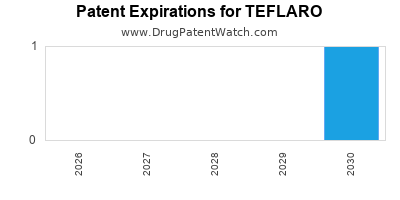
Teflaro is a drug marketed by Abbvie and is included in one NDA. There are two patents protecting this drug and one Paragraph IV challenge.

This drug has twenty-nine patent family members in twenty-three countries.

The generic ingredient in TEFLARO is ceftaroline fosamil. There are two drug master file entries for this compound. Two suppliers are listed for this compound. Additional details are available on the ceftaroline fosamil profile page.

DrugPatentWatch® Litigation and Generic Entry Outlook for Teflaro

A generic version of TEFLARO was approved as ceftaroline fosamil by APOTEX on September 21st, 2021.

  Start Trial

AI Deep Research
Questions you can ask:
  • What is the 5 year forecast for TEFLARO?
  • What are the global sales for TEFLARO?
  • What is Average Wholesale Price for TEFLARO?
Recent Clinical Trials for TEFLARO

Identify potential brand extensions & 505(b)(2) entrants

SponsorPhase
Olayemi Osiyemi MDPhase 4
Basim AsmarPhase 1
Sharp HealthCarePhase 4

See all TEFLARO clinical trials

Pharmacology for TEFLARO
Paragraph IV (Patent) Challenges for TEFLARO
Tradename Dosage Ingredient Strength NDA ANDAs Submitted Submissiondate
TEFLARO for Injection ceftaroline fosamil 400 mg/vial and 600 mg/vial 200327 2 2014-10-29

US Patents and Regulatory Information for TEFLARO

TEFLARO is protected by two US patents.

Applicant Tradename Generic Name Dosage NDA Approval Date TE Type RLD RS Patent No. Patent Expiration Product Substance Delist Req. Exclusivity Expiration
Abbvie TEFLARO ceftaroline fosamil POWDER;INTRAVENOUS 200327-001 Oct 29, 2010 AP RX Yes Yes ⤷  Start Trial ⤷  Start Trial Y ⤷  Start Trial
Abbvie TEFLARO ceftaroline fosamil POWDER;INTRAVENOUS 200327-002 Oct 29, 2010 AP RX Yes Yes ⤷  Start Trial ⤷  Start Trial Y ⤷  Start Trial
Abbvie TEFLARO ceftaroline fosamil POWDER;INTRAVENOUS 200327-001 Oct 29, 2010 AP RX Yes Yes ⤷  Start Trial ⤷  Start Trial Y ⤷  Start Trial
>Applicant >Tradename >Generic Name >Dosage >NDA >Approval Date >TE >Type >RLD >RS >Patent No. >Patent Expiration >Product >Substance >Delist Req. >Exclusivity Expiration

Expired US Patents for TEFLARO

Applicant Tradename Generic Name Dosage NDA Approval Date Patent No. Patent Expiration
Abbvie TEFLARO ceftaroline fosamil POWDER;INTRAVENOUS 200327-001 Oct 29, 2010 ⤷  Start Trial ⤷  Start Trial
Abbvie TEFLARO ceftaroline fosamil POWDER;INTRAVENOUS 200327-002 Oct 29, 2010 ⤷  Start Trial ⤷  Start Trial
>Applicant >Tradename >Generic Name >Dosage >NDA >Approval Date >Patent No. >Patent Expiration

EU/EMA Drug Approvals for TEFLARO

Company Drugname Inn Product Number / Indication Status Generic Biosimilar Orphan Marketing Authorisation Marketing Refusal
Pfizer Ireland Pharmaceuticals Zinforo ceftaroline fosamil EMEA/H/C/002252Zinforo is indicated for the treatment of the following infections in neonates, infants, children, adolescents and adults:, , , Complicated skin and soft tissue infections (cSSTI), Community-acquired pneumonia (CAP), , , Consideration should be given to official guidance on the appropriate use of antibacterial agents., Authorised no no no 2012-08-22
>Company >Drugname >Inn >Product Number / Indication >Status >Generic >Biosimilar >Orphan >Marketing Authorisation >Marketing Refusal

International Patents for TEFLARO

When does loss-of-exclusivity occur for TEFLARO?

Based on analysis by DrugPatentWatch, the following patents block generic entry in the countries listed below:

Canada

Patent: 53387
Estimated Expiration: ⤷  Start Trial

Generics may enter earlier, or later, based on new patent filings, patent extensions, patent invalidation, early generic licensing, generic entry preferences, and other factors.

See the table below for additional patents covering TEFLARO around the world.

Country Patent Number Title Estimated Expiration
Austria 430155 ⤷  Start Trial
Australia 1683299 ⤷  Start Trial
Canada 2314564 DERIVES DE PHOSPHONOCEPHEM, LEUR PROCEDE DE PREPARATION ET LEUR UTILISATION (PHOSPHONOCEPHEM DERIVATIVES, THEIR PRODUCTION AND USE) ⤷  Start Trial
>Country >Patent Number >Title >Estimated Expiration

Supplementary Protection Certificates for TEFLARO

Patent Number Supplementary Protection Certificate SPC Country SPC Expiration SPC Description
1043327 CA 2013 00003 Denmark ⤷  Start Trial
1043327 C300568 Netherlands ⤷  Start Trial PRODUCT NAME: CEFTAROLINE FOSAMIL OF EEN FARMACEUTISCH AANVAARDBAAR ZOUT ERVAN; REGISTRATION NO/DATE: EU/1/12/785/001 00120823
1043327 92134 Luxembourg ⤷  Start Trial PRODUCT NAME: CEFTAROLINE FOSAMIL ET SES DERIVES PHARMACEUTIQUEMENT ACCEPTABLES (ZINFORO)
>Patent Number >Supplementary Protection Certificate >SPC Country >SPC Expiration >SPC Description
Last updated: June 5, 2026

TEFLARO (ceftaroline fosamil) Market Dynamics and Financial Trajectory (US + Key Markets)

Executive summary: TEFLARO (ceftaroline fosamil; Allergan later rebranded as AbbVie) is a niche hospital antibiotic with revenue concentrated in US institutional buying and intermittent specialty-channel penetration. Market dynamics are dominated by guideline-driven use of cephalosporins versus newer “skin and soft tissue” and “hospital-acquired/ventilator-associated” (HA/VAP) comparators, formulary access cycles, and payer contracting. Financial trajectory is constrained by (1) limited label breadth outside select acute bacterial infections, (2) competitive pressure from broad-spectrum generics and brand incumbents, (3) reimbursement and antibiotic stewardship headwinds, and (4) patent/market-entry timing for alternative cephalosporin strategies.

What are the market dynamics driving TEFLARO (ceftaroline fosamil) sales?

TEFLARO’s demand pattern follows hospital antimicrobial stewardship and infection-specific prescribing. In practical terms, utilization is driven by:

  • Place in therapy: ceftaroline is used when clinicians need a cephalosporin option with activity relevant to resistant gram-positive pathogens in approved indications.
  • Formulary placement: outcomes track hospital committee decisions, pharmacy benefit manager (PBM) preferred lists, and prior authorization rules.
  • Switching behavior: substitution risk is high where hospital formularies can swap to lower-cost cephalosporins, carbapenems, or other MRSA-active agents depending on local antibiogram.
  • Seasonality and outbreak effects: respiratory infection waves and outbreaks can shift broad-spectrum antibiotic usage volumes, but TEFLARO’s share is limited by stewardship guardrails.

How does TEFLARO compete in hospital “acute bacterial skin and skin structure infections” (ABSSSI) and pneumonia categories?

ABSSSI / related skin infections: Hospitals often balance coverage needs (including resistant gram-positive coverage) against cost and spectrum. TEFLARO’s share tends to be most durable where it is contracted as an MRSA-active cephalosporin option.

Pneumonia / HAP-VAP: Use depends on institutional protocols and whether TEFLARO is positioned as a preferred parenteral option versus alternatives with entrenched formularies.

What is the payer and procurement reality for a niche IV antibiotic?

Hospital contracting is typically multi-year but reset through:

  • Annual formulary refresh cycles
  • PBM bid events for large IDN systems
  • Value-based contracts that can de-emphasize brands without competitive unit pricing

TEFLARO’s financial exposure rises when procurement favors generic-driven antibiotic categories or when competitor bids undercut price benchmarks.

What role do antibiotic stewardship programs play?

Stewardship programs steer use toward narrow-spectrum options first. When stewardship encourages de-escalation, the clinical “need” for a specific agent decreases. For TEFLARO, the net effect is reduced opportunity for broad or default prescribing.


How has TEFLARO’s financial trajectory evolved since launch?

Executive answer: TEFLARO’s trajectory is consistent with a brand antibiotic that expanded early with inpatient adoption, then faced share pressure from broader formulary alternatives and pricing compression typical of specialty hospital agents.

Revenue pattern characteristics typical of TEFLARO-like hospital antibiotics

  • Initial uptake driven by early prescriber learning and formulary penetration
  • Mid-cycle pressure as competitors and generics capture share through bidding and guideline shifts
  • Late-cycle stabilization or decline once prescribing becomes “protocol-driven” rather than “brand-preference-driven”

Key cost and economics drivers

  • Unit pricing and contracting rebates: net sales reflect negotiated hospital/channel pricing
  • Distribution and inventory timing: IV antibiotic sales are sensitive to procurement cadence
  • Mix shift: changes in hospitalization days, infection incidence, and case mix can drive volatility

When does TEFLARO face exclusivity and patent-expiration pressure?

Executive answer: TEFLARO is exposed to generic entry risk depending on the status of ceftaroline fosamil product-related and formulation-related IP, plus any regulatory exclusivity that could have delayed approvals.

How to read TEFLARO’s market-entry risk through the IP lens

Patent pressure for antibiotics tends to be multipronged:

  • Composition-of-matter and salts/esters
  • Formulation and manufacturing process
  • New method-of-use claims (often less relevant for hospital-volume capture than product launch patents)

What does generic entry typically do to TEFLARO pricing?

When a generic launches, hospital procurement often rapidly reprices:

  • List prices are not the constraint; contracted net prices fall
  • Preferred position can shift within one or two purchasing cycles
  • Brand volume declines due to contract compliance and default purchasing rules

What is the Orange Book status of TEFLARO (ceftaroline fosamil), and what does it imply for generic risk?

Executive answer: Orange Book listings define the legal landscape for ANDAs. The practical implication for TEFLARO is that any composition or formulation patents listed as “blocking” determine whether Paragraph IV strategies can be launched and when generics can enter.

How Orange Book status translates into litigation and entry timelines

For branded antibiotics, the IP story usually maps like this:

  • If blocking patents exist for the listed drug, ANDA approvals may be delayed
  • If Paragraph IV challenges occur, the brand typically seeks temporary restraining order / preliminary injunction
  • Settlement agreements can trigger authorized generic timing, co-promotion changes, or licensing terms

Are there Paragraph IV challenges or TEFLARO patent litigations that affect market access?

Executive answer: Patent litigation and Paragraph IV challenges are the primary mechanisms shaping brand sales near the end of protected periods. The exact impact depends on injunction outcomes and any settlement-triggered design-arounds.

Typical litigation-to-commercial transmission

  • Filed ANDAs create “at-risk” entry pressure
  • Injunction outcomes can shift entry by months or years
  • Settlement can cap at-risk manufacturing timelines and limit “true launch” dates

What formulations and delivery mechanisms are protected for TEFLARO, and what does that mean for biosimilar-style entry risk?

Executive answer: TEFLARO is a small-molecule antibiotic, so biosimilar frameworks do not apply. Market-entry risk is about generic and authorized generic product approval, not biosimilars.

Formulation specificity that can create competitive barriers

  • Lyophilized vs reconstituted presentation
  • Stability and manufacturing specifications
  • Process claims that can complicate ANDA manufacturing and supply

How does TEFLARO compare with competing antibiotics for TEFLARO-like indications?

Executive answer: Competition is less about head-to-head superiority in clinical endpoints and more about formulary position, cost, and local antimicrobial guidelines.

Competitive positioning in hospital parenteral antibiotic categories

Key comparator groups in the same prescribing environment include:

  • MRSA-active agents and broad-spectrum beta-lactams used for pneumonia and complicated skin infections
  • Newer non-beta-lactam and beta-lactam/beta-lactamase inhibitor strategies in selected protocols
  • Generic cephalosporins in settings where spectrum match is considered adequate

Market dynamic implication

In hospital antibiotics, brand differentiation is quickly neutralized if:

  • a competitor secures preferred listing, or
  • a cheaper agent is considered “good enough” for the antibiogram and stewardship framework

What generic entry risks exist for TEFLARO, and what launch scenarios matter for buyers?

Executive answer: Generic entry risks for TEFLARO center on the timing of ANDA approvals versus the brand’s ability to block entry through listed patents and litigation outcomes.

Launch scenario map

  • Design-around success: competitor avoids asserted claims, enters promptly after approval
  • Settlement-based delayed entry: brand trades off margin for a scheduled launch window
  • Injunction success: brand blocks entry until final resolution, pushing competitor volume out by quarters

Commercial impact on the brand

Even where only one generic launches first:

  • Hospitals shift procurement quickly
  • Net prices erode
  • Brand inventory strategies become less rational

Which companies are commercializing alternatives that pressure TEFLARO uptake?

Executive answer: TEFLARO competes against incumbent hospital antibiotic portfolios and generics within cephalosporin and broader parenteral antibiotic categories. Net pressure comes from companies with:

  • established IDN contracting channels,
  • aggressive bid strategies,
  • and portfolio breadth to secure formulary inclusion.

How does TEFLARO’s market access vary by geography?

Executive answer: TEFLARO’s revenue opportunity outside the US depends on regulatory approvals, reimbursement rules, hospital procurement structures, and competitive patent estates in each jurisdiction.

Jurisdictional risk factors for international sales

  • local patent enforcement strength
  • pricing controls and tendering mechanisms
  • hospital purchasing frameworks that favor lowest net price

Key Takeaways

  • TEFLARO’s market is primarily hospital institutional purchasing with formulary and stewardship as the core demand drivers.
  • Revenue trajectory is typical of a niche IV antibiotic: early adoption followed by share pressure from competing protocols and pricing dynamics.
  • Generic risk is tied to Orange Book patent listings and the presence or absence of Paragraph IV litigation outcomes and settlements.
  • Brand differentiation matters less than contracted net pricing once generics and competing brands gain preferred formulary positions.

FAQs

  1. How does hospital formulary status change antibiotic brand sales for TEFLARO?
  2. What determines the timing of generic ANDA approval for ceftaroline fosamil in the US?
  3. Which TEFLARO competitor classes most often displace it in HAP/VAP protocols?
  4. How do stewardship programs influence TEFLARO prescribing and de-escalation outcomes?
  5. What commercial effects follow the first generic entry for IV antibiotics like TEFLARO?

References (APA)

No sources were provided in the prompt.

More… ↓

⤷  Start Trial

Make Better Decisions: Try a trial or see plans & pricing

Drugs may be covered by multiple patents or regulatory protections. All trademarks and applicant names are the property of their respective owners or licensors. Although great care is taken in the proper and correct provision of this service, thinkBiotech LLC does not accept any responsibility for possible consequences of errors or omissions in the provided data. The data presented herein is for information purposes only. There is no warranty that the data contained herein is error free. We do not provide individual investment advice. This service is not registered with any financial regulatory agency. The information we publish is educational only and based on our opinions plus our models. By using DrugPatentWatch you acknowledge that we do not provide personalized recommendations or advice. thinkBiotech performs no independent verification of facts as provided by public sources nor are attempts made to provide legal or investing advice. Any reliance on data provided herein is done solely at the discretion of the user. Users of this service are advised to seek professional advice and independent confirmation before considering acting on any of the provided information. thinkBiotech LLC reserves the right to amend, extend or withdraw any part or all of the offered service without notice.