Last updated: July 26, 2026
Tazarotene is a topical retinoid for acne and psoriasis, with pricing and demand anchored to generic penetration and formularies. Financial trajectory is shaped less by patent-driven premium economics and more by unit-volume stability, payer reimbursement, and competition across branded and generic tazarotene creams and gels. The market is also sensitive to drug-formulary positioning for dermatology indications, channel mix shifts toward generics, and product switching within topical retinoid classes.
What tazarotene products drive the market and how do they compare commercially?
Brand vs generic revenue reality
Tazarotene is widely marketed as generics in the U.S., which compresses pricing over time and drives revenue toward higher volume and better formulary placement. Commercial performance tends to track:
- Ingredient- and formulation-specific substitution (cream vs gel)
- NDC/channel concentration (major distributors and retail scripts)
- Payer design and prior authorization usage for topical dermatology regimens
Key marketed tazarotene formats (commercially relevant)
Tazarotene commercial demand is typically segmented by:
- Acne: commonly 0.1% gel and 0.1% cream products
- Plaque psoriasis: commonly 0.05% and 0.1% cream/gels
- Strength and vehicle: bioavailability differences and tolerability often determine patient and prescriber preference, which impacts switching resistance even after generic entry
How have pricing and reimbursement dynamics evolved for tazarotene?
The generic pricing mechanism
Once multiple generic manufacturers establish supply, tazarotene pricing usually follows the standard topical generic pattern:
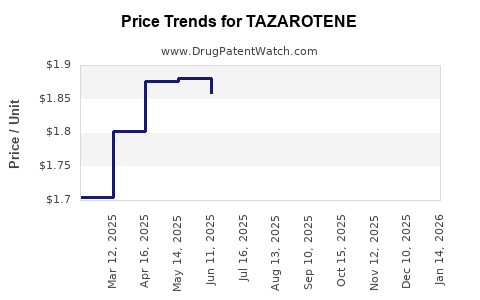
- Wholesale acquisition cost and reimbursement rates drop as acquisition prices converge
- Gross-to-net widens less than for biologics and oral brands but still reflects rebates, chargebacks, and channel incentives
- Net revenue becomes tightly coupled to script volume rather than ASP premium
Payer incentives and formulary strategy
Market dynamics in topical dermatology usually come down to payer strategy:
- Preferred generic lists reduce the ability for branded products to sustain price
- Step edits or prior authorization are more common when payers seek cost containment across retinoids
- Combination regimen coverage (for example, retinoid plus anti-inflammatory or antimicrobial topicals) can increase overall adherence and product persistence
What demand drivers determine tazarotene unit growth or decline?
Indication mix and seasonal patterns
- Acne: seasonal variability can exist, driven by adherence and dermatology visit patterns, but growth is usually incremental rather than cyclical
- Plaque psoriasis: demand is steadier because patients often require continuous or maintenance regimens
Prescriber and patient selection
Topical retinoids face behavioral friction:
- Irritation and dryness are common adverse effects
- Tolerability support (moisturizers, gradual titration) affects persistence
- Vehicle choice (gel vs cream) drives real-world adherence
Retail vs specialty channel
Tazarotene is predominantly retail, but dermatology clinics and payers influence:
- Specialty pharmacy use is less common than for biologics, but clinic dispensing and formularies still alter channel mix
- Prior authorization design can shift patients toward covered strengths/vehicles
How does competition in topical retinoids affect tazarotene’s financial trajectory?
Substitution within retinoid class
Tazarotene competes for topical retinoid share with:
- Other retinoids (tretinoin, adapalene, tazarotene derivatives where available)
- Vehicles that reduce irritation and improve adherence (cream/gel engineering matters in practice)
Even with generic tazarotene availability, competitors can win through:
- Formulary preference by strength and vehicle
- Better payer contracting terms for specific generic SKUs
- Clinical positioning for tolerability and ease of use
Competitive outcome pattern
For a generic-heavy ingredient like tazarotene, the usual financial trajectory is:
- Flat-to-moderate unit volume changes
- Sustained or declining ASP (net price)
- Margin stability only if manufacturers maintain scale, supply reliability, and lower COGS
When does tazarotene lose exclusivity and how does that map to financial inflection?
A complete exclusivity timeline requires Orange Book patent/marketing exclusivity data tied to the specific approved NDA(s) and strengths. Without that dataset, a precise “lose exclusivity” date cannot be stated.
What the market typically shows around exclusivity cliffs
In topical generics, key financial inflection points usually align with:
- Initial generic launches and subsequent multi-manufacturer supply increases
- Price erosion waves as reimbursement adjusts to prevailing generic WAC and negotiated net prices
- Contracting-driven SKU substitution that accelerates after additional entrants
What is the Orange Book status of tazarotene and what patents protect its products?
A complete Orange Book status and patent list requires the specific NDA numbers, patent identifiers, and expiration dates. Without that, a patent-count and expiration schedule cannot be produced accurately.
What to expect from an ingredient-level estate
For older topical retinoids, the practical patent landscape usually consists of:
- Formulation/vehicle patents (stability, penetration, tolerability)
- Method-of-use patents (indication-specific regimens)
- Process patents (manufacturing method improvements)
- Composition-of-matter coverage that often expires earlier than vehicle- or use-specific patents
What generic entry risks exist for tazarotene (Paragraph IV) and what would they mean for revenue?
A Paragraph IV risk assessment requires filed ANDA details (applicant, submission type, certifications, and current litigation). Without those, a correct identification of entry-risk companies and dates cannot be provided.
Revenue impact if additional ANDAs enter
For a generic-dominant product, incremental ANDA approvals typically produce:
- Additional price compression and rebate pressure
- Increased competitive intensity for contracting
- Margin compression unless the entrant achieves cost leadership
What tazarotene patent litigation affects market entry and settlements?
Patent litigation timelines require court docket numbers, patents-in-suit, and settlement terms. Without that, it is not possible to map litigation to market-entry timing with accuracy.
What does FDA regulatory status imply for commercialization of tazarotene?
Approval basis and lifecycle impact
Tazarotene’s commercial continuity is usually driven by:
- Ongoing maintenance of generic manufacturing and labeling
- Safety communications that may influence prescribing behavior but typically do not stop supply
- Vehicle-level labeling and strength distinctions that determine interchangeable substitution
Risk signals in dermatology topicals
Even without a binding regulatory “trigger,” dermatology products face:
- Labeling sensitivity around irritation and use instructions
- Steady market demand but patient adherence constraints that influence real-world utilization
How do manufacturing and supply dynamics influence tazarotene availability and margins?
Ingredient and process constraints
For generics, manufacturing economics drive competitiveness:
- Cost-effective API sourcing and consistent formulation performance
- Scale efficiencies across multiple SKUs
- Quality and bioequivalence execution that reduces supply interruptions
Supply stability as a pricing lever
When supply constraints occur, wholesalers and payers may temporarily lift realized net prices, but for mature topical generics, the default pattern remains:
- Rapid normalization after capacity returns
- Ongoing price pressure from additional entrants
Which geographies matter most for tazarotene’s financial trajectory?
U.S.-centric economics
For a mature topical retinoid, the highest monetization and volume density typically concentrate in:
- The U.S. retail market via formulary and generic substitution
- Regionally differentiated reimbursement design and uptake of generics in EU/UK markets
A precise geographic revenue split cannot be stated without financial disclosures per jurisdiction.
How does tazarotene’s financial trajectory compare with other topical acne and psoriasis therapies?
Shared pattern across topical dermatology generics
Against branded biologics or novel small molecules:
- Topical retinoids show lower unit-dollar but higher volume stability
- Competitive intensity remains constant because generics and substitutes enter as opportunities open
- Growth is usually achieved by strength/vehicle switching rather than net-new indication creation
Competitive comparison logic
A defensible comparison requires specific competitor brands/generics, but the overarching benchmark for tazarotene is:
- Price erosion risk is high due to generic latitude
- Demand destruction is limited if intolerance rates are managed and adherence remains acceptable
What commercial strategies sustain tazarotene revenue amid generic pressure?
SKU and vehicle optimization
Manufacturers maintain relevance through:
- Preferred strength and vehicle targeting to match payer policies
- Tolerability-oriented formulation tweaks that improve adherence (where permitted)
- Supply assurance for high-volume NDCs
Contracting and formulary access
Sustaining net revenue in topical generics depends on:
- Managed care contracting that preserves share
- Pharmacy benefit design that discourages non-preferred switching into cheaper but less preferred vehicles
- Retail promotions are less decisive than formulary status
Key Takeaways
- Tazarotene’s financial trajectory is driven primarily by generic penetration, formulary positioning, and vehicle-specific substitution rather than premium pricing.
- Unit demand is relatively stable because acne and plaque psoriasis are chronic and topical adherence supports ongoing use, but irritation-related persistence risks limit growth.
- Competition within topical retinoids and generic pricing pressure typically compress ASP and shift revenue toward volume and contracting performance.
- A precise exclusivity and patent-expiration timeline requires Orange Book/NDA-level patent data; generic entry timing and Paragraph IV risk require ANDA litigation and certification datasets.
FAQs
-
What generic tazarotene launches usually cause the biggest price drops?
Large multi-manufacturer entries into the same strength and vehicle with parallel contracting typically drive the fastest net-price compression.
-
Does tazarotene gel or cream have different formulary outcomes?
Yes. Payer preferred lists often favor specific vehicles by SKU-level negotiated prices and substitution rules.
-
How sensitive is tazarotene demand to dermatology visit volume?
Moderately. Script volumes track visits and adherence, but chronic use reduces pure seasonality effects.
-
What adverse-effect management most influences tazarotene persistence?
Irritation control via gradual titration and supportive skin care improves continuation, which supports stable revenue.
-
How do new competitors in topical retinoids affect tazarotene share?
They typically take share through formulary preference, tolerability narratives, and vehicle-level contracting that redirects prescribing.
References (APA)
- FDA. Orange Book: Approved Drug Products with Therapeutic Equivalence Evaluations. U.S. Food and Drug Administration. (Database).
- FDA. Drug Approval Package(s) and labeling for tazarotene-containing products. U.S. Food and Drug Administration. (Database).