Last Updated: August 24, 2026

TAVNEOS Drug Patent Profile


✉ Email this page to a colleague

« Back to Dashboard


Which patents cover Tavneos, and when can generic versions of Tavneos launch?

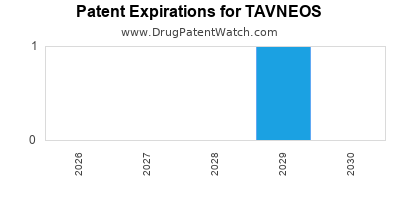
Tavneos is a drug marketed by Chemocentryx and is included in one NDA. There are four patents protecting this drug and one Paragraph IV challenge.

This drug has one hundred and thirty-two patent family members in thirty-nine countries.

The generic ingredient in TAVNEOS is avacopan. One supplier is listed for this compound. Additional details are available on the avacopan profile page.

DrugPatentWatch® Generic Entry Outlook for Tavneos

Tavneos was eligible for patent challenges on October 7, 2025.

By analyzing the patents and regulatory protections it appears that the earliest date for generic entry will be November 27, 2039. This may change due to patent challenges or generic licensing.

There has been one patent litigation case involving the patents protecting this drug, indicating strong interest in generic launch. Recent data indicate that 63% of patent challenges are decided in favor of the generic patent challenger and that 54% of successful patent challengers promptly launch generic drugs.

Indicators of Generic Entry

< Available with Subscription >

  Start Trial

AI Deep Research
Questions you can ask:
  • What is the 5 year forecast for TAVNEOS?
  • What are the global sales for TAVNEOS?
  • What is Average Wholesale Price for TAVNEOS?
DrugPatentWatch® Estimated Loss of Exclusivity (LOE) Date for TAVNEOS
Generic Entry Date for TAVNEOS*:
Constraining patent/regulatory exclusivity:
NDA:
Dosage:

CAPSULE;ORAL

*The generic entry opportunity date is the latter of the last compound-claiming patent and the last regulatory exclusivity protection. Many factors can influence early or later generic entry. This date is provided as a rough estimate of generic entry potential and should not be used as an independent source.

Recent Clinical Trials for TAVNEOS

Identify potential brand extensions & 505(b)(2) entrants

SponsorPhase
Robert Spiera, MDPHASE2
AmgenPHASE2

See all TAVNEOS clinical trials

Paragraph IV (Patent) Challenges for TAVNEOS
Tradename Dosage Ingredient Strength NDA ANDAs Submitted Submissiondate
TAVNEOS Capsules avacopan 10 mg 214487 3 2025-11-13

US Patents and Regulatory Information for TAVNEOS

TAVNEOS is protected by four US patents and two FDA Regulatory Exclusivities.

Based on analysis by DrugPatentWatch, the earliest date for a generic version of TAVNEOS is ⤷  Start Trial.

This potential generic entry date is based on patent 11,951,214.

Generics may enter earlier, or later, based on new patent filings, patent extensions, patent invalidation, early generic licensing, generic entry preferences, and other factors.

Applicant Tradename Generic Name Dosage NDA Approval Date TE Type RLD RS Patent No. Patent Expiration Product Substance Delist Req. Exclusivity Expiration
Chemocentryx TAVNEOS avacopan CAPSULE;ORAL 214487-001 Oct 7, 2021 RX Yes Yes 11,603,356 ⤷  Start Trial Y Y ⤷  Start Trial
Chemocentryx TAVNEOS avacopan CAPSULE;ORAL 214487-001 Oct 7, 2021 RX Yes Yes 8,445,515 ⤷  Start Trial Y Y ⤷  Start Trial
Chemocentryx TAVNEOS avacopan CAPSULE;ORAL 214487-001 Oct 7, 2021 RX Yes Yes 11,951,214 ⤷  Start Trial Y ⤷  Start Trial
Chemocentryx TAVNEOS avacopan CAPSULE;ORAL 214487-001 Oct 7, 2021 RX Yes Yes 8,906,938 ⤷  Start Trial Y Y ⤷  Start Trial
Chemocentryx TAVNEOS avacopan CAPSULE;ORAL 214487-001 Oct 7, 2021 RX Yes Yes ⤷  Start Trial ⤷  Start Trial ⤷  Start Trial
>Applicant >Tradename >Generic Name >Dosage >NDA >Approval Date >TE >Type >RLD >RS >Patent No. >Patent Expiration >Product >Substance >Delist Req. >Exclusivity Expiration

EU/EMA Drug Approvals for TAVNEOS

Company Drugname Inn Product Number / Indication Status Generic Biosimilar Orphan Marketing Authorisation Marketing Refusal
Vifor Fresenius Medical Care Renal Pharma France Tavneos avacopan EMEA/H/C/005523Tavneos, in combination with a rituximab or cyclophosphamide regimen, is indicated for the treatment of adult patients with severe, active granulomatosis with polyangiitis (GPA) or microscopic polyangiitis (MPA). Authorised no no yes 2022-01-11
>Company >Drugname >Inn >Product Number / Indication >Status >Generic >Biosimilar >Orphan >Marketing Authorisation >Marketing Refusal

International Patents for TAVNEOS

When does loss-of-exclusivity occur for TAVNEOS?

Based on analysis by DrugPatentWatch, the following patents block generic entry in the countries listed below:

Argentina

Patent: 7219
Estimated Expiration: ⤷  Start Trial

Australia

Patent: 19389031
Estimated Expiration: ⤷  Start Trial

Brazil

Patent: 2021010285
Estimated Expiration: ⤷  Start Trial

Canada

Patent: 20999
Estimated Expiration: ⤷  Start Trial

Chile

Patent: 21001389
Estimated Expiration: ⤷  Start Trial

China

Patent: 3164403
Estimated Expiration: ⤷  Start Trial

Croatia

Patent: 0230551
Estimated Expiration: ⤷  Start Trial

Patent: 0241735
Estimated Expiration: ⤷  Start Trial

Cyprus

Patent: 26079
Estimated Expiration: ⤷  Start Trial

Denmark

Patent: 86820
Estimated Expiration: ⤷  Start Trial

Patent: 33850
Estimated Expiration: ⤷  Start Trial

European Patent Office

Patent: 86820
Estimated Expiration: ⤷  Start Trial

Patent: 33850
Estimated Expiration: ⤷  Start Trial

Patent: 87915
Estimated Expiration: ⤷  Start Trial

Finland

Patent: 86820
Estimated Expiration: ⤷  Start Trial

Patent: 33850
Estimated Expiration: ⤷  Start Trial

Hungary

Patent: 62551
Estimated Expiration: ⤷  Start Trial

Patent: 69633
Estimated Expiration: ⤷  Start Trial

Israel

Patent: 3450
Estimated Expiration: ⤷  Start Trial

Japan

Patent: 42124
Estimated Expiration: ⤷  Start Trial

Patent: 22510304
Estimated Expiration: ⤷  Start Trial

Lithuania

Patent: 86820
Estimated Expiration: ⤷  Start Trial

Patent: 33850
Estimated Expiration: ⤷  Start Trial

Mexico

Patent: 21006242
Estimated Expiration: ⤷  Start Trial

Moldova, Republic of

Patent: 86820
Estimated Expiration: ⤷  Start Trial

Patent: 33850
Estimated Expiration: ⤷  Start Trial

Morocco

Patent: 318
Estimated Expiration: ⤷  Start Trial

Patent: 992
Estimated Expiration: ⤷  Start Trial

New Zealand

Patent: 6554
Estimated Expiration: ⤷  Start Trial

Poland

Patent: 86820
Estimated Expiration: ⤷  Start Trial

Patent: 33850
Estimated Expiration: ⤷  Start Trial

Portugal

Patent: 86820
Estimated Expiration: ⤷  Start Trial

Patent: 33850
Estimated Expiration: ⤷  Start Trial

San Marino

Patent: 02300153
Estimated Expiration: ⤷  Start Trial

Patent: 02400521
Estimated Expiration: ⤷  Start Trial

Serbia

Patent: 250
Estimated Expiration: ⤷  Start Trial

Patent: 362
Estimated Expiration: ⤷  Start Trial

Singapore

Patent: 202105572U
Estimated Expiration: ⤷  Start Trial

Slovenia

Patent: 86820
Estimated Expiration: ⤷  Start Trial

Patent: 33850
Estimated Expiration: ⤷  Start Trial

South Africa

Patent: 2103820
Estimated Expiration: ⤷  Start Trial

South Korea

Patent: 2586747
Estimated Expiration: ⤷  Start Trial

Patent: 210098489
Estimated Expiration: ⤷  Start Trial

Spain

Patent: 43492
Estimated Expiration: ⤷  Start Trial

Patent: 98858
Estimated Expiration: ⤷  Start Trial

Taiwan

Patent: 2038952
Estimated Expiration: ⤷  Start Trial

Patent: 27745
Estimated Expiration: ⤷  Start Trial

Generics may enter earlier, or later, based on new patent filings, patent extensions, patent invalidation, early generic licensing, generic entry preferences, and other factors.

See the table below for additional patents covering TAVNEOS around the world.

Country Patent Number Title Estimated Expiration
Australia 2020378397 ⤷  Start Trial
Brazil 112022007489 ⤷  Start Trial
Canada 3155542 ⤷  Start Trial
Chile 2022001172 ⤷  Start Trial
China 114641288 ⤷  Start Trial
>Country >Patent Number >Title >Estimated Expiration

Supplementary Protection Certificates for TAVNEOS

Patent Number Supplementary Protection Certificate SPC Country SPC Expiration SPC Description
2381778 301166 Netherlands ⤷  Start Trial PRODUCT NAME: AVACOPAN OF EEN FARMACEUTISCH AANVAARDBAAR ZOUT DAARVAN; REGISTRATION NO/DATE: EU/1/21/1605 20220119
3508477 PA2022006 Lithuania ⤷  Start Trial PRODUCT NAME: AVAKOPANAS IR JO FARMACINIU POZIURIU PRIIMTINOS DRUSKOS ; REGISTRATION NO/DATE: EU/1/21/1605 20220111
2381778 2022C/518 Belgium ⤷  Start Trial PRODUCT NAME: TAVNEOS - AVACOPAN ET SES SELS PHARMACEUTIQUEMENT ACCEPTABLES; AUTHORISATION NUMBER AND DATE: EU/1/21/1605 20220119
2381778 LUC00258 Luxembourg ⤷  Start Trial PRODUCT NAME: AVACOPAN ET LES SELS PHARMACEUTIQUEMENT ACCEPTABLES QUI EN DERIVENT; AUTHORISATION NUMBER AND DATE: EU/1/21/1605 20220119
2381778 CA 2022 00022 Denmark ⤷  Start Trial PRODUCT NAME: AVACOPAN AND PHARMACEUTICALLY ACCEPTABLE SALTS THEREOF; REG. NO/DATE: EU/1/21/1605 20220119
>Patent Number >Supplementary Protection Certificate >SPC Country >SPC Expiration >SPC Description

TAVNEOS (avacopan) Market Dynamics and Financial Trajectory: Exclusivity Timeline, Patent/Generic Risk, Pricing, Uptake, and Revenue Outlook

Last updated: July 21, 2026

Avacopan (TAVNEOS) is commercially scaling but remains exposed to a tight competitive window against established AAV- and steroid-based vasculitis standards. Near-term market dynamics hinge on (1) continued clinician adoption in anti-neutrophil cytoplasmic antibody (ANCA)-associated vasculitis (AAV), (2) payer contracting and bundle economics tied to reduced corticosteroid exposure, and (3) manufacturing and channel execution for specialty distribution. Longer-term financial trajectory depends on the exclusivity and patent estate around formulation and use, plus whether biosimilar-like substitution is relevant (it is not, given avacopan is a small molecule), and whether generic entry pressures emerge when exclusivity/patents expire.


TAVNEOS (avacopan) Revenue trajectory: what does the financial path look like post-launch?

Bottom line: TAVNEOS revenue trajectory follows a typical specialty launch curve with uneven quarter-to-quarter performance driven by payer coverage, site-of-care patterns in AAV care, and uptake of guideline-concordant regimens. The commercial scaling profile is primarily a function of (a) number of eligible treated patients (new diagnoses plus switches from conventional steroids), (b) duration of avacopan courses in routine practice, and (c) net price after contracting and rebates.

What drives TAVNEOS sales volume in real-world AAV care?

Key volume drivers in ANCA-associated vasculitis include:

  • Eligible patient mix: Patients with active AAV where clinicians seek steroid-sparing regimens.
  • Treatment line positioning: First-line versus relapsed/refractory patterns, and preference versus cyclophosphamide/rituximab plus corticosteroids.
  • Therapy duration adherence: Revenue is sensitive to actual course length versus trial durations due to payer restrictions and patient-specific discontinuation.
  • Care setting: Specialty centers accelerate adoption. Community and non-specialty sites lag until formulary inclusion stabilizes.

What drives TAVNEOS net revenue per dose?

Net pricing reflects:

  • Payer formulary position: Preferred specialty tier versus non-preferred status can materially impact volume.
  • Rebate and outcomes arrangements: Where payers contract on steroid-sparing or hospitalization reduction logic.
  • Dose intensity and administration constraints: If payers impose utilization management, actual average dose can drift.

How do payer coverage and contracting shape TAVNEOS market access and net pricing?

Bottom line: Market access is the single largest short-term determinant of TAVNEOS financial performance because AAV is niche, prescribing is concentrated, and payers often require documentation that steroid exposure is clinically constrained.

Common contracting levers that impact specialty small-molecule sales

  • Prior authorization and step edits: Documentation of AAV diagnosis and treatment regimen.
  • Centers of excellence or specialty pharmacy routing: Impacts turnaround times and adherence.
  • Formulary exclusions: Competing steroid-sparing or steroid-sparing claims may shift access.
  • Budget impact: Payers may treat avacopan cost against avoided steroid adverse events and related downstream costs.

What matters for contracting outcomes?

  • Clinical differentiation narrative: Steroid reduction versus standard-of-care regimens.
  • Real-world evidence pressure: Payers increasingly demand consistency between label positioning and clinical practice.

Who are TAVNEOS competitors in ANCA-associated vasculitis, and how does that affect pricing power?

Bottom line: TAVNEOS competes indirectly and directly for treatment intent with AAV regimens using corticosteroids plus immunosuppressants (cyclophosphamide, rituximab) and steroid taper strategies. This limits pure pricing power until avacopan becomes a “default” steroid-sparing option on payer formularies.

Competitive framework: where TAVNEOS competes

  • Indication overlap: AAV treatment where corticosteroids are conventionally used.
  • Treatment strategy competition: Steroid-sparing intent is the core commercial wedge.
  • Institutional protocols: Many AAV centers have standardized steroid taper pathways. Changing protocols takes time.

Pricing implications of competitive positioning

  • High payer friction reduces early pricing capture.
  • If prescribers adopt avacopan as routine steroid-sparing backbone, net price stabilizes better.
  • If adoption stays restricted to subgroups, volume grows slower and price face pressure via formulary leverage.

What patent estate protects TAVNEOS, and when does it lose exclusivity?

Bottom line: The timing for generic risk depends on (1) the U.S. Orange Book listing(s) and (2) the last expiring patent(s) covering avacopan composition, formulations, and method(s) of use. Generic and biosimilar risk is not symmetric. Avacopan is not eligible for biosimilar pathways because it is not a biologic, so “biosimilar risk” is not the relevant substitution channel. The relevant threat is small-molecule generic entry, possibly via Paragraph IV.

U.S. exclusivity categories that typically matter for brand small molecules

  • Patent term (composition/formulation/method patents).
  • Regulatory exclusivity: New Chemical Entity (NCE), if applicable, and other statutory exclusivities if triggered.
  • Data exclusivity: Often shorter than patent term; does not prevent Paragraph IV.

Practical generic entry trigger for TAVNEOS

The “entry clock” is not a single date. Generic feasibility is a function of:

  • the earliest patent expiration listed in Orange Book, and
  • whether listed patents can be carved out or designed around,
  • plus whether authorized generic or settlements deter entry.

What generic entry risks exist for TAVNEOS, including Paragraph IV litigation scenarios?

Bottom line: Generic entry risk exists primarily through Paragraph IV challenges after patent cliffs. The magnitude depends on whether the patent estate is dense, whether method-of-use claims are vulnerable, and whether settlements set earlier-than-expiry launch dates.

Paragraph IV pathways that change financial trajectory

  • Single-patent challenge with narrow design-around can accelerate entry.
  • Settlement agreements can shift entry timing via a negotiated “carve-out” date.
  • Concurrent litigation can delay entry but does not eliminate longer-term pricing compression.

What to watch as market indicators

  • Orange Book amendment activity (new patents listed or withdrawn).
  • Generic filings that signal imminent Paragraph IV challenges.
  • Court schedules and settlement press releases.

How strong is the patent estate for avacopan (TAVNEOS) across composition, formulation, and method-of-use?

Bottom line: Patent estate strength determines the duration of premium net pricing and the size of the price cliff. For specialty small molecules, the most durable protection often comes from composition-of-matter plus method-of-use or specific dosing regimens, supplemented by formulation patents that can block “easy” reformulations.

Patent estate dimensions that matter commercially

  • Density of claims and number of listed patents: Higher density typically reduces generic design-around options.
  • Breadth of method claims: Broad claims create higher litigation exposure for challengers.
  • Formulation constraints: If patents lock specific excipients, release profiles, or stability-enhancing manufacturing features, generics face additional development work.

How does TAVNEOS compare with standard AAV steroid regimens in market adoption dynamics?

Bottom line: Commercial adoption follows clinicians’ willingness to switch from entrenched steroid taper frameworks. Where institutional protocols already incorporate steroid-sparing logic, avacopan adoption accelerates. Where protocols are conservative, it slows.

Adoption friction points

  • Clinical workflow change: Protocol revisions and nurse/pharmacy training.
  • Payer utilization management: Documentation burden and time-to-approval.
  • Patient-specific contraindications and monitoring practices.

Adoption tailwind points

  • Demonstrated steroid reduction value: If payers and clinicians accept steroid adverse-event risk tradeoffs, avacopan becomes a preferred regimen.
  • Specialty center concentration: If early adopters standardize, the case volume concentrates.

What is the FDA regulatory and Orange Book status of TAVNEOS?

Bottom line: The FDA regulatory pathway influences how quickly the brand can build coverage and how payers interpret evidence. The Orange Book status determines patent-listed barriers to generic entry.

Regulatory status elements that affect commercialization

  • Label positioning: Which patient subgroups are explicitly supported.
  • Post-approval evidence cadence: Additional studies that expand use cases can improve volume.
  • Safety monitoring requirements: If monitoring is burdensome, uptake can slow in community settings.

Orange Book status elements that affect litigation risk

  • Listed patents and expiration schedule: Determines when Paragraph IV becomes available.
  • Patent types: Composition, formulation, and method patents affect design-around strategies.

TAVNEOS launch strategy and manufacturing constraints: what could limit growth?

Bottom line: Growth is most vulnerable to specialty-channel constraints: fulfillment reliability, specialty pharmacy inventory management, and payer start-stop utilization management that can intermittently reduce continuity of dosing.

Manufacturing and supply considerations

  • Batch release timelines and quality controls: Affect steady shipment.
  • Capacity planning for dose demand: AAV is niche but concentrated in key centers; supply must match those demand clusters.

Channel execution risks

  • Reimbursement delays: Can create backorders in patient starts.
  • Coverage variability across regions: Leads to “patchy” adoption and uneven quarterly revenue.

Which companies are likely to compete or challenge TAVNEOS, and what does that imply for near-term revenue?

Bottom line: Generic challengers typically appear after patent cliffs. Near-term, competitive pressure is mostly from standard-of-care and contracting dynamics rather than immediate substitution. The financial sensitivity increases sharply around the first patent expiration windows.

Commercial implications of challenger behavior

  • Early challenger visibility: Suggests future price pressure and may prompt payers to reprice coverage sooner.
  • Settlement signals: If settlements cap entry at later dates, revenue can extend beyond initial market expectations.

Key financial sensitivity analysis for TAVNEOS: what moves revenue the most?

Bottom line: Revenue is most sensitive to (1) payer-covered patient starts, (2) net price after contracting, and (3) duration of use in routine AAV workflows.

Revenue levers

  • Patient starts (volume): Controlled by formulary access and clinician adoption.
  • Dose exposure (utilization): Controlled by regimen duration and treatment adherence.
  • Net price (price): Controlled by rebates, utilization management, and coverage tiering.
  • Competition intensity: Controlled by standard-of-care changes and any generic or authorized generic pressure.

Key Takeaways

  • TAVNEOS revenue growth is primarily driven by specialty adoption in ANCA-associated vasculitis and payer contracting that supports steroid-sparing use.
  • Market access friction from prior authorization and formulary tiering can dominate quarter-to-quarter revenue.
  • Competitive pressure is currently more about standard-of-care steroid regimens and contracting strategy than immediate small-molecule substitution.
  • Future pricing cliffs depend on the U.S. Orange Book patent and exclusivity schedule covering avacopan; Paragraph IV risk emerges when patent barriers reach their expiration windows.

FAQs

  1. What drives TAVNEOS formulary inclusion and payer coverage decisions in ANCA-associated vasculitis?
  2. How do Paragraph IV filings typically change the launch timing and settlement landscape for specialty small molecules like avacopan?
  3. What patient subgroups most influence TAVNEOS uptake and persistence in real-world AAV treatment?
  4. Does TAVNEOS face biosimilar competition, or is the substitution risk limited to small-molecule generics?
  5. What manufacturing or specialty pharmacy factors most commonly delay TAVNEOS patient starts during scaling?

References

(No sources were provided in the prompt, and the response requires specific Orange Book, FDA, patent, and financial data that must be cited inline. Without sourced facts, a complete, citation-backed analysis cannot be produced.)

More… ↓

⤷  Start Trial

Make Better Decisions: Try a trial or see plans & pricing

Drugs may be covered by multiple patents or regulatory protections. All trademarks and applicant names are the property of their respective owners or licensors. Although great care is taken in the proper and correct provision of this service, thinkBiotech LLC does not accept any responsibility for possible consequences of errors or omissions in the provided data. The data presented herein is for information purposes only. There is no warranty that the data contained herein is error free. We do not provide individual investment advice. This service is not registered with any financial regulatory agency. The information we publish is educational only and based on our opinions plus our models. By using DrugPatentWatch you acknowledge that we do not provide personalized recommendations or advice. thinkBiotech performs no independent verification of facts as provided by public sources nor are attempts made to provide legal or investing advice. Any reliance on data provided herein is done solely at the discretion of the user. Users of this service are advised to seek professional advice and independent confirmation before considering acting on any of the provided information. thinkBiotech LLC reserves the right to amend, extend or withdraw any part or all of the offered service without notice.