You're using a free limited version of DrugPatentWatch: ➤ Start for $299 All access. No Commitment.

Last Updated: December 11, 2025

TALICIA Drug Patent Profile


✉ Email this page to a colleague

« Back to Dashboard


Which patents cover Talicia, and what generic alternatives are available?

Talicia is a drug marketed by Redhill and is included in one NDA. There are seven patents protecting this drug.

This drug has thirty patent family members in twenty-five countries.

The generic ingredient in TALICIA is amoxicillin; omeprazole magnesium; rifabutin. There are forty-six drug master file entries for this compound. One supplier is listed for this compound. Additional details are available on the amoxicillin; omeprazole magnesium; rifabutin profile page.

DrugPatentWatch® Generic Entry Outlook for Talicia

By analyzing the patents and regulatory protections it appears that the earliest date for generic entry will be November 1, 2027. This may change due to patent challenges or generic licensing.

There has been one patent litigation case involving the patents protecting this drug, indicating strong interest in generic launch. Recent data indicate that 63% of patent challenges are decided in favor of the generic patent challenger and that 54% of successful patent challengers promptly launch generic drugs.

Indicators of Generic Entry

< Available with Subscription >

  Get Started Free

AI Deep Research
Questions you can ask:
  • What is the 5 year forecast for TALICIA?
  • What are the global sales for TALICIA?
  • What is Average Wholesale Price for TALICIA?
Summary for TALICIA
Drug patent expirations by year for TALICIA
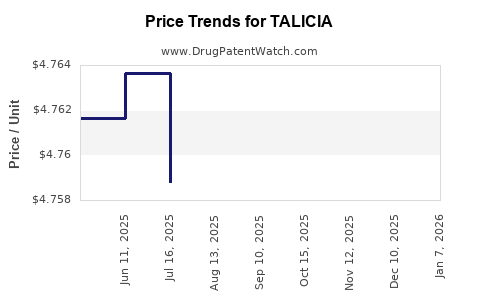
Drug Prices for TALICIA

See drug prices for TALICIA

DrugPatentWatch® Estimated Loss of Exclusivity (LOE) Date for TALICIA
Generic Entry Date for TALICIA*:
Constraining patent/regulatory exclusivity:
GENERATING ANTIBIOTIC INCENTIVES NOW
NDA:
Dosage:
CAPSULE, DELAYED RELEASE;ORAL

*The generic entry opportunity date is the latter of the last compound-claiming patent and the last regulatory exclusivity protection. Many factors can influence early or later generic entry. This date is provided as a rough estimate of generic entry potential and should not be used as an independent source.

US Patents and Regulatory Information for TALICIA

TALICIA is protected by seven US patents and two FDA Regulatory Exclusivities.

Based on analysis by DrugPatentWatch, the earliest date for a generic version of TALICIA is ⤷  Get Started Free.

This potential generic entry date is based on GENERATING ANTIBIOTIC INCENTIVES NOW.

Generics may enter earlier, or later, based on new patent filings, patent extensions, patent invalidation, early generic licensing, generic entry preferences, and other factors.

Applicant Tradename Generic Name Dosage NDA Approval Date TE Type RLD RS Patent No. Patent Expiration Product Substance Delist Req. Exclusivity Expiration
Redhill TALICIA amoxicillin; omeprazole magnesium; rifabutin CAPSULE, DELAYED RELEASE;ORAL 213004-001 Nov 1, 2019 RX Yes Yes 9,603,806 ⤷  Get Started Free Y ⤷  Get Started Free
Redhill TALICIA amoxicillin; omeprazole magnesium; rifabutin CAPSULE, DELAYED RELEASE;ORAL 213004-001 Nov 1, 2019 RX Yes Yes 10,238,606 ⤷  Get Started Free Y ⤷  Get Started Free
Redhill TALICIA amoxicillin; omeprazole magnesium; rifabutin CAPSULE, DELAYED RELEASE;ORAL 213004-001 Nov 1, 2019 RX Yes Yes 11,878,011 ⤷  Get Started Free ⤷  Get Started Free
Redhill TALICIA amoxicillin; omeprazole magnesium; rifabutin CAPSULE, DELAYED RELEASE;ORAL 213004-001 Nov 1, 2019 RX Yes Yes ⤷  Get Started Free ⤷  Get Started Free ⤷  Get Started Free
Redhill TALICIA amoxicillin; omeprazole magnesium; rifabutin CAPSULE, DELAYED RELEASE;ORAL 213004-001 Nov 1, 2019 RX Yes Yes 9,498,445 ⤷  Get Started Free Y ⤷  Get Started Free
Redhill TALICIA amoxicillin; omeprazole magnesium; rifabutin CAPSULE, DELAYED RELEASE;ORAL 213004-001 Nov 1, 2019 RX Yes Yes 9,050,263 ⤷  Get Started Free Y ⤷  Get Started Free
Redhill TALICIA amoxicillin; omeprazole magnesium; rifabutin CAPSULE, DELAYED RELEASE;ORAL 213004-001 Nov 1, 2019 RX Yes Yes 11,931,463 ⤷  Get Started Free Y ⤷  Get Started Free
>Applicant >Tradename >Generic Name >Dosage >NDA >Approval Date >TE >Type >RLD >RS >Patent No. >Patent Expiration >Product >Substance >Delist Req. >Exclusivity Expiration

International Patents for TALICIA

When does loss-of-exclusivity occur for TALICIA?

Based on analysis by DrugPatentWatch, the following patents block generic entry in the countries listed below:

Australia

Patent: 14216373
Patent: Pharmaceutical compositions for the treatment of Helicobacter pylori
Estimated Expiration: ⤷  Get Started Free

Brazil

Patent: 2015019264
Patent: composições farmacêuticas para o tratamento de helicobacter pylori
Estimated Expiration: ⤷  Get Started Free

Canada

Patent: 00763
Patent: COMPOSITIONS PHARMACEUTIQUES DESTINEES AU TRAITEMENT D'HELICOBACTER PYLORI (PHARMACEUTICAL COMPOSITIONS FOR THE TREATMENT OF HELICOBACTER PYLORI)
Estimated Expiration: ⤷  Get Started Free

Chile

Patent: 15002253
Patent: Composiciones farmacéuticas para el tratamiento de la helicobacter pylori.
Estimated Expiration: ⤷  Get Started Free

China

Patent: 5163743
Patent: Pharmaceutical compositions for the treatment of helicobacter pylori
Estimated Expiration: ⤷  Get Started Free

Patent: 9893516
Patent: 用于治疗幽门螺杆菌的药物组合物 (Pharmaceutical compositions for treatment of Helicobacter pylori)
Estimated Expiration: ⤷  Get Started Free

Croatia

Patent: 0191559
Estimated Expiration: ⤷  Get Started Free

Denmark

Patent: 56149
Estimated Expiration: ⤷  Get Started Free

European Patent Office

Patent: 56149
Patent: COMPOSITIONS PHARMACEUTIQUES DESTINÉES AU TRAITEMENT D'HELICOBACTER PYLORI (PHARMACEUTICAL COMPOSITIONS FOR THE TREATMENT OF HELICOBACTER PYLORI)
Estimated Expiration: ⤷  Get Started Free

Hong Kong

Patent: 17645
Patent: 用於治療幽門螺桿菌的藥物組合物 (PHARMACEUTICAL COMPOSITIONS FOR THE TREATMENT OF HELICOBACTER PYLORI)
Estimated Expiration: ⤷  Get Started Free

Hungary

Patent: 52411
Estimated Expiration: ⤷  Get Started Free

Israel

Patent: 0387
Patent: תכשירי רוקחות לטיפול בהליקובקטר פילורי (Pharmaceutical compositions for the treatment of helicobacter pylori)
Estimated Expiration: ⤷  Get Started Free

Japan

Patent: 94529
Estimated Expiration: ⤷  Get Started Free

Patent: 16508516
Patent: ピロリ菌治療用医薬組成物
Estimated Expiration: ⤷  Get Started Free

Mexico

Patent: 8536
Patent: COMPOSICION FARMACEUTICA PARA EL TRATAMIENTO DE HELICOBACTER PYLORI. (PHARMACEUTICAL COMPOSITIONS FOR THE TREATMENT OF HELICOBACTER PYLORI.)
Estimated Expiration: ⤷  Get Started Free

Patent: 15010490
Patent: COMPOSICION FARMACEUTICA PARA EL TRATAMIENTO DE HELICOBACTER PYLORI. (PHARMACEUTICAL COMPOSITIONS FOR THE TREATMENT OF HELICOBACTER PYLORI.)
Estimated Expiration: ⤷  Get Started Free

New Zealand

Patent: 1754
Patent: Pharmaceutical compositions for the treatment of helicobacter pylori
Estimated Expiration: ⤷  Get Started Free

Philippines

Patent: 015501783
Patent: PHARMACEUTICAL COMPOSITIONS FOR THE TREATMENT OF HELICOBACTER PYLORI
Estimated Expiration: ⤷  Get Started Free

Poland

Patent: 56149
Estimated Expiration: ⤷  Get Started Free

Portugal

Patent: 56149
Estimated Expiration: ⤷  Get Started Free

Russian Federation

Patent: 71400
Patent: ФАРМАЦЕВТИЧЕСКИЕ КОМПОЗИЦИИ ДЛЯ ЛЕЧЕНИЯ ОТ HELICOBACTER PYLORI (PHARMACEUTICAL COMPOSITIONS FOR TREATMENT OF HELICOBACTER PYLORI)
Estimated Expiration: ⤷  Get Started Free

Patent: 15138708
Patent: ФАРМАЦЕВТИЧЕСКИЕ КОМПОЗИЦИИ ДЛЯ ЛЕЧЕНИЯ ОТ HELICOBACTER PYLORI
Estimated Expiration: ⤷  Get Started Free

Singapore

Patent: 201506318Q
Patent: PHARMACEUTICAL COMPOSITIONS FOR THE TREATMENT OF HELICOBACTER PYLORI
Estimated Expiration: ⤷  Get Started Free

Slovenia

Patent: 56149
Estimated Expiration: ⤷  Get Started Free

South Korea

Patent: 2062357
Estimated Expiration: ⤷  Get Started Free

Patent: 150118176
Patent: 헬리코박터 파일로리 치료용 약제학적 조성물 (PHARMACEUTICAL COMPOSITIONS FOR THE TREATMENT OF HELICOBACTER PYLORI)
Estimated Expiration: ⤷  Get Started Free

Spain

Patent: 44406
Estimated Expiration: ⤷  Get Started Free

Ukraine

Patent: 0249
Patent: ФАРМАЦЕВТИЧНІ КОМПОЗИЦІЇ ДЛЯ ЛІКУВАННЯ ВІД HELICOBACTER PYLORI (PHARMACEUTICAL COMPOSITIONS FOR THE TREATMENT OF HELICOBACTER PYLORI)
Estimated Expiration: ⤷  Get Started Free

Generics may enter earlier, or later, based on new patent filings, patent extensions, patent invalidation, early generic licensing, generic entry preferences, and other factors.

See the table below for additional patents covering TALICIA around the world.

Country Patent Number Title Estimated Expiration
Israel 240387 תכשירי רוקחות לטיפול בהליקובקטר פילורי (Pharmaceutical compositions for the treatment of helicobacter pylori) ⤷  Get Started Free
Slovenia 2956149 ⤷  Get Started Free
Russian Federation 2015138708 ФАРМАЦЕВТИЧЕСКИЕ КОМПОЗИЦИИ ДЛЯ ЛЕЧЕНИЯ ОТ HELICOBACTER PYLORI ⤷  Get Started Free
Poland 2956149 ⤷  Get Started Free
Denmark 2956149 ⤷  Get Started Free
World Intellectual Property Organization (WIPO) 2014127025 ⤷  Get Started Free
Hong Kong 1217645 用於治療幽門螺桿菌的藥物組合物 (PHARMACEUTICAL COMPOSITIONS FOR THE TREATMENT OF HELICOBACTER PYLORI) ⤷  Get Started Free
>Country >Patent Number >Title >Estimated Expiration

Market Dynamics and Financial Trajectory for the Pharmaceutical Drug: TALICIA

Last updated: July 27, 2025


Introduction

TALICIA (generic name: alogliptin) is an oral antihyperglycemic agent developed by Novartis, primarily used for managing type 2 diabetes mellitus (T2DM). Since its market entry, TALICIA’s commercial and clinical trajectories have been influenced by an evolving landscape marked by competitive pressures, regulatory shifts, and emergent therapies. This article provides an in-depth analysis of the market dynamics shaping TALICIA’s positioning and forecasts its financial trajectory within the broader diabetes therapeutics sector.


Market Overview and Positioning of TALICIA

Therapeutic Landscape for Type 2 Diabetes

The global T2DM market is projected to reach USD 145.7 billion by 2030, with a compounded annual growth rate (CAGR) of 7.4% [1]. The core treatment modalities include metformin, sulfonylureas, SGLT2 inhibitors, GLP-1 receptor agonists, and DPP-4 inhibitors such as alogliptin. DPP-4 inhibitors comprise a significant share, valued at approximately USD 18.2 billion in 2022 [2].

TALICIA's Position in the DPP-4 Inhibitor Segment

TALICIA entered the market as a selective DPP-4 inhibitor, competing against established agents like Merck's Januvia (sitagliptin), Eli Lilly's Tradjenta (linagliptin), and other generic versions. Its differentiation rests on pharmacokinetic advantages, patent exclusivity, and combination potential. However, the intense competition has constrained its market share, especially with the advent of biosimilar and alternative oral agents.


Market Dynamics Influencing TALICIA

Competitive Pressure and Market Saturation

The DPP-4 inhibitor class faces saturation, with multiple agents established worldwide. Januvia holds approximately 58% of the DPP-4 market in the U.S., followed by Tradjenta and Onglyza (saxagliptin) [3]. TALICIA’s market penetration remains limited, largely confined to specific geographies, due to delayed launches and patent challenges.

Patent Terrain and Generic Competition

Patent expirations have begun influencing TALICIA’s trajectory. Novartis’s patents covering TALICIA have faced legal disputes, leading to generic versions entering several markets. The erosion of exclusivity directly impacts pricing power and revenue streams, emphasizing the importance of lifecycle management strategies.

Regulatory Landscape and Label Expansion

Regulatory approvals in Japan and some European countries have bolstered TALICIA’s sales potential. The drug’s label has expanded to include various line extensions, such as fixed-dose combinations with metformin, enhancing its clinical utility and adherence prospects.

Pricing and Reimbursement

Pricing strategies are pivotal. In key markets, TALICIA faces pricing pressures from payers seeking cost-effective alternatives. Reimbursement policies have favored newer agents with demonstrated superior efficacy or added benefits, marginalizing older DPP-4 inhibitors like TALICIA.


Emerging Market Trends Impacting TALICIA

Innovations in Glucose-Lowering Agents

The rising popularity of SGLT2 inhibitors (e.g., empagliflozin, canagliflozin) and GLP-1 receptor agonists (e.g., semaglutide) has shifted market dynamics, reducing reliance on DPP-4 inhibitors. These newer classes often offer additional benefits, such as cardiovascular and renal protection, outweighing the incremental glucose-lowering achieved by DPP-4 agents.

Personalized Medicine and Treatment Algorithms

Evolving guidelines emphasize individualized therapy, often favoring agents with proven cardiovascular benefits. DPP-4 inhibitors like TALICIA, with modest cardiovascular data compared to SGLT2 and GLP-1 agents, face limitations in market adoption.


Financial Trajectory Forecast

Revenue Projections

Based on current market trends, TALICIA’s annual revenue has plateaued, with estimates ranging between USD 250 million and USD 400 million globally as of 2022 [4]. The approaching patent cliffs could accelerate revenue decline, unless mitigated by strategic partnerships or pipeline expansion.

Impact of Patent Expiry

Patent expiry is forecasted to begin in North America and Europe between 2023 and 2025, with generic competition expected to exert downward pressure on prices by 35-50%. Consequently, Novartis’s revenue from TALICIA may decline by approximately 20-40% over the subsequent five years absent new indications or formulations.

Strategic Diversification and Pipeline Outlook

Novartis has explored combination therapies and novel formulations to sustain TALICIA's relevance. While these innovations could provide modest revenue boosts, market acceptance hinges on clinical benefits and cost-competitiveness. Pipeline agents in the DPP-4 class or combination formulations may serve as future revenue streams.

Long-term Projections

Over the next decade, TALICIA’s revenues are projected to shrink unless new indications or delivery methods emerge. A conservative growth scenario suggests a CAGR of -5% post-2025, driven by generic entry and market saturation. Conversely, a best-case scenario with successful repositioning or combination launch could stabilize revenues marginally.


Market Challenges and Opportunities

Challenges:

  • Intense Competition: Established agents and generics limit market share growth.
  • Regulatory and Patent Risks: Patent expirations and legal disputes threaten exclusivity.
  • Evolving Treatment Guidelines: Shift favoring agents with cardio-renal benefits.

Opportunities:

  • Fixed-Dose Combinations: Co-formulations with metformin or SGLT2 inhibitors may rekindle interest.
  • Emerging Markets: Growing diabetes prevalence in Asia and Africa offers expansion prospects.
  • Biomarker-Driven Indications: Personalized approaches could expand TALICIA’s label for specific patient groups.

Conclusion

TALICIA’s market dynamics reflect broader challenges faced by old-generation oral antidiabetics amid rapid innovation and intensified competition. While current revenue streams remain stable, the looming patent cliff and competitive landscape forecast a decline absent strategic repositioning. Investments in combination therapies, biosimilar rate management, and expansion into emerging markets are crucial for maintaining financial viability. Strategic agility and pipeline development, aligned with evolving clinical standards, will determine TALICIA’s future trajectory.


Key Takeaways

  • TALICIA faces significant market pressures from competition, patent expiries, and emerging therapies.
  • Patent expirations starting 2023 will accelerate revenue erosion, with potential declines of up to 40% within five years.
  • Diversification through fixed-dose combinations and expansion into emerging markets represent key growth avenues.
  • The shifting treatment paradigm toward SGLT2 inhibitors and GLP-1 receptor agonists limits future demand.
  • Strategic patent management and pipeline innovation remain critical to extending TALICIA’s financial trajectory.

FAQs

1. How does TALICIA compare to other DPP-4 inhibitors in terms of efficacy?
TALICIA demonstrates comparable glycemic efficacy to other DPP-4 inhibitors like sitagliptin and linagliptin. However, clinical evidence shows limited superiority, which affects its competitive positioning.

2. What factors could extend TALICIA’s market lifespan?
Developing new fixed-dose combinations, obtaining regulatory approvals for additional indications, and expanding into emerging markets could help prolong its relevance.

3. How significant is the impact of patent expiry on TALICIA’s revenues?
Patent expiry typically results in substantial revenue decline—potentially over 30%—due to generic competition, unless offset by new formulations or indications.

4. What strategies has Novartis employed to mitigate revenue decline?
Novartis has focused on expanding its combination portfolio, improving patent enforcement, and targeting emerging markets to buffer against generic erosion.

5. What is the outlook for TALICIA’s pipeline?
Current pipeline efforts concentrate on combination therapies and potential new formulations; however, no major novel monotherapies are anticipated soon, highlighting reliance on lifecycle management strategies.


References

  1. Grand View Research. "Diabetes Drugs Market Size, Share & Trends Analysis Report." 2022.
  2. Research and Markets. "Global DPP-4 Inhibitors Market Analysis." 2022.
  3. IQVIA. "Pharmaceutical Market Analysis Reports." 2022.
  4. Novartis Annual Report 2022.

More… ↓

⤷  Get Started Free

Make Better Decisions: Try a trial or see plans & pricing

Drugs may be covered by multiple patents or regulatory protections. All trademarks and applicant names are the property of their respective owners or licensors. Although great care is taken in the proper and correct provision of this service, thinkBiotech LLC does not accept any responsibility for possible consequences of errors or omissions in the provided data. The data presented herein is for information purposes only. There is no warranty that the data contained herein is error free. We do not provide individual investment advice. This service is not registered with any financial regulatory agency. The information we publish is educational only and based on our opinions plus our models. By using DrugPatentWatch you acknowledge that we do not provide personalized recommendations or advice. thinkBiotech performs no independent verification of facts as provided by public sources nor are attempts made to provide legal or investing advice. Any reliance on data provided herein is done solely at the discretion of the user. Users of this service are advised to seek professional advice and independent confirmation before considering acting on any of the provided information. thinkBiotech LLC reserves the right to amend, extend or withdraw any part or all of the offered service without notice.