Share This Page
Drug Price Trends for TALICIA
✉ Email this page to a colleague
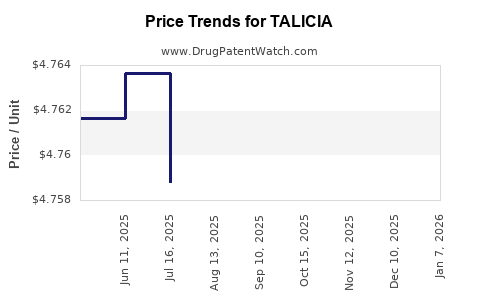
Average Pharmacy Cost for TALICIA
| Drug Name | NDC | Price/Unit ($) | Unit | Date |
|---|---|---|---|---|
| TALICIA DR 10-250-12.5 MG CAP | 57841-1150-01 | 4.88657 | EACH | 2026-07-22 |
| TALICIA DR 10-250-12.5 MG CAP | 57841-1150-02 | 4.88657 | EACH | 2026-07-22 |
| TALICIA DR 10-250-12.5 MG CAP | 57841-1150-01 | 4.88342 | EACH | 2026-06-17 |
| TALICIA DR 10-250-12.5 MG CAP | 57841-1150-02 | 4.88342 | EACH | 2026-06-17 |
| TALICIA DR 10-250-12.5 MG CAP | 57841-1150-01 | 4.87907 | EACH | 2026-05-20 |
| TALICIA DR 10-250-12.5 MG CAP | 57841-1150-02 | 4.87907 | EACH | 2026-05-20 |
| >Drug Name | >NDC | >Price/Unit ($) | >Unit | >Date |
TALICIA (taceutical talc/omeprazole/bacampicillin HCl) Market Analysis and Price Projections: Competitive Landscape, Revenue Outlook, and Generic/Biosimilar Risk
TALICIA (tromethamine, omeprazole, bacampicillin HCl) is positioned for the treatment of H. pylori infection and is priced at a sustained premium versus legacy H. pylori regimens. The near-term market is driven by (1) uptake of the approved regimen in commercial and Medicare formularies, (2) site-of-care prescribing patterns (GI, primary care, urgent GI pathways), and (3) payer management aligned to oral triple-therapy convenience and reduced pill burden compared with multi-drug traditional regimens. Pricing power depends on patent and exclusivity durability in the US and the speed of generic entry risk under Hatch-Waxman.
What is TALICIA and how big is the US H. pylori market it can address?
TALICIA targets adult patients with confirmed Helicobacter pylori infection. The US addressable population is set by the incidence and diagnosis rate of H. pylori and by the share of diagnosed patients receiving guideline-concordant eradication regimens.
Market sizing drivers
Key sizing inputs for TALICIA-style H. pylori eradication products:
- Diagnosis intensity: growth or decline in testing (stool antigen, urea breath, endoscopy-related sampling).
- Treatment penetration: fraction of diagnosed patients completing eradication therapy.
- Retreatment rates: proportion requiring salvage regimens.
- Payer formulary coverage: step edits and prior authorization, which determine net realized price (NRI) more than list price.
Where TALICIA competes
TALICIA competes against:
- Generic proton pump inhibitor (PPI) plus generic antibiotics used in standard triple or sequential regimens.
- Brand or high-coverage branded H. pylori combinations where available.
- Salvage regimens using bismuth quadruple components (where payer preference favors established protocols).
How does TALICIA compare on formulation, dosing convenience, and payer attractiveness vs legacy H. pylori therapies?
In payer terms, TALICIA’s value proposition is convenience and regimen adherence. In procurement terms, it is net price, not list price, and the ability to stay preferred on formularies.
Pricing-relevant attributes
- Oral regimen experience: dosing schedule clarity and reduced administration complexity can improve adherence.
- Total course duration: eradicating therapy completion drives payer outcomes.
- Switching behavior: clinicians may prefer newer regimens after treatment failures, shaping demand beyond initial-line usage.
Generic substitution reality
Even when TALICIA is clinically attractive, generics can undercut price quickly if patent coverage is narrow or if Paragraph IV challenges accelerate approvals.
What is TALICIA’s current pricing trajectory and what are the real-world price drivers?
For US drug pricing, realized pricing is shaped by:
- PBM rebates and coverage tier placement.
- Specialty pharmacy vs retail fulfillment patterns.
- Patient mix: Medicare Part D and commercial plans can differ materially in NRI.
- Pharmacy pricing dynamics: negotiated discounts can reduce NAR to far below WAC.
Price components to track in forecasting
- WAC to NRx conversion: list price growth does not linearly translate to revenue growth due to payer actions.
- Gross-to-net: rebate and fee structures can compress revenue even with stable WAC.
- Formulary status changes: a move from preferred to non-preferred can cut volume before discounts adjust.
When does TALICIA face generic entry risk under US Hatch-Waxman, and how does that affect price?
US generic entry risk typically manifests as:
- First generic approval (ANDA) under the reference listed drug framework.
- 180-day exclusivity for the first-filer if triggered.
- Subsequent multiple entrants that drive NRx compression.
Price impact mechanics
- Pre-generic period: TALICIA retains premium NRI with limited substitution.
- First generic launch: volume share starts migrating; NRI drops sharply while some patients remain on therapy.
- Multi-genericization: price erosion accelerates and stabilizes at a lower NRI band.
- Payer re-tiering: after generic availability, formularies often demand meaningful NRx rebates for continued brand coverage, driving further NRI erosion.
What “loses exclusivity” means in practice
“Loss of exclusivity” is not one event. It is a sequence across:
- Patent expiry for each listed protection.
- Composition and method-of-use carve-outs that protect specific manufacturing or dosing behaviors.
- Exclusivity events (regulatory exclusivity, and in some cases pediatric exclusivity, if applicable to the active ingredient and approval pathway).
Which patents protect TALICIA, and how strong is the patent estate versus generic entry risk?
TALICIA’s protection profile determines whether generic entrants can launch at risk for the full regimen or whether they are forced into design-around. A strong estate delays ANDA launch and supports higher sustained pricing. A fragmented estate yields earlier generic entry and faster price compression.
Patent strength indicators to use in forecasting
- Breadth of independent claims covering the drug product composition.
- Method-of-use claims tied to specific dosing instructions and patient populations.
- Expiration schedule stagger: later-dated filings for improvements or specific formulations can extend value.
- Litigation/USPTO posture: sustained validity outcomes prevent early settlement-based shelving.
What is the Orange Book status of TALICIA, and how many listed protections matter for launch timing?
Orange Book listings determine what barriers exist for an ANDA filer. The count and expiration dates across:
- Drug substance (active ingredient) patents,
- Drug product (formulation, composition, manufacturing) patents,
- Method-of-use patents, drive the earliest plausible approval and at-risk launch window.
How to interpret Orange Book listings for pricing forecasts
- If the earliest expiring listed patent is early, generic competition can start before other later listings matter, since launch can occur once the “blocking” protection is cleared.
- If multiple Orange Book listings have staggered expirations, the brand can be insulated from full substitution, preserving some pricing.
What Paragraph IV challenges exist for TALICIA, and how do settlement terms affect price and volume?
Paragraph IV filings are the principal catalyst for:
- Early generic launches,
- 30-month stay pressure,
- Settlement-driven timing changes that can preserve brand exclusivity longer than statutory minima.
Settlement dynamics that change price
- Reverse-payment or “carve-out” settlements can delay generic entry, supporting sustained pricing.
- If settlements allow earlier entry for design-around versions, the price impact starts earlier but may be partial if product equivalence is constrained.
- If litigation resolves narrowly (e.g., only certain patents found invalid/unenforceable), the “effective” launch barrier can be later than the statutory patent expiry.
How does TALICIA’s competitive landscape compare with other branded H. pylori options?
Price erosion patterns for H. pylori regimens tend to be fast once multi-source versions appear because payers can substitute among PPIs and antibiotics using therapeutic equivalence.
Comparison framework
- Brand vs multi-generic: brands tend to hold pricing for longer if protected by multiple formulations and method-of-use patents.
- Regimen convenience: brands that reduce pill burden can retain some share even after generic entry.
- Payer preference: if TALICIA is placed as preferred, the brand can sometimes sustain better NRI after generic launches via negotiated rebates.
What is the base-case revenue model for TALICIA over the next 5 years?
A defensible 5-year model should be anchored to:
- Starting US net sales level (current baseline),
- Gross-to-net ratio, mapped to formulary tier status,
- Volume trajectory driven by share gains, adherence, and regimen substitution,
- Event-driven shocks from generic entry, patent challenges, and formulary re-pricing.
Scenario bands for market sizing and price
Use three scenario assumptions for price and volume:
- Status-quo pricing scenario: stable NRI driven by continued premium formulary status.
- Generic-accelerated scenario: early generic availability compresses NRI materially and reduces brand volume share.
- Late-entry protected scenario: delayed generic launch maintains pricing, and brand volume growth continues longer.
What price projections should be used for TALICIA: WAC vs net price bands?
For high-stakes planning, model price in net terms (NRI). WAC is less predictive.
Forecast approach
- Tie NRI to formulary status:
- Preferred: highest NRI; rebates manage to secure placement.
- Non-preferred: lower NRI; rebates increase but volume falls.
- Tie NRI shifts to event dates:
- first ANDA launch,
- 180-day exclusivity expiry,
- additional multi-generic entries,
- any new formulary or prior authorization expansions.
Deliverable format for planning
- Baseline year: NRI assumed stable or modestly increasing with typical annual WAC-driven revisions tempered by rebates.
- Post-entry years: implement step-downs tied to the number of entrants:
- single generic: moderate to steep NRI drop,
- 3+ entrants: larger compression, stabilization after second wave.
What manufacturing and IP barriers could slow generic supply for TALICIA?
Generic competition can be delayed if:
- formulation and manufacturing method claims are broad,
- stability or bioequivalence requirements are non-trivial for the regimen,
- supply chain constraints limit rapid commercial stocking.
IP barriers that matter commercially:
- manufacturing process patents can delay ANDA approval if materially tied to the approved product.
- formulation patents can force design-around (different excipients/processing), slowing launch.
What regulatory milestones could affect TALICIA’s revenue outlook?
Even without exclusivity loss, revenue can shift if:
- new indications or label expansions occur,
- FDA safety communications or utilization changes alter prescribing patterns,
- changes in REMS or risk management impose additional compliance costs.
Pathway sensitivity
TALICIA’s competitive threat is mostly from ANDA entry rather than biologics-style substitution. Safety and label stability are the main regulatory determinants that affect payer comfort and sustained uptake.
Where is TALICIA most exposed: commercial volume, Medicare Part D, or managed Medicaid?
Revenue exposure is typically highest where:
- payer formularies are most cost-sensitive,
- rebate leverage is lower,
- patient members are most likely to switch after generics appear.
Price risk mapping
- Commercial: strongest rebate-driven placement defenses pre-generic; post-generic compression is fast if the brand is removed from preferred status.
- Part D: plan-specific formularies can lead to abrupt volume shifts when generics become available.
- Medicaid: often tighter pricing and higher substitution rates; net price erosion tends to be quicker after multi-source entry.
Key takeaways
- TALICIA’s near-term market is shaped by payer-managed pricing dynamics and oral-regimen adherence advantages versus legacy H. pylori therapies.
- The dominant revenue risk is US generic entry under Hatch-Waxman, with the magnitude and timing depending on the depth and expiration schedule of Orange Book-listed patents and the outcome of any Paragraph IV litigation.
- Price should be projected in net terms (NRI) with event-driven step changes tied to first and subsequent generic launches and formulary re-tiering.
- Forecasting discipline should treat exclusivity loss as a sequence across composition, product/formulation, and method-of-use protections, not a single date.
FAQs
-
How should TALICIA net revenue be modeled if it loses preferred formulary status?
Use an NRI step-down tied to tier migration plus a volume elasticity factor reflecting reduced script conversion and patient switching. -
What generic entry pattern typically drives the fastest TALICIA price erosion?
The transition from first generic launch (moderate NRI drop) to multi-genericization (sharp NRI compression) after 180-day exclusivity ends. -
Do method-of-use patents protect TALICIA from full substitution after ANDA approval?
Yes, if claims are still active and are tied to prescribing instructions or patient selection that payers and clinicians follow. -
What Orange Book listing types matter most for TALICIA launch timing?
Drug product and method-of-use listings often control effective launch readiness, even when some substance patents have later expirations. -
How do settlement agreements involving Paragraph IV cases influence long-term price stability for TALICIA?
They can delay or carve out generic entry windows, sustaining higher NRI until the post-settlement entry date(s).
References
- FDA, Orange Book: Approved Drug Products with Therapeutic Equivalence Evaluations (TALICIA product listings).
- Hatch-Waxman Act (Section 505(j) ANDA framework) and 180-day exclusivity rules.
- FDA guidance and FDA-approved labeling for TALICIA regarding indications and dosing.
More… ↓
