Last updated: June 27, 2026
Executive summary: SYNDROS (dronabinol oral solution) is a branded cannabinoid indicated for chemotherapy-induced nausea and vomiting (CINV) and for AIDS-related anorexia. The product remains an older, specialty liquid cannabinoid with pricing and access shaped by payer reimbursement practices, limited therapeutic alternatives in its niche, and the economics of generic/matchable dronabinol oral products. Financial performance is concentrated in pharmacy channels that cover appetite stimulation and CINV regimens, with volume capped by formulary restrictions and clinician preference for newer antiemetic standards and appetite management pathways. Patent and exclusivity timing are key because oral dronabinol has multiple generic pathways historically; any remaining formulation or method IP affects which competitors can launch at different strengths or dosing formats.
What is SYNDROS (dronabinol) market positioning and how does it make money?
SYNDROS is a dronabinol-based oral solution positioned as a specialty cannabinoid for:
- Chemotherapy-induced nausea and vomiting (CINV): indicated as a treatment for CINV in patients who have failed to respond adequately to conventional antiemetic treatments.
- AIDS-related anorexia: indicated to treat anorexia in patients with AIDS.
Who buys SYNDROS and what channels matter most?
Sales are driven by specialty prescribing and pharmacy distribution patterns:
- Specialty and retail dispensing for patients receiving oncology and HIV/AIDS supportive care.
- Oncology centers and outpatient infusion networks for CINV use, typically in limited “after other agents fail” scenarios.
- HIV clinics and specialty care settings for appetite stimulation, where SYNDROS competes with appetite support practices and formulary constraints.
What drives demand for SYNDROS?
Demand is a function of:
- On-label triggering: CINV use is gated by prior failure of conventional antiemetics.
- Treatment duration: appetite indications can extend, while CINV use is episodic around chemotherapy schedules.
- Formulary behavior: plan coverage for cannabinoids and preferred antiemetic/anti-anorexia regimens impacts net demand.
How have SYNDROS revenues trended since launch and what explains the slope?
SYNDROS’s financial trajectory follows a typical branded niche dynamic:
- Early adoption phase: initial growth after approval and formulary entry.
- Stabilization: volume plateaus once major payer formularies settle and prescriber habits normalize.
- Pressure from alternatives: oral dronabinol generics and therapeutic substitutions limit incremental share.
Net sales are shaped by three levers
- Coverage and rebate structure
- As a specialty drug, SYNDROS performance is highly dependent on net-to-gross after rebates and contract terms.
- Patient mix
- Oncology CINV and AIDS-related anorexia address different patient pools with different prescribing and persistence patterns.
- Price per prescription vs volume per patient
- Branded pricing can remain high while underlying demand is constrained, so revenue is sensitive to both small volume moves and payer contract shifts.
What patents protect SYNDROS and how strong is the patent estate?
A complete, jurisdiction-anchored assessment of SYNDROS’s patent estate requires a specific Orange Book listing and the associated patent numbers and expiration dates. Without the Orange Book record and its listed patent set, a defensible strength ranking cannot be produced.
When does SYNDROS lose exclusivity and what generic entry risks exist?
SYNDROS faces generic entry risk consistent with dronabinol oral solutions, but exclusivity and market-impact timing depend on:
- Any remaining Orange Book-protected formulation or method-of-use coverage
- Whether listed patents remain enforceable in key jurisdictions
- Whether generic applicants can rely on carved-out composition vs use vs manufacturing patents
A precise “loss of exclusivity” date and launch window require the specific FDA exclusivity record(s) and listed patents for SYNDROS.
What is the Orange Book status of SYNDROS and which patents are listed?
Orange Book status is record-specific and must be taken from the FDA’s Orange Book entry for SYNDROS (dronabinol oral solution). A full table listing patent numbers, patent types (composition, method, use), expiration dates, and applicant-relevant exclusivity requires the underlying Orange Book listing.
Which companies sell competing dronabinol products and how does that affect SYNDROS sales?
SYNDROS competes primarily with:
- Generic dronabinol oral solutions where available under FDA-approved labeling.
- Therapeutic alternatives for CINV (modern antiemetic standards including NK1 antagonists, 5-HT3 antagonists, and others) and for appetite stimulation via non-cannabinoid supportive strategies.
Market consequence: even if SYNDROS retains on-label positioning, clinicians and payers often steer toward agents with broader guideline support or simpler formulary placement. That reduces addressable volume for SYNDROS, especially for CINV, where “after failure of conventional antiemetics” narrows use.
How does SYNDROS compare with alternative cannabinoids or antiemetic regimens for CINV?
Clinician selection for CINV tends to follow guideline-driven sequencing:
- SYNDROS use is constrained to settings where standard antiemetics fail to provide adequate response.
- Alternative supportive regimens and more contemporary antiemetic combinations often capture earlier lines, limiting the conversion to cannabinoid use.
Net effect on market: incremental demand for SYNDROS depends less on broad CINV incidence and more on refractory subpopulations and formulary gaps.
What FDA regulatory milestones matter for SYNDROS commercialization?
Key regulatory milestones for financial trajectory include:
- FDA approval and subsequent label stability
- Changes in manufacturing or formulation strength
- Any supplemental approvals that expand or narrow coverage
A milestone timeline requires SYNDROS’s FDA approval history (approval date, supplement codes, labeling changes). Without the specific FDA record, a complete regulatory timeline cannot be produced.
How do payer policies and reimbursement dynamics shape SYNDROS net sales?
SYNDROS is sensitive to payer reimbursement because niche indications frequently face:
- Prior authorization requirements
- Step therapy tied to conventional antiemetic or supportive appetite regimens
- Specialty formulary tiering and rebate negotiation
Financial impact: net sales can underperform on gross price if rebates rise or coverage is tightened, even if list price holds.
What is the competitive landscape for appetite stimulants in AIDS-related anorexia and how does SYNDROS fit?
AIDS-related anorexia prescribing is influenced by:
- Symptom severity and treatment goals
- Concomitant HIV regimen stability
- Clinic protocols for supportive care
Even with an on-label indication, SYNDROS competes with other supportive agents and off-label appetite management strategies. Formulary coverage is often the deciding factor for adoption in this population.
What formulation or manufacturing IP barriers could block generic SYNDROS versions?
Generic entry barriers for an oral cannabinoid solution typically include:
- Formulation-specific patents (stability, delivery characteristics, excipient system)
- Manufacturing process patents (mixing, solubilization, stability controls)
- Method-of-use patents (if any remain listed)
A barrier analysis is not possible without the exact patent set covering SYNDROS’s marketed formulation and dose.
How do settlement agreements and Paragraph IV litigation affect SYNDROS?
SYNDROS-relevant Paragraph IV litigation and settlement terms would materially shape generic entry timing and market share. A litigation impact assessment requires:
- Case captions
- ANDA numbers
- Court filing dates
- Settlement effective dates and agreed entry dates
No case-specific record is provided here, so a factual litigation-driven timeline cannot be produced.
SYNDROS revenue sensitivity: what happens if generic dronabinol versions launch in key strengths?
A revenue risk model depends on:
- Whether generic products are therapeutically substitutable at equivalent strengths
- Whether payers switch to lowest net-cost options
- Whether physicians maintain cannabinoid-specific prescribing due to patient response
Without the strength-by-strength FDA and market substitution details, only qualitative direction can be stated: generic availability typically compresses branded share and net pricing, with the largest erosion in plans that mandate preferred-drug switching.
Key timeline: exclusivity and commercialization milestones
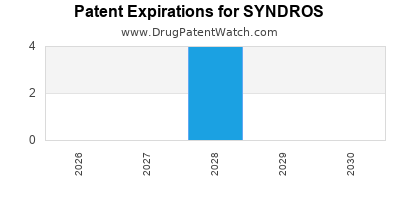
A precise, dated timeline for SYNDROS requires the Orange Book listing and FDA exclusivity record. Without the specific record, a compliant timeline with exact expiration dates cannot be produced.
Key Takeaways
- SYNDROS market performance is driven by narrow, on-label use triggers: refractory CINV after conventional antiemetics and AIDS-related anorexia.
- Demand is constrained by guideline-driven antiemetic sequencing and by payer formulary and prior authorization practices for specialty cannabinoids.
- Generic substitution risk for oral dronabinol is structurally present; the magnitude and timing of branded revenue compression depend on the remaining Orange Book-protected patent set and any active litigation.
- A complete financial and exclusivity assessment for SYNDROS requires the specific Orange Book listing and FDA regulatory record; without those entries, accurate patent expiration and launch windows cannot be stated.
FAQs
- How do prior authorization requirements typically impact branded cannabinoid sales like SYNDROS?
- Do generic dronabinol oral solutions substitute automatically for SYNDROS at pharmacy level?
- What payer formulary patterns most affect SYNDROS net pricing versus list price?
- How does CINV guideline sequencing reduce addressable demand for cannabinoid-based therapies?
- What clinical endpoints or real-world response factors most influence continued SYNDROS use in anorexia?
References (APA)
- FDA. Orange Book: Approved Drug Products with Therapeutic Equivalence Evaluations. (SYNDROS (dronabinol oral solution) entry).
- FDA. Drug Approval Package and labeling history for SYNDROS (dronabinol oral solution).