Share This Page
STROMECTOL Drug Patent Profile
✉ Email this page to a colleague
When do Stromectol patents expire, and what generic alternatives are available?
Stromectol is a drug marketed by Merck Sharp Dohme and is included in one NDA.
The generic ingredient in STROMECTOL is ivermectin. There is one drug master file entry for this compound. Twenty-seven suppliers are listed for this compound. Additional details are available on the ivermectin profile page.
DrugPatentWatch® Litigation and Generic Entry Outlook for Stromectol
A generic version of STROMECTOL was approved as ivermectin by EDENBRIDGE PHARMS on October 24th, 2014.
AI Deep Research
Questions you can ask:
- What is the 5 year forecast for STROMECTOL?
- What are the global sales for STROMECTOL?
- What is Average Wholesale Price for STROMECTOL?
Summary for STROMECTOL
| US Patents: | 0 |
| Applicants: | 1 |
| NDAs: | 1 |
| Finished Product Suppliers / Packagers: | 1 |
| Raw Ingredient (Bulk) Api Vendors: | 65 |
| Clinical Trials: | 23 |
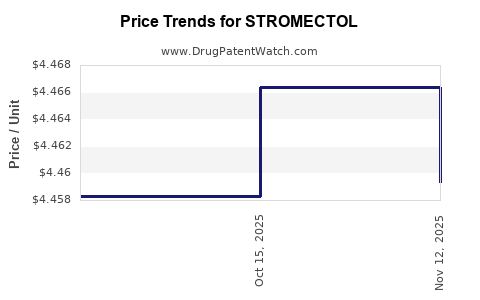
| Drug Prices: | Drug price information for STROMECTOL |
| What excipients (inactive ingredients) are in STROMECTOL? | STROMECTOL excipients list |
| DailyMed Link: | STROMECTOL at DailyMed |
Recent Clinical Trials for STROMECTOL
Identify potential brand extensions & 505(b)(2) entrants
| Sponsor | Phase |
|---|---|
| Jennifer Keiser | Phase 2 |
| Public Health Laboratory Ivo de Carneri | Phase 2 |
| Galvita AG, Switzerland | Early Phase 1 |
Pharmacology for STROMECTOL
| Drug Class | Antiparasitic Pediculicide |
US Patents and Regulatory Information for STROMECTOL
| Applicant | Tradename | Generic Name | Dosage | NDA | Approval Date | TE | Type | RLD | RS | Patent No. | Patent Expiration | Product | Substance | Delist Req. | Exclusivity Expiration |
|---|---|---|---|---|---|---|---|---|---|---|---|---|---|---|---|
| Merck Sharp Dohme | STROMECTOL | ivermectin | TABLET;ORAL | 050742-002 | Oct 8, 1998 | AB | RX | Yes | Yes | ⤷ Start Trial | ⤷ Start Trial | ⤷ Start Trial | |||
| Merck Sharp Dohme | STROMECTOL | ivermectin | TABLET;ORAL | 050742-001 | Nov 22, 1996 | DISCN | Yes | No | ⤷ Start Trial | ⤷ Start Trial | ⤷ Start Trial | ||||
| >Applicant | >Tradename | >Generic Name | >Dosage | >NDA | >Approval Date | >TE | >Type | >RLD | >RS | >Patent No. | >Patent Expiration | >Product | >Substance | >Delist Req. | >Exclusivity Expiration |
Stromectol Market Dynamics and Financial Trajectory
Stromectol is Merck’s branded oral ivermectin product. Its commercial value is limited by long-standing generic competition, expired core patent protection, and narrow approved indications. Merck does not report Stromectol revenue as a separate line item, so the product’s financial trajectory cannot be quantified from public company filings. The most material commercial event was the 2020-2022 surge in ivermectin demand linked to COVID-19, followed by normalization after regulators rejected ivermectin as an authorized COVID-19 treatment.
What is Stromectol and how is it used?
Stromectol contains ivermectin, an antiparasitic agent derived from the avermectin class. The FDA approved Stromectol tablets in 1996 for oral treatment of strongyloidiasis caused by Strongyloides stercoralis and onchocerciasis caused by Onchocerca volvulus.[1]
The product is supplied as 3 mg tablets. Dosing depends on body weight and indication. For onchocerciasis, treatment is generally administered as a single weight-based dose, with repeat treatment determined by clinical response and medical judgment. Strongyloidiasis also uses weight-based dosing.[1]
Stromectol is distinct from other ivermectin products:
| Product or category | Active ingredient | Route | Primary commercial position |
|---|---|---|---|
| Stromectol | Ivermectin | Oral tablet | Human antiparasitic treatment |
| Generic ivermectin tablets | Ivermectin | Oral tablet | Lower-cost substitutes for Stromectol |
| Sklice | Ivermectin | Topical lotion | Head-lice treatment |
| Veterinary ivermectin | Ivermectin | Injectable, oral, topical and other forms | Animal health; not interchangeable with human products |
| Mectizan donation program | Ivermectin | Oral treatment | Public-health distribution for neglected tropical diseases |
The FDA has not approved Stromectol or ivermectin to prevent or treat COVID-19. The agency has warned against using veterinary formulations in humans and against unapproved dosing or self-medication.[2]
When does Stromectol lose exclusivity?
Stromectol’s core small-molecule exclusivity expired many years ago. The product is now exposed to generic substitution and does not have the market protection associated with a newly approved branded medicine.
The commercial exclusivity timeline is broadly as follows:
| Milestone | Date | Commercial significance |
|---|---|---|
| FDA approval of Stromectol tablets | 1996 | Established the human oral ivermectin brand |
| Core ivermectin composition and early formulation patents | 1980s-1990s | Supported initial product development |
| Core patent protection | Expired before the current market period | Removed the principal barrier to generic entry |
| Generic ivermectin competition | Established before 2020 | Reduced branded pricing power |
| COVID-19 demand surge | 2020-2022 | Created temporary demand and supply disruption |
| Post-COVID normalization | 2022 onward | Returned the product to a mature antiparasitic market |
Public FDA materials identify Stromectol as an approved product, but the commercially relevant patent estate is no longer a meaningful barrier to generic entry. Any remaining patents associated with later formulations, packaging, manufacturing processes or unrelated topical ivermectin products would not restore exclusivity for the original oral Stromectol tablet.
What patents protect Stromectol?
The original ivermectin patent portfolio is expired and does not provide current market exclusivity for Stromectol tablets. Because ivermectin was developed decades ago, the relevant composition-of-matter and early product patents reached the end of their statutory terms long before the current market period.
The remaining intellectual-property position is better analyzed by product category:
Original oral Stromectol tablets
The original oral tablet is exposed to generic competition. No current patent barrier is generally understood to prevent approved generic ivermectin tablets from competing with Stromectol.
Formulation patents
Later formulation patents may cover specific excipients, delivery systems, particle sizes or dosage forms. Those patents do not automatically cover the conventional 3 mg oral tablets approved under Stromectol’s original product profile.
Method-of-use patents
Ivermectin has been studied for multiple conditions beyond the approved Stromectol indications. Patent claims directed to a specific method of use would need to satisfy patentability and infringement requirements and would not create broad exclusivity for ivermectin itself.
COVID-19-related use claims did not create FDA-recognized commercial protection for Stromectol. The FDA stated that available clinical evidence did not establish ivermectin as an effective treatment for COVID-19 and that the drug was not authorized for that use.[2]
Manufacturing and process patents
Manufacturing know-how can affect cost, quality and supply reliability. It is not equivalent to product exclusivity. Generic manufacturers can compete where they use independently developed or non-infringing processes and meet FDA quality requirements.
What is the Orange Book status of Stromectol?
Stromectol is an FDA-approved prescription product listed under Merck’s ivermectin tablet product. Its practical Orange Book position is that of an established, off-patent drug with generic alternatives.
For an authorized generic or ANDA applicant, the main legal route is an abbreviated new drug application demonstrating pharmaceutical equivalence and bioequivalence. The applicant may certify against listed patents or state that no relevant patent remains in force. The high commercial risk for a generic entrant is therefore price competition, not a durable Stromectol patent blockade.
The Orange Book does not confer exclusivity merely because a brand remains marketed. A branded product can retain an FDA listing while losing most of its market share to generic equivalents.
Have companies challenged Stromectol through Paragraph IV filings?
Paragraph IV litigation is not a major current driver of Stromectol’s market. The core commercial challenge occurred through the normal generic-entry process after patent expiry rather than through a presently active, high-value patent dispute.
A Paragraph IV certification alleges that a listed patent is invalid, unenforceable or not infringed. For Stromectol, the aged patent position limits the ability of a new Paragraph IV filer to obtain a commercially valuable first-launch advantage. Generic manufacturers can instead enter a mature market under ordinary ANDA pathways when no enforceable blocking patent remains.
Publicly visible Stromectol economics therefore differ from newer branded drugs, where a single Paragraph IV case can determine billions of dollars in launch timing. For Stromectol, the main issues are supplier access, regulatory compliance, purchasing contracts and retail reimbursement.
How strong is the Stromectol patent estate?
The current patent estate is weak as a source of exclusivity but relevant as a historical record of product development.
| Patent-estate factor | Current assessment |
|---|---|
| Composition-of-matter protection | Expired |
| Core oral-tablet protection | Expired or commercially exhausted |
| Generic substitution risk | High |
| Formulation protection | Limited to specific later formulations, if applicable |
| Method-of-use protection | Narrow and indication-specific |
| Manufacturing barriers | Operational rather than exclusivity-based |
| Biosimilar exposure | Not applicable |
| Litigation leverage | Low for the original oral product |
The product’s remaining competitive advantages are brand recognition, physician familiarity, supply-chain relationships and Merck’s historical credibility. None substitutes for enforceable exclusivity.
What caused the 2020-2022 ivermectin market surge?
Demand expanded sharply during the COVID-19 pandemic after ivermectin was promoted by some physicians, advocacy groups and online communities despite the absence of FDA authorization for COVID-19.
The market impact had several components:
- Prescribing and dispensing increased in certain regions.
- Pharmacies reported shortages and supply constraints.
- Veterinary ivermectin products were purchased or used inappropriately.
- Regulators issued public warnings concerning toxicity, misuse and unapproved COVID-19 treatment.
- Subsequent randomized clinical evidence failed to establish meaningful benefit for COVID-19 treatment.
The COVID-related spike did not produce durable branded exclusivity. It also did not convert Stromectol into a conventional specialty-care growth product. Demand was driven by an unapproved use and therefore was vulnerable to regulatory communications, clinical evidence and public-health guidance.
What is the financial trajectory for Stromectol?
Merck does not disclose Stromectol revenue as a standalone product line in its annual reporting. Its public financial statements aggregate products into broader pharmaceutical categories, which prevents a reliable independent revenue series for Stromectol.
The financial trajectory is best represented in phases:
1996 through generic maturity
Stromectol initially benefited from first-mover brand status and FDA approval for human ivermectin use. The product addressed diseases with established clinical need but limited commercial volume in high-income markets. Its economics were supported by brand pricing and the absence of generic substitution during the protected period.
Generic erosion
After core patent expiry, generic ivermectin reduced pricing power and shifted purchasing toward pharmacy benefit managers, wholesalers, hospitals and public-health procurement programs. The brand’s unit economics deteriorated even where prescription volume remained stable.
Public-health distribution
Ivermectin has substantial public-health importance in onchocerciasis and lymphatic filariasis control. Merck’s Mectizan Donation Program has supplied ivermectin for mass drug administration in endemic regions. These donations support disease elimination but should not be treated as conventional Stromectol product revenue.[3]
Merck reported that the Mectizan program had donated more than 4 billion treatments by 2022, reflecting the scale of public-health distribution rather than commercial sales.[3]
Pandemic demand shock
Ivermectin demand increased during 2020-2022. The surge likely benefited the broader ivermectin supply chain, but public filings do not establish a separately reported Stromectol revenue gain. Generic products accounted for much of the market, limiting the amount captured by the Merck brand.
Post-pandemic normalization
After FDA warnings and negative or inconclusive clinical evidence, COVID-related demand receded. The product returned to a mature, low-growth antiparasitic category characterized by generic price pressure and relatively stable medical demand.
What is Stromectol’s revenue exposure for Merck?
Stromectol is not a disclosed material revenue driver for Merck. Merck’s major pharmaceutical revenues are concentrated in products such as Keytruda, Gardasil/Gardasil 9, Januvia and other larger franchises. Stromectol is not separately identified as a significant contributor in Merck’s annual reports.[4]
The financial exposure has three limits:
- Merck does not publish Stromectol net sales.
- Generic ivermectin constrains the brand’s price and volume.
- Donation activity is separate from ordinary commercial sales.
The COVID period may have increased gross demand for ivermectin, but it did not create a transparent, durable revenue franchise for Merck. Investors should avoid using total ivermectin prescription data as a proxy for Stromectol sales.
Which companies compete with Stromectol?
Competition comes primarily from generic manufacturers rather than from another branded antiparasitic with identical positioning.
Relevant competitive groups include:
| Competitor group | Competitive effect |
|---|---|
| Generic ivermectin tablet manufacturers | Direct substitution and price erosion |
| Specialty pharmacies | Dispensing and sourcing competition |
| International ivermectin suppliers | Lower-cost supply in global markets |
| Other antiparasitic drugs | Therapeutic substitution depending on infection |
| Veterinary ivermectin suppliers | Separate market, with regulatory and safety barriers against human use |
For strongyloidiasis, alternative treatments may include other antiparasitic agents depending on disease severity, patient characteristics and clinician judgment. For onchocerciasis, ivermectin remains central to mass-treatment programs, which limits therapeutic substitution in public-health campaigns even when branded Stromectol is not used.
Is biosimilar risk relevant to Stromectol?
No. Stromectol is a small-molecule drug, not a biologic. Biosimilar pathways do not apply. The relevant competitive pathway is the ANDA generic-drug system, which requires demonstration of pharmaceutical equivalence and bioequivalence.
This distinction matters commercially. Generic entry can occur without the development costs, clinical-trial burden and interchangeability issues associated with biosimilars.
What generic entry risks exist for Stromectol?
Generic entry risk is high and already realized. The principal risks are:
- lower reimbursement and retail prices;
- substitution at the pharmacy level;
- loss of formulary preference;
- procurement concentration among low-cost suppliers;
- shortages caused by limited manufacturing capacity;
- quality or compliance actions affecting individual suppliers;
- loss of brand visibility outside specialist or public-health settings.
A new generic entrant could gain volume through lower pricing, supply reliability or wholesaler contracts. It would face limited protection from brand loyalty because ivermectin tablets are widely recognized by their active ingredient.
What patent litigation or settlements affect Stromectol?
There is no major current Stromectol litigation narrative comparable to active patent disputes involving newer oncology, immunology or metabolic drugs. The product’s legal profile is dominated by patent expiry, generic availability and regulatory enforcement against unapproved COVID-19 promotion.
Settlement agreements are not a central current commercial factor. Any historical generic settlements would have limited relevance compared with the present off-patent market structure unless they imposed an unusual supply, launch or licensing restriction.
How does Stromectol compare with other mature antiparasitic drugs?
| Factor | Stromectol | Mature alternative antiparasitics |
|---|---|---|
| Core patent status | Expired | Usually expired or limited |
| Primary market | Strongyloidiasis and onchocerciasis | Depends on pathogen and indication |
| Generic competition | High | Often high |
| Brand pricing power | Low | Varies |
| Public-health relevance | High | Varies |
| Biosimilar risk | None | None for small molecules |
| COVID-related demand impact | Significant temporary surge | Generally limited |
| Long-term growth profile | Low | Usually low to moderate |
Stromectol has stronger global public-health relevance than many mature antiparasitic brands, but that relevance does not translate directly into commercial revenue because a large portion of ivermectin distribution occurs through generic procurement and donation programs.
What is the outlook for Stromectol?
The base-case outlook is stable but financially modest. Human antiparasitic demand should persist in approved indications, especially in endemic areas and among patients requiring treatment for strongyloidiasis. Generic competition will keep prices under pressure.
Potential upside is limited by the absence of current exclusivity and by the lack of an FDA-approved new indication. Potential downside comes from further generic price erosion, supplier consolidation, regulatory restrictions on inappropriate use and substitution with other antiparasitic therapies where clinically suitable.
The strongest strategic assets are Merck’s regulatory history, physician recognition and association with the Mectizan public-health program. The weakest assets are pricing power, patent protection and standalone revenue growth.
Key Takeaways
- Stromectol is Merck’s branded oral ivermectin product, approved by the FDA in 1996 for strongyloidiasis and onchocerciasis.
- Core patent protection has expired, and generic ivermectin is the main competitive threat.
- Stromectol has no biosimilar risk because ivermectin is a small-molecule drug.
- The 2020-2022 COVID-related demand surge was temporary and did not establish a durable branded revenue franchise.
- Merck does not disclose Stromectol revenue separately.
- Mectizan donations are economically and operationally important but should not be counted as ordinary Stromectol sales.
- The current patent estate is weak for exclusivity, while manufacturing quality and supply reliability remain relevant market barriers.
- The long-term outlook is mature, low-growth and price-sensitive.
FAQs
Is Stromectol still sold by Merck?
Yes. Stromectol is an FDA-approved ivermectin tablet product associated with Merck, although actual availability and dispensing can vary by wholesaler, pharmacy and market.
Can a generic manufacturer launch ivermectin without a license from Merck?
Generally, yes, if the manufacturer satisfies the applicable FDA ANDA requirements and no enforceable patent or regulatory exclusivity blocks approval or marketing.
Did ivermectin sales make Stromectol a major COVID drug?
No. Ivermectin demand increased during the pandemic, but the FDA did not approve Stromectol for COVID-19, and Merck does not report Stromectol as a major standalone revenue product.
Does Stromectol have pediatric exclusivity?
The standard commercial profile of Stromectol is not based on a current pediatric-exclusivity period. Pediatric use depends on the FDA label, patient weight, indication and clinician judgment.
Is veterinary ivermectin interchangeable with Stromectol?
No. Veterinary ivermectin products are not approved substitutes for human Stromectol tablets and may have different formulations, concentrations, excipients and dosing instructions.
References
- U.S. Food and Drug Administration. (1996). Stromectol (ivermectin) tablets prescribing information.
- U.S. Food and Drug Administration. (2021). Why you should not use ivermectin to treat or prevent COVID-19.
- Merck & Co., Inc. (2022). Mectizan Donation Program: 4 billion treatments and global disease-elimination efforts.
- Merck & Co., Inc. (2023). 2022 annual report.
More… ↓
