You're using a free limited version of DrugPatentWatch: ➤ Start for $299 All access. No Commitment.

Last Updated: December 29, 2025

SORILUX Drug Patent Profile


✉ Email this page to a colleague

« Back to Dashboard


When do Sorilux patents expire, and what generic alternatives are available?

Sorilux is a drug marketed by Mayne Pharma and is included in one NDA. There are two patents protecting this drug.

This drug has twenty-nine patent family members in thirteen countries.

The generic ingredient in SORILUX is calcipotriene. There are twelve drug master file entries for this compound. Seven suppliers are listed for this compound. Additional details are available on the calcipotriene profile page.

DrugPatentWatch® Litigation and Generic Entry Outlook for Sorilux

A generic version of SORILUX was approved as calcipotriene by FOUGERA PHARMS on May 6th, 2008.

  Get Started Free

AI Deep Research
Questions you can ask:
  • What is the 5 year forecast for SORILUX?
  • What are the global sales for SORILUX?
  • What is Average Wholesale Price for SORILUX?
Summary for SORILUX
International Patents:29
US Patents:2
Applicants:1
NDAs:1
Finished Product Suppliers / Packagers: 1
Raw Ingredient (Bulk) Api Vendors: 56
Clinical Trials: 5
Patent Applications: 5,615
Drug Prices: Drug price information for SORILUX
What excipients (inactive ingredients) are in SORILUX?SORILUX excipients list
DailyMed Link:SORILUX at DailyMed
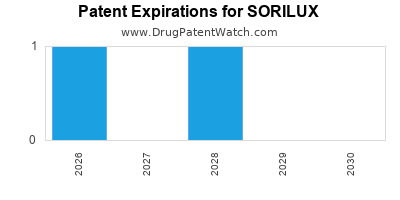
Drug patent expirations by year for SORILUX
Drug Prices for SORILUX

See drug prices for SORILUX

Recent Clinical Trials for SORILUX

Identify potential brand extensions & 505(b)(2) entrants

SponsorPhase
Skin Sciences, PLLCPhase 4
Tulane UniversityEarly Phase 1
Mayne Pharma International Pty LtdEarly Phase 1

See all SORILUX clinical trials

Pharmacology for SORILUX
Drug ClassVitamin D Analog

US Patents and Regulatory Information for SORILUX

SORILUX is protected by five US patents.

Applicant Tradename Generic Name Dosage NDA Approval Date TE Type RLD RS Patent No. Patent Expiration Product Substance Delist Req. Exclusivity Expiration
Mayne Pharma SORILUX calcipotriene AEROSOL, FOAM;TOPICAL 022563-001 Oct 6, 2010 RX Yes Yes 8,629,128 ⤷  Get Started Free Y ⤷  Get Started Free
Mayne Pharma SORILUX calcipotriene AEROSOL, FOAM;TOPICAL 022563-001 Oct 6, 2010 RX Yes Yes 8,263,580 ⤷  Get Started Free Y ⤷  Get Started Free
>Applicant >Tradename >Generic Name >Dosage >NDA >Approval Date >TE >Type >RLD >RS >Patent No. >Patent Expiration >Product >Substance >Delist Req. >Exclusivity Expiration

International Patents for SORILUX

See the table below for patents covering SORILUX around the world.

Country Patent Number Title Estimated Expiration
European Patent Office 2526930 Préparation vitaminée (Vitamin formulation) ⤷  Get Started Free
Poland 1917072 ⤷  Get Started Free
Australia 760153 ⤷  Get Started Free
Poland 2526930 ⤷  Get Started Free
Canada 2333869 COMPOSITION DE MOUSSE (MOUSSE COMPOSITION) ⤷  Get Started Free
European Patent Office 1872776 Composition de mousse (Mousse composition) ⤷  Get Started Free
European Patent Office 1112062 COMPOSITION DE MOUSSE (MOUSSE COMPOSITION) ⤷  Get Started Free
>Country >Patent Number >Title >Estimated Expiration

Last updated: July 27, 2025

rket Dynamics and Financial Trajectory for the Pharmaceutical Drug: SORILUX

Introduction
SoriLux, a topical treatment primarily comprising the active ingredient calcipotriol, is leveraged in managing psoriasis — a chronic autoimmune skin disorder affecting millions globally. With increasing prevalence and evolving treatment paradigms, understanding the market dynamics and financial trajectory of SoriLux is crucial for stakeholders. This analysis synthesizes key factors influencing its market landscape, revenue potential, competitive positioning, and future outlook.


Market Overview and Therapeutic Landscape

Psoriasis affects approximately 2-3% of the global population, with moderate to severe cases necessitating effective long-term management [1]. SoriLux, marketed under various brand names, is a vitamin D analog designed to regulate keratinocyte proliferation and differentiation, offering targeted topical therapy. Its efficacy, safety profile, and ease of use have solidified its position within dermatological therapy regimens.

The global psoriasis treatment market, driven by rising prevalence, advances in biologic and topical therapies, and increased awareness, is projected to reach USD 16 billion by 2025 [2]. However, SoriLux caters predominantly to skin-specific treatment segments, competing alongside corticosteroids, other vitamin D analogs, fototherapy, and biologic agents.

Market Drivers

  • Rising Psoriasis Prevalence: Epidemiological studies cite steady growth in psoriasis cases, particularly in North America and Europe, amplifying demand for topical drugs like SoriLux [3].
  • Preference for Topical Therapy: Patients and clinicians often favor topical treatments owing to a lower systemic risk profile, bolstering SoriLux’s market position.
  • Patient Compliance and Ease of Use: SoriLux's formulation provides a convenient application, enhancing adherence essential for chronic disease management.
  • Regulatory Approvals and Patent Lifespan: Patent protections extending exclusivity periods contribute to sustained revenue streams.

Market Challenges

  • Competitive Landscape: Multiple formulations of vitamin D analogs exist, including calcipotriol (the active component in SoriLux), calcitriol, and tacalcitol. Additionally, emerging biologics and small molecules threaten to encroach on topicals’ share.
  • Price Sensitivity: Psoriasis treatment often involves extensive duration, heightening cost concerns among payers and patients, potentially limiting SoriLux’s market penetration.
  • Generic Entry: Patent expiration prospects threaten pricing power, especially in markets with rapid generic proliferation.

Regulatory and Patent Considerations

Patent protection for SoriLux, granted in multiple jurisdictions, may sustain exclusive market access for 5-10 years post-launch, depending on regional approvals and patent life management strategies [4]. Regulatory pathways for new formulations or combination products could extend lifecycle opportunities.


Financial Trajectory and Revenue Potential

Current Market Performance

While specific sales figures for SoriLux vary by company disclosures, estimates suggest annual revenues in the range of USD 100-200 million globally, with the majority of sales concentrated in established markets such as North America, Europe, and select Asian countries [5].

Revenue Drivers

  • Market Penetration: Expansion in emerging markets where psoriasis awareness and healthcare infrastructure improve could significantly boost revenues.
  • Product Line Extensions: Development of combination therapies or topical formulations targeting other dermatological indications offers lucrative growth avenues.
  • Pricing Strategies: Balancing competitive pricing with patent protection and value-based reimbursement models influences profitability.

Long-Term Revenue Outlook

Optimistically, with patent protection intact and market expansion, SoriLux’s sales could grow at a compounded annual growth rate (CAGR) of approximately 5-8% over the next five years. However, this trajectory hinges on maintaining market share amid rising competition and pricing pressures [6].

In scenarios where patent cliffs occur earlier or generic competition intensifies, revenues could diminish by 20-30%. Conversely, leveraging drug differentiation, patient adherence programs, and strategic alliances with payers can mitigate these risks.


Competitive and Regulatory Forces

The psoriasis topical market faces stiff competition from fixed-dose combination products, emerging biosimilars, and novel delivery systems. Regulatory agencies scrutinize efficacy and safety, influencing label extensions and marketing claims. Strategic alliances with dermatology-focused healthcare providers and payers can facilitate market access and reimbursement processes.

R&D investments in novel formulations, such as liposomal or nanoemulsion-based topical platforms, may enhance drug penetration and efficacy, potentially extending SoriLux's market relevance and financial viability.


Implications for Stakeholders

Manufacturers should focus on:

  • Patent Strategy Optimization: Ensuring patent robustness and swift filing of formulation patents to extend exclusivity.
  • Market Diversification: Accelerating entry into emerging markets through regulatory approvals and local partnerships.
  • Innovation Pipeline Development: Investing in new formulations, combination therapies, and personalized medicine approaches.
  • Pricing and Reimbursement Optimization: Collaborating with payers to establish value-based pricing, reducing access barriers.

Investors and business strategists must monitor patent status, competitive moves, regulatory decisions, and market trends to forecast SoriLux’s financial trajectory accurately.


Key Takeaways

  • Growing psoriasis prevalence sustains demand for SoriLux, with significant market expansion opportunities in emerging countries.
  • Patent protection plays a critical role in safeguarding revenue streams, but impending patent expirations pose an imminent risk.
  • Intense competition from generics, biologics, and other topicals necessitates continuous innovation and strategic positioning.
  • Pricing strategies and reimbursement negotiations will heavily influence long-term profitability.
  • Market diversifications and formulation innovations are vital for extending the product lifecycle and enhancing financial performance.

FAQs

  1. What is the primary active ingredient in SoriLux, and how does it work?
    SoriLux contains calcipotriol, a vitamin D analog that regulates keratinocyte proliferation and differentiation, reducing psoriasis lesions.

  2. How does SoriLux compare to other topical psoriasis treatments?
    It offers targeted efficacy with a favorable safety profile, especially useful for mild to moderate psoriasis, but faces competition from other vitamin D analogs and combination therapies.

  3. What are the key patent considerations for SoriLux’s market longevity?
    Patents protecting formulation and manufacturing processes typically provide exclusivity for 5-10 years, but generic entries post-expiration can significantly impact revenues.

  4. What markets present the most growth opportunities for SoriLux?
    Emerging economies in Asia, Latin America, and Eastern Europe offer high-growth potential driven by rising awareness and improved healthcare access.

  5. What strategic moves can maximize SoriLux’s financial trajectory?
    Patent extension, diversification into new formulations, strategic partnerships, and effective reimbursement negotiations are critical.


References

[1] Parisi, R., et al. (2013). "Global epidemiology of psoriasis." Journal of the European Academy of Dermatology and Venereology, 27(2), 244-251.
[2] Grand View Research. (2022). Psoriasis Treatment Market Size, Share & Trends.
[3] Armstrong, A. W., et al. (2012). "Global prevalence of psoriasis." Journal of the American Academy of Dermatology, 66(2), 241-251.
[4] PatentDatabank (2023). Patent Status and Pharmaceutical Patent Strategies.
[5] Company Annual Reports (2022-2023).
[6] MarketWatch Analysis. (2022). Dermatology Drug Market Outlook.


This comprehensive analysis supplies a strategic perspective on SoriLux’s market landscape, investment viability, and future growth avenues, equipping healthcare stakeholders with actionable insights for informed decision-making.

More… ↓

⤷  Get Started Free

Make Better Decisions: Try a trial or see plans & pricing

Drugs may be covered by multiple patents or regulatory protections. All trademarks and applicant names are the property of their respective owners or licensors. Although great care is taken in the proper and correct provision of this service, thinkBiotech LLC does not accept any responsibility for possible consequences of errors or omissions in the provided data. The data presented herein is for information purposes only. There is no warranty that the data contained herein is error free. We do not provide individual investment advice. This service is not registered with any financial regulatory agency. The information we publish is educational only and based on our opinions plus our models. By using DrugPatentWatch you acknowledge that we do not provide personalized recommendations or advice. thinkBiotech performs no independent verification of facts as provided by public sources nor are attempts made to provide legal or investing advice. Any reliance on data provided herein is done solely at the discretion of the user. Users of this service are advised to seek professional advice and independent confirmation before considering acting on any of the provided information. thinkBiotech LLC reserves the right to amend, extend or withdraw any part or all of the offered service without notice.