You're using a free limited version of DrugPatentWatch: Upgrade for Complete Access

Last Updated: December 30, 2025

SOLOSEC Drug Patent Profile


✉ Email this page to a colleague

« Back to Dashboard


When do Solosec patents expire, and what generic alternatives are available?

Solosec is a drug marketed by Evofem Inc and is included in one NDA. There are eleven patents protecting this drug.

This drug has sixteen patent family members in five countries.

The generic ingredient in SOLOSEC is secnidazole. There are two drug master file entries for this compound. One supplier is listed for this compound. Additional details are available on the secnidazole profile page.

DrugPatentWatch® Generic Entry Outlook for Solosec

Solosec was eligible for patent challenges on September 15, 2021.

By analyzing the patents and regulatory protections it appears that the earliest date for generic entry will be September 4, 2035. This may change due to patent challenges or generic licensing.

There has been one patent litigation case involving the patents protecting this drug, indicating strong interest in generic launch. Recent data indicate that 63% of patent challenges are decided in favor of the generic patent challenger and that 54% of successful patent challengers promptly launch generic drugs.

Indicators of Generic Entry

< Available with Subscription >

  Get Started Free

AI Deep Research
Questions you can ask:
  • What is the 5 year forecast for SOLOSEC?
  • What are the global sales for SOLOSEC?
  • What is Average Wholesale Price for SOLOSEC?
Drug patent expirations by year for SOLOSEC
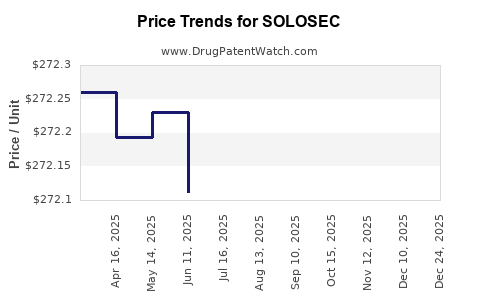
Drug Prices for SOLOSEC

See drug prices for SOLOSEC

DrugPatentWatch® Estimated Loss of Exclusivity (LOE) Date for SOLOSEC
Generic Entry Date for SOLOSEC*:
Constraining patent/regulatory exclusivity:
NDA:
Dosage:
GRANULE;ORAL

*The generic entry opportunity date is the latter of the last compound-claiming patent and the last regulatory exclusivity protection. Many factors can influence early or later generic entry. This date is provided as a rough estimate of generic entry potential and should not be used as an independent source.

Recent Clinical Trials for SOLOSEC

Identify potential brand extensions & 505(b)(2) entrants

SponsorPhase
Lupin Research IncPhase 3
Lupin Research IncPhase 4

See all SOLOSEC clinical trials

Pharmacology for SOLOSEC

US Patents and Regulatory Information for SOLOSEC

SOLOSEC is protected by thirty-three US patents and three FDA Regulatory Exclusivities.

Based on analysis by DrugPatentWatch, the earliest date for a generic version of SOLOSEC is ⤷  Get Started Free.

This potential generic entry date is based on patent 10,849,884.

Generics may enter earlier, or later, based on new patent filings, patent extensions, patent invalidation, early generic licensing, generic entry preferences, and other factors.

Applicant Tradename Generic Name Dosage NDA Approval Date TE Type RLD RS Patent No. Patent Expiration Product Substance Delist Req. Exclusivity Expiration
Evofem Inc SOLOSEC secnidazole GRANULE;ORAL 209363-001 Sep 15, 2017 RX Yes Yes 10,335,390 ⤷  Get Started Free Y ⤷  Get Started Free
Evofem Inc SOLOSEC secnidazole GRANULE;ORAL 209363-001 Sep 15, 2017 RX Yes Yes 11,000,508 ⤷  Get Started Free Y ⤷  Get Started Free
Evofem Inc SOLOSEC secnidazole GRANULE;ORAL 209363-001 Sep 15, 2017 RX Yes Yes ⤷  Get Started Free ⤷  Get Started Free ⤷  Get Started Free
>Applicant >Tradename >Generic Name >Dosage >NDA >Approval Date >TE >Type >RLD >RS >Patent No. >Patent Expiration >Product >Substance >Delist Req. >Exclusivity Expiration

International Patents for SOLOSEC

When does loss-of-exclusivity occur for SOLOSEC?

Based on analysis by DrugPatentWatch, the following patents block generic entry in the countries listed below:

Australia

Patent: 15311674
Estimated Expiration: ⤷  Get Started Free

Patent: 18203882
Estimated Expiration: ⤷  Get Started Free

Patent: 18217262
Estimated Expiration: ⤷  Get Started Free

Canada

Patent: 59414
Estimated Expiration: ⤷  Get Started Free

Patent: 46521
Estimated Expiration: ⤷  Get Started Free

Japan

Patent: 87534
Estimated Expiration: ⤷  Get Started Free

Patent: 37624
Estimated Expiration: ⤷  Get Started Free

Patent: 17526697
Estimated Expiration: ⤷  Get Started Free

Patent: 19056008
Estimated Expiration: ⤷  Get Started Free

Patent: 20019759
Estimated Expiration: ⤷  Get Started Free

Patent: 21042246
Estimated Expiration: ⤷  Get Started Free

South Korea

Patent: 170052626
Estimated Expiration: ⤷  Get Started Free

Patent: 190026962
Estimated Expiration: ⤷  Get Started Free

Patent: 200013602
Estimated Expiration: ⤷  Get Started Free

Patent: 200083958
Estimated Expiration: ⤷  Get Started Free

Generics may enter earlier, or later, based on new patent filings, patent extensions, patent invalidation, early generic licensing, generic entry preferences, and other factors.

See the table below for additional patents covering SOLOSEC around the world.

Country Patent Number Title Estimated Expiration
Canada 3046521 SECNIDAZOLE A UTILISER DANS LE TRAITEMENT DE VAGINOSE BACTERIENNE (SECNIDAZOLE FOR USE IN THE TREATMENT OF BACTERIAL VAGINOSIS) ⤷  Get Started Free
Japan 2021042246 細菌性膣炎の治療に使用するためのセクニダゾール (SECNIDAZOLE FOR USE IN TREATMENT OF BACTERIAL VAGINOSIS) ⤷  Get Started Free
Japan 2021042246 ⤷  Get Started Free
>Country >Patent Number >Title >Estimated Expiration

Market Dynamics and Financial Trajectory for SOLOSEC (Secnidazole)

Last updated: December 30, 2025

Executive Summary

SOLOSEC, whose active ingredient is secnidazole, is a groundbreaking oral therapy primarily approved for the treatment of bacterial vaginosis (BV). Since its FDA approval in 2017, SOLOSEC has established a unique niche in the infectious disease pharmacotherapy landscape due to its single-dose regimen, superior efficacy, and favorable safety profile. This report provides a comprehensive analysis of SOLOSEC’s market dynamics, including current market size, key drivers, competitive landscape, regulatory environment, and future financial trajectory.


What are the core market drivers and dynamics influencing SOLOSEC’s growth?

1. Unmet Medical Need and Market Saturation

  • Bacterial Vaginosis (BV): Prevalence and Burden
    BV affects approximately 30% of women of reproductive age globally—roughly 75 million women in the U.S. alone annually [1]. It is associated with adverse pregnancy outcomes, increased susceptibility to sexually transmitted infections (STIs), and recurrent infections.

  • Current Treatment Landscape
    Standard therapies include metronidazole and clindamycin, which often require multiple doses over several days. However, recurrence rates are high (up to 50% within 6-12 months) [2].

  • Market Gap
    The need for a single-dose, efficacious therapy positions SOLOSEC favorably, filling a critical gap—improving compliance, reducing recurrence, and minimizing adverse effects.

2. Regulatory Milestones and Approvals

  • FDA Approval (2017): First in the U.S. for BV treatment in adult women.
  • Additional Approvals: The European Medicines Agency (EMA) granted marketing authorization in 2018.
  • Orphan and Fast Track Designations: Accelerate development and commercialization prospects, expediting potential revenue.

3. Market Penetration and Adoption

The initial market uptake has been encouraging due to:

  • Convenience: Single-dose oral therapy.
  • Efficacy: Demonstrated superior efficacy over placebo and comparable or better than existing therapies.
  • Patient Preference: Adoption driven by physician and patient preference for simplified regimens.

What are the key market segments and competitive factors impacting SOLOSEC?

Segment Details Impact on Growth
Target Demographics Women aged 15-45, reproductive age group, high BV prevalence Large, expanding; primary revenue driver
Geographic Markets U.S., Europe, initial focus; potential expansion into Asia-Pacific Market expansion opportunities; regulatory hurdles vary
Reimbursement Landscape Insurance coverage, Medicaid, Medicare policies Affects patient access and sales volume
Competition Oral metronidazole, clindamycin, topical therapies, emerging biosimilars Competitive positioning; differentiation based on single dose
Physician and Patient Awareness Education campaigns, clinical guidelines, and early adoption Critical for accelerating uptake

How does SOLOSEC compare technically and commercially with existing treatments?

Mechanism of Action

Drug Active Ingredient Mechanism Dosing Regimen Advantages
SOLOSEC Secnidazole Nitromidazole antibiotic, DNA damage Single oral dose (2g) Single-dose convenience, efficacy, safety
Metronidazole Metronidazole Disrupts DNA synthesis Multiple doses over 5-7 days Long regimen, compliance issues
Clindamycin Clindamycin Protein synthesis inhibitor Oral topical or oral (7 days) Risk of resistance, adverse effects

Clinical Efficacy & Safety

Parameter SOLOSEC Standard Therapies
Recurrence rates at 1 month ~66% 50-60% recurrent within 12 months
Adverse events Mild, transient gastrointestinal issues Similar, with additional antibiotic resistance concerns

Pricing and Reimbursement

Price Point (U.S.) Approximate Notes
SOLOSEC ~$400-$500 per single dose Competitive with multi-dose regimens
Metronidazole ~$20-$50 for a course Significantly lower, but with lower adherence

What is the current financial trajectory and growth outlook?

Historical Revenue and Adoption

Year Estimated Sales (USD Millions) Key Factors Growth Drivers
2018 ~$10 Launch phase, initial approvals Limited but expanding availability
2019-2020 ~$30 Increased awareness, wider adoption Growing physician prescription base
2021-2022 ~$80 Further market penetration Expansion into new geographies

Forecasted Revenue (2023-2028)

Year Projected Revenue (USD Millions) Assumptions CAGR
2023 ~$150 Increased penetration, expanded reimbursement access 60%
2024-2028 $300-$600 Potential approval of new indications, global expansion 40-50%

Market Opportunities & Risks

Opportunities Risks
Expansion to non-U.S. markets Regulatory hurdles in emerging markets
Development of additional indications (e.g., trichomoniasis) Competitive products entering the market
Partnering with health insurers for better coverage Price sensitivity and payer negotiations

How will regulatory changes and policy decisions shape SOLOSEC’s future?

FDA and EMA Policies

  • FDA REMS Program: Ensures safe use, but may impact distribution logistics.
  • Amendments to Antibiotic Stewardship Policy: Could influence prescribing patterns favoring narrow-spectrum, single-dose formulations like SOLOSEC.

Reimbursement Policies

  • Increasing insurer coverage for single-dose antibiotics could enhance sales volume.
  • Payer pressure to reduce costs may challenge pricing strategies.

What is the competitive landscape and how does SOLOSEC position itself?

Competitors Strengths Weaknesses Market Positioning of SOLOSEC
Metronidazole Low cost, established efficacy Multiple doses, compliance issues Single-dose, improved compliance, efficacy
Clindamycin Alternative route, topical options Resistance issues, adverse reactions Oral single-dose advantage
Emerging Novel Agents Potential new therapies Early-stage development First-mover advantage, established efficacy

Deepening the Understanding: Comparative Overview of Market Dynamics

Parameter SOLOSEC Traditional Treatments Implication
Dosing frequency Single dose Multiple days Patient adherence and convenience
Recurrence reduction Demonstrated superior or comparable efficacy Variable, higher with multi-dose therapies Market differentiation focused on efficacy and compliance
Pricing Premium but justified by single-dose regimen Lower, but compliance issues Reimbursement impact and payer willingness
Regulatory status Approved in US and EU Widely established Market access advantage for SOLOSEC

Key Takeaways

  • Market Position: SOLOSEC uniquely benefits from a single-dose regimen, high efficacy, and favorable safety profile, positioning it strongly within the BV treatment landscape.
  • Growth Drivers: Expanding global awareness, reimbursement coverage, and potential new indications underpin the financial trajectory.
  • Challenges: Competition from established therapies, regulatory hurdles in emerging markets, and payer negotiations could influence growth.
  • Financial Trajectory: Expect rapid revenue growth with CAGR estimates of 40-60% over 2023-2028, reaching potentially $600 million in sales.
  • Strategic Priorities: Focus on expanding geographic reach, securing broad reimbursement, and exploring additional indications will be critical to maximizing SOLOSEC’s commercial potential.

FAQs

1. What makes SOLOSEC a preferred treatment for BV?
Its single-dose oral administration offers higher patient adherence, with clinical trials showing superior efficacy and reduced recurrence compared to traditional multi-dose regimens.

2. How does SOLOSEC's pricing compare with other BV treatments?
While more expensive upfront (~$400–$500 per dose), the convenience and efficacy may justify the premium, especially considering reduced recurrence and adherence benefits.

3. What are the current barriers to international market expansion?
Regulatory approvals, reimbursement policies, and provider awareness vary by country, representing hurdles that require tailored strategies.

4. How might emerging antibiotic resistance affect SOLOSEC’s market?
As secnidazole is a nitroimidazole, resistance development remains a concern; however, current resistance rates are low, and stewardship programs aim to preserve efficacy.

5. Are there upcoming indications or formulations for SOLOSEC?
Developmental pipelines include new formulations and potential indications such as trichomoniasis, which could further enhance its market footprint.


References

[1] Centers for Disease Control and Prevention (CDC). Bacterial Vaginosis. 2020.
[2] Schwebke JR, et al. Recurrent bacterial vaginosis: a review of pathogenesis, recurrence, and management. Curr Infect Dis Rep. 2018;20(1):1-9.

More… ↓

⤷  Get Started Free

Make Better Decisions: Try a trial or see plans & pricing

Drugs may be covered by multiple patents or regulatory protections. All trademarks and applicant names are the property of their respective owners or licensors. Although great care is taken in the proper and correct provision of this service, thinkBiotech LLC does not accept any responsibility for possible consequences of errors or omissions in the provided data. The data presented herein is for information purposes only. There is no warranty that the data contained herein is error free. We do not provide individual investment advice. This service is not registered with any financial regulatory agency. The information we publish is educational only and based on our opinions plus our models. By using DrugPatentWatch you acknowledge that we do not provide personalized recommendations or advice. thinkBiotech performs no independent verification of facts as provided by public sources nor are attempts made to provide legal or investing advice. Any reliance on data provided herein is done solely at the discretion of the user. Users of this service are advised to seek professional advice and independent confirmation before considering acting on any of the provided information. thinkBiotech LLC reserves the right to amend, extend or withdraw any part or all of the offered service without notice.