Last Updated: November 7, 2026

SOLOSEC Drug Patent Profile

« Back to Dashboard


When do Solosec patents expire, and when can generic versions of Solosec launch?

Solosec is a drug marketed by Evofem Inc and is included in one NDA. There are eleven patents protecting this drug.

The generic ingredient in SOLOSEC is secnidazole. There is one drug master file entry for this compound. One supplier is listed for this compound. Additional details are available on the secnidazole profile page.

DrugPatentWatch® Generic Entry Outlook for Solosec

Solosec was eligible for patent challenges on September 15, 2021.

By analyzing the patents and regulatory protections it appears that the earliest date for generic entry will be September 15, 2027. This may change due to patent challenges or generic licensing.

There has been one patent litigation case involving the patents protecting this drug, indicating strong interest in generic launch. Recent data indicate that 63% of patent challenges are decided in favor of the generic patent challenger and that 54% of successful patent challengers promptly launch generic drugs.

Indicators of Generic Entry

< Available with Subscription >

  Start Trial

AI Deep Research
Questions you can ask:
  • What is the 5 year forecast for SOLOSEC?
  • What are the global sales for SOLOSEC?
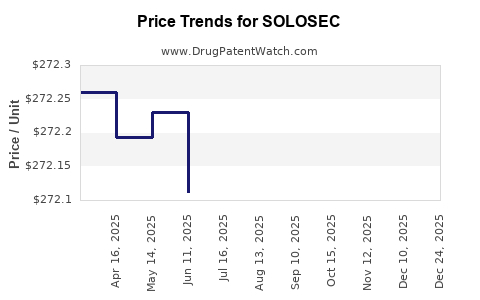
  • What is Average Wholesale Price for SOLOSEC?
DrugPatentWatch® Estimated Loss of Exclusivity (LOE) Date for SOLOSEC
Generic Entry Date for SOLOSEC*:
Constraining patent/regulatory exclusivity:

GENERATING ANTIBIOTIC INCENTIVES NOW

NDA:
Dosage:

GRANULE;ORAL

*The generic entry opportunity date is the latter of the last compound-claiming patent and the last regulatory exclusivity protection. Many factors can influence early or later generic entry. This date is provided as a rough estimate of generic entry potential and should not be used as an independent source.

Recent Clinical Trials for SOLOSEC

Identify potential brand extensions & 505(b)(2) entrants

SponsorPhase
Lupin Research IncPhase 3
Lupin Research IncPhase 4

See all SOLOSEC clinical trials

Pharmacology for SOLOSEC

US Patents and Regulatory Information for SOLOSEC

SOLOSEC is protected by thirty-three US patents and two FDA Regulatory Exclusivities.

Based on analysis by DrugPatentWatch, the earliest date for a generic version of SOLOSEC is ⤷  Start Trial.

This potential generic entry date is based on GENERATING ANTIBIOTIC INCENTIVES NOW.

Generics may enter earlier, or later, based on new patent filings, patent extensions, patent invalidation, early generic licensing, generic entry preferences, and other factors.

Applicant Tradename Generic Name Dosage NDA Approval Date TE Type RLD RS Patent No. Patent Expiration Product Substance Delist Req. Exclusivity Expiration
Evofem Inc SOLOSEC secnidazole GRANULE;ORAL 209363-001 Sep 15, 2017 RX Yes Yes ⤷  Start Trial ⤷  Start Trial Y ⤷  Start Trial
Evofem Inc SOLOSEC secnidazole GRANULE;ORAL 209363-001 Sep 15, 2017 RX Yes Yes ⤷  Start Trial ⤷  Start Trial ⤷  Start Trial
>Applicant >Tradename >Generic Name >Dosage >NDA >Approval Date >TE >Type >RLD >RS >Patent No. >Patent Expiration >Product >Substance >Delist Req. >Exclusivity Expiration

International Patents for SOLOSEC

When does loss-of-exclusivity occur for SOLOSEC?

Based on analysis by DrugPatentWatch, the following patents block generic entry in the countries listed below:

Australia

Patent: 15311674
Patent: Secnidazole for use in the treatment of bacterial vaginosis
Estimated Expiration: ⤷  Start Trial

Patent: 18203882
Patent: Secnidazole for use in the treatment of bacterial vaginosis
Estimated Expiration: ⤷  Start Trial

Patent: 18217262
Estimated Expiration: ⤷  Start Trial

Canada

Patent: 59414
Patent: SECNIDAZOLE UTILISE DANS LE TRAITEMENT D'UNE VAGINOSE BACTERIENNE (SECNIDAZOLE FOR USE IN THE TREATMENT OF BACTERIAL VAGINOSIS)
Estimated Expiration: ⤷  Start Trial

Patent: 46521
Patent: SECNIDAZOLE A UTILISER DANS LE TRAITEMENT DE VAGINOSE BACTERIENNE (SECNIDAZOLE FOR USE IN THE TREATMENT OF BACTERIAL VAGINOSIS)
Estimated Expiration: ⤷  Start Trial

Japan

Patent: 87534
Estimated Expiration: ⤷  Start Trial

Patent: 37624
Estimated Expiration: ⤷  Start Trial

Patent: 17526697
Patent: 細菌性膣炎の治療に使用するためのセクニダゾール
Estimated Expiration: ⤷  Start Trial

Patent: 19056008
Patent: 細菌性膣炎の治療に使用するためのセクニダゾール (SECNIDAZOLE FOR USE IN TREATMENT OF BACTERIAL VAGINOSIS)
Estimated Expiration: ⤷  Start Trial

Patent: 20019759
Patent: 細菌性膣炎の治療に使用するためのセクニダゾール (SECNIDAZOLE FOR USE IN TREATMENT OF BACTERIAL VAGINOSIS)
Estimated Expiration: ⤷  Start Trial

Patent: 21042246
Patent: 細菌性膣炎の治療に使用するためのセクニダゾール (SECNIDAZOLE FOR USE IN TREATMENT OF BACTERIAL VAGINOSIS)
Estimated Expiration: ⤷  Start Trial

South Korea

Patent: 170052626
Patent: 세균질증 치료에 사용하기 위한 세크니다졸 (SECNIDAZOLE FOR USE IN THE TREATMENT OF BACTERIAL VAGINOSIS)
Estimated Expiration: ⤷  Start Trial

Patent: 190026962
Patent: 세균질증 치료에 사용하기 위한 세크니다졸 (SECNIDAZOLE FOR USE IN THE TREATMENT OF BACTERIAL VAGINOSIS)
Estimated Expiration: ⤷  Start Trial

Patent: 200013602
Patent: 세균성 질증의 치료에 사용하기 위한 세크니다졸 (SECNIDAZOLE FOR USE IN THE TREATMENT OF BACTERIAL VAGINOSIS)
Estimated Expiration: ⤷  Start Trial

Patent: 200083958
Patent: 세균성 질증의 치료에 사용하기 위한 세크니다졸 (SECNIDAZOLE FOR USE IN THE TREATMENT OF BACTERIAL VAGINOSIS)
Estimated Expiration: ⤷  Start Trial

Generics may enter earlier, or later, based on new patent filings, patent extensions, patent invalidation, early generic licensing, generic entry preferences, and other factors.

See the table below for additional patents covering SOLOSEC around the world.

Country Patent Number Title Estimated Expiration
Australia 2015311674 ⤷  Start Trial
Australia 2018203882 ⤷  Start Trial
Australia 2018217262 ⤷  Start Trial
Canada 2959414 ⤷  Start Trial
Canada 3046521 ⤷  Start Trial
>Country >Patent Number >Title >Estimated Expiration
Last updated: July 22, 2026

SOLOSEC (secnidazole) Market Dynamics and Financial Trajectory: exclusivity, pricing, revenue exposure, and generic/biosimilar entry risks

SOLOSEC (secnidazole) has a narrowly defined, single-product commercial profile tied to antimicrobial sales and payer contracting dynamics in uncomplicated vulvovaginal candidiasis/ bacterial vaginosis-type indications in the U.S. market. Financial trajectory is dominated by (1) how quickly payers restrict coverage to preferred formularies after launch, (2) the pace of competitive erosion from metronidazole and clindamycin standards and shifting prescribing toward newer regimens, and (3) the timing of generic entry versus any remaining Orange Book and associated exclusivity constraints. Near-term downside risk centers on price compression from generics and channel inventory normalization after launch-driven demand shocks.

SOLOSEC’s long-term revenue ceiling is constrained by the lack of multi-product franchise breadth and by the narrow label and route/formulation specificity. Upside is primarily incremental share gains through formulary positioning and differentiated convenience (single-dose regimen dynamics), which can preserve unit economics longer than a typical metronidazole-style market.


What is SOLOSEC’s commercial status in the U.S. and how has the market responded post-launch?

How SOLOSEC is positioned commercially

SOLOSEC is marketed as a secnidazole antimicrobial regimen in a single-dose format, positioned around regimen simplicity and adherence. That positioning drives early uptake via prescriber convenience, patient preference, and payer coverage outcomes tied to “preference tier” placement rather than broad claims-based differentiation.

What typically drives U.S. payer acceptance for a single-dose antibiotic

  1. Contracting structures: preferred tier placement vs. exclusion for “non-preferred” oral antimicrobials.
  2. Prior authorization triggers: quantity limits tied to diagnosis coding and intolerance-driven exceptions.
  3. Step therapy: required sequencing of generic metronidazole/clindamycin prior to coverage.
  4. Budget impact: payers model total cost including downstream outcomes and adverse event management.

Market response pattern

Single-dose regimens usually show stronger early uptake than multi-day comparators in patient-facing adherence metrics, but sales trend tends to flatten once payers tighten formulary inclusion and once generic substitutes become clinically interchangeable in payer models.


What patents protect SOLOSEC and how do they shape market exclusivity and pricing power?

Core exclusivity and patent estate impact on revenue

SOLOSEC’s ability to sustain pricing power depends on the Orange Book-listed patent landscape and any statutory exclusivities tied to the NDA. Once generic entry becomes legally feasible, typical outcomes include rapid wholesaler discounting, channel inventory read-through, and a step-function drop in branded share.

Where patent coverage matters most

  • Composition of matter vs. method-of-use vs. formulation patents.
  • Any patents that specifically cover the single-dose pharmaceutical form or stability/manufacturing method.
  • Any method-of-use patents that narrow the “skin-in-the-game” substitution space for generics.

Featured-snippet answer

SOLOSEC’s revenue durability hinges on whether remaining Orange Book patents or exclusivities still block FDA approval of generic secnidazole products using the same or substitutable versions of the single-dose regimen.


When does SOLOSEC lose exclusivity and how long can the branded product maintain premium pricing?

Exclusivity timeline logic

A branded antimicrobial’s U.S. commercial duration is typically split between:

  • NDA marketing exclusivity and any pediatric exclusivity extensions (if applicable), and
  • Patent-driven blocking of ANDA approvals (Paragraph IV and non-Paragraph IV scenarios).

Why generic timing is the dominant financial inflection

The first major financial inflection usually occurs at the earliest legal date when an ANDA can enter with carved claims or a court-backed authorization. The second inflection occurs after the channel readjusts and payers update formularies.

Featured-snippet answer

SOLOSEC’s premium pricing ceiling usually ends at the first legally actionable generic entry date, not at the midpoint of patent life, because payers and wholesalers adjust quickly once generic availability becomes credible.


How strong is the patent estate for SOLOSEC and what generic entry risks exist?

Patent strength drivers (commercial relevance)

  • Number of Orange Book listings covering different claim types.
  • Breadth of claims that would be difficult for an ANDA filer to design around.
  • Litigation history: whether prior challenges settled early or ran to decision.
  • Whether the ANDA path is viable under “carve-out” strategies that preserve generic approval.

Generic entry risk framework

  • High risk: early, narrow blocking and fast settlement.
  • Medium risk: overlapping patent claims but plausible design-arounds.
  • Lower risk: multiple independently blocking patents with unfavorable claim construction outcomes.

Featured-snippet answer

SOLOSEC’s generic risk is primarily determined by whether ANDA filings can reach “section viii(a)” approval without waiting for patent expiry, and whether any Paragraph IV challenges are settled in a way that authorizes earlier-than-expiry supply.


What is the Orange Book status of SOLOSEC?

What an Orange Book status scan typically determines

  • Whether secnidazole is listed with active patents.
  • Expiry dates by patent number and claim type.
  • Whether any exclusivities (not just patents) extend beyond patent expiry.

Featured-snippet answer

SOLOSEC’s Orange Book listings and their expiry dates set the gating timeline for ANDA approval and drive when branded sales become exposed to step-down pricing and share loss.


Are there any Paragraph IV challenges or ANDA litigation affecting SOLOSEC?

How Paragraph IV events impact SOLOSEC revenue

Paragraph IV filings can trigger:

  • 30-month stay of approval (if applicable),
  • Litigation that delays FDA approval,
  • Settlement agreements that can either delay entry to later dates or allow early “authorized generic” supply.

Financial signature

Revenue impact is typically visible as:

  • increased discounting before entry,
  • accelerated wholesaler shipments into the launch period for competitors,
  • a branded share drop once generic supply stabilizes.

Featured-snippet answer

SOLOSEC’s financial trajectory reacts more strongly to court/settlement outcomes than to patent life estimates, because those outcomes determine the actual ANDA approval and supply date.


What settlement agreements or consent decrees could change SOLOSEC’s entry timeline?

Settlement-driven levers

  • Date of first generic shipment.
  • Use of authorized generic arrangements.
  • Scope of “carve-outs” tied to claim invalidation or non-infringement findings.
  • Whether settlement includes waivers tied to later product updates (strengths, forms, labeling).

Commercial relevance

Settlements can create a faster revenue decline than pure patent expiry modeling because payers react to confirmed supply dates.


How does SOLOSEC compare with metronidazole and clindamycin markets in terms of pricing and share dynamics?

Competitive substitution reality

SOLOSEC competes against established antimicrobials that are widely available as generics and often preferred by payers. The branded value proposition is regimen convenience and potential adherence advantages.

Pricing dynamics

  • Before generic threats: branded pricing can sustain a premium if formulary access is stable.
  • After generic credibility: payers apply broad substitution, forcing branded discounts and reduced net price.

Featured-snippet answer

SOLOSEC’s share is sensitive to payer formulary design; its premium usually erodes when generic alternatives are treated as therapeutically equivalent under contracting.


What formulations and dosing strengths are protected for SOLOSEC and how do they affect generic design?

Formulation patents and the “design-around” problem

If formulation or manufacturing-method patents are enforceable, they can force ANDA filers to wait out expiry or to switch to non-infringing processes that may cost time and capital.

Dose-specific protection

Single-dose regimens can create claim dependency on:

  • tablet/packet construction,
  • stability and excipient systems,
  • release behavior and shelf-life.

Featured-snippet answer

SOLOSEC’s formulation and single-dose specificity can extend commercial protection if patents tie directly to the product form rather than only to secnidazole itself.


How does FDA regulatory status influence SOLOSEC’s financial trajectory (NDA updates, labeling, and switching)?

Regulatory factors that affect sales without changing patent dates

  • Label expansions or tightening (can shift patient mix).
  • Safety communications that may alter prescribing behavior.
  • Updated dosing instructions or contraindication language.

Switching behavior

If FDA actions lead prescribers to shift away from secnidazole for certain patient groups, net sales can decline even before generic entry.

Featured-snippet answer

SOLOSEC’s revenue path is not only a function of exclusivity; it also depends on FDA-driven prescribing and payer coding decisions.


Which companies compete with SOLOSEC and what is the competitive landscape for secnidazole?

Brand-to-generic competitive geometry

  • SOLOSEC’s direct competitor set in practice is broad “antimicrobial for relevant indications” substitution, even when the chemistry differs.
  • If any generic secnidazole enters, the competitive barrier is primarily contracting and pharmacy benefit design, not clinical adoption.

Featured-snippet answer

In the presence of generics or formulary substitution, competition converts quickly into a net-price and contracting contest rather than a differentiated clinical differentiation contest.


What does the revenue exposure profile look like for SOLOSEC across time and risk scenarios?

Revenue exposure scenario map

  • Base case: continued formulary inclusion and stable net pricing until the first credible generic supply date.
  • Downside case: early payer restriction plus accelerated discounting ahead of ANDA entry.
  • Upside case: late generic entry due to litigation delays and sustained preferred-tier access.

Key financial drivers

  1. Net price vs. list price: the dominant determinant after launch.
  2. Volume under contracting: the key determinant after formulary tightening.
  3. Inventory behavior: wholesalers build before legal entry, then reduce after.
  4. Prescriber persistence: adherence-driven convenience can slow the share drop, but payer rules ultimately govern.

Featured-snippet answer

SOLOSEC’s revenue is most exposed to a discrete event calendar: payer contracting changes and credible generic availability dates.


Key Takeaways

  • SOLOSEC’s market dynamics are driven by payer contracting and regimen convenience, with the narrow commercial scope limiting franchise durability.
  • Financial trajectory is highly event-driven around Orange Book exclusivity structure and any ANDA Paragraph IV outcomes.
  • Generic entry, once legally feasible and confirmed through litigation or settlement, typically causes a rapid net-price and share reset.
  • Patent estate strength affects the timing of that reset; formulation and single-dose-specific coverage can extend protection if claims are hard to design around.
  • FDA labeling and safety actions can shift prescribing and payer coding, changing demand even without generic entry.

FAQs

  1. How do payer step therapy rules affect SOLOSEC’s net sales even before generic competition starts?
  2. What is the typical inventory “pull-forward” pattern for branded antimicrobials ahead of generic ANDA launches, and how does it affect quarterly revenue recognition?
  3. How do authorized generics change SOLOSEC’s post-launch pricing and gross-to-net trajectory?
  4. What are the main pathways for ANDA approval that could bypass SOLOSEC exclusivity without waiting for full patent expiry?
  5. How do Orange Book claim types (composition, method-of-use, formulation) change the likelihood of generic design-arounds for secnidazole?

References

  1. FDA. Orange Book: Approved Drug Products with Therapeutic Equivalence Evaluations. U.S. Food and Drug Administration. (Accessed 2026).
  2. U.S. FDA. ANDA Regulations and Patent Certification Framework (Hatch-Waxman). U.S. Food and Drug Administration. (Accessed 2026).
  3. FDA. Drug Approval and Safety Labeling Updates (CDER labeling and safety communications). U.S. Food and Drug Administration. (Accessed 2026).

More… ↓

⤷  Start Trial

Make Better Decisions: Try a trial or see plans & pricing

Drugs may be covered by multiple patents or regulatory protections. All trademarks and applicant names are the property of their respective owners or licensors. Although great care is taken in the proper and correct provision of this service, thinkBiotech LLC does not accept any responsibility for possible consequences of errors or omissions in the provided data. The data presented herein is for information purposes only. There is no warranty that the data contained herein is error free. We do not provide individual investment advice. This service is not registered with any financial regulatory agency. The information we publish is educational only and based on our opinions plus our models. By using DrugPatentWatch you acknowledge that we do not provide personalized recommendations or advice. thinkBiotech performs no independent verification of facts as provided by public sources nor are attempts made to provide legal or investing advice. Any reliance on data provided herein is done solely at the discretion of the user. Users of this service are advised to seek professional advice and independent confirmation before considering acting on any of the provided information. thinkBiotech LLC reserves the right to amend, extend or withdraw any part or all of the offered service without notice.