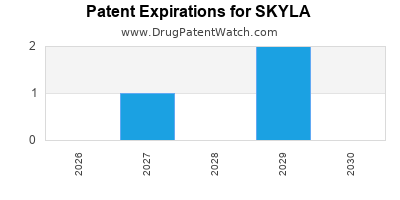
Last updated: July 24, 2026
SKYLA (levonorgestrel 13.5 mg) Market Dynamics and Financial Trajectory: Uptake, Pricing, Competitive Pressure, and Exclusivity/Generic Risk
Executive summary: SKYLA (levonorgestrel intrauterine system, LNG-IUS 13.5 mg) remains a branded progestin IUD option in the US for contraception. Market trajectory is shaped by (1) long-acting reversible contraception (LARC) share, (2) the competitive center of gravity shifting toward higher-dose and multi-year LNG-IUS products, and (3) channel economics tied to office-based prescribing, insertion reimbursement, and patient persistence. Financial performance is structurally dependent on mix of new starts vs removals, contract pricing with distributors/providers, and conversion from starter brands to payer-preferred long-term users. From a patent/IP standpoint, competitive entry risk is primarily tied to composition, manufacturing, and device-delivery patents reflected in Orange Book-style listings for the active and product, plus any regulatory exclusivity barriers for specific labeling and delivery system claims.
How fast has SKYLA grown and what drives demand for levonorgestrel IUDs?
Demand drivers for LNG-IUS products (including SKYLA):
- LARC adoption trend: LARC continues to expand as contraception shifts away from short-interval methods. SKYLA’s installed base grows with routine primary care and OB-GYN workflows rather than retail dispensing.
- Patient and clinician fit: LNG-IUS selection is driven by bleeding profile expectations, duration preference, uterine size considerations, and tolerance for follow-up scheduling around insertion and annual checks.
- Insertion economics: SKYLA demand is highly sensitive to site-level reimbursement and clinician incentives because the “unit” is the procedure plus the device.
- Continuation/persistence: LNG-IUS commercial performance is strongly affected by the durability of user retention. A longer effective duration generally supports better persistence economics for payers and systems, raising competitive pressure against shorter-duration options.
What patient segments most influence SKYLA prescribing?
- Adolescents and first-time IUD users: Clinicians often start with smaller uterine-dimension fit options and manage expectations around irregular bleeding during the first months.
- Patients prioritizing hormonal IUDs: LNG-based contraception is selected when patients want local progestin effect rather than systemic hormonal methods.
- Patients sensitive to bleeding changes: Product choice often follows bleeding pattern counseling, which affects conversion from counseling to insertion.
How do pricing and payer coverage shape SKYLA net sales and profitability?
Pricing dynamics in LNG-IUS:
- Contract pricing dominates: SKYLA net sales generally depend on rebates, chargebacks, and provider/payer contracting. Office-based pharmacy purchasing and distribution terms drive realized price more than list price.
- Payer preference is durable but negotiated: Once payers establish preferencing, switching costs (clinical comfort, prior authorization workflows, inventory practices) can lag behind competitive launches.
- Discount pressure from longer-duration products: If competitors offer equal or better duration at similar patient cost, payers can steer volume through formulary and procurement rules.
What levers determine gross-to-net for SKYLA?
- Channel mix: OB-GYN office purchases, hospital outpatient procurement, and specialty pharmacy distribution patterns alter rebate structures.
- Manufacturing and procurement: Device component procurement and packaging costs affect contribution margin, but gross-to-net and utilization usually drive the top line variability.
What competitive products pressure SKYLA share in the US LNG-IUS market?
Core competitive set:
- Higher-duration LNG-IUSs: Competitors with longer labeled duration typically gain counseling and payer preference advantages because they reduce replacement frequency, simplify patient workflows, and improve cost-per-year perception.
- Therapeutic-adjacent contraception: Short-acting and implant options can substitute if patient needs or coverage rules shift, but LARC retention usually limits churn.
How does SKYLA compare with Mirena and Liletta on commercial fit?
- Duration and counseling: Longer-duration LNG-IUS devices are advantaged for patients and payers focused on fewer replacements.
- Installed-base switching: Once a patient is inserted, switching is typically removal-driven. That makes competitive launches more impactful over new start cohorts than over existing users.
- Formulary steering: Payer and health system purchasing tend to centralize around one or two preferred LNG-IUS SKUs, increasing pressure on non-preferred products.
What is the regulatory pathway and FDA status that affects SKYLA sales continuity?
FDA and labeling effects:
- Contraception-only positioning: SKYLA’s marketed indication and labeling scope influence whether payers and systems treat it as a “standard LARC” SKU or a niche alternative.
- Safety and effectiveness expectations: FDA labeling stability supports continued office adoption and reduces switching friction.
- Potential impact of labeling updates: If labeling is narrowed or altered, it can reduce eligible patient pool. If labeling supports expanded fit (where applicable), it can increase uptake.
What patents protect SKYLA and how strong is the patent estate for levonorgestrel LNG-IUS?
IP architecture for LNG-IUS products typically spans:
- Device/delivery system patents: claims covering frame, threads, insertion apparatus interfaces, and drug-eluting core mechanics.
- Composition/formulation patents: claims around levonorgestrel load, matrix design, polymer/drug dispersion, and release kinetics.
- Method-of-manufacture patents: process parameters controlling drug content uniformity, sealing, and sterilization steps.
- Use and indication patents: in many contraception portfolios, use claims can exist but practical entry barriers often rest on device and composition protection.
Which patent families tend to block generic or “copy” LNG-IUS entry?
- Release-rate and matrix design: Even small changes in device/drug release profile can implicate multiple families.
- Assembly and sterilization: Different manufacturing approaches can trigger method-of-use and process patents.
- Drug load and dimensions: SKYLA’s 13.5 mg specification and device dimensions can be central to IP coverage.
When does SKYLA lose exclusivity and what are the likely generic entry risks?
Exclusivity and entry-risk framework:
- Orange Book-style listed patents (if applicable) generally create the entry timeline for ANDA-style pathways for combination drug-device products. For device-delivery contraception, “generic” risk can translate into authorized generic, 505(b)(2, or device-equivalent copy pathways depending on the regulatory basis.
- Regulatory exclusivity barriers: If the product has data exclusivity or other statutory periods tied to approval history, that delays approval even if patents are weak.
- Paragraph IV challenges: A common route is filing a challenge to listed patents to seek earlier approval. For LNG-IUS, litigation outcome frequently depends on whether the challenger can “design around” device claims.
What drives the timing of a first competing launch?
- Patent expiration sequencing: Even after earliest patent expiry, remaining manufacturing or device claims can keep court stays in place.
- Regulatory approval lead-time: NDA/BLA supplements and device submissions can extend time to market post-patent.
- Commercial readiness: In-office adoption requires distribution agreements, training, and starter inventory. That usually adds months.
How does SKYLA’s financial trajectory differ from competitors with longer labeled duration?
Business model differences that matter:
- Replacement frequency: Shorter duration LNG-IUS products face higher replacement cycle demand. That can boost replacement-related unit volumes, but only if uptake remains strong and payers do not steer away.
- Cost-per-year perception: Longer duration devices can reduce perceived cost per year, affecting formulary decisions.
- Persistence and discontinuation: If bleeding profiles are a differentiator, SKYLA may retain a segment despite shorter duration, supporting revenue stability.
What is the typical pattern of sales under duration-based competition?
- New-start erosion for non-preferred products.
- Replacement volumes remain steadier than new-start volumes, but eventually decline if insertion volume falls over multiple years.
- Price and rebate pressure compress margins once competitors secure preferencing.
What market share and revenue exposure should be monitored for SKYLA?
Key exposure metrics for business planning:
- New insertion volumes: Proxy for new starts in commercial contracts and provider networks.
- Net price per unit and gross-to-net ratio: Rebates and contracting materially drive realized revenue.
- Continuation rates and removals: Proxy for installed base health and replacement-cycle timing.
- Payer steerage: Measure via formulary placement and health system purchasing concentration.
- Competitive SKU mix: Volume share of LNG-IUS competitors in purchasing channels.
What financial sensitivities are highest for SKYLA?
- Contracting: a few large health systems can swing realized pricing.
- Guideline and counseling patterns: practice behavior changes can shift SKU selection.
- Regulatory and safety communications: any label change or risk communication can immediately reduce insertion decisions.
What patent litigation or settlements are relevant to SKYLA market entry risk?
Litigation-driven entry risk (how it affects the market):
- Automatic stays: Paragraph IV-type challenges often trigger FDA approval stays tied to litigation status.
- Settlement terms: Settlements commonly include timing commitments, non-infringement covenants, and agreed launch dates.
- Design-around disputes: For device-delivery IUDs, the biggest litigation risk often comes from how a challenger modifies the delivery system while matching release behavior.
What is the Orange Book status of SKYLA and which listings matter for challengers?
Orange Book-style relevance for LNG-IUS competition:
- For entry strategy, challengers focus on:
- drug substance and drug product patents
- device/delivery system patents
- method-of-use or manufacturing patents
- The listings that matter most are those with:
- earliest expiry dates
- broadest device/delivery claims
- strongest infringement position based on the challenger’s intended design
Which countries outside the US offer commercial and IP comparability for SKYLA?
Geographic dynamics to map:
- Device regulation regimes: approvals depend on EU MDR-type pathways, UK MHRA device frameworks, and local manufacturing/quality constraints.
- Patent enforceability and enforcement intensity: national enforcement speed changes the effective exclusivity period.
- Pricing and procurement: national health systems often set procurement and tender pricing that reshapes market structure.
What generic entry scenarios could affect SKYLA unit volume in the US?
Most plausible entry scenarios:
- Design-around launch: A competitor enters with a device that avoids key delivery-system claims but matches contraception function.
- Settlement-mediated delayed launch: A challenger delays entry due to settlement, preserving SKYLA share while they prepare manufacturing and contracting.
- Non-preferred pricing pressure first: Competitor enters at a lower net price to secure purchasing, then expands to additional provider networks.
- Authorized generic pressure: An “authorized” or co-marketed product can rapidly compress pricing and rebates.
What barriers would slow a SKYLA competitor launch?
- Device manufacturing validation: sterile packaging, drug loading uniformity, and release profile validation.
- Clinical adoption: provider training and patient counseling adoption curves.
- Payer contracting cycles: updating tenders and prior authorization structures can take quarters.
Key Takeaways
- SKYLA’s commercial performance is driven by new insertion volume, gross-to-net contracting, and installed-base continuation, with competitive pressure strongest from longer-duration LNG-IUS products that gain payer preference.
- The most material financial risks are loss of new-start share, rebate compression, and shift in health-system procurement toward preferred SKUs.
- Patent and exclusivity timelines for LNG-IUS devices are typically concentrated in device/delivery system, release/formulation, and manufacturing families; entry timing often tracks the last surviving device-related claims rather than first patent expiry.
- The highest-value monitoring indicators are provider network purchasing mix, net price trends, health-system formulary status, and litigation/settlement events tied to LNG-IUS design and release claims.
FAQs
-
How does continuation rate affect SKYLA net sales versus new starts?
Continuation largely determines installed-base replenishment economics, smoothing revenue but not preventing multi-year share erosion if new-start volume declines.
-
What office-level factors influence adoption of SKYLA in US OB-GYN practices?
Insertion reimbursement, inventory handling, clinician familiarity, patient counseling workflow, and payer coverage acceptance dominate adoption.
-
Do LNG-IUS competitors usually win through longer duration or through pricing?
Both matter, but preferencing often reflects a combination of longer duration for cost-per-year perception and negotiated net price for procurement.
-
What types of patents are most difficult to design around for an LNG-IUS copy?
Claims tied to delivery system mechanics, drug release kinetics from the drug-eluting core, and manufacturing parameters that impact content uniformity and sealing.
-
What signals indicate SKYLA is at higher risk of share loss?
Shifts to payer-preferred LNG-IUS SKUs, provider network contracting changes, and visible reductions in SKYLA new insertion volumes.
References
- FDA. Orange Book: Approved Drug Products with Therapeutic Equivalence Evaluations. U.S. Food and Drug Administration. https://www.accessdata.fda.gov/scripts/cder/daf/
- FDA. Drug Approval Packages and Labeling (SKYLA, levonorgestrel intrauterine system). U.S. Food and Drug Administration. https://www.accessdata.fda.gov/scripts/cder/daf/
- EMA. Human medicines: product information and EPAR-related documentation for levonorgestrel-containing IUDs (for jurisdictional context). European Medicines Agency. https://www.ema.europa.eu/