Last Updated: November 13, 2026

SIVEXTRO Drug Patent Profile

« Back to Dashboard


When do Sivextro patents expire, and what generic alternatives are available?

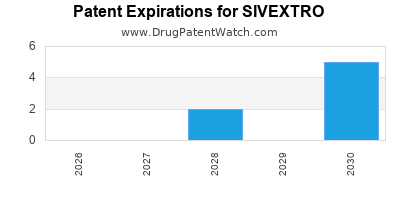
Sivextro is a drug marketed by Cubist Pharms Llc and is included in two NDAs. There are seven patents protecting this drug.

The generic ingredient in SIVEXTRO is tedizolid phosphate. There is one drug master file entry for this compound. One supplier is listed for this compound. Additional details are available on the tedizolid phosphate profile page.

DrugPatentWatch® Generic Entry Outlook for Sivextro

Sivextro was eligible for patent challenges on June 20, 2018.

By analyzing the patents and regulatory protections it appears that the earliest date for generic entry will be February 3, 2030. This may change due to patent challenges or generic licensing.

Indicators of Generic Entry

< Available with Subscription >

  Start Trial

AI Deep Research
Questions you can ask:
  • What is the 5 year forecast for SIVEXTRO?
  • What are the global sales for SIVEXTRO?
  • What is Average Wholesale Price for SIVEXTRO?
Summary for SIVEXTRO
DrugPatentWatch® Estimated Loss of Exclusivity (LOE) Date for SIVEXTRO
Generic Entry Dates for SIVEXTRO*:
Constraining patent/regulatory exclusivity:
NDA:
Dosage:

POWDER;INTRAVENOUS

Generic Entry Dates for SIVEXTRO*:
Constraining patent/regulatory exclusivity:
NDA:
Dosage:

TABLET;ORAL

*The generic entry opportunity date is the latter of the last compound-claiming patent and the last regulatory exclusivity protection. Many factors can influence early or later generic entry. This date is provided as a rough estimate of generic entry potential and should not be used as an independent source.

Recent Clinical Trials for SIVEXTRO

Identify potential brand extensions & 505(b)(2) entrants

SponsorPhase
Assistance Publique - Hôpitaux de ParisPhase 2
Lundquist Institute for Biomedical Innovation at Harbor-UCLA Medical CenterPhase 2
Los Angeles Biomedical Research InstitutePhase 2

See all SIVEXTRO clinical trials

Pharmacology for SIVEXTRO

US Patents and Regulatory Information for SIVEXTRO

SIVEXTRO is protected by seven US patents and one FDA Regulatory Exclusivity.

Based on analysis by DrugPatentWatch, the earliest date for a generic version of SIVEXTRO is ⤷  Start Trial.

This potential generic entry date is based on patent 10,065,947.

Generics may enter earlier, or later, based on new patent filings, patent extensions, patent invalidation, early generic licensing, generic entry preferences, and other factors.

Applicant Tradename Generic Name Dosage NDA Approval Date TE Type RLD RS Patent No. Patent Expiration Product Substance Delist Req. Exclusivity Expiration
Cubist Pharms Llc SIVEXTRO tedizolid phosphate POWDER;INTRAVENOUS 205436-001 Jun 20, 2014 RX Yes Yes 8,426,389 ⤷  Start Trial Y Y ⤷  Start Trial
Cubist Pharms Llc SIVEXTRO tedizolid phosphate POWDER;INTRAVENOUS 205436-001 Jun 20, 2014 RX Yes Yes 10,065,947 ⤷  Start Trial Y ⤷  Start Trial
Cubist Pharms Llc SIVEXTRO tedizolid phosphate POWDER;INTRAVENOUS 205436-001 Jun 20, 2014 RX Yes Yes 9,624,250 ⤷  Start Trial Y Y ⤷  Start Trial
>Applicant >Tradename >Generic Name >Dosage >NDA >Approval Date >TE >Type >RLD >RS >Patent No. >Patent Expiration >Product >Substance >Delist Req. >Exclusivity Expiration

EU/EMA Drug Approvals for SIVEXTRO

Company Drugname Inn Product Number / Indication Status Generic Biosimilar Orphan Marketing Authorisation Marketing Refusal
Merck Sharp & Dohme B.V. Sivextro tedizolid phosphate EMEA/H/C/002846Sivextro is indicated for the treatment of acute bacterial skin and skin structure infections (ABSSSI) in adults and adolescents 12 years of age and older. Authorised no no no 2015-03-23
>Company >Drugname >Inn >Product Number / Indication >Status >Generic >Biosimilar >Orphan >Marketing Authorisation >Marketing Refusal

International Patents for SIVEXTRO

When does loss-of-exclusivity occur for SIVEXTRO?

Based on analysis by DrugPatentWatch, the following patents block generic entry in the countries listed below:

African Regional IP Organization (ARIPO)

Patent: 87
Patent: Crystalline form of (R)-3-(-4(2-(2-methyltetrazol-5-YL)pyridin-5-YL)-3-fluorophenyl)-5-hydroxymethyloxazolidin-2-one dihydrogen phosphate
Estimated Expiration: ⤷  Start Trial

Australia

Patent: 10210627
Patent: Crystalline form of R)-3-(4-(2-(2-methyltetrazol-5-yl)pyridin-5-yl)-3-fluorophenyl)-5-hydroxymethyl oxazolidin-2-one dihydrogen phosphate
Estimated Expiration: ⤷  Start Trial

Brazil

Patent: 1008829
Patent: forma cristalina de dihidrogenofosfato de (r)-3-(4-(2-(2-metiltetrazol-5-il) piridin-5-il)-3-fluorofenil)-5-hidroximetil oxazolidin-2-ona
Estimated Expiration: ⤷  Start Trial

Canada

Patent: 51392
Patent: FORME CRISTALLINE DU DIHYDROGENOPHOSPHATE DE (R)-3-(4-(2-(2-METHYLTETRAZOL-5-YL)PYRIDIN-5-YL)-3-FLUOROPHENYL)-5-HYDROXYMETHYL OXAZOLIDIN-2-ONE (CRYSTALLINE FORM OF R)-3-(4-(2-(2-METHYLTETRAZOL-5-YL)PYRIDIN-5-YL)-3-FLUOROPHENYL)-5-HYDROXYMETHYL OXAZOLIDIN-2-ONE DIHYDROGEN PHOSPHATE)
Estimated Expiration: ⤷  Start Trial

Chile

Patent: 11001855
Patent: Partículas cristalinas que comprenden al compuesto fosfato de dihidrógeno de (r)-3-(4-(2-(2-metiltetrazol-5-il)piridin-5-il)-3-fluorofenil)-5-hidroximetil oxazolidin-2-ona; proceso de preparación; mezcla que la comprende; composición farmacéutica; y su uso para tratar una infección bacteriana.
Estimated Expiration: ⤷  Start Trial

China

Patent: 2439006
Patent: Crystalline form of r)-3-(4-(2-(2-methyltetrazol-5-yl)pyridin-5-yl)-3-fluorophenyl)-5-hydroxymethyl oxazolidin-2-one dihydrogen phosphate
Estimated Expiration: ⤷  Start Trial

Patent: 7082790
Patent: 种噁唑烷酮化合物的晶型 (Crystalline form of R)-3-(4-(2-(2-methyltetrazol-5-yl)pyridin-5-yl)-3-fluorophenyl)-5-hydroxymethyl oxazolidin-2-one dihydrogen phosphate)
Estimated Expiration: ⤷  Start Trial

Colombia

Patent: 20071
Patent: Forma cristalina del fosfato de dihidrogeno r)-3-(4-(2-(2-metiltetrazol-5-il)piridin-5-il)-3-fluorofenil)-5-hidroximetil oxazolidin-2-ona
Estimated Expiration: ⤷  Start Trial

Costa Rica

Patent: 110464
Patent: FORMA CRISTALINA DEL FOSFATO DE DIHIDROGENO R)-3-(4-(2-(2-METILTETRAZOL-5-IL)PIRIDIN-5-IL)-3-FLUOROFENIL)-5- HIDROXIMETIL OXAZOLIDIN-2-ONA
Estimated Expiration: ⤷  Start Trial

Cuba

Patent: 089
Patent: FORMA CRISTALINA DEL FOSFATO DE DIHIDRÓGENO R)-3-(4-(2-(2-METILTRETAZOL-5-IL)-3-FLUOROFENIL)-5-HIDROXIMETIL OXAZOLIDIN-2-ONA
Estimated Expiration: ⤷  Start Trial

Patent: 110155
Patent: FORMA CRISTALINA DEL FOSFATO DE DIHIDRÓGENO R)-3-(4-(2-(2-METILTRETAZOL-5-IL)-3-FLUOROFENIL)-5-HIDROXIMETIL OXAZOLIDIN-2-ONA
Estimated Expiration: ⤷  Start Trial

Dominican Republic

Patent: 011000251
Patent: FORMA CRISTALINA DEL FOSFATO DE DIHIDROGENO R)-3-(4-(2-(2-METILTETRAZOL-5-IL) PIRIDIN-5-IL)-3-FLUOROFENIL)-5-HIDROXIMETIL OXAZOLIDIN-2-ONA
Estimated Expiration: ⤷  Start Trial

Ecuador

Patent: 11011285
Patent: FORMA CRISTALINA DEL FOSFATO DE DIHIDROGENO R)-3-(4-(2-(2-METILTETRAZOL-5-IL)PIRIDIN-5-IL)-3-FLUOROFENIL)-5-HIDROXIMETIL OXAZOLIDIN-2-ONA
Estimated Expiration: ⤷  Start Trial

European Patent Office

Patent: 93808
Patent: FORME CRISTALLINE DU DIHYDROGÉNOPHOSPHATE DE (R)-3-(4-(2-(2-MÉTHYLTÉTRAZOL-5-YL)PYRIDIN-5-YL)-3-FLUOROPHÉNYL)-5-HYDROXYMÉTHYL OXAZOLIDIN-2-ONE (CRYSTALLINE FORM OF R)-3-(4-(2-(2-METHYLTETRAZOL-5-YL)PYRIDIN-5-YL)-3-FLUOROPHENYL)-5-HYDROXYMETHYL OXAZOLIDIN-2-ONE DIHYDROGEN PHOSPHATE)
Estimated Expiration: ⤷  Start Trial

Israel

Patent: 4401
Patent: צורה גבישית של (r)-3-(4-(2-(2-מתילטטראזול-5-יל)פירידין-5-יל)-3-פלואורופניל)-5-הידרוקסימתיל אוקסאזולידין-2-און דיהידרוגן פוספאט (Crystalline form of (r)-3-(4-(2-(2-methyltetrazol-5-yl)pyridin-5-yl)-3-fluorophenyl)-5-hydroxymethyl oxazolidin-2-one dihydrogen phosphate)
Estimated Expiration: ⤷  Start Trial

Japan

Patent: 84705
Estimated Expiration: ⤷  Start Trial

Patent: 12516894
Estimated Expiration: ⤷  Start Trial

Malaysia

Patent: 6354
Patent: CRYSTALLINE FORM OF R)-3-(4-(2-(2-METHYLTETRAZOL-5-YL)PYRIDIN-5-YL)-3-FLUOROPHENYL)-5-HYDROXYMETHYL OXAZOLIDIN-2-ONE DIHYDROGEN PHOSPHATE
Estimated Expiration: ⤷  Start Trial

Mexico

Patent: 4300
Patent: FORMA CRISTALINA DEL FOSFATO DE DIHIDROGENO R) -3- (4- (2- (2-METILTETRAZOL-5-IL) PIRIDIN-5-IL) -3-FLUOROFENIL) -5-HIDROXIMETIL OXAZOLIDIN-2-ONA. (CRYSTALLINE FORM OF R)-3-(4-(2-(2-METHYLTETRAZOL-5-YL)PYRIDIN-5-YL)-3-FLUOROPHENYL)-5-HYDROXYMETHYL OXAZOLIDIN-2-ONE DIHYDROGEN PHOSPHATE)
Estimated Expiration: ⤷  Start Trial

Patent: 11008093
Patent: FORMA CRISTALINA DEL FOSFATO DE DIHIDROGENO R)-3-(4-(2-(2-METILTET RAZOL-5-IL)PIRIDIN-5-IL)-3-FLUOROFENIL)-5-HIDROXIMETIL OXAZOLIDIN-2-ONA. (CRYSTALLINE FORM OF R)-3-(4-(2-(2-METHYLTETRAZOL-5-YL)PYRIDIN-5-Y L)-3-FLUOROPHENYL)-5-HYDROXYMETHYL OXAZOLIDIN-2-ONE DIHYDROGEN PHOSPHATE.)
Estimated Expiration: ⤷  Start Trial

Patent: 20011773
Patent: FORMA CRISTALINA DEL FOSFATO DE DIHIDROGENO R)-3-(4-(2-(2-METILTET RAZOL-5-IL)PIRIDIN-5-IL)-3-FLUOROFENIL)-5-HIDROXIMETIL OXAZOLIDIN-2-ONA. (CRYSTALLINE FORM OF R)-3-(4-(2-(2-METHYLTETRAZOL-5-YL)PYRIDIN-5-Y L)-3-FLUOROPHENYL)-5-HYDROXYMETHYL OXAZOLIDIN-2-ONE DIHYDROGEN PHOSPHATE.)
Estimated Expiration: ⤷  Start Trial

Morocco

Patent: 092
Patent: FORME CRISTALLINE DU DIHYDROGÉNOPHOSPHATE DE (R)-3-(4-(2-(2-MÉTHYLTÉTRAZOL-5-YL)PYRIDIN-5-YL)-3-FLUOROPHÉNYL)-5-HYDROXYMÉTHYL OXAZOLIDIN-2-ONE
Estimated Expiration: ⤷  Start Trial

New Zealand

Patent: 4408
Patent: Crystalline form of r)-3-(4-(2-(2-methyltetrazol-5-yl)pyridin-5-yl)-3-fluorophenyl)-5-hydroxymethyl oxazolidin-2-one dihydrogen phosphate
Estimated Expiration: ⤷  Start Trial

Patent: 0458
Patent: Crystalline form of r)-3-(4-(2-(2-methyltetrazol-5-yl)pyridin-5-yl)-3-fluorophenyl)-5-hydroxymethyl oxazolidin-2-one dihydrogen phosphate
Estimated Expiration: ⤷  Start Trial

Patent: 2289
Patent: Crystalline form of r)-3-(4-(2-(2-methyltetrazol-5-yl)pyridin-5-yl)-3-fluorophenyl)-5-hydroxymethyl oxazolidin-2-one dihydrogen phosphate
Estimated Expiration: ⤷  Start Trial

Peru

Patent: 120585
Patent: FORMA CRISTALINA DEL FOSFATO DE DIHIDROGENO R)-3-(4-(2-(2-METILTETRAZOL-5-IL) PIRIDIN-5-IL)-3-FLUOROFENSIL)-5-HIDROXIMETIL OXAZOLIDIN-2-ONA
Estimated Expiration: ⤷  Start Trial

Philippines

Patent: 014500092
Patent: CRYSTALLINE FORM OF R)-3-(4-(2-(2-METHYLTETRAZOL-5-YL)PYRIDIN-5-YL)-3-FLUOROPHENYL)-5-HYDROXYMETHYL OXAZOLIDIN-2-ONE DIHYDROGEN PHOSPHATE
Estimated Expiration: ⤷  Start Trial

Russian Federation

Patent: 55928
Patent: Кристаллические частицы для приготовления твердых лекарственных форм для лечения бактериальных инфекций, реакционная смесь, содержащая такие частицы, и фармацевтическая композиция для лечения бактериальных инфекций (CRYSTALLINE PARTICLES FOR PREPARATION OF SOLID DOSAGE FORMS FOR TREATMENT OF BACTERIAL INFECTIONS, REACTION MIXTURE CONTAINING SUCH PARTICLES, AND PHARMACEUTICAL COMPOSITION FOR TREATING BACTERIAL INFECTIONS)
Estimated Expiration: ⤷  Start Trial

Patent: 11136537
Patent: КРИСТАЛЛИЧЕСКАЯ ФОРМА (R)-3-(4-(2-МЕТИЛТЕТРАЗОЛ-5-ИЛ)ПИРИДИН-5-ИЛ)-3-ФТОРФЕНИЛ)-5-ГИДРОКСИМЕТИЛ ОКСАЗОЛИДИН-2-ОН ДИВОДОРОД ФОСФАТА
Estimated Expiration: ⤷  Start Trial

Singapore

Patent: 201500207Q
Patent: CRYSTALLINE FORM OF R)-3-(4-(2-(2-METHYLTETRAZOL-5-YL)PYRIDIN-5-YL)-3-FLUOROPHENYL)-5-HYDROXYMETHYL OXAZOLIDIN-2-ONE DIHYDROGEN PHOSPHATE
Estimated Expiration: ⤷  Start Trial

Patent: 3497
Patent: CRYSTALLINE FORM OF R)-3-(4-(2-(2-METHYLTETRAZOL-5-YL)PYRIDIN-5-YL)-3-FLUOROPHENYL)-5-HYDROXYMETHYL OXAZOLIDIN-2-ONE DIHYDROGEN PHOSPHATE
Estimated Expiration: ⤷  Start Trial

South Africa

Patent: 1106412
Patent: CRYSTALLINE FORM OF R)-3-(4-(2-(2-METHYLTETRAZOL-5-YL)PYRIDIN-5-YL)-3-FLUOROPHENYL)-5-HYDROXYMETHYL OXAZOLIDIN-2-ONE DIHYDROGEN PHOSPHATE
Estimated Expiration: ⤷  Start Trial

Patent: 1306536
Patent: CRYSTALLINE FORM OF R)-3-(4-(2-(2-METHYLTETRAZOL-5-YL)PYRIDIN-5-YL)-3-FLUOROPHENYL)-5-HYDROXYMETHYL OXAZOLIDIN-2-ONE DIHYDROGEN PHOSPHATE
Estimated Expiration: ⤷  Start Trial

South Korea

Patent: 1739923
Estimated Expiration: ⤷  Start Trial

Patent: 1918678
Estimated Expiration: ⤷  Start Trial

Patent: 110120311
Patent: CRYSTALLINE FORM OF R)-3-(4-(2-(2-METHYLTETRAZOL-5-YL)PYRIDIN-5-YL)-3-FLUOROPHENYL)-5-HYDROXYMETHYL OXAZOLIDIN-2-ONE DIHYDROGEN PHOSPHATE
Estimated Expiration: ⤷  Start Trial

Patent: 170040371
Patent: R)-3--5-히드록시메틸 옥사졸리딘-2-온 디히드로겐 포스페이트의 결정형 (-3-4-2-2--5--5--3--5- -2- Crystalline form of R-3-4-2-2-methyltetrazol-5-ylpyridin-5-yl-3-fluorophenyl-5-hydroxymethyl oxazolidin-2-one dihydrogen phosphate)
Estimated Expiration: ⤷  Start Trial

Patent: 170135984
Patent: R)-3--5-히드록시메틸 옥사졸리딘-2-온 디히드로겐 포스페이트의 결정형 (-3-4-2-2--5--5--3--5- -2- Crystalline form of R-3-4-2-2-methyltetrazol-5-ylpyridin-5-yl-3-fluorophenyl-5-hydroxymethyl oxazolidin-2-one dihydrogen phosphate)
Estimated Expiration: ⤷  Start Trial

Spain

Patent: 34724
Estimated Expiration: ⤷  Start Trial

Tunisia

Patent: 11000381
Patent: CRYSTALLINE FORM OF R)-3-(4-(2-(2-METHYLTETRAZOL-5-YL)PYRIDIN-5-YL)-3-FLUOROPHENYL)-5-HYDROXYMETHYL OXAZOLIDIN-2-ONE DIHYDROGEN PHOSPHATE
Estimated Expiration: ⤷  Start Trial

Ukraine

Patent: 4068
Estimated Expiration: ⤷  Start Trial

Generics may enter earlier, or later, based on new patent filings, patent extensions, patent invalidation, early generic licensing, generic entry preferences, and other factors.

See the table below for additional patents covering SIVEXTRO around the world.

Country Patent Number Title Estimated Expiration
African Regional IP Organization (ARIPO) 2987 ⤷  Start Trial
Australia 2010210627 ⤷  Start Trial
Brazil PI1008829 ⤷  Start Trial
>Country >Patent Number >Title >Estimated Expiration

Supplementary Protection Certificates for SIVEXTRO

Patent Number Supplementary Protection Certificate SPC Country SPC Expiration SPC Description
1699784 C300759 Netherlands ⤷  Start Trial PRODUCT NAME: TEDIZOLID, DESGEWENST IN DE; REGISTRATION NO/DATE: EU/1/15/991 20150323
1699784 PA2015032 Lithuania ⤷  Start Trial PRODUCT NAME: TEDIZOLIDO FOSFATAS; REGISTRATION NO/DATE: EU/1/15/991 20150323
1699784 92834 Luxembourg ⤷  Start Trial PRODUCT NAME: TEDIZOLIDE, OPTIONNELLEMENT SOUS LA FORME D UN ESTER, EN PARTICULIER UN PHOSPHATE OU UN SEL DE CELUI-CI PHARMACEUTIQUEMENT ACCEPTABLE. FIRST REGISTRATION: 20150325
>Patent Number >Supplementary Protection Certificate >SPC Country >SPC Expiration >SPC Description

SIVEXTRO Market Dynamics, Financial Trajectory, Patents, and Generic Entry Risk

Last updated: October 30, 2026

SIVEXTRO, the brand name for tedizolid phosphate, is a niche anti-infective marketed by Merck for acute bacterial skin and skin-structure infections. Its commercial profile is constrained by the size of the approved market, competition from generic linezolid and long-acting antibiotics, hospital antibiotic stewardship, and the absence of separately reported revenue in Merck’s financial statements. The product retains commercial value through once-daily dosing, a six-day treatment course, and oral and intravenous formulations, but it is not a major contributor to Merck’s pharmaceutical revenue.

What is SIVEXTRO and how is it used?

SIVEXTRO is an oxazolidinone antibiotic containing tedizolid phosphate. The FDA approved it on June 20, 2014, for the treatment of acute bacterial skin and skin-structure infections caused by susceptible Gram-positive bacteria, including methicillin-resistant Staphylococcus aureus.[1]

Attribute SIVEXTRO profile
Active ingredient Tedizolid phosphate
Brand owner and marketer Merck & Co., Inc., through Merck Sharp & Dohme
FDA approval June 20, 2014
FDA indication Acute bacterial skin and skin-structure infections
Dosage 200 mg once daily
Treatment duration Six days
Formulations Oral tablets and intravenous injection
Drug class Oxazolidinone antibacterial
Main comparator Linezolid, including generic linezolid
Regulatory pathway New drug application, NDA 205435

SIVEXTRO was designed to preserve the oxazolidinone mechanism of linezolid while reducing dosing frequency and treatment duration. The six-day regimen is shorter than the usual 10- to 14-day linezolid course for comparable infections. The label does not establish broad clinical superiority over linezolid across all relevant endpoints.[1]

How has the SIVEXTRO market developed since launch?

SIVEXTRO entered the market during a period of intense competition in hospital and infectious-disease medicine. Its launch was supported by a differentiated dosing profile, but uptake was limited by several factors:

  1. Generic linezolid was already available or approaching broad generic availability.
  2. Vancomycin remained a widely used inpatient standard.
  3. Long-acting agents such as dalbavancin and oritavancin offered less frequent administration.
  4. Hospitals imposed antibiotic stewardship restrictions on newer agents.
  5. Acute bacterial skin infections are a meaningful clinical category but not a large chronic-use market.

SIVEXTRO’s principal commercial advantage is operational rather than transformational. Once-daily oral and intravenous administration can simplify treatment, particularly when a patient transitions from inpatient intravenous therapy to outpatient oral therapy. The six-day course can reduce pill burden and treatment duration.

The principal commercial disadvantage is that generic linezolid provides a lower-cost alternative with extensive clinical familiarity. SIVEXTRO also competes with agents that offer different value propositions, including long-acting intravenous therapies that can eliminate daily dosing.

SIVEXTRO competitive landscape

Product Company or market position Dosing and positioning Competitive effect
SIVEXTRO Merck Once daily for six days; oral and IV Short-course oxazolidinone option
Generic linezolid Multiple generic manufacturers Usually twice daily; generally longer course Major price competitor
Zyvox Pfizer, originator brand Linezolid, oral and IV Brand reference product, limited price advantage
Vancomycin Multiple manufacturers IV, monitoring often required Hospital standard and low-cost option
Dalbavancin AbbVie, formerly Melinta Long-acting IV therapy Reduces administration frequency
Oritavancin Melinta Single-dose IV option Competes in outpatient treatment
Delafloxacin Melinta Oral and IV fluoroquinolone Alternative for selected ABSSSI cases
Omadacycline Paratek Oral and IV tetracycline-class agent Alternative for resistant infections

The product’s economic value depends heavily on local formularies, infectious-disease protocols, hospital acquisition costs, and reimbursement. SIVEXTRO is most defensible where clinicians value short treatment duration, oral bioavailability, and avoidance of linezolid-associated monitoring or tolerability concerns.

What is the financial trajectory of SIVEXTRO?

Merck does not report SIVEXTRO as a standalone revenue line in its public annual reports. The company reports major products individually but places smaller products within broader pharmaceutical or other-product categories.[2-5] As a result, there is no reliable public series for annual SIVEXTRO net sales, gross margin, or operating profit.

The available financial interpretation is therefore directional:

Period Commercial development Financial implication
2014 FDA approval and launch Initial launch investment and hospital formulary buildout
2015-2017 Early commercialization amid generic-linezolid competition Limited contribution relative to Merck’s major products
2018-2020 Mature niche positioning Revenue likely stabilized within Merck’s smaller-product portfolio
2021 onward Continued availability without separate public reporting Product remained commercially relevant but immaterial to consolidated Merck revenue

SIVEXTRO was acquired as part of Merck’s 2015 purchase of Cubist Pharmaceuticals. The transaction was valued at approximately $9.5 billion, including assumed debt, and gave Merck a portfolio of anti-infective products, including Cubicin, Zerbaxa, and SIVEXTRO.[6] The acquisition thesis relied more heavily on Cubicin and the broader hospital anti-infective portfolio than on SIVEXTRO alone.

SIVEXTRO’s revenue trajectory has likely been shaped by portfolio-level cost controls rather than standalone expansion. The lack of individual disclosure indicates that sales have not met Merck’s threshold for separate reporting. This does not establish that the product is unprofitable. A mature branded hospital antibiotic can remain commercially attractive if manufacturing costs are controlled and promotional requirements are limited.

When does SIVEXTRO lose exclusivity?

SIVEXTRO’s key regulatory exclusivity expired in 2019, five years after FDA approval. New chemical entity exclusivity generally prevents submission of an abbreviated new drug application for five years, subject to the statutory patent-challenge exception.[1][7]

The commercial protection period is longer than the FDA exclusivity period because patent rights may continue after regulatory exclusivity ends.

Protection type Relevant date or period
FDA approval June 20, 2014
Five-year NCE exclusivity Generally through June 20, 2019
Earliest routine ANDA submission date Generally June 20, 2018, if accompanied by a Paragraph IV certification
Core U.S. patent commonly associated with tedizolid U.S. Patent No. 8,716,294
Reported expiration for core patent December 24, 2028, subject to applicable patent-term adjustments or extensions
Generic launch risk Highest after expiration or upon a successful Paragraph IV challenge

The patent term shown in commercial patent databases and Orange Book records should be distinguished from FDA regulatory exclusivity. Patent expiry does not automatically produce generic entry if other listed patents remain enforceable, if a court blocks launch, or if a settlement delays entry.

What patents protect SIVEXTRO?

The principal patent estate protects tedizolid-related compounds and pharmaceutical uses. Public patent records identify U.S. Patent No. 8,716,294 as a core patent associated with tedizolid phosphate and the SIVEXTRO product.[8]

The relevant protection categories are:

Composition and active-ingredient patents

Composition patents provide the strongest protection because they cover the active pharmaceutical ingredient or closely related chemical compounds. A valid composition patent can block commercial sale of a generic product regardless of whether the generic manufacturer changes excipients or packaging.

Formulation patents

SIVEXTRO is available as oral tablets and an intravenous formulation. Formulation claims may cover dosage forms, salts, solid-state properties, excipients, or methods for preparing the dosage form. Formulation patents are generally narrower than composition patents and may be easier to design around.

Method-of-use patents

The approved use is treatment of acute bacterial skin and skin-structure infections. Method-of-use patents can create targeted protection if they cover a specific patient population, dosage regimen, or treatment protocol. They generally do not prevent an ANDA applicant from marketing a product for unpatented uses if the applicant properly labels the product.

The commercial strength of the estate is therefore highest at the active-ingredient level and lower for narrow formulation or method-of-use claims. Tedizolid’s six-day regimen may support regimen-specific claims, but the scope and enforceability of any such claims depend on the live Orange Book listing and the patent language.

What is the Orange Book status of SIVEXTRO?

SIVEXTRO is listed in FDA’s Approved Drug Products with Therapeutic Equivalence Evaluations, commonly called the Orange Book, under NDA 205435.[7] The Orange Book is the controlling public source for listed patents, pediatric exclusivity, therapeutic-equivalence information, and patent certification context.

The relevant Hatch-Waxman pathways are:

  • Paragraph I: no patent information is listed.
  • Paragraph II: the listed patent has expired.
  • Paragraph III: the applicant accepts delayed approval until the patent expires.
  • Paragraph IV: the applicant asserts that the patent is invalid, unenforceable, or will not be infringed.

A Paragraph IV certification can trigger patent litigation by the NDA holder or patent owner. If suit is filed within the statutory period, FDA approval may be stayed for up to 30 months, subject to court decisions and statutory exceptions.[9]

No major publicly reported Paragraph IV litigation has established an earlier SIVEXTRO generic launch. The absence of a prominent public challenge does not remove future risk, particularly as the core patent approaches expiration.

Which companies could challenge SIVEXTRO?

Potential generic challengers include large ANDA manufacturers with hospital-antibiotic portfolios and smaller companies specializing in difficult-to-manufacture oral and injectable products. The most likely entrants would seek approval for tedizolid phosphate tablets, with injectable competition requiring additional manufacturing, sterility, and supply-chain capabilities.

Potential entrants would evaluate:

  • The scope and remaining term of the core composition patent.
  • Orange Book-listed formulation or use patents.
  • Availability and cost of tedizolid phosphate active ingredient.
  • Bioequivalence requirements for oral tablets.
  • Injectable manufacturing and sterile-filling requirements.
  • Expected generic price erosion.
  • Hospital formulary adoption and market size.

Because SIVEXTRO is a small market relative to high-volume oral drugs, a generic launch may attract fewer competitors. That could moderate the speed of price erosion. The opposite risk is that one approved generic could materially reduce branded volume because hospital purchasers are highly price-sensitive.

What generic launch scenarios exist for SIVEXTRO?

Scenario 1: Launch after core patent expiry

A generic manufacturer launches after the principal patent expires, subject to any remaining listed patents. This is the lowest litigation-risk scenario and the most predictable pathway.

Scenario 2: Paragraph IV challenge

An ANDA applicant challenges the core patent before expiry. Merck or the relevant patent owner may file suit, potentially producing a 30-month stay. The result could be an earlier launch, a delayed launch, or a settlement with a licensed entry date.

Scenario 3: Authorized generic or licensed entry

Merck could authorize another manufacturer to sell a generic or near-generic version. No major publicly disclosed SIVEXTRO authorized-generic transaction is established in the cited sources.

Scenario 4: Formulation-specific entry

A challenger could enter with tablets while avoiding injectable competition, or vice versa, depending on patent scope and manufacturing economics. This would create partial rather than full generic pressure.

How strong is the SIVEXTRO patent estate?

SIVEXTRO has moderate remaining protection value but limited long-term commercial leverage.

Factor Assessment
Core active-ingredient protection Stronger than formulation or use claims
Regulatory exclusivity Expired
Time to reported core-patent expiry Limited but material
Generic substitution risk High after core patent expiry
Biosimilar risk None, because SIVEXTRO is a small-molecule drug
Formulation complexity Moderate for tablets; higher for sterile injectable
Market attractiveness to generics Moderate to low because of niche volume
Pricing durability Vulnerable to hospital purchasing pressure
Litigation value Dependent on remaining listed patents and claim scope

The main commercial barrier is not biosimilar regulation. Tedizolid is a chemically synthesized small molecule and would be challenged through the ANDA pathway, not the biosimilar pathway under the Public Health Service Act.

What manufacturing and intellectual-property barriers affect SIVEXTRO?

The oral tablet is likely easier to reproduce than the intravenous product. Generic manufacturers must establish pharmaceutical equivalence, bioequivalence, quality controls, and reliable supply of the active ingredient. The injectable formulation adds sterile manufacturing, container-closure integrity, stability, and injectable-product quality requirements.

Manufacturing barriers may slow entry but are unlikely to prevent competition permanently if the market supports adequate returns. Intellectual-property barriers are more consequential before the core patent expires. After that date, remaining formulation and use patents may affect specific presentations or labels but are less likely to preserve broad branded exclusivity.

What is the commercial outlook for SIVEXTRO?

SIVEXTRO is best viewed as a mature, defensible niche antibiotic rather than a growth product. Its near-term value rests on continued formulary access, physician familiarity, supply reliability, and the clinical convenience of a six-day oral or intravenous course.

The main risks are:

  • Generic linezolid price pressure.
  • Hospital stewardship restrictions.
  • Substitution by long-acting antibiotics.
  • Limited expansion of the approved indication.
  • Generic entry after core patent expiry.
  • Low standalone revenue relative to Merck’s reporting threshold.

The main support factors are:

  • Once-daily administration.
  • Oral and intravenous availability.
  • Short treatment duration.
  • Established use in resistant Gram-positive infections.
  • Potentially limited generic participation because of market size and sterile manufacturing requirements.

Key Takeaways

  • SIVEXTRO is Merck’s tedizolid phosphate antibiotic for acute bacterial skin and skin-structure infections.
  • FDA approval occurred on June 20, 2014, and five-year NCE exclusivity ended in 2019.
  • Merck does not separately disclose SIVEXTRO revenue, preventing a verified standalone sales series.
  • The product is a mature niche asset, not a material contributor to Merck’s consolidated revenue.
  • U.S. Patent No. 8,716,294 is a core patent publicly associated with tedizolid, with reported expiration on December 24, 2028.
  • The product faces substantial competition from generic linezolid, vancomycin, dalbavancin, oritavancin, delafloxacin, and omadacycline.
  • SIVEXTRO has no biosimilar risk because it is a small-molecule drug. Its relevant future challenge pathway is an ANDA Paragraph IV filing.
  • Generic entry risk rises sharply after core patent expiry, although sterile injectable manufacturing may limit the number of entrants.
  • The product’s commercial value depends on formulary positioning and convenience rather than broad market expansion.

FAQs

Is SIVEXTRO still patent protected?

The core U.S. patent publicly associated with tedizolid is reported to expire in December 2028. The live Orange Book listing controls the current patent position, including any additional formulation or use patents.

Does SIVEXTRO have orphan-drug exclusivity?

SIVEXTRO was approved for acute bacterial skin and skin-structure infections, not a designated rare disease indication. Its principal regulatory protection was five-year new chemical entity exclusivity rather than orphan-drug exclusivity.

Is tedizolid a generic version of linezolid?

No. Tedizolid and linezolid are different active ingredients within the oxazolidinone class. Generic linezolid competes with SIVEXTRO but is not a generic version of tedizolid.

Can a generic manufacturer launch SIVEXTRO before 2028?

A manufacturer could seek an earlier launch through a Paragraph IV patent challenge, a successful noninfringement or invalidity position, a license, or a settlement. Without such an outcome, broad generic entry would generally be expected after enforceable patent protection expires.

Why has Merck not disclosed SIVEXTRO sales separately?

Merck’s public reporting separately identifies major products but groups smaller products into broader categories. SIVEXTRO sales are therefore not sufficiently material, or are not separately reported, for investors to verify a standalone annual revenue trend from company filings.

References

  1. U.S. Food and Drug Administration. (2014). SIVEXTRO (tedizolid phosphate) prescribing information.
  2. Merck & Co., Inc. (2014). 2014 annual report.
  3. Merck & Co., Inc. (2015). 2015 annual report.
  4. Merck & Co., Inc. (2020). 2020 annual report.
  5. Merck & Co., Inc. (2023). 2023 annual report.
  6. Merck & Co., Inc. (2015). Merck completes acquisition of Cubist Pharmaceuticals.
  7. U.S. Food and Drug Administration. (2024). Approved drug products with therapeutic equivalence evaluations.
  8. U.S. Patent and Trademark Office. (2014). U.S. Patent No. 8,716,294, oxazolidinone derivatives.
  9. U.S. Food and Drug Administration. (2024). Abbreviated new drug application approvals and patent certifications.

More… ↓

⤷  Start Trial

Make Better Decisions: Try a trial or see plans & pricing

Drugs may be covered by multiple patents or regulatory protections. All trademarks and applicant names are the property of their respective owners or licensors. Although great care is taken in the proper and correct provision of this service, thinkBiotech LLC does not accept any responsibility for possible consequences of errors or omissions in the provided data. The data presented herein is for information purposes only. There is no warranty that the data contained herein is error free. We do not provide individual investment advice. This service is not registered with any financial regulatory agency. The information we publish is educational only and based on our opinions plus our models. By using DrugPatentWatch you acknowledge that we do not provide personalized recommendations or advice. thinkBiotech performs no independent verification of facts as provided by public sources nor are attempts made to provide legal or investing advice. Any reliance on data provided herein is done solely at the discretion of the user. Users of this service are advised to seek professional advice and independent confirmation before considering acting on any of the provided information. thinkBiotech LLC reserves the right to amend, extend or withdraw any part or all of the offered service without notice.