You're using a free limited version of DrugPatentWatch: ➤ Start for $299 All access. No Commitment.

Last Updated: December 30, 2025

SEGLENTIS Drug Patent Profile


✉ Email this page to a colleague

« Back to Dashboard


When do Seglentis patents expire, and when can generic versions of Seglentis launch?

Seglentis is a drug marketed by Kowa Pharms and is included in one NDA. There are seven patents protecting this drug.

This drug has one hundred and seven patent family members in thirty-six countries.

The generic ingredient in SEGLENTIS is celecoxib; tramadol hydrochloride. There are twenty-six drug master file entries for this compound. Additional details are available on the celecoxib; tramadol hydrochloride profile page.

DrugPatentWatch® Generic Entry Outlook for Seglentis

By analyzing the patents and regulatory protections it appears that the earliest date for generic entry will be April 19, 2030. This may change due to patent challenges or generic licensing.

Indicators of Generic Entry

< Available with Subscription >

  Get Started Free

AI Deep Research
Questions you can ask:
  • What is the 5 year forecast for SEGLENTIS?
  • What are the global sales for SEGLENTIS?
  • What is Average Wholesale Price for SEGLENTIS?
Summary for SEGLENTIS
International Patents:107
US Patents:7
Applicants:1
NDAs:1
Drug Prices: Drug price information for SEGLENTIS
What excipients (inactive ingredients) are in SEGLENTIS?SEGLENTIS excipients list
DailyMed Link:SEGLENTIS at DailyMed
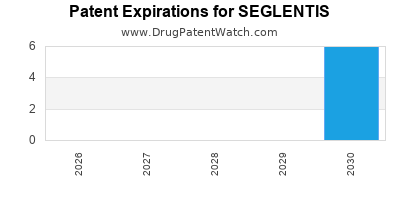
Drug patent expirations by year for SEGLENTIS
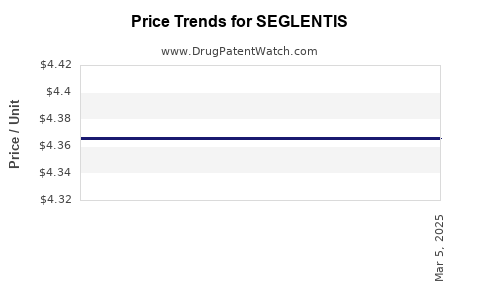
Drug Prices for SEGLENTIS

See drug prices for SEGLENTIS

DrugPatentWatch® Estimated Loss of Exclusivity (LOE) Date for SEGLENTIS
Generic Entry Date for SEGLENTIS*:
Constraining patent/regulatory exclusivity:
NDA:
Dosage:
TABLET;ORAL

*The generic entry opportunity date is the latter of the last compound-claiming patent and the last regulatory exclusivity protection. Many factors can influence early or later generic entry. This date is provided as a rough estimate of generic entry potential and should not be used as an independent source.

US Patents and Regulatory Information for SEGLENTIS

SEGLENTIS is protected by seven US patents.

Based on analysis by DrugPatentWatch, the earliest date for a generic version of SEGLENTIS is ⤷  Get Started Free.

This potential generic entry date is based on patent 10,245,276.

Generics may enter earlier, or later, based on new patent filings, patent extensions, patent invalidation, early generic licensing, generic entry preferences, and other factors.

Applicant Tradename Generic Name Dosage NDA Approval Date TE Type RLD RS Patent No. Patent Expiration Product Substance Delist Req. Exclusivity Expiration
Kowa Pharms SEGLENTIS celecoxib; tramadol hydrochloride TABLET;ORAL 213426-001 Oct 15, 2021 DISCN Yes No 10,238,668 ⤷  Get Started Free Y Y ⤷  Get Started Free
Kowa Pharms SEGLENTIS celecoxib; tramadol hydrochloride TABLET;ORAL 213426-001 Oct 15, 2021 DISCN Yes No 8,598,152 ⤷  Get Started Free Y Y ⤷  Get Started Free
Kowa Pharms SEGLENTIS celecoxib; tramadol hydrochloride TABLET;ORAL 213426-001 Oct 15, 2021 DISCN Yes No 8,846,744 ⤷  Get Started Free Y ⤷  Get Started Free
Kowa Pharms SEGLENTIS celecoxib; tramadol hydrochloride TABLET;ORAL 213426-001 Oct 15, 2021 DISCN Yes No 10,548,909 ⤷  Get Started Free ⤷  Get Started Free
>Applicant >Tradename >Generic Name >Dosage >NDA >Approval Date >TE >Type >RLD >RS >Patent No. >Patent Expiration >Product >Substance >Delist Req. >Exclusivity Expiration

International Patents for SEGLENTIS

When does loss-of-exclusivity occur for SEGLENTIS?

Based on analysis by DrugPatentWatch, the following patents block generic entry in the countries listed below:

Argentina

Patent: 9008
Estimated Expiration: ⤷  Get Started Free

Australia

Patent: 09304235
Estimated Expiration: ⤷  Get Started Free

Patent: 10306168
Estimated Expiration: ⤷  Get Started Free

Brazil

Patent: 0920358
Estimated Expiration: ⤷  Get Started Free

Patent: 2012005011
Estimated Expiration: ⤷  Get Started Free

Canada

Patent: 37754
Estimated Expiration: ⤷  Get Started Free

Patent: 71665
Estimated Expiration: ⤷  Get Started Free

China

Patent: 2186465
Estimated Expiration: ⤷  Get Started Free

Patent: 2573825
Estimated Expiration: ⤷  Get Started Free

Patent: 4817501
Estimated Expiration: ⤷  Get Started Free

Patent: 4844513
Estimated Expiration: ⤷  Get Started Free

Colombia

Patent: 11248
Estimated Expiration: ⤷  Get Started Free

Croatia

Patent: 0130316
Estimated Expiration: ⤷  Get Started Free

Patent: 0161526
Estimated Expiration: ⤷  Get Started Free

Cyprus

Patent: 13956
Estimated Expiration: ⤷  Get Started Free

Patent: 18374
Estimated Expiration: ⤷  Get Started Free

Denmark

Patent: 49238
Estimated Expiration: ⤷  Get Started Free

Patent: 88169
Estimated Expiration: ⤷  Get Started Free

Ecuador

Patent: 12011734
Estimated Expiration: ⤷  Get Started Free

European Patent Office

Patent: 77215
Estimated Expiration: ⤷  Get Started Free

Patent: 49238
Estimated Expiration: ⤷  Get Started Free

Patent: 88169
Estimated Expiration: ⤷  Get Started Free

Patent: 86432
Estimated Expiration: ⤷  Get Started Free

Hong Kong

Patent: 73380
Estimated Expiration: ⤷  Get Started Free

Hungary

Patent: 30976
Estimated Expiration: ⤷  Get Started Free

India

Patent: 35DEN2012
Estimated Expiration: ⤷  Get Started Free

Israel

Patent: 1785
Estimated Expiration: ⤷  Get Started Free

Patent: 8256
Estimated Expiration: ⤷  Get Started Free

Japan

Patent: 99564
Estimated Expiration: ⤷  Get Started Free

Patent: 45830
Estimated Expiration: ⤷  Get Started Free

Patent: 12505847
Estimated Expiration: ⤷  Get Started Free

Patent: 13507402
Estimated Expiration: ⤷  Get Started Free

Lithuania

Patent: 49238
Estimated Expiration: ⤷  Get Started Free

Malaysia

Patent: 6285
Estimated Expiration: ⤷  Get Started Free

Mexico

Patent: 6318
Estimated Expiration: ⤷  Get Started Free

Patent: 11003612
Estimated Expiration: ⤷  Get Started Free

Patent: 12003050
Estimated Expiration: ⤷  Get Started Free

Morocco

Patent: 742
Estimated Expiration: ⤷  Get Started Free

New Zealand

Patent: 1873
Estimated Expiration: ⤷  Get Started Free

Patent: 8353
Estimated Expiration: ⤷  Get Started Free

Poland

Patent: 49238
Estimated Expiration: ⤷  Get Started Free

Patent: 88169
Estimated Expiration: ⤷  Get Started Free

Portugal

Patent: 49238
Estimated Expiration: ⤷  Get Started Free

Patent: 88169
Estimated Expiration: ⤷  Get Started Free

Russian Federation

Patent: 47830
Estimated Expiration: ⤷  Get Started Free

Patent: 99717
Estimated Expiration: ⤷  Get Started Free

Patent: 11119608
Estimated Expiration: ⤷  Get Started Free

Patent: 12120088
Estimated Expiration: ⤷  Get Started Free

San Marino

Patent: 01300048
Estimated Expiration: ⤷  Get Started Free

Patent: 01600439
Estimated Expiration: ⤷  Get Started Free

Singapore

Patent: 8835
Estimated Expiration: ⤷  Get Started Free

Slovenia

Patent: 49238
Estimated Expiration: ⤷  Get Started Free

Patent: 88169
Estimated Expiration: ⤷  Get Started Free

South Africa

Patent: 1102762
Estimated Expiration: ⤷  Get Started Free

Patent: 1201892
Estimated Expiration: ⤷  Get Started Free

South Korea

Patent: 1471585
Estimated Expiration: ⤷  Get Started Free

Patent: 1679400
Estimated Expiration: ⤷  Get Started Free

Patent: 110069860
Estimated Expiration: ⤷  Get Started Free

Patent: 120099212
Estimated Expiration: ⤷  Get Started Free

Spain

Patent: 02112
Estimated Expiration: ⤷  Get Started Free

Patent: 03962
Estimated Expiration: ⤷  Get Started Free

Taiwan

Patent: 41630
Estimated Expiration: ⤷  Get Started Free

Patent: 1116273
Estimated Expiration: ⤷  Get Started Free

Tunisia

Patent: 12000075
Estimated Expiration: ⤷  Get Started Free

Ukraine

Patent: 9534
Estimated Expiration: ⤷  Get Started Free

Generics may enter earlier, or later, based on new patent filings, patent extensions, patent invalidation, early generic licensing, generic entry preferences, and other factors.

See the table below for additional patents covering SEGLENTIS around the world.

Country Patent Number Title Estimated Expiration
Taiwan I441630 ⤷  Get Started Free
Israel 218256 ⤷  Get Started Free
Ecuador SP12011734 ⤷  Get Started Free
Denmark 2349238 ⤷  Get Started Free
>Country >Patent Number >Title >Estimated Expiration

Supplementary Protection Certificates for SEGLENTIS

Patent Number Supplementary Protection Certificate SPC Country SPC Expiration SPC Description
2488169 C202330042 Spain ⤷  Get Started Free PRODUCT NAME: COCRISTAL DE TRAMADOL, OPCIONALMENTE EN FORMA DE UNA SAL FISIOLOGICAMENTE ACEPTABLE, Y CELECOXIB; NATIONAL AUTHORISATION NUMBER: 89051; DATE OF AUTHORISATION: 20230925; NUMBER OF FIRST AUTHORISATION IN EUROPEAN ECONOMIC AREA (EEA): 89051; DATE OF FIRST AUTHORISATION IN EEA: 20230925
0731795 10075033 Germany ⤷  Get Started Free PRODUCT NAME: CELECOXIB; NAT. REGISTRATION NO/DATE: 48802.00.00 20000518; FIRST REGISTRATION: SE 14838 19991203
>Patent Number >Supplementary Protection Certificate >SPC Country >SPC Expiration >SPC Description

Market Dynamics and Financial Trajectory for SEGLENTIS

Last updated: July 27, 2025

Introduction

SEGLENTIS (ertugliflozin and sitagliptin) represents a significant advancement in the management of type 2 diabetes mellitus (T2DM), combining two well-established mechanisms into a single oral therapy. Since its approval, understanding the drug’s market dynamics and projected financial trajectory is crucial for stakeholders strategizing in the competitive diabetic care landscape. The evolution of this combination therapy is influenced by regulatory, clinical, and commercial factors shaping its adoption and revenue potential.

Market Overview of T2DM Pharmacotherapy

Type 2 diabetes remains a global health burden, with over 400 million affected individuals worldwide and an anticipated increase to 700 million by 2045 [1]. The therapeutic landscape features a spectrum of agents: metformin, SGLT2 inhibitors, DPP-4 inhibitors, GLP-1 receptor agonists, and insulin. The choice hinges on efficacy, safety profiles, patient comorbidities, and healthcare policies.

Combination therapies like SEGLENTIS address unmet needs by improving glycemic control while minimizing adverse effects. Such fixed-dose combinations (FDCs) offer improved adherence, simplified regimens, and potentially better clinical outcomes, making them attractive in the T2DM market.

Product Profile and Clinical Positioning of SEGLENTIS

SEGLENTIS combines ertugliflozin—a sodium-glucose cotransporter 2 (SGLT2) inhibitor—with sitagliptin, a DPP-4 inhibitor. This dual mechanism provides additive glycemic lowering effects, with benefits including weight reduction and low hypoglycemia risk.

Regulatory approvals, primarily from the FDA in 2018, have positioned SEGLENTIS as a complementary therapy to existing monotherapies. Its clinical benefits, supported by studies like VERTIS and TECOS, bolster its positioning among combination agents intended for patients inadequately controlled on monotherapy.

Market Dynamics Influencing SEGLENTIS

Regulatory Environment

Regulatory agencies scrutinize combination drugs for safety and efficacy, often requiring robust clinical data. The FDA’s approval of SEGLENTIS affirmed its safety profile but also placed emphasis on demonstrating added benefits over individual components.

Upcoming regulatory trends favor the approval of FDCs with proven clinical advantages, facilitating accelerated market entry and broader adoption.

Competitive Landscape

SEGLENTIS faces competition from multiple fixed-dose combinations:

  • Dapagliflozin/pravastatin and Empagliflozin/linagliptin offer similar dual mechanisms.
  • Single-agent drugs like empagliflozin and sitagliptin are still popular, mainly due to cost considerations.
  • New entrants, including GLP-1 receptor agonist combinations, challenge the market with higher efficacy but at increased cost.

The competitive advantage of SEGLENTIS resides in its proven efficacy, safety, and once-daily dosing, which appeal to physicians focused on individualized therapy.

Prescriber and Patient Acceptance

Physician perception hinges on the clinical profile—particularly the combination’s safety, tolerability, and comprehensiveness. Patient acceptance correlates with ease of administration, side-effect profile, and cost. Education campaigns and guideline endorsements (e.g., ADA/EASD consensus reports) influence prescribing patterns favorably for SEGLENTIS.

Reimbursement and Pricing Strategies

Pricing determines access and utilization. As a branded combination, SEGLENTIS incurs a premium relative to generic agents. Negotiations with payers and formulary placements critically impact market penetration.

Health economics assessments demonstrating cost-effectiveness compared to monotherapy or other combinations facilitate inclusion in payer formularies, enhancing market access.

Financial Trajectory and Revenue Projections

Market Penetration Potential

Initial uptake has been promising in markets with high prevalence of T2DM and supportive reimbursement policies, notably North America and Europe. Growth prospects hinge on expanding indications, such as in combination with other agents, and on increasing prescription adoption through clinician education.

Forecasts suggest that SEGLENTIS could capture a significant niche within the dual-class combination segment, especially as guidelines increasingly favor multidrug regimens for early and aggressive management.

Revenue Drivers

  • Volume growth driven by expanding patient populations.
  • Pricing strategies, balancing profitability with market access.
  • Global expansion, particularly into emerging markets with rising diabetes prevalence.

Risks and Challenges

  • Generic competition with monotherapies and formulary restrictions.
  • Market saturation in mature regions.
  • Regulatory hurdles in emerging markets.
  • Cost-containment pressures impacting reimbursement.

Long-term Outlook

Given the projected rise in T2DM prevalence, SEGLENTIS’s revenue trajectory appears optimistic if it maintains competitive positioning and navigates reimbursement complexities. With ongoing clinical trials and potential label extensions, its market lifespan could be extended.

Key Market Trends Steering Future Performance

  1. Personalized medicine emphasizing tailored combination therapies.
  2. Shifting guidelines favoring early combination therapy for high-risk patients.
  3. Adoption of value-based pricing aligning reimbursement with clinical outcomes.
  4. Emerging innovations—such as dual-mechanism injectables—potentially competing with oral combinations.
  5. Digital health integration enhancing adherence and monitoring.

Conclusion

SEGLENTIS’s market dynamics reflect a complex interplay of clinical efficacy, safety, competition, and economic factors. Its financial trajectory is cautiously optimistic, supported by rising global T2DM rates and the growing preference for combination regimens. Successful market capture necessitates strategic positioning, robust clinical data, and proactive engagement with payers. Stakeholders must monitor evolving guidelines, competitor movements, and regulatory developments to optimize the drug’s growth potential.


Key Takeaways

  • SEGLENTIS benefits from its dual-mechanism approach, fitting well into modern T2DM management paradigms favoring combination therapies.
  • Market success depends heavily on physician acceptance, payer reimbursement policies, and competitive positioning against evolving treatment options.
  • The global rise in T2DM prevalence underpins a strong long-term revenue forecast, provided market access and pricing strategies align with healthcare economic realities.
  • Ongoing clinical data, regulatory navigation, and healthcare policy shifts will shape the drug’s financial trajectory.
  • Strategic expansion into emerging markets and integration into personalized therapy strategies can unlock additional growth avenues.

FAQs

  1. How does SEGLENTIS compare to other T2DM combination therapies?
    SEGLENTIS offers a unique dual mechanism with proven efficacy, a favorable safety profile, and once-daily dosing, positioning it competitively alongside other combinations like dapagliflozin/metformin or empagliflozin/linagliptin. Its clinical data support its use in patients needing two mechanisms of action without injections.

  2. What are the main barriers to SEGLENTIS’s market growth?
    Key barriers include high treatment costs, potential competition from newer or injectable therapies, formulary restrictions, and the preference for generics in some regions, which can limit adoption.

  3. What is the outlook for SEGLENTIS in emerging markets?
    The outlook remains positive, aided by increasing diabetes prevalence. However, regulatory approval processes, supply chain considerations, and price sensitivity pose challenges that require strategic planning.

  4. How might future clinical trials influence SEGLENTIS’s market position?
    Demonstrating additional benefits, such as cardiovascular or renal protection, could expand its indications and appeal, reinforcing its market position and driving revenue growth.

  5. What are potential opportunities for expanding SEGLENTIS's indications?
    Future trials exploring its benefits in populations with comorbidities like cardiovascular disease or in combination with other novel agents could open new markets and increase sales.


Sources:

[1] International Diabetes Federation. IDF Diabetes Atlas, 9th Edition, 2019.

More… ↓

⤷  Get Started Free

Make Better Decisions: Try a trial or see plans & pricing

Drugs may be covered by multiple patents or regulatory protections. All trademarks and applicant names are the property of their respective owners or licensors. Although great care is taken in the proper and correct provision of this service, thinkBiotech LLC does not accept any responsibility for possible consequences of errors or omissions in the provided data. The data presented herein is for information purposes only. There is no warranty that the data contained herein is error free. We do not provide individual investment advice. This service is not registered with any financial regulatory agency. The information we publish is educational only and based on our opinions plus our models. By using DrugPatentWatch you acknowledge that we do not provide personalized recommendations or advice. thinkBiotech performs no independent verification of facts as provided by public sources nor are attempts made to provide legal or investing advice. Any reliance on data provided herein is done solely at the discretion of the user. Users of this service are advised to seek professional advice and independent confirmation before considering acting on any of the provided information. thinkBiotech LLC reserves the right to amend, extend or withdraw any part or all of the offered service without notice.