Last updated: September 26, 2026
Seasonique is an extended-cycle combined oral contraceptive containing levonorgestrel and ethinyl estradiol. Its commercial value has shifted from product innovation to portfolio economics: generic competition, low switching costs, pharmacy substitution, and competition from other extended-cycle contraceptives now limit pricing power. Teva remains the principal U.S. commercial reference for the product, while public filings do not disclose standalone Seasonique revenue.
What is Seasonique and how does it work?
Seasonique is a 91-day oral contraceptive regimen containing:
| Component |
Strength |
Function |
| Levonorgestrel |
0.15 mg |
Progestin |
| Ethinyl estradiol |
0.03 mg |
Estrogen |
| Ethinyl estradiol-only tablets |
0.01 mg |
Maintains scheduled estrogen exposure |
The regimen uses 84 active combination tablets followed by seven low-dose ethinyl estradiol tablets. It is designed to produce four scheduled withdrawal bleeding episodes per year rather than monthly bleeding.[1]
Seasonique is indicated for the prevention of pregnancy in females of reproductive potential. As a combined hormonal contraceptive, it carries class risks involving venous thromboembolism, arterial thrombotic events, hypertension, and estrogen-related contraindications.[1]
FDA approval and product history
The U.S. Food and Drug Administration approved Seasonique under NDA 021543 in 2006. The product was originally associated with Duramed Pharmaceuticals and later became part of the Barr Pharmaceuticals and Teva portfolios following corporate consolidation.[1][2]
The product’s commercial distinction was its extended-cycle dosing format. The active ingredients were established contraceptive molecules, so the principal product differentiation came from regimen design, packaging, physician familiarity, and consumer preference rather than a new molecular entity.
What is the FDA regulatory status of Seasonique?
Seasonique is an FDA-approved prescription oral contraceptive. Its regulatory position is that of an established branded combination product with generic equivalents and therapeutically substitutable alternatives in the U.S. market.[1][3]
| Regulatory item |
Status |
| Product |
Seasonique |
| Active ingredients |
Levonorgestrel and ethinyl estradiol |
| Dosage form |
Oral tablets |
| NDA |
021543 |
| Initial U.S. approval |
2006 |
| FDA pathway |
Full NDA approval |
| Therapeutic category |
Combined hormonal contraceptive |
| Current commercial structure |
Branded reference product with generic competition |
The product does not have the commercial characteristics of a protected specialty drug. It is distributed through retail pharmacies and is subject to formulary placement, generic substitution, insurer rebate structures, and pharmacy benefit manager controls.
When did Seasonique lose exclusivity?
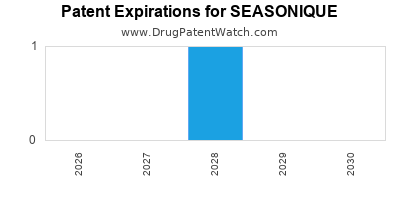
Seasonique’s meaningful market exclusivity ended when generic versions of the extended-cycle levonorgestrel and ethinyl estradiol regimen entered the U.S. market. FDA new-drug exclusivity for a combination product approved in 2006 would not ordinarily support long-term protection against ANDA competition.
A practical exclusivity timeline is:
| Period |
Commercial position |
| 2006 |
FDA approval of Seasonique |
| 2006-2009 |
New-product launch and early branded differentiation |
| After initial FDA exclusivity |
Generic development became possible, subject to patent and regulatory barriers |
| Mid-2010s onward |
Generic extended-cycle products and branded alternatives expanded |
| Current market |
Mature, price-sensitive oral contraceptive segment |
The relevant economic event was not only patent expiry. Generic entry, pharmacy substitution and the availability of other 91-day contraceptive products collectively reduced the reference brand’s ability to sustain premium pricing.
What patents protect Seasonique?
Seasonique’s protection is primarily associated with the product formulation, dosing regimen and regulatory exclusivity history rather than a novel active ingredient.
Orange Book status
The FDA Orange Book is the authoritative source for current patent listings and exclusivity associated with NDA 021543. Patent listings for combination oral contraceptives can change over time as listed patents expire, are delisted, or cease to have practical blocking effect.[3]
The commercially important distinction is between:
- Patents listed for the reference product.
- Patents covering the active ingredients broadly.
- Patents covering the 91-day regimen or specific tablet sequence.
- Manufacturing and formulation patents.
- Regulatory exclusivity under the Federal Food, Drug, and Cosmetic Act.
Levonorgestrel and ethinyl estradiol are long-established molecules. Any historic patent value therefore depended on the specific combination, regimen, packaging or formulation claims. Those claims generally provide narrower protection than a composition-of-matter patent for a new chemical entity.
Formulation and method-of-use protection
Potential claim categories associated with extended-cycle contraceptives include:
- A sequence of 84 hormone-containing tablets followed by a hormone-free or low-estrogen interval.
- Specific levonorgestrel and ethinyl estradiol strengths.
- Packaging configurations for quarterly administration.
- Methods of reducing the frequency of withdrawal bleeding.
- Methods of preventing pregnancy through extended-cycle administration.
These categories can support patent litigation or Paragraph IV challenges, but they usually do not prevent competition indefinitely once generic applicants can certify that listed patents are invalid, unenforceable or not infringed.
How many patents cover Seasonique?
The number of currently effective patents cannot be reliably inferred from historical product literature alone. The FDA Orange Book, not the prescribing label, determines the current listed-patent record for the reference NDA.[3]
From a commercial perspective, the patent estate is weaker than the estate of a complex small molecule or biologic because:
- The active ingredients are old and widely used.
- The dosage form is a conventional oral tablet.
- Multiple extended-cycle contraceptive products exist.
- Generic applicants can use Paragraph IV certifications against listed patents.
- Manufacturing does not require a highly specialized biological process.
The principal residual barriers are therefore regulatory compliance, supply reliability, bioequivalence, manufacturing scale and payer access rather than difficult active-ingredient synthesis.
Which companies challenge Seasonique through generic competition?
The U.S. extended-cycle oral contraceptive market has included products sold under both generic names and competing brand names. Relevant commercial participants have included Teva, Amneal, Perrigo and other generic manufacturers, depending on the specific product, dosage strength and market period.
Comparable products include:
| Product |
Commercial role |
| Seasonique |
Reference branded extended-cycle product |
| Amethia |
Generic or branded-generic extended-cycle alternative |
| Camrese |
Extended-cycle contraceptive alternative |
| Daysee |
Extended-cycle levonorgestrel/ethinyl estradiol product |
| Introvale |
Extended-cycle contraceptive alternative |
| Generic levonorgestrel/ethinyl estradiol/ethinyl estradiol |
ANDA-based substitution product |
The exact manufacturer and marketing status can vary by National Drug Code and by year. The strategic effect is consistent: multiple approved or marketed equivalents create substitution pressure and limit the value of brand-only differentiation.
What Paragraph IV challenges affected Seasonique?
Generic applicants for approved products may file Paragraph IV certifications asserting that listed patents are invalid, unenforceable or not infringed. A Paragraph IV filing can trigger patent litigation and, in some circumstances, a 30-month stay of FDA approval under the Hatch-Waxman framework.[4]
For Seasonique, the commercial effect of Paragraph IV activity would depend on:
- The number of Orange Book-listed patents.
- The remaining patent term.
- Whether the generic applicant seeks a first-filer advantage.
- The strength of regimen or formulation claims.
- Whether litigation ends in settlement, dismissal or a court judgment.
Seasonique’s economic profile indicates that generic entry, rather than a prolonged patent block, became the dominant market event. No publicly disclosed settlement is required to explain the current mature-market pricing structure.
What is the competitive landscape for Seasonique?
Seasonique competes across three segments:
Other extended-cycle oral contraceptives
These products directly replicate the quarterly bleeding concept. Competition is based on price, insurance coverage, tablet configuration, manufacturer availability and physician familiarity.
Conventional monthly oral contraceptives
Monthly combined oral contraceptives remain substitutes because many patients and prescribers prioritize cost and formulary coverage over quarterly dosing.
Long-acting and nonoral contraceptives
Intrauterine devices, implants, injections, patches, rings and progestin-only products compete for the same contraceptive demand. These products can reduce reliance on daily oral adherence and may receive stronger contraceptive-counseling support in some clinical settings.
Seasonique’s differentiation is therefore meaningful but narrow. It addresses bleeding-frequency preference and dosing convenience, but it does not create a durable barrier against alternative contraceptive methods.
What is Seasonique’s financial trajectory?
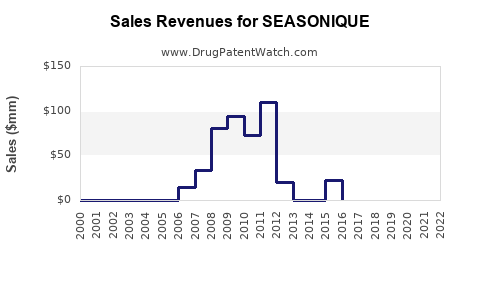
Teva and predecessor companies have not generally reported Seasonique as a standalone revenue line. Public filings aggregate women’s health, generic products or broader pharmaceutical categories. A precise historical revenue series for Seasonique is therefore not available from issuer financial statements.
The financial trajectory can be assessed through market structure:
| Phase |
Revenue and margin dynamics |
| Launch phase |
Higher branded pricing and marketing investment |
| Early adoption |
Growth driven by regimen differentiation and physician awareness |
| Generic-entry phase |
Lower net price, reduced volume share for the brand and payer substitution |
| Mature phase |
Stable or declining branded revenue, with profitability dependent on manufacturing and distribution efficiency |
| Current economics |
Portfolio contribution rather than platform-level growth asset |
Revenue exposure
Seasonique is unlikely to be material to the consolidated financial results of a diversified pharmaceutical company. Its economic value is more relevant at the product-portfolio level:
- Brand revenue is exposed to generic substitution.
- Net sales depend heavily on formulary positioning.
- Retail channel inventory and wholesaler purchasing can cause quarterly volatility.
- Marketing expenses can exceed the incremental value of marginal patient acquisition.
- Generic products can preserve category participation while compressing branded margins.
The product may still generate recurring revenue because some patients prefer the reference brand, some plans restrict automatic substitution, and some prescribers retain brand familiarity. Those factors do not restore the pricing power available before generic competition.
How strong is the Seasonique patent estate?
Seasonique’s patent estate is commercially moderate to weak compared with protected specialty medicines.
| Factor |
Assessment |
| Active ingredient novelty |
Low |
| Formulation complexity |
Low to moderate |
| Regimen differentiation |
Moderate |
| Manufacturing complexity |
Low |
| Generic substitution risk |
High |
| Biosimilar risk |
None |
| Litigation leverage |
Limited after generic entry |
| Long-term pricing power |
Low |
The most defensible intellectual-property claims would historically have involved the extended-cycle regimen or a particular formulation and package configuration. Those claims are narrower than claims covering a new active ingredient and are more vulnerable to design-around strategies.
What manufacturing and IP barriers affect Seasonique?
Seasonique does not face the manufacturing barriers associated with biologics, sterile injectables or complex drug-device combinations. Production requires conventional pharmaceutical manufacturing controls for oral tablets, including:
- Content uniformity.
- Dissolution performance.
- Stability of ethinyl estradiol and levonorgestrel.
- Packaging integrity.
- Tablet sequencing and labeling accuracy.
- Compliance with current good manufacturing practices.
The main operational risks are supply interruptions, quality investigations, active-ingredient sourcing and packaging errors. These risks can affect market share even when patent protection is no longer meaningful.
There is no biosimilar pathway for Seasonique. Biosimilar competition applies to biologics under the Public Health Service Act. Seasonique faces conventional small-molecule generic competition through ANDAs.
What litigation and settlement risks affect Seasonique?
The primary legal risks are:
- Hatch-Waxman litigation involving Orange Book-listed patents.
- Patent challenges to regimen or formulation claims.
- Product-liability claims associated with estrogen-containing contraception.
- Manufacturing and quality-related enforcement.
- Trademark or trade-dress disputes involving competing contraceptive products.
The most material current commercial risk is generic substitution rather than an active patent dispute. Once a generic is approved and available, litigation may preserve a limited period of brand exclusivity, but it rarely supports durable long-term price premiums for a conventional oral contraceptive.
How does Seasonique compare with newer contraceptive products?
| Attribute |
Seasonique |
Long-acting contraceptives |
Monthly oral contraceptives |
| Administration |
Daily oral dosing |
Infrequent administration |
Daily oral dosing |
| Bleeding schedule |
Quarterly withdrawal bleeding |
Product-dependent |
Usually monthly |
| Adherence burden |
High |
Low |
High |
| Generic exposure |
High |
Varies by product |
High |
| Manufacturing complexity |
Low |
Moderate to high |
Low |
| Differentiation |
Regimen and bleeding frequency |
Convenience and persistence |
Broad choice and price |
| Pricing power |
Limited |
Potentially higher for differentiated products |
Limited |
Seasonique’s position is strongest among patients who prefer fewer scheduled bleeding episodes and do not want a device or long-acting method. Its position is weakest where payers apply automatic generic substitution or where patients prioritize adherence-free contraception.
What generic launch scenarios exist for Seasonique?
The likely generic-market scenarios are:
Continued brand coexistence
The reference brand retains a minority share through brand preference, physician prescribing habits and coverage exceptions. Revenue declines gradually rather than disappearing.
Accelerated generic substitution
Several suppliers compete on price, leading pharmacies and payers to substitute rapidly. Brand volume contracts and the reference product becomes a low-growth portfolio asset.
Supply-driven share shifts
A manufacturing problem at one generic supplier temporarily increases demand for the brand or another generic. These gains are usually reversible.
Product reformulation or lifecycle extension
The manufacturer could pursue packaging changes, adherence tools or additional market positioning. Such measures may protect niche demand but are unlikely to recreate original exclusivity.
Key Takeaways
- Seasonique is an FDA-approved extended-cycle combined oral contraceptive containing levonorgestrel and ethinyl estradiol.
- Its commercial differentiation is the 91-day dosing regimen and quarterly withdrawal bleeding.
- The product has faced generic competition since the mid-2010s, materially reducing pricing power.
- The active ingredients are old; residual patent value depends mainly on regimen, formulation and packaging claims.
- Seasonique has no biosimilar exposure because it is a conventional small-molecule tablet.
- Public filings do not provide a reliable standalone Seasonique revenue history.
- The product is best viewed as a mature branded portfolio asset, not a high-growth pharmaceutical franchise.
- Generic substitution, payer coverage and retail supply execution are more important current value drivers than patent duration.
FAQs About Seasonique Market and Exclusivity
Is Seasonique still a branded product?
Yes. Seasonique remains the reference branded product, but it competes with generic and branded-generic extended-cycle oral contraceptives.
Is Seasonique more expensive than generic levonorgestrel and ethinyl estradiol?
Generally, the branded product carries a higher list-price position than generic equivalents. The actual patient cost depends on insurance coverage, formulary placement, coupons and pharmacy substitution.
Does Seasonique have a biosimilar?
No. Biosimilars apply to biologic products. Seasonique is a small-molecule oral tablet subject to conventional generic competition.
Can a generic manufacturer launch Seasonique without copying the brand name?
Yes. An ANDA applicant can market an approved equivalent using the established generic name, subject to FDA requirements for bioequivalence, labeling and patent certifications.
Is Seasonique a high-value licensing asset?
Its licensing value is likely limited because the product is mature, generic competition is established and the active ingredients are widely available. Value would depend on geographic rights, distribution access, manufacturing cost and portfolio synergies rather than on long-term exclusivity.
References
- U.S. Food and Drug Administration. (2024). Seasonique prescribing information. Teva Pharmaceuticals USA, Inc.
- Teva Pharmaceutical Industries Ltd. (2008). Annual report 2008.
- U.S. Food and Drug Administration. (2024). Approved drug products with therapeutic equivalence evaluations: Orange Book.
- U.S. Food and Drug Administration. (2024). Hatch-Waxman amendments and abbreviated new drug applications.